Daily Archives: March 10, 2025

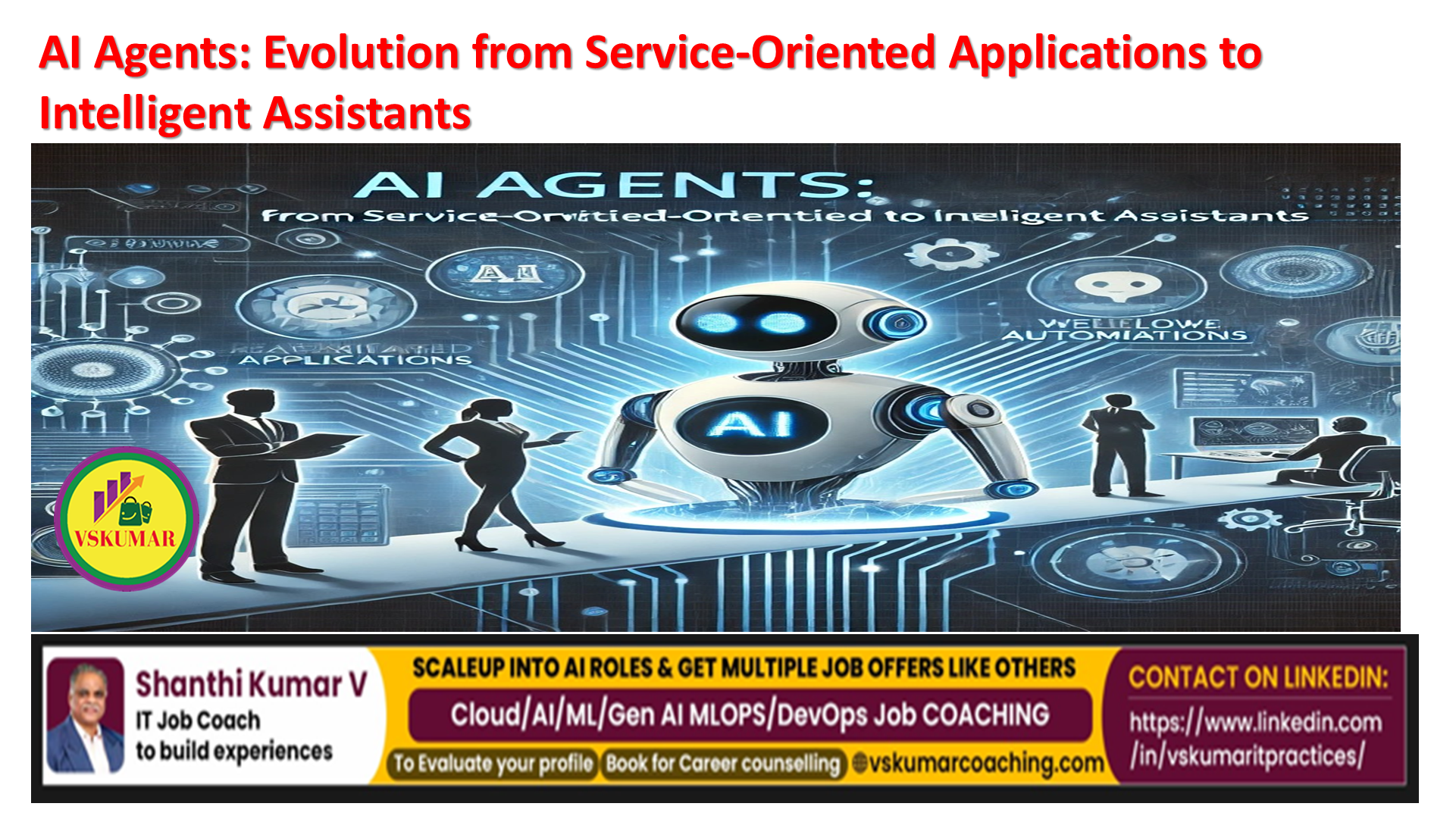
AI Agents: Evolution from Service-Oriented Applications to Intelligent Assistants

AI Agents: Evolution from Service-Oriented Applications to Intelligent Assistants

Artificial Intelligence (AI) has significantly reshaped the technological landscape, bringing forth a new era of intelligent agents. These AI agents, designed to perform tasks autonomously and interact with users in natural language, are a stark evolution from the traditional service-oriented applications (SOAs) of the past. This article explores how AI agents have revolutionized task management and compares this transformation to the earlier migration of service-oriented applications into intelligent assistants.

The Era of Service-Oriented Applications

Before the advent of AI agents, service-oriented applications played a pivotal role in business operations. These applications were designed to offer specific services through a network of interoperable components. Key characteristics of SOAs included:

  • Modularity: Services were divided into discrete units that could be reused across different applications.
  • Interoperability: These units could communicate with each other using standardized protocols.
  • Scalability: Services could be scaled up or down based on demand.
  • Loose Coupling: Components were designed to be independent, reducing dependencies and enhancing flexibility.

SOAs were instrumental in streamlining business processes, enabling organizations to deploy and manage services efficiently.

Transition to AI Agents

The transition from SOAs to AI agents marked a significant technological leap. AI agents are sophisticated programs capable of learning from data, making decisions, and performing tasks autonomously. Key differentiators between AI agents and traditional SOAs include:

  • Intelligence: AI agents are equipped with machine learning algorithms, enabling them to learn from experience and improve their performance over time.
  • Natural Language Processing (NLP): AI agents can understand and generate human language, facilitating more intuitive interactions with users.
  • Autonomy: AI agents can perform tasks without human intervention, making them highly efficient in managing repetitive and complex activities.
  • Context Awareness: These agents can understand the context of tasks and interactions, providing more relevant and personalized assistance.

Comparing SOAs and AI Agents

Task Automation

  • Service-Oriented Applications: SOAs primarily focused on automating specific services, such as processing transactions, managing inventory, or handling customer queries through predefined workflows.
  • AI Agents: AI agents take automation to the next level by not only performing predefined tasks but also learning from user interactions and data to optimize processes continuously. They can handle complex tasks that require understanding context, such as personalized customer support or predictive maintenance.

Interactivity and User Experience

  • Service-Oriented Applications: User interactions with SOAs were typically limited to predefined inputs and outputs through graphical user interfaces (GUIs). These interactions were often rigid and lacked personalization.
  • AI Agents: AI agents provide a more interactive and personalized user experience. Through NLP and machine learning, they can engage in natural language conversations, understand user preferences, and provide tailored responses. This enhances user satisfaction and engagement.

Integration and Flexibility

  • Service-Oriented Applications: SOAs were designed with interoperability in mind, allowing different services to communicate using standardized protocols. However, integrating new services often required significant effort and customization.
  • AI Agents: AI agents are designed to seamlessly integrate with various platforms and applications, leveraging APIs and other integration tools. They can dynamically adapt to different environments and requirements, offering greater flexibility and ease of deployment.

Decision-Making and Adaptability

  • Service-Oriented Applications: SOAs relied on predefined rules and logic to make decisions, limiting their ability to adapt to changing conditions or new information.
  • AI Agents: AI agents use advanced algorithms and data analytics to make informed decisions in real-time. They can adapt to new information, learn from outcomes, and continuously improve their performance, making them highly adaptable to changing business needs.

Real-world Implementations

  1. Customer Support: Many organizations have transitioned from using SOAs for customer support to deploying AI agents. These agents can handle customer inquiries 24/7, provide personalized responses, and escalate complex issues to human agents when necessary.
  2. IT Help Desk: Traditional IT help desks relied on SOAs to manage service requests and incidents. Today, AI agents can automate routine IT tasks, provide real-time support, and proactively identify and resolve issues before they impact users.
  3. Sales and Marketing: AI agents have transformed sales and marketing by automating lead generation, personalizing marketing campaigns, and analyzing customer data to provide actionable insights. This is a significant advancement from the rule-based marketing automation tools used in SOAs.

Conclusion

The evolution from service-oriented applications to AI agents represents a paradigm shift in how organizations manage tasks and interact with users. AI agents offer unprecedented levels of intelligence, interactivity, and adaptability, making them indispensable tools in modern business operations. By leveraging the capabilities of AI agents, organizations can enhance productivity, improve user experiences, and stay competitive in an increasingly digital world.
AI Management Practice 11: Customizable Agents: Elevating Productivity in Microsoft 365

Customizable agents in Microsoft 365 enhance productivity by providing real-time assistance with tasks like managing emails, scheduling meetings, and generating reports. They improve communication through tools like Microsoft Teams and offer language support, breaking down barriers in global teams. Tailored to organizational needs, these agents adapt to workflows, automate routine tasks, and provide data-driven insights. Real-world implementations include employee IT self-help, real-time customer support, and SharePoint integration, demonstrating their transformative impact on modern workplaces.
https://www.linkedin.com/pulse/ai-management-practice-11-customizable-agents-365-shanthi-kumar-v–9w4wc

Practice 75 interview questions on AWS Essential services

Test you AWS live knowledge and experiences with “AWS Services Demystified: Exploring Live Use Cases and Practical Scenarios ” with 75 questions.

1. Fundamentals of Cloud Computing and AWS

  1. What are the key characteristics of cloud computing?
  2. Explain the different types of cloud computing models (IaaS, PaaS, SaaS).
  3. What are the core services provided by AWS?

2. Cloud Conversion Strategies

  1. What are the steps involved in migrating legacy systems to the public cloud?
  2. What challenges might you face during cloud migration?
  3. Explain the concept of a hybrid cloud solution.

3. AWS Infrastructure Security and Solutions

  1. What is AWS IAM and how does it help secure AWS resources?
  2. Describe the best practices for securing AWS infrastructure.
  3. What are VPCs and why are they important in AWS?

4. Compliance and Advanced AWS Policies

  1. What are the key compliance standards supported by AWS?
  2. Explain the concept of AWS Virtual Desktops.
  3. How can you manage collaboration tools within AWS?

5. AWS Deployment Models Demystified

  1. What are the different deployment models in AWS?
  2. Explain the concept of AWS Elastic Beanstalk.
  3. Describe a practical scenario where AWS CloudFormation can be used.

6. Storage Expertise with AWS S3

  1. What are the key features of AWS S3?
  2. How does AWS S3 ensure data durability and availability?
  3. Explain the concept of S3 versioning and its benefits.

7. Networking Mastery with AWS

  1. What is Amazon VPC and how is it used?
  2. Describe the purpose of NAT Instances and NAT Gateways in AWS.
  3. How do you configure an Internet Gateway in a VPC?

8. Securing AWS Networks

  1. What are Security Groups and how do they work?
  2. Explain the difference between Security Groups and Network ACLs.
  3. How can you secure communication between AWS resources?

9. Connecting AWS VPCs

  1. What is VPC Peering and how does it work?
  2. Describe the concept of AWS PrivateLink.
  3. How can you set up VPC Endpoints?

10. AWS VPC Private EC2 Lab

  1. What is an EC2 instance and how do you create one?
  2. How can you configure a private EC2 instance in a VPC?
  3. Explain the concept of subnetting in AWS.

11. Efficient AWS CLI Usage

  1. What is AWS CLI and how is it used?
  2. How can you automate AWS operations using the CLI?
  3. Describe a scenario where AWS CLI can be beneficial.

12. Decoding AWS Networking

  1. What are VPG, CGW, and VPN in AWS networking?
  2. How do you set up a VPN connection in AWS?
  3. Explain the concept of AWS Direct Connect.

13. AWS RDS for Databases

  1. What is Amazon RDS and what databases does it support?
  2. How can you optimize database performance in RDS?
  3. Describe the backup and recovery options in RDS.

14. AWS IAM: Identity and Access Management

  1. What are IAM roles and how do they differ from IAM users?
  2. How do you implement Multi-Factor Authentication (MFA) in AWS IAM?
  3. Explain the concept of IAM policies and their structure.

15. AWS IAM and Active Directory (AD) Discussion

  1. How can you integrate AWS IAM with Active Directory?
  2. What are the benefits of using AWS Managed AD?
  3. Describe a use case where AWS IAM and AD integration is beneficial.

16. AWS Redshift Usage Scenarios

  1. What is Amazon Redshift and what are its use cases?
  2. How can you optimize query performance in Redshift?
  3. Describe the process of setting up a Redshift cluster.

17. AWS DNS and ROUTE53 Usage

  1. What is Amazon Route 53 and how is it used?
  2. Explain the concept of DNS failover in Route 53.
  3. How can you configure domain name routing in Route 53?

18. AWS-SWF-SNS-SQS Usage Scenarios

  1. What are the differences between SWF, SNS, and SQS?
  2. Describe a scenario where AWS Simple Workflow Service (SWF) is used.
  3. How can you implement messaging and notifications using SNS and SQS?

19. AWS Autoscale in Action

  1. What is AWS Auto Scaling and how does it work?
  2. How can you configure scaling policies in AWS?
  3. Describe a use case where AWS Auto Scaling is beneficial.

20. AWS Security – Shared Responsibility Model

  1. What is the AWS Shared Responsibility Model?
  2. What are the security responsibilities of AWS and its customers?
  3. Explain the concept of data encryption in AWS.

21. Global Infrastructure Security

  1. How does AWS ensure the security of its global infrastructure?
  2. What are the best practices for securing data across AWS regions?
  3. Describe the concept of AWS Edge Locations.

22. DevOps Culture Implementation

  1. What are the key principles of DevOps culture?
  2. How can you implement a DevOps culture within AWS?
  3. Describe a practical scenario where DevOps practices enhance AWS operations.

23. Mapping Legacy Infrastructure to AWS Cloud Roles

  1. What are the roles and responsibilities when transitioning to AWS Cloud?
  2. How can you map on-premises infrastructure roles to AWS Cloud roles?
  3. Describe a use case for role mapping in AWS Cloud migration.

24. Traditional Load Balancers vs. AWS Elastic Load Balancers

  1. What are the differences between traditional load balancers and AWS Elastic Load Balancers?
  2. How do you configure an AWS Elastic Load Balancer?
  3. Describe a practical scenario where AWS Elastic Load Balancers are used.

25. AWS Memcache Applications

  1. What is AWS Memcache and how is it used?
  2. How can you implement caching strategies using AWS Memcache?
  3. Describe a use case where AWS Memcache improves application performance.

Learn all the above topics from the digital course “AWS Services Demystified: Exploring Live Use Cases and Practical Scenarios”

URL:

https://kqegdo.courses.store/419768?utm_source%3Dother%26utm_medium%3Dtutor-course-referral%26utm_campaign%3Dcourse-overview-webapp

Course Overview

AWS Services Demystified is designed to provide an in-depth understanding of Amazon Web Services (AWS) through practical, real-world examples and hands-on experience. The course is structured to guide you from foundational concepts to advanced applications, ensuring you gain a comprehensive understanding of AWS architectures and live implementations.

Module 1: Fundamentals of Cloud Computing and AWS

  • Introduction to Cloud Computing: Understand the basic concepts and characteristics of cloud computing.
  • AWS Core Services: Explore the primary services provided by AWS, including EC2, S3, and RDS.
  • Benefits of Cloud Computing: Learn about the advantages of using cloud services, such as scalability, flexibility, and cost-efficiency.

Module 2: Cloud Conversion Strategies

  • Migrating Legacy Systems: Step-by-step guide on transitioning from traditional IT systems to the cloud.
  • Challenges and Solutions: Identify potential obstacles during migration and strategies to overcome them.
  • Hybrid Cloud Solutions: Understand the integration of on-premises infrastructure with cloud services.

Module 3: AWS Infrastructure Security and Solutions

  • AWS Identity and Access Management (IAM): Learn to manage user permissions and access control.
  • Best Practices for Security: Implement security measures to protect your AWS infrastructure.
  • Virtual Private Cloud (VPC): Understand the importance and configuration of VPCs.

Module 4: Compliance and Advanced AWS Policies

  • AWS Compliance Standards: Explore the compliance requirements and how AWS meets them.
  • Virtual Desktops: Learn about AWS WorkSpaces and managing virtual desktops.
  • Advanced Policies: Delve into complex AWS policies and their applications.

Module 5: AWS Deployment Models Demystified

  • Deployment Models: Understand different AWS deployment models, including Elastic Beanstalk and CloudFormation.
  • Practical Scenarios: Explore real-world deployment scenarios and best practices.

Module 6: Storage Expertise with AWS S3

  • AWS S3 Features: Discover the capabilities of AWS S3, including data durability and availability.
  • Data Management: Learn about S3 versioning, lifecycle policies, and storage classes.
  • Practical Applications: Explore use cases and best practices for using AWS S3.

Module 7: Networking Mastery with AWS

  • Virtual Private Cloud (VPC): Gain a deep understanding of VPC components and configurations.
  • NAT Instances and Gateways: Learn about the role of NAT in AWS networking.
  • Internet Gateways: Configure and manage internet gateways for VPCs.

Module 8: Securing AWS Networks

  • Security Groups: Understand the function and configuration of security groups.
  • Network ACLs: Learn the difference between security groups and network ACLs.
  • Secure Communication: Implement secure communication practices between AWS resources.

Module 9: Connecting AWS VPCs

  • VPC Peering: Explore the concept and implementation of VPC peering.
  • AWS PrivateLink: Understand how PrivateLink ensures secure access to AWS services.
  • VPC Endpoints: Learn to set up and use VPC endpoints for private connectivity.

Module 10: AWS VPC Private EC2 Lab

  • Creating EC2 Instances: Step-by-step guide to creating and configuring private EC2 instances.
  • Subnetting: Gain hands-on experience with subnetting in AWS.
  • Private EC2 Lab: Set up a private EC2 test lab within a VPC.

Module 11: Efficient AWS CLI Usage

  • Introduction to AWS CLI: Learn the basics of AWS Command Line Interface (CLI).
  • Automation: Discover how to automate AWS operations using CLI.
  • Practical Scenarios: Explore real-world examples of efficient AWS CLI usage.

Module 12: Decoding AWS Networking

  • Networking Fundamentals: Understand VPG, CGW, and VPN in AWS networking.
  • VPN Setup: Step-by-step guide to setting up VPN connections.
  • AWS Direct Connect: Learn about Direct Connect and its applications.

Module 13: AWS RDS for Databases

  • Introduction to Amazon RDS: Explore the features and supported databases of RDS.
  • Database Optimization: Learn strategies for optimizing database performance.
  • Backup and Recovery: Understand backup and recovery options in RDS.

Module 14: AWS IAM: Identity and Access Management

  • IAM Roles and Users: Differentiate between IAM roles and users.
  • Multi-Factor Authentication (MFA): Implement MFA for enhanced security.
  • IAM Policies: Learn to create and manage IAM policies.

Module 15: AWS IAM and Active Directory (AD) Discussion

  • Integration with Active Directory: Understand how to integrate AWS IAM with AD.
  • AWS Managed AD: Explore the benefits and use cases of AWS Managed AD.
  • Identity Management: Learn advanced identity management strategies.

Module 16: AWS Redshift Usage Scenarios

  • Introduction to Amazon Redshift: Discover the capabilities and use cases of Redshift.
  • Query Optimization: Learn how to optimize query performance in Redshift.
  • Setting Up Redshift Clusters: Step-by-step guide to setting up Redshift clusters.

Module 17: AWS DNS and ROUTE53 Usage

  • Amazon Route 53: Understand the features and applications of Route 53.
  • DNS Failover: Learn about DNS failover and how to configure it.
  • Domain Name Routing: Explore domain name routing within Route 53.

Module 18: AWS-SWF-SNS-SQS Usage Scenarios

  • SWF, SNS, and SQS: Differentiate between Simple Workflow Service (SWF), Simple Notification Service (SNS), and Simple Queue Service (SQS).
  • Practical Applications: Learn real-world use cases for SWF, SNS, and SQS.
  • Messaging and Notifications: Implement messaging and notification services using SNS and SQS.

Module 19: AWS Autoscale in Action

  • AWS Auto Scaling: Understand the principles and benefits of auto-scaling.
  • Scaling Policies: Learn to configure scaling policies for optimal resource management.
  • Use Cases: Explore practical scenarios where auto-scaling is beneficial.

Module 20: AWS Security – Shared Responsibility Model

  • Shared Responsibility Model: Gain insights into the security responsibilities of AWS and its customers.
  • Data Encryption: Learn about data encryption techniques in AWS.
  • Security Best Practices: Implement best practices for maintaining a secure AWS environment.

Module 21: Global Infrastructure Security

  • AWS Global Infrastructure: Explore the security measures of AWS’s global infrastructure.
  • Data Security Across Regions: Understand best practices for securing data across multiple regions.
  • AWS Edge Locations: Learn about AWS Edge Locations and their role in global security.

Module 22: DevOps Culture Implementation

  • DevOps Principles: Understand the key principles of DevOps culture.
  • Implementing DevOps: Learn strategies for implementing a DevOps culture within AWS.
  • Practical Scenarios: Explore real-world examples of DevOps practices in AWS.

Module 23: Mapping Legacy Infrastructure to AWS Cloud Roles

  • Transitioning to AWS Cloud: Understand the roles and responsibilities during cloud migration.
  • Role Mapping: Learn to map on-premises infrastructure roles to AWS Cloud roles.
  • Use Cases: Explore practical use cases for role mapping in AWS Cloud migration.

Module 24: Traditional Load Balancers vs. AWS Elastic Load Balancers

  • Load Balancer Comparison: Compare traditional load balancers with AWS Elastic Load Balancers.
  • Configuring AWS ELB: Step-by-step guide to configuring AWS Elastic Load Balancers.
  • Practical Scenarios: Learn about real-world applications of AWS ELB.

Module 25: AWS Memcache Applications

  • Introduction to AWS Memcache: Discover the capabilities and use cases of AWS Memcache.
  • Caching Strategies: Learn to implement effective caching strategies using Memcache.
  • Performance Improvement: Explore practical scenarios where Memcache improves application performance.

For our courses store:

https://kqegdo.courses.store/

Use ORG CODE: KQEGDO, while buying any course 1st time.

Mastering Machine Learning Interviews: Key Topics and Questions

Mastering Machine Learning Interviews: Key Topics and Questions

Preparing for ML job interviews can be challenging, but with the right approach, you can master the process and ace your interviews. Here’s a list of 20 questions covering key topics in machine learning, along with how our course can help you prepare effectively.

Data Handling and Preprocessing

  1. How can you handle imbalanced datasets in machine learning?
  2. How do you effectively handle categorical variables in a dataset?
  3. How can you handle missing values in a dataset?

Our course provides hands-on experience with techniques like SMOTE for balancing datasets, one-hot encoding for categorical variables, and methods for dealing with missing data.

Machine Learning Concepts and Algorithms

  1. What is ensemble learning, and how can it improve model performance?
  2. What are the differences between bagging and boosting?
  3. How can transfer learning be applied?

Learn how to leverage ensemble learning techniques like bagging and boosting, and understand the principles of transfer learning through practical examples and case studies.

Model Evaluation and Selection

  1. How do you choose the right evaluation metric for a machine learning problem?
  2. How do you evaluate the performance of a clustering algorithm?
  3. How do you handle hyperparameter tuning?

Our course teaches you how to select appropriate evaluation metrics, assess clustering algorithms, and perform hyperparameter tuning using grid search, random search, and Bayesian optimization.

Optimization and Regularization

  1. Can you explain the difference between L1 and L2 regularization?
  2. What techniques can reduce overfitting in machine learning models?
  3. How do you choose the right activation function for a neural network?

Gain insights into regularization techniques, strategies for reducing overfitting, and selecting the optimal activation function for neural networks to enhance model performance.

Neural Networks and Deep Learning

  1. What is the difference between a feedforward neural network and a recurrent neural network?
  2. How do you evaluate the performance of a recommendation system?
  3. How do you process large-scale data for machine learning?

Our course provides comprehensive knowledge of neural network architectures, evaluation techniques for recommendation systems, and methods for handling large-scale data processing.

Specific Techniques and Applications

  1. What are common techniques for data augmentation, and why are they important?
  2. What are some applications of natural language processing (NLP)?
  3. How do you handle outliers in a dataset?

Learn about various data augmentation techniques, explore practical NLP applications, and discover ways to manage outliers effectively in your dataset.

General Knowledge and Comparisons

  1. What is the difference between a generative and a discriminative model?
  2. How can you compare logistic regression and linear regression?

Understand the distinctions between different machine learning models and algorithms, and learn how to apply them in real-world scenarios.

How the Course Can Help You Prepare

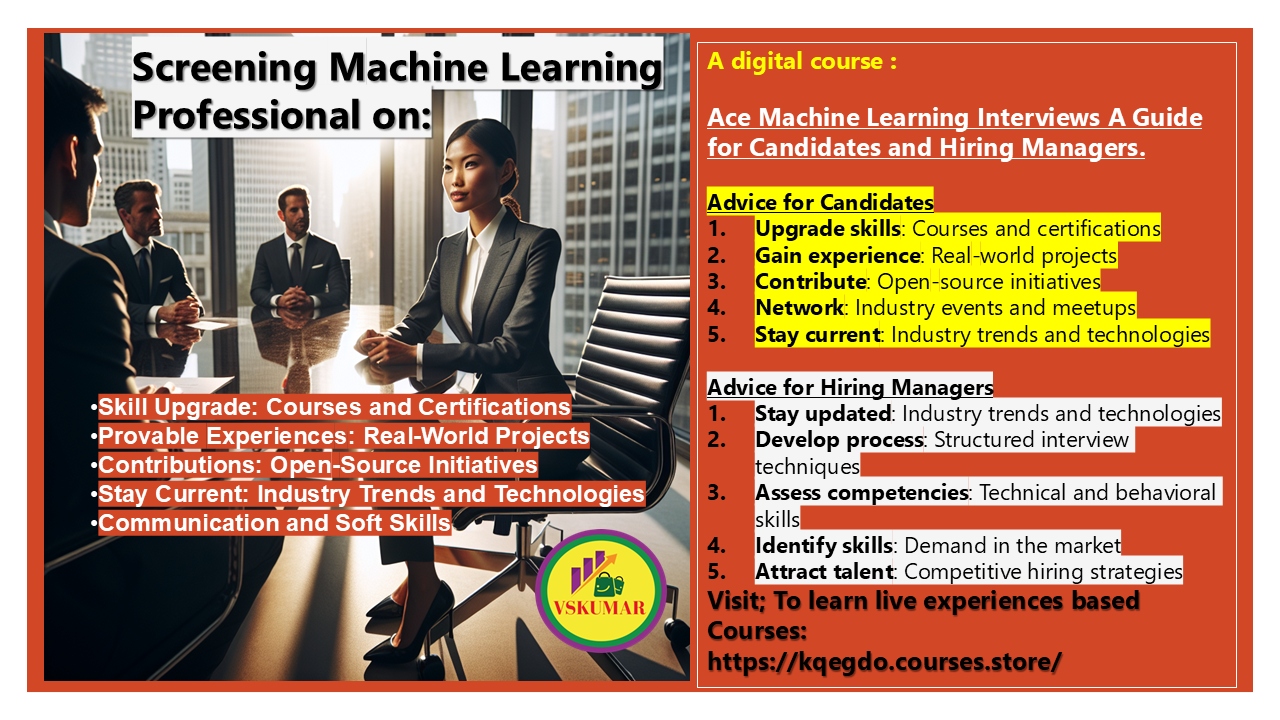
Our comprehensive digital course, “Ace Machine Learning Interviews: A Guide for Candidates and Hiring Managers,” is designed to help you master these topics and more. Here’s how it can assist you:

  1. Technical Mastery: Deep dive into core ML concepts like handling imbalanced datasets, ensemble learning, and choosing evaluation metrics.
  2. Behavioral Insights: Learn to effectively articulate experiences and technical knowledge using the STAR method. Master common behavioral questions.
  3. Practical Assessments: Prepare for real-world scenarios and case studies that test your ML knowledge. Tips on analyzing case studies and performing practical assessments.
  4. Resume Crafting: Create standout resumes highlighting your technical and soft skills, tailored for specific ML roles.
  5. Interview Practice: Engage in mock interviews to refine responses, receive constructive feedback, and build confidence.
  6. Role Clarity for Hiring Managers: Understand various ML roles and develop strategies to assess both technical and behavioral competencies.
  7. Effective Interview Techniques: Design case studies and practical assessments tailored to your organization’s needs.
  8. Candidate Evaluation: Evaluate resumes and identify key attributes indicating strong candidates. Conduct remote interviews efficiently.
  9. Building a Talent Pipeline: Leverage networking and job search strategies to attract top talent. Utilize online platforms and industry events.
  10. Continuous Learning: Access a wealth of resources, including books, online courses, webinars, and expert guidance.

Whether you’re an aspiring ML professional looking to land your dream job or a hiring manager seeking to refine your interview process, our course provides the tools and insights needed to excel. By addressing both candidates and hiring managers, this course offers a holistic approach to mastering ML interviews.

Join us today and take the first step towards mastering the art of ML interviews.

How the Course Can Help You Prepare

Our comprehensive digital course, “Ace Machine Learning Interviews: A Guide for Candidates and Hiring Managers,” is designed to help you master these topics and more. Here’s how it can assist you:

  1. Technical Mastery:
    • Deep dive into core ML concepts like handling imbalanced datasets, ensemble learning, and choosing evaluation metrics.
    • Hands-on experience with techniques such as data augmentation, L1 and L2 regularization, and feature scaling using tools like TensorFlow and PyTorch.
  2. Behavioral Insights:
    • Learn to effectively articulate experiences and technical knowledge using the STAR method.
    • Master common behavioral questions to demonstrate skills in teamwork, problem-solving, and adaptability.
  3. Practical Assessments:
    • Prepare for real-world scenarios and case studies that test your ML knowledge.
    • Tips on analyzing case studies and performing practical assessments, such as evaluating clustering algorithms and recommendation systems.
  4. Resume Crafting:
    • Create standout resumes highlighting your technical and soft skills, tailored for specific ML roles.
    • Learn to present relevant projects, such as those involving NLP applications and handling missing data.
  5. Interview Practice:
    • Engage in mock interviews to refine your responses, receive constructive feedback, and build confidence.
  6. Role Clarity for Hiring Managers:
    • Understand various ML roles and develop strategies to assess both technical and behavioral competencies.
  7. Effective Interview Techniques:
    • Design case studies and practical assessments tailored to your organization’s needs.
    • Assess candidate’s technical and behavioral competencies effectively.
  8. Candidate Evaluation:
    • Evaluate resumes and identify key attributes that indicate strong candidates.
    • Conduct remote interviews efficiently, ensuring a smooth process.
  9. Building a Talent Pipeline:
    • Leverage networking and job search strategies to attract top talent.
    • Utilize online platforms and industry events to expand professional networks.
  10. Continuous Learning:
    • Access a wealth of resources, including books, online courses, webinars, and expert guidance.

Whether you’re an aspiring ML professional looking to land your dream job or a hiring manager seeking to refine your interview process, our course provides the tools and insights needed to excel.

By addressing both candidates and hiring managers, this course offers a holistic approach to mastering ML interviews. Join us today and take the first step towards mastering the art of ML interviews.

Check out the course here: ML Interview Guide