
Understanding AI and Its Impact on Business
Artificial Intelligence (AI) has transitioned from a theoretical concept to a practical tool that is reshaping the business landscape. IT professionals are at the forefront of this transformation, tasked with integrating AI solutions into existing infrastructures. Understanding AI’s capabilities and its potential impact on business operations is essential for architects and developers alike. By leveraging AI technologies, organizations can optimize processes, enhance customer experiences, and make data-driven decisions that propel growth.
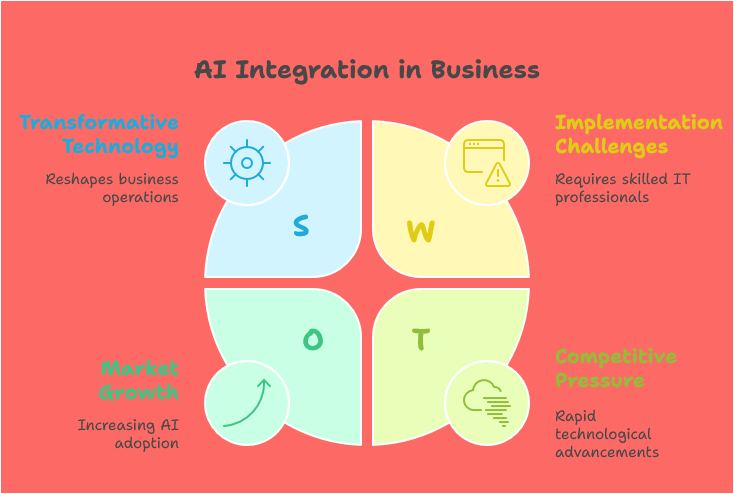
The integration of AI with cloud platforms like AWS and Azure offers unique advantages for businesses seeking automation. AWS provides a suite of AI services, such as Amazon SageMaker for building, training, and deploying machine learning models, while Azure features tools like Azure Machine Learning that facilitate the development of intelligent applications. These platforms not only simplify the implementation of AI but also ensure scalability and flexibility. IT professionals must familiarize themselves with these tools to effectively architect solutions that harness AI for business automation.
As businesses increasingly adopt AI, they are witnessing significant improvements in operational efficiency. AI-driven automation allows organizations to streamline workflows, reduce human error, and free up valuable resources for strategic initiatives. Tasks that were once labor-intensive can now be accomplished with precision and speed, leading to cost savings and increased productivity. IT professionals play a crucial role in identifying areas where AI can be applied, ensuring that the integration aligns with business objectives and delivers measurable results.
Moreover, AI enhances decision-making capabilities by providing insights derived from vast amounts of data. With advanced analytics and machine learning algorithms, businesses can uncover patterns and trends that inform strategic choices. IT professionals must focus on creating robust data architectures that support AI initiatives, enabling seamless data flow and real-time analysis. This data-driven approach empowers organizations to stay competitive and responsive to market changes, highlighting the importance of IT expertise in AI deployment.
In conclusion, understanding AI and its impact on business is vital for IT professionals involved in architecting solutions with AWS and Azure. The potential for AI to automate processes, improve efficiency, and enhance decision-making is immense. By embracing these technologies, IT architects can help businesses navigate the complexities of digital transformation, ultimately driving innovation and success in an increasingly automated world. As the landscape continues to evolve, ongoing education and adaptation will be key for professionals seeking to leverage AI effectively in their organizations.
The Role of Cloud Computing in AI
The integration of cloud computing with artificial intelligence (AI) has transformed the landscape of business automation, enabling IT professionals to build scalable, efficient, and innovative solutions. Cloud platforms like AWS and Azure provide the necessary infrastructure and services that facilitate the deployment and management of AI applications. By leveraging cloud resources, organizations can access powerful computing capabilities, extensive storage options, and advanced AI tools without the need for substantial upfront investments in hardware and software. This flexibility allows businesses to innovate rapidly and respond to market demands effectively.
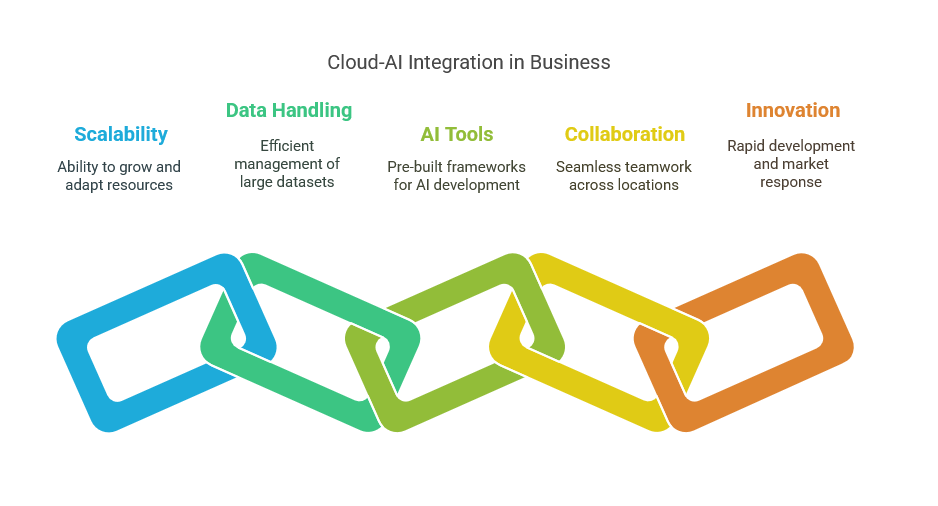
One of the key advantages of cloud computing in AI is its ability to handle massive datasets efficiently. AI algorithms thrive on vast amounts of data for training and learning. Cloud platforms offer the scalability required to store and process these datasets, enabling organizations to harness data from various sources, including IoT devices, customer interactions, and social media. This capability not only accelerates the development of AI models but also enhances their performance by allowing continuous learning and adaptation to new information. IT professionals can easily scale their data storage and compute resources, ensuring that their AI initiatives are not hindered by infrastructure limitations.
Moreover, cloud service providers offer a plethora of AI-specific tools and frameworks that simplify the development process for IT professionals. Services such as AWS SageMaker and Azure Machine Learning provide pre-built algorithms, development environments, and deployment options that allow teams to focus on building and refining their models rather than dealing with the underlying infrastructure. This ease of access to advanced technologies democratizes AI, enabling organizations of all sizes to implement AI-driven solutions that enhance business processes, improve customer experiences, and drive operational efficiencies.
The collaborative nature of cloud computing further enhances its role in AI development. With cloud platforms facilitating real-time collaboration among teams, IT professionals can work together seamlessly, regardless of their geographical locations. This collaboration is vital for AI projects, which often require cross-disciplinary expertise from data scientists, software engineers, and business analysts. By utilizing cloud-based tools, organizations can foster a culture of innovation, where ideas can be shared, tested, and iterated upon rapidly, leading to more effective AI applications that align closely with business objectives.
In summary, the synergy between cloud computing and AI is reshaping the way businesses approach automation and digital transformation. For IT professionals, understanding the capabilities and advantages of platforms like AWS and Azure is essential for architecting future-ready solutions. By leveraging cloud resources, organizations can build robust AI applications that not only enhance operational efficiency but also position them competitively in an increasingly data-driven marketplace. Embracing this technological convergence will empower IT professionals to lead their organizations into the future of intelligent business automation.
Overview of AWS and Azure Platforms
Amazon Web Services (AWS) and Microsoft Azure are two of the most prominent cloud computing platforms, playing a pivotal role in transforming the landscape of IT infrastructure and business applications. Both platforms provide a comprehensive suite of services that enable organizations to build, deploy, and manage applications in the cloud, making them indispensable for IT professionals looking to leverage artificial intelligence for business automation. AWS, with its extensive global infrastructure and vast array of services, empowers businesses to innovate rapidly while maintaining flexibility. Meanwhile, Azure offers seamless integration with Microsoft products, providing a familiar environment for enterprises already invested in Microsoft technologies.
AWS stands out for its mature ecosystem and extensive range of services, from computing power and storage to machine learning and data analytics. Its services like Amazon EC2, S3, and Lambda enable businesses to scale effortlessly according to demand. Additionally, AWS provides advanced AI services such as Amazon SageMaker, which simplifies the process of building and deploying machine learning models. This flexibility and scalability make AWS an ideal choice for organizations aiming to automate business processes and leverage AI capabilities to enhance operational efficiency and drive innovation.
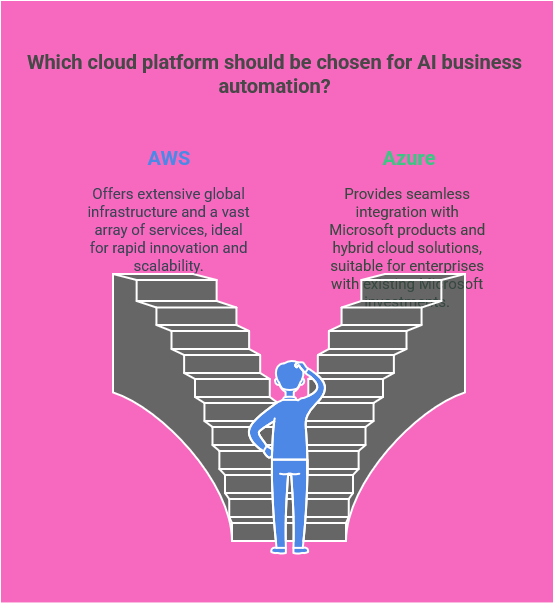
On the other hand, Microsoft Azure has gained significant traction, particularly among enterprises looking for integrated solutions that align with existing Microsoft products. Azure’s offerings, such as Azure Machine Learning, Azure Functions, and Azure DevOps, allow IT professionals to create automated workflows that enhance collaboration and streamline processes. Azure’s commitment to hybrid cloud solutions also enables businesses to maintain a balance between on-premises infrastructure and cloud capabilities, facilitating a gradual transition to cloud-native applications while leveraging existing investments in technology.
The competitive nature of AWS and Azure has led to continuous innovation, with both platforms regularly introducing new features and services designed to meet evolving business needs. For IT professionals, understanding the strengths and weaknesses of each platform is crucial for making informed decisions about architecture and implementation. This understanding becomes even more vital when integrating AI capabilities into business applications, as both platforms offer unique tools and frameworks that can significantly enhance automation and data-driven decision-making.
In conclusion, both AWS and Azure offer robust frameworks for IT professionals to harness the power of AI in business automation. Their diverse range of services, coupled with their ongoing innovations, provides organizations with the tools needed to enhance productivity, optimize operations, and drive growth. As businesses continue to embrace digital transformation, a comprehensive understanding of these platforms will be essential for architects and developers in creating efficient, intelligent systems that can adapt to the ever-changing demands of the market.
 Building Cloud/DevOps/AI/ML/Gen AI Architects