
Emerging Technologies and In-Demand Roles Shaping Global IT in 2025
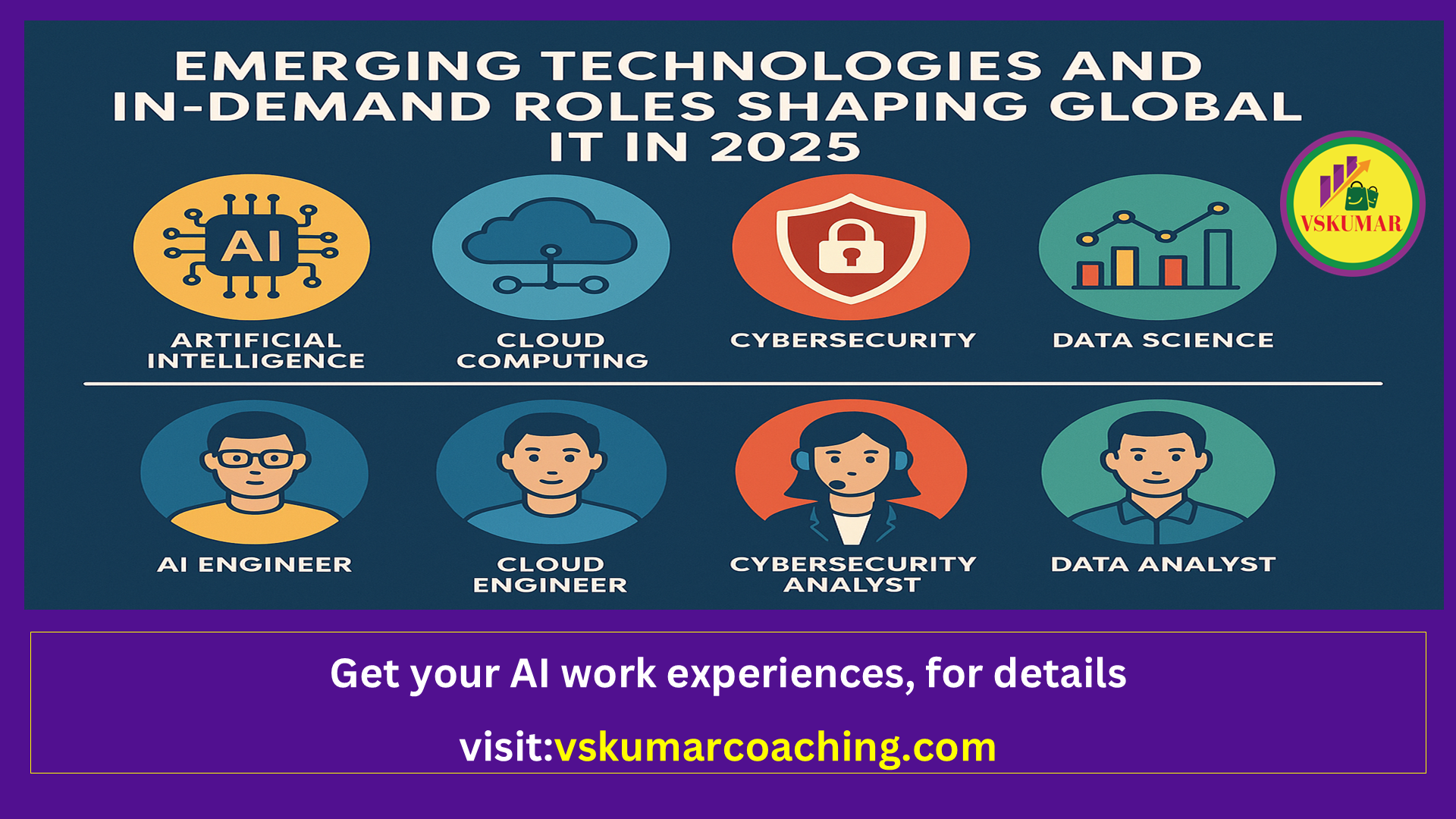
The information technology landscape continues to evolve at a breakneck pace, driven by breakthroughs in artificial intelligence (AI), connectivity, and computing paradigms. Organizations across industries are racing to adopt innovative solutions that can optimize operations, enhance customer experiences, and generate new revenue streams. Simultaneously, the demand for professionals with specialized skills to design, deploy, and maintain these technologies is skyrocketing. This comprehensive article explores the top trending technologies in global IT for 2025 and the roles that will be most sought-after in the coming years.
1. Artificial Intelligence and Its Evolving Ecosystem
1.1 Generative AI
Generative AI refers to algorithms that can create new content—ranging from text and images to audio and code—based on patterns learned from large datasets. Applications such as automated content creation, drug discovery, and creative design are becoming commonplace. Companies are integrating generative models into product design workflows to accelerate prototyping and reduce time to market.
According to Deloitte’s Tech Trends 2025 report, generative AI has been “woven into the fabric of our lives,” with organizations starting to view it as fundamental as the HTTP protocol for web communication(Deloitte Insights). This deep integration is driving a surge in demand for AI engineers, machine learning specialists, and prompt engineering experts.
1.2 Agentic AI
Also known as autonomous AI, agentic AI systems can perform tasks with minimal human oversight, making decisions and taking actions across multiple systems. From automating customer support through advanced chatbots to orchestrating complex supply chain operations, agentic AI promises to boost efficiency and reduce human error.
Gartner highlights agentic AI as one of its Top 10 Strategic Technology Trends for 2025, emphasizing its potential to transform enterprise workflows(Gartner). Roles in high demand include AI ethics officers, responsible for ensuring agentic systems operate transparently and in compliance with regulations, and AI operations (AIOps) engineers, who monitor and manage the health of AI-driven systems.
1.3 Applied AI and AI Governance Platforms
Beyond generative and agentic AI, applied AI refers to the deployment of AI models for specific industry use cases, such as predictive maintenance in manufacturing or fraud detection in financial services. With concerns over bias, privacy, and regulatory compliance mounting, AI governance platforms are emerging to provide model documentation, monitoring, and auditing capabilities.
McKinsey’s technology trends outlook identifies applied AI as a cornerstone of digital transformation, with adoption rates climbing steadily across sectors(McKinsey). Demand is growing for AI governance managers, data stewards, and machine learning operations (MLOps) engineers who can ensure models remain performant, fair, and auditable throughout their lifecycle.
2. Quantum Computing and Post-Quantum Cryptography
Quantum computing leverages quantum mechanics to perform calculations at speeds unattainable by classical computers. In areas such as cryptography, materials science, and complex system simulations, quantum processors promise revolutionary breakthroughs.
2.1 Quantum Hardware and Algorithms
Leading technology firms and startups are racing to build stable, error-corrected quantum hardware. Simultaneously, quantum algorithm researchers are developing novel techniques to solve optimization and simulation problems more efficiently.
Simplilearn’s list of the Top 25 Emerging Technologies for 2025 places quantum computing among the highest-impact developments, alongside generative AI and 5G expansion(Simplilearn). Organizations that harness quantum advantage will need quantum software developers, quantum algorithm scientists, and quantum hardware engineers to shepherd their initiatives from research to production.
2.2 Post-Quantum Cryptography
As quantum computers advance, many of today’s encryption schemes will become vulnerable. Post-quantum cryptography focuses on developing algorithms resistant to quantum attacks. Governments and enterprises are already standardizing new encryption methods to safeguard sensitive data against future threats.
Gartner projects that post-quantum cryptography will become a mainstream priority for security teams by 2025(Gartner). This has fueled demand for cryptographers, security architects, and compliance specialists trained in post-quantum standards such as lattice-based cryptography and hash-based signatures.
3. Connectivity and Next-Generation Networks
3.1 5G and Beyond
The rollout of 5G networks is enabling ultra-low-latency, high-bandwidth connectivity, which is crucial for real-time applications like autonomous vehicles, telesurgery, and mission-critical industrial automation. In parallel, research into 6G promises to push the boundaries further with terahertz frequencies and native AI integration.
According to Simplilearn, the global expansion of 5G remains a key driver of transformation, underpinning new services and business models(Simplilearn). Network architects, RF engineers, and edge computing specialists are in high demand as organizations build and optimize these next-generation networks.
3.2 Advanced Connectivity: Satellite and Mesh Networks
In addition to terrestrial 5G, companies are deploying satellite constellations and mesh networks to extend coverage to remote regions and support IoT deployments at a global scale. These alternative connectivity solutions pave the way for real-time data collection in mining, agriculture, and environmental monitoring.
McKinsey highlights advanced connectivity technologies—ranging from high-altitude platforms to low-Earth orbit satellites—as crucial enablers of digital inclusion(McKinsey). Specialists in satellite communications, network protocol engineering, and security for distributed networks will be essential to maximize these investments.
4. Immersive Technologies: AR, VR, and Spatial Computing
4.1 Virtual Reality (VR) 2.0 and Augmented Reality (AR)
Immersive technologies are entering a new phase, with VR headsets becoming lighter and more affordable, and AR gaining traction in enterprise use cases such as remote assistance, training, and product visualization.
Simplilearn’s Tech Trends for 2025 list includes VR 2.0 and AR among the top 25 technologies likely to reshape industries(Simplilearn). As a result, demand is soaring for XR (extended reality) developers, 3D artists, and UX/UI designers who can craft seamless, intuitive experiences.
4.2 Spatial Computing
Spatial computing goes beyond AR and VR by integrating digital content into the physical environment in a context-aware manner. It leverages sensors, cameras, and real-time mapping to anchor virtual objects in space, enabling applications in industrial design, healthcare, and location-based services.
Gartner identifies spatial computing as a strategic trend, noting its potential to create new forms of collaboration and interaction(Gartner). Roles such as spatial computing engineers, holographic content creators, and sensor fusion experts are emerging to support these sophisticated environments.
5. Cloud and Edge Computing Convergence
5.1 Cloud-Native Architectures
Cloud-native design principles—such as containerization, microservices, and serverless computing—remain central to delivering scalable, resilient applications. Enterprises are modernizing legacy systems and adopting DevOps and GitOps practices to accelerate feature delivery and operational efficiency.
According to McKinsey, cloud and edge computing together account for 48% of the top technology trend impact across industries(McKinsey). Consequently, cloud architects, site reliability engineers (SREs), and DevOps engineers continue to be among the most sought-after roles in IT.
5.2 Edge Computing and IoT Integration
Edge computing processes data closer to where it is generated, reducing latency and bandwidth usage. This is especially critical for IoT use cases that require real-time insights, such as autonomous vehicles, smart grids, and industrial automation.
The CompTIA IT Industry Outlook 2025 underscores the synergy among cloud computing, IoT, and edge platforms in reshaping business operations(CompTIA). Emerging roles in this space include edge infrastructure engineers, IoT solution architects, and data engineers specializing in real-time analytics.
6. Cybersecurity and Data Privacy
6.1 Zero Trust and Identity Management
As cyber threats become more sophisticated, organizations are shifting toward zero trust models, which assume no implicit trust in any network component or user. Identity and access management (IAM), multi-factor authentication (MFA), and continuous monitoring are core pillars of zero trust architectures.
Gartner projects that by 2025, 60% of enterprises will implement zero trust strategies for at least half of their use cases(Gartner). This trend is fueling a surge in demand for cybersecurity analysts, identity architects, and ethical hackers to secure modern IT environments.
6.2 Privacy-Enhancing Technologies
With regulatory frameworks like GDPR, CCPA, and emerging data protection laws worldwide, privacy-enhancing technologies (PETs) such as homomorphic encryption, differential privacy, and secure multi-party computation are gaining traction. These approaches enable data analytics and machine learning on sensitive data without exposing raw information.
According to Gartner, post-quantum cryptography and privacy-centric security measures will be fundamental to building trust in digital services(Gartner). Roles in high demand include privacy engineers, data protection officers, and compliance specialists familiar with global privacy regulations.
7. Data Analytics and Edge-AI
7.1 Real-Time Analytics
Businesses are increasingly leveraging real-time analytics to make informed decisions on the fly—whether optimizing supply chains, personalizing customer experiences, or detecting fraud. Technologies like stream processing, in-memory databases, and edge-AI inference engines are central to these capabilities.
McKinsey reports that applied AI and advanced analytics are among the top five technology investments for executive agendas in 2025(McKinsey). As a result, demand for data scientists, analytics engineers, and streaming data architects remains robust.
7.2 Machine Learning Operations (MLOps)
To operationalize machine learning models at scale, organizations are adopting MLOps practices that automate the deployment, monitoring, and governance of models in production. This discipline ensures model reliability, reproducibility, and compliance.
The World Economic Forum’s Future of Jobs Report 2025 emphasizes that MLOps engineers and AI validation specialists will be among the fastest-growing roles in technology(WEF). These professionals bridge the gap between data science and IT operations, enabling continuous AI-driven innovation.
8. Sustainability and Green IT
8.1 Energy-Efficient Data Centers
As the global digital footprint expands, energy consumption by data centers is under scrutiny. Organizations are investing in liquid cooling, AI-driven power management, and renewable energy sourcing to reduce carbon emissions and operational costs.
Deloitte’s Digital Media Trends report notes that sustainability is becoming a key factor in technology strategy, with enterprises seeking solutions that balance performance and environmental impact(Deloitte). Green IT roles—such as sustainability analysts, energy optimization engineers, and carbon footprint auditors—are critical to achieving these objectives.
8.2 Circular Economy for Electronics
The concept of a circular economy encourages designing products for longevity, repairability, and recyclability. In the IT sector, this translates to modular hardware, remanufacturing practices, and take-back programs to minimize e-waste.
According to the World Economic Forum, emerging technologies like blockchain can enhance transparency and traceability in electronics supply chains, supporting circular initiatives(WEF). Supply chain sustainability managers, reverse logistics coordinators, and eco-design engineers are poised to play leading roles in this transformation.
9. Key Roles and Career Pathways in 2025
The rapid evolution of technology necessitates a workforce equipped with both specialized technical skills and strong soft skills. Below is an overview of the most in-demand IT roles, their core responsibilities, and the skills required to thrive.
9.1 AI and Data Science
- AI Engineer: Develops, trains, and deploys machine learning and deep learning models. Proficiency in Python, TensorFlow, PyTorch, and MLOps frameworks is essential(Coursera).
- Data Scientist: Extracts insights from complex datasets using statistical analysis and predictive modeling. Requires expertise in R, SQL, and data visualization tools.
- MLOps Engineer: Automates end-to-end ML workflows, ensuring model reliability and compliance. Familiarity with Kubernetes, Docker, and CI/CD pipelines is critical.
9.2 Cloud and DevOps
- Cloud Architect: Designs and oversees cloud infrastructure across AWS, Azure, or Google Cloud Platform. Knowledge of networking, security, and cost optimization is vital(Indeed).
- DevOps Engineer: Bridges development and operations, implementing CI/CD, infrastructure as code, and monitoring solutions.
- Site Reliability Engineer (SRE): Ensures system reliability and performance, applying software engineering practices to IT operations.
9.3 Cybersecurity and Compliance
- Security Analyst: Monitors systems for threats and responds to incidents. Proficiency in SIEM tools, intrusion detection systems, and threat intelligence is required(Gartner).
- IAM Specialist: Manages user identities, access policies, and authentication mechanisms within zero trust frameworks.
- Privacy Engineer: Implements PETs and ensures compliance with data protection regulations such as GDPR and CCPA.
9.4 Connectivity and Network Engineering
- Network Architect: Designs high-performance, resilient networks for 5G, satellite, and mesh deployments.
- RF Engineer: Focuses on radio frequency planning and optimization for wireless networks.
- Edge Computing Specialist: Deploys and manages edge nodes, handling real-time data processing and device integration.
9.5 Immersive and Spatial Computing
- XR Developer: Builds AR/VR applications using Unity, Unreal Engine, and WebXR frameworks.
- 3D Artist/Modeler: Creates assets and environments for immersive experiences.
- Spatial Computing Engineer: Integrates sensor data, computer vision, and mapping technologies to anchor digital content in the physical world.
9.6 Quantum and Advanced Computing
- Quantum Software Developer: Writes and tests algorithms for quantum simulators and hardware.
- Quantum Hardware Engineer: Designs qubit architectures, control electronics, and cryogenic systems.
- Cryptographer: Develops and analyzes post-quantum encryption schemes to secure future communications.
9.7 Sustainability and Green IT
- Sustainability Analyst: Tracks environmental metrics and recommends strategies to reduce carbon footprints in IT operations(Deloitte).
- Eco-Design Engineer: Develops products with modular, repairable designs to support circular economy goals.
- Energy Optimization Engineer: Implements AI-driven power management and cooling solutions in data centers.
10. Upskilling and Educational Pathways
In a landscape of continuous disruption, professionals must embrace lifelong learning to stay competitive. Top educational resources include:
- Vendor Certifications: AWS Certified Solutions Architect, Google Professional Cloud Architect, Microsoft Certified: Azure AI Engineer.
- Open Enrollment Programs: Data science and AI courses on Coursera, Udacity Nanodegrees in AI and ML operations.
- Industry Reports and Communities: Gartner, Deloitte, CompTIA, and the World Economic Forum offer free insights, webinars, and communities for professionals to stay updated.
By combining formal education, hands-on projects, and active participation in professional networks, IT practitioners can position themselves for success in high-growth roles.
Conclusion
The global IT ecosystem in 2025 is defined by powerful synergies among AI, quantum computing, next-generation connectivity, immersive experiences, and sustainable practices. Organizations that successfully integrate these technologies will gain competitive advantage, operational resilience, and new value creation pathways. To realize these benefits, a strong pipeline of skilled professionals—ranging from AI engineers and cybersecurity analysts to quantum researchers and sustainability experts—is indispensable.
For those charting their career paths, aligning skill development with these emerging trends offers a roadmap to some of the most dynamic and rewarding roles in the years ahead. Whether you’re a seasoned technologist or an aspiring professional, the convergence of these technologies presents an unprecedented opportunity to shape the future of our digital world.
NOTE:
If you want to upskill into any of the above roles study out coaching site: https://vskumarcoaching.com/ And book an appointment through DM on lnkedin.
 Building Cloud/DevOps/AI/ML/Gen AI Architects