
Best Practices for Prompt Engineering (with Business Examples)
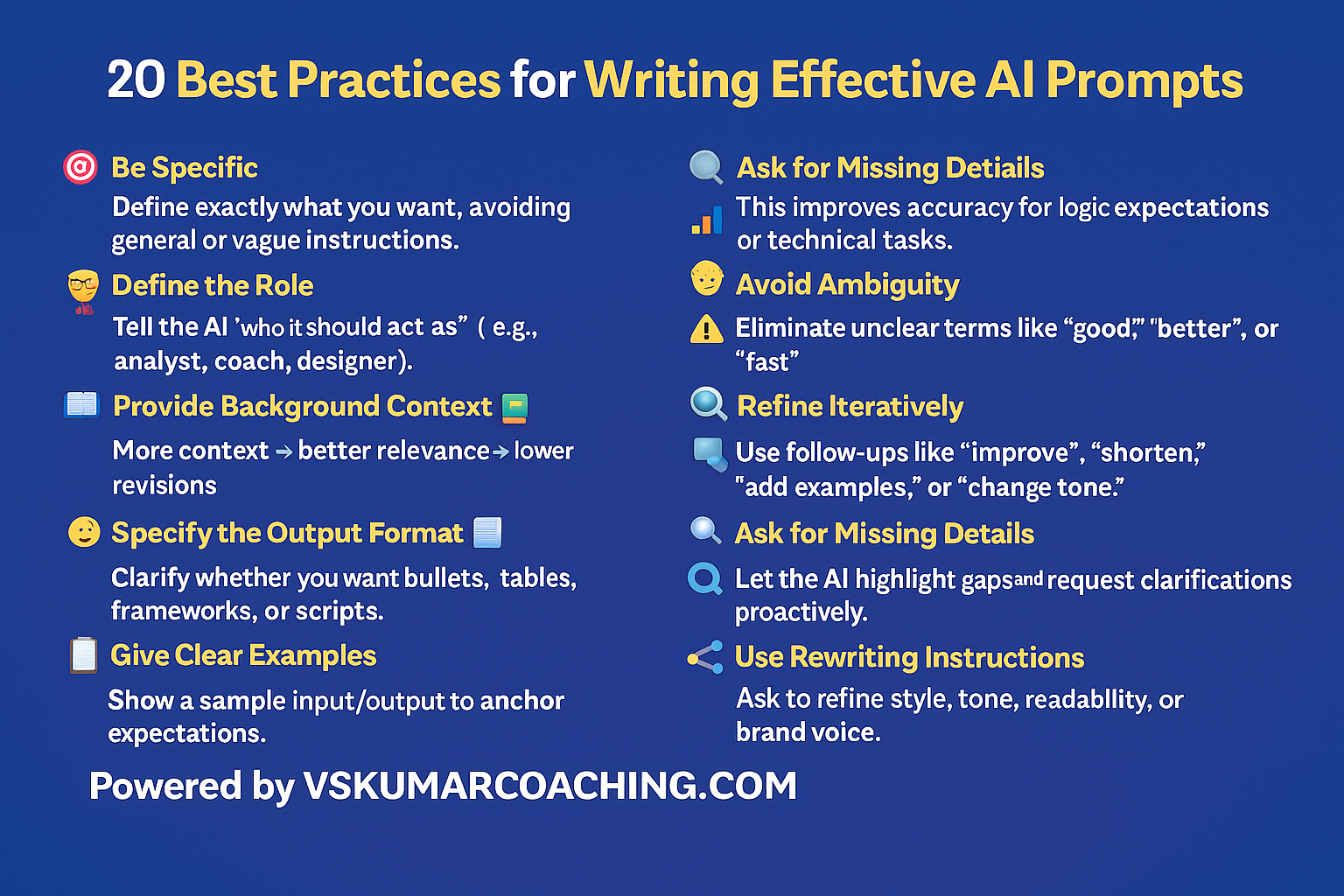
This “Best Practices for Prompt Engineering with Examples“, is with 3 business examples for each practice for easy application.
How to get the most accurate, actionable, and high-impact results from AI tools.
Prompt engineering is now a critical skill for professionals, leaders, and creators. Whether you’re drafting reports, analyzing data, writing emails, or designing workflows, the quality of your prompts directly shapes the quality of the AI output.
Here are the 20 best practices for prompt engineering, each paired with three practical business examples you can use immediately.
1. Be Specific
The clearer your request, the better the output. Avoid vague terms like “explain” or “write something.”
Examples:
- “Write a 150-word summary of this customer feedback in bullet points.”
- “Create a list of 5 KPIs for an e-commerce marketing team.”
- “Draft a 10-line WhatsApp-style message announcing a product update.”
2. Define the Role
Give the AI a role so it adopts the right tone and expertise.
Examples:
- “Act as a CFO and analyze the financial risks in this plan.”
- “Act as an HR expert and rewrite this policy in simple language.”
- “Act as a sales coach and rewrite this pitch to improve closing rates.”
3. Give Context
Provide background, goals, constraints, and details.
Examples:
- “We are a SaaS startup targeting small clinics; write website copy for them.”
- “Summarize this report for a board meeting where members prefer short insights.”
- “Rewrite this marketing email for customers who recently abandoned their carts.”
4. State the Format
Tell the AI how you want the answer structured.
Examples:
- “Give me a table comparing AWS, GCP, and Azure.”
- “Create a 6-step SOP in bullet points.”
- “Write a 3-section executive summary (context, insights, recommendations).”
5. Set the Tone
Tone changes the impact of your communication.
Examples:
- “Write this investor email in a confident but respectful tone.”
- “Write this product description in a friendly, non-technical tone.”
- “Write a formal memo to staff about the policy change.”
6. Break Down Tasks
Split complex tasks into smaller tasks for accuracy.
Examples:
- “First analyze the problem, then propose solutions, then prioritize them.”
- “Step 1: Summarize customer reviews; Step 2: Identify patterns.”
- “Write the outline first. After I approve, write the full article.”
7. Show Examples
Provide samples so AI can mirror style, formatting, or tone.
Examples:
- “Write a case study in the same style as the sample below.”
- “Rewrite this LinkedIn post to match this writing style.”
- “Create a sales script similar to this example but shorter.”
8. Use Constraints
Limit length, complexity, or vocabulary.
Examples:
- “Explain this concept in under 100 words.”
- “Write this in simple English for a 12-year-old reader.”
- “Give me only bullet points, no paragraphs.”
9. Ask for Multiple Options
Options help you compare and refine.
Examples:
- “Give me 3 versions of this email in different tones.”
- “Suggest 5 tagline options for this campaign.”
- “Give me 3 alternatives to this process workflow.”
10. Use Iterative Refinement
Ask AI to improve its earlier answers.
Examples:
- “Rewrite version 2 with more confidence and fewer words.”
- “Improve this SWOT analysis by adding market data points.”
- “Enhance this proposal with more clarity and structure.”
11. Ask for Missing Details
Let the AI request clarification.
Examples:
- “Before writing, ask me any questions you need for perfection.”
- “Ask for missing data before creating the financial forecast.”
- “Ask clarifying questions before drafting the contract summary.”
12. Use Step-by-Step Reasoning
Structure thinking → better answers.
Examples:
- “Think step-by-step and list the logic behind your recommendation.”
- “Break your reasoning into steps before giving the final result.”
- “Show your calculation process before giving the projection.”
13. Avoid Ambiguity
Replace vague words with precise instructions.
Examples:
- “Instead of ‘improve this’, say ‘make it shorter and more persuasive’.”
- “Specify whether ‘report’ means PDF-style, bullet-style, or narrative.”
- “Instead of ‘suggest ideas’, say ‘give me 10 marketing ideas for Instagram only’.”
14. Clarify the Audience
Audience determines style, tone, and depth.
Examples:
- “Write this for first-time home buyers.”
- “Create this training manual for interns.”
- “Prepare this strategy note for senior leadership.”
15. Restrict Unwanted Behavior
Tell the AI what not to include.
Examples:
- “Avoid jargon and keep explanations simple.”
- “Do not add extra assumptions; stick to the data.”
- “Avoid motivational language; keep it strictly factual.”
16. Use Rewriting Instructions
Rewrite the same text in different versions.
Examples:
- “Rewrite this email in three tones: formal, friendly, and urgent.”
- “Shorten this proposal to half its length.”
- “Rewrite this blog as a LinkedIn post.”
17. Request Validation
Ask AI to check its own output.
Examples:
- “Review this proposal for gaps or inconsistencies.”
- “Check this financial summary for errors.”
- “Validate this process flow: identify missing or unclear steps.”
18. Use Multi-Step Commands
Tell AI to complete tasks sequentially.
Examples:
- “Step 1: Analyze the data; Step 2: Write insights; Step 3: Recommend actions.”
- “Read this case study, then summarize, then extract 5 key lessons.”
- “Evaluate the risks first, then propose mitigations.”
19. Chain Prompts Together
Use one response as input for the next.
Examples:
- “Use the outline you created to now write the full article.”
- “Take these marketing ideas and turn them into a quarterly plan.”
- “Convert this SWOT analysis into a board-ready presentation.”
20. Clarify the Intent
Explain the purpose so AI produces relevant, aligned output.
Examples:
- “This summary is for a C-level meeting — keep it crisp and data-focused.”
- “This email aims to re-engage inactive customers — keep it persuasive.”
- “I need this report for an investor pitch — highlight growth potential.”
Conclusion
Prompt engineering is not about writing long prompts — it’s about writing clear, structured, intentional prompts.
When you apply these 20 best practices in your business workflows, you get:
✔ Sharper answers
✔ Faster outputs
✔ Highly actionable insights
✔ Consistent quality
✔ Less rework
 Building Cloud/DevOps/AI/ML/Gen AI Architects