
This systematic process moves the AI application from a conceptual blueprint to a continuously improving product.
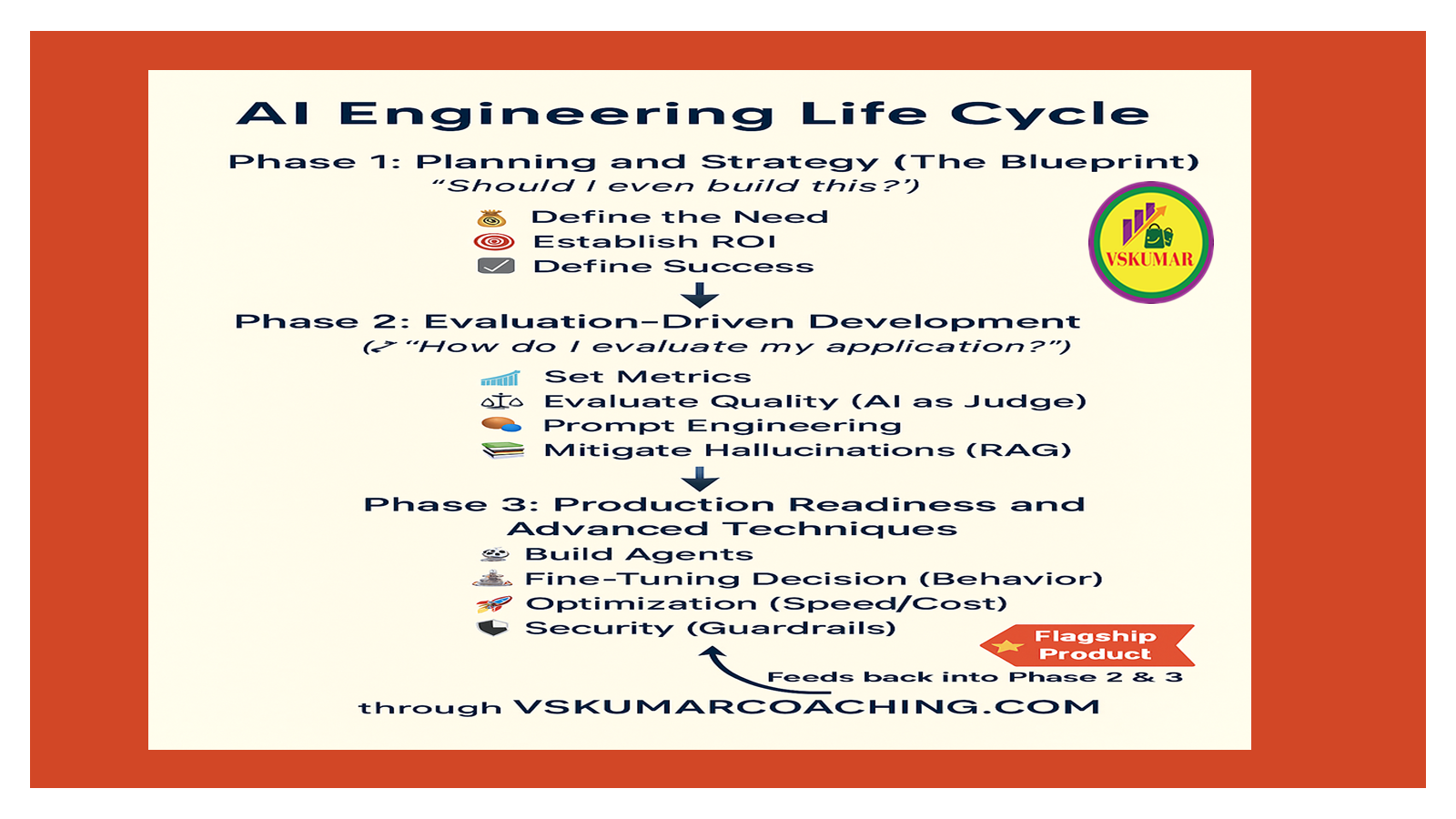
AI Engineering Life Cycle Visual (Text Flowchart)
The AI Engineering Life Cycle is defined by a systematic process of planning, evaluating, prompt engineering, using RAG, and knowing when to apply advanced techniques like agents and fine-tuning.
Phase 1: Planning and Strategy (The Blueprint)
This phase answers the critical question: “Should I even build this?”.
| Stage | Key Activity | Goal and Criteria | Source |
|---|---|---|---|
| 1. Define the Need | Determine if the application addresses a real tangible need. | Solve a strong business problem, not just build a “cool demo”. | |
| 2. Establish ROI | Identify the Return on Investment (ROI) for the business use case. | Show how the application, such as a package-tracking chatbot, solves a problem and reduces support tickets. | |
| 3. Define Success | Establish a clear way to measure the application’s success. | Set clear measurable goals before starting development. |
Phase 2: Evaluation-Driven Development
This phase focuses on the crucial question: “How do I evaluate my application?”.
| Stage | Key Activity | Goal and Criteria | Source |
|---|---|---|---|
| 4. Set Metrics | Practice evaluation-driven development by tying performance to a real-world outcome. | Differentiate between Model Metrics (e.g., factual consistency) and Business Metrics (e.g., customer satisfaction, support tickets resolved). | |
| 5. Evaluate Quality | Use advanced techniques like “AI as a judge”. | Employ a powerful model (like GPT-4) as an impartial evaluator using a detailed scoring rubric to automate evaluation scalably. | |
| 6. Prompt Engineering | Master the art of communication with the AI. | Be incredibly specific (role, audience, task), provide examples (few-shot prompting), and break down complex tasks. | |
| 7. Mitigate Hallucinations | Prevent the AI from confidently stating something false. | Implement Retrieval Augmented Generation (RAG). RAG grounds the model in reality by retrieving factual, up-to-date information and instructing the model to answer only based on that context. RAG is for knowledge. |
Phase 3: Production Readiness and Advanced Techniques
This phase introduces methods to enhance complexity, security, and scalability.
| Stage | Key Activity | Goal and Criteria | Source |
|---|---|---|---|
| 8. Build Agents | Build an agent—an AI that performs actions using tools (e.g., calculator, API) to achieve a goal. | Evaluation metric is simple: Did it succeed in completing the mission?. | |
| 9. Fine-Tuning Decision | Train the model further on custom data only for specific needs. | Use fine-tuning only to teach a very specific style, format, or behavior (e.g., a unique brand voice) that is hard to specify in a prompt. Do not use it to teach new facts (that is RAG’s job). Fine-tuning is for behavior. | |
| 10. Optimization | Prepare the application to be faster and cheaper. | Use smaller optimized models and techniques like quantization (making the model work with smaller numbers). | |
| 11. Security | Implement necessary checks to prevent misuse. | Implement guardrails on both the user’s input and the model’s output to block harmful content. |
Phase 4: Continuous Improvement (The Feedback Loop)
This phase ensures the application gets smarter over time and answers the question: “How do I improve my applications and model?”.
| Stage | Key Activity | Goal and Criteria | Source |
|---|---|---|---|
| 12. Create Feedback Loop | Implement a required system for collecting user interactions. | Feedback can be explicit (thumbs up/down) or implicit (tracking user choices between drafts). | |
| 13. Refinement Fuel | Use collected interaction data as fuel for the next round of fine-tuning. | Application gets smarter with every user interaction. |
(Cycle Repeats)
The data collected in Phase 4 feeds back into Phase 2 and Phase 3 (Evaluation and Advanced Techniques), starting the cycle of refinement and improvement.
This life cycle operates like a closed loop thermostat: you define the desired temperature (Planning), constantly measure the current temperature (Evaluation), adjust the heating system (Production Readiness/Advanced Techniques), and continuously monitor and log performance (Continuous Improvement/Feedback Loop) to ensure the system consistently maintains the desired output.
 Building Cloud/DevOps/AI/ML/Gen AI Architects