


“Why AI Agents Are Failing in Production? – Root Causes”
— written from a real-world enterprise / DevOps / AI leadership perspective, not theory.
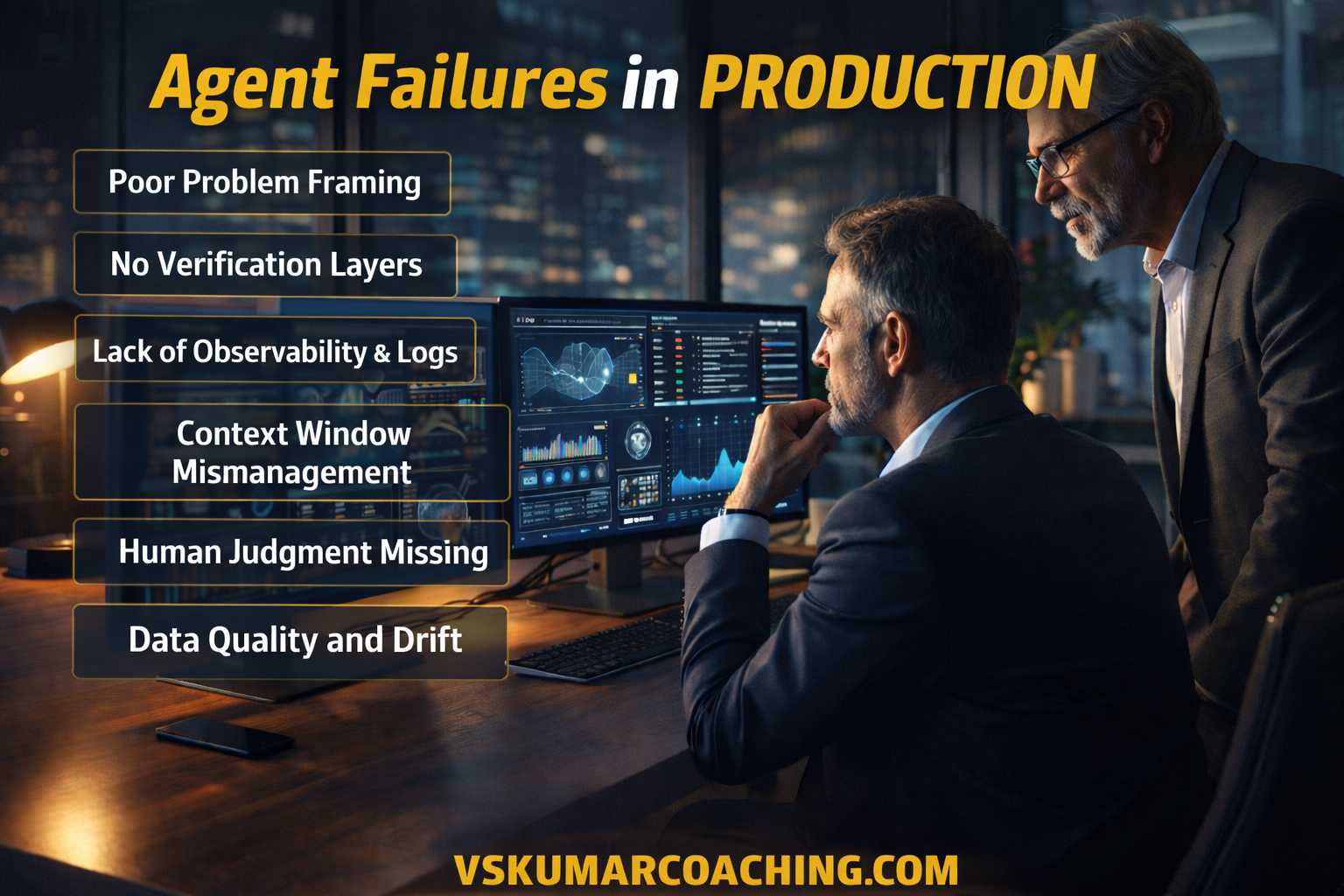
1. Poor Problem Framing Before Agent Design
Most AI agents fail because they are built to demonstrate capability, not to solve a clearly defined business problem. Teams jump straight into tools and frameworks without answering:
- What decision is the agent responsible for?
- Who owns the outcome?
- What does “success” mean in production?
Without crisp problem framing, agents generate outputs—but not outcomes.
2. Over-Reliance on Prompting Instead of System Design
Many teams treat AI agents as “smart prompts” rather than systems with roles, constraints, and boundaries. Prompt-heavy agents break easily when:
- Context grows
- Inputs vary
- Edge cases appear
Production agents need architecture, memory strategies, guardrails, and fallbacks—not just clever prompts.
3. No Deterministic Control in Critical Workflows
AI agents are probabilistic by nature, but production systems demand predictability. Failures occur when agents are allowed to:
- Execute irreversible actions
- Make decisions without confidence thresholds
- Act without human approval loops
Successful production agents mix AI reasoning with deterministic rules and approvals.
4. Weak or Missing Verification Layers
Agents often fail silently because their outputs are not verified. LLMs can be confidently wrong, yet production pipelines trust them blindly.
Common gaps include:
- No secondary model validation
- No fact or policy checks
- No output confidence scoring
Verification is not optional—it is the agent’s safety net.
5. Lack of Observability and Telemetry
Teams deploy AI agents without visibility into:
- Why a decision was made
- Which prompt or context caused failure
- Where hallucinations originated
Without logs, traces, and decision explainability, production debugging becomes guesswork—and trust collapses.
6. Context Window and Memory Mismanagement
AI agents fail when:
- Important historical context is dropped
- Memory grows uncontrolled
- Irrelevant data pollutes reasoning
Production agents require curated memory, not infinite memory. What the agent remembers is more important than how much it remembers.
7. Ignoring Human-in-the-Loop Design
Many agent failures occur because humans are removed too early. Fully autonomous agents struggle with:
- Ethical judgment
- Business nuance
- Ambiguous scenarios
Human-in-the-loop is not a weakness—it is a production maturity stage.
8. Data Quality and Real-World Drift
Agents trained or tested in clean environments fail in production due to:
- Noisy inputs
- Changing user behavior
- Domain drift
If data pipelines are unstable, the smartest agent will still make poor decisions.
9. Misalignment Between Engineering and Business Ownership
AI agents often sit in a gray zone:
- Engineers own the code
- Business owns the outcome
- No one owns failure
Production success requires clear accountability: who is responsible when the agent gets it wrong?
10. Treating AI Agents as Products Instead of Capabilities
Many organizations launch agents as “features” instead of evolving them as living systems.
AI agents require:
- Continuous monitoring
- Prompt and policy updates
- Retraining and recalibration
Agents fail when teams expect “build once, deploy forever”.
AI agents don’t fail because AI is weak.
They fail because production demands discipline, design, and responsibility—not demos.
Watch this video also:
 Building Cloud/DevOps/AI/ML/Gen AI Architects