
What fundamental components and architectural frameworks are essential for building intelligent data agents?
Building intelligent data agents requires a combination of specific technical components and a robust architectural framework designed to handle complex data tasks and derive actionable insights.
Here are 10 high-quality, thought-provoking questions aligned directly to this blog content [What fundamental components and architectural frameworks are essential for building intelligent data agents?]:
You can try them after reading it.
Why is effective data collection considered the foundation of intelligent data agents, and what risks arise if it is poorly implemented?
How do different machine learning algorithms (from regression to neural networks) influence the decision-making capability of a data agent?
What role does data cleaning and preprocessing play in preventing inaccurate or misleading AI insights?
How does the choice of programming languages and tooling impact the scalability and maintainability of intelligent data agents?
What are the key stages in a core workflow framework for data agents, and how do they ensure systematic data processing?
Why is architectural flexibility critical when data volume and complexity increase over time?
How do integration capabilities with ERP and CRM systems enhance the real-world effectiveness of data agents?
What testing and validation mechanisms are essential to ensure continuous accuracy and adaptability of AI agents?
What ethical risks—such as bias, privacy violations, or lack of transparency—must be addressed when building intelligent data agents?
How does the water filtration system analogy help explain the relationship between data collection, processing, machine learning, and architecture in intelligent data agents?
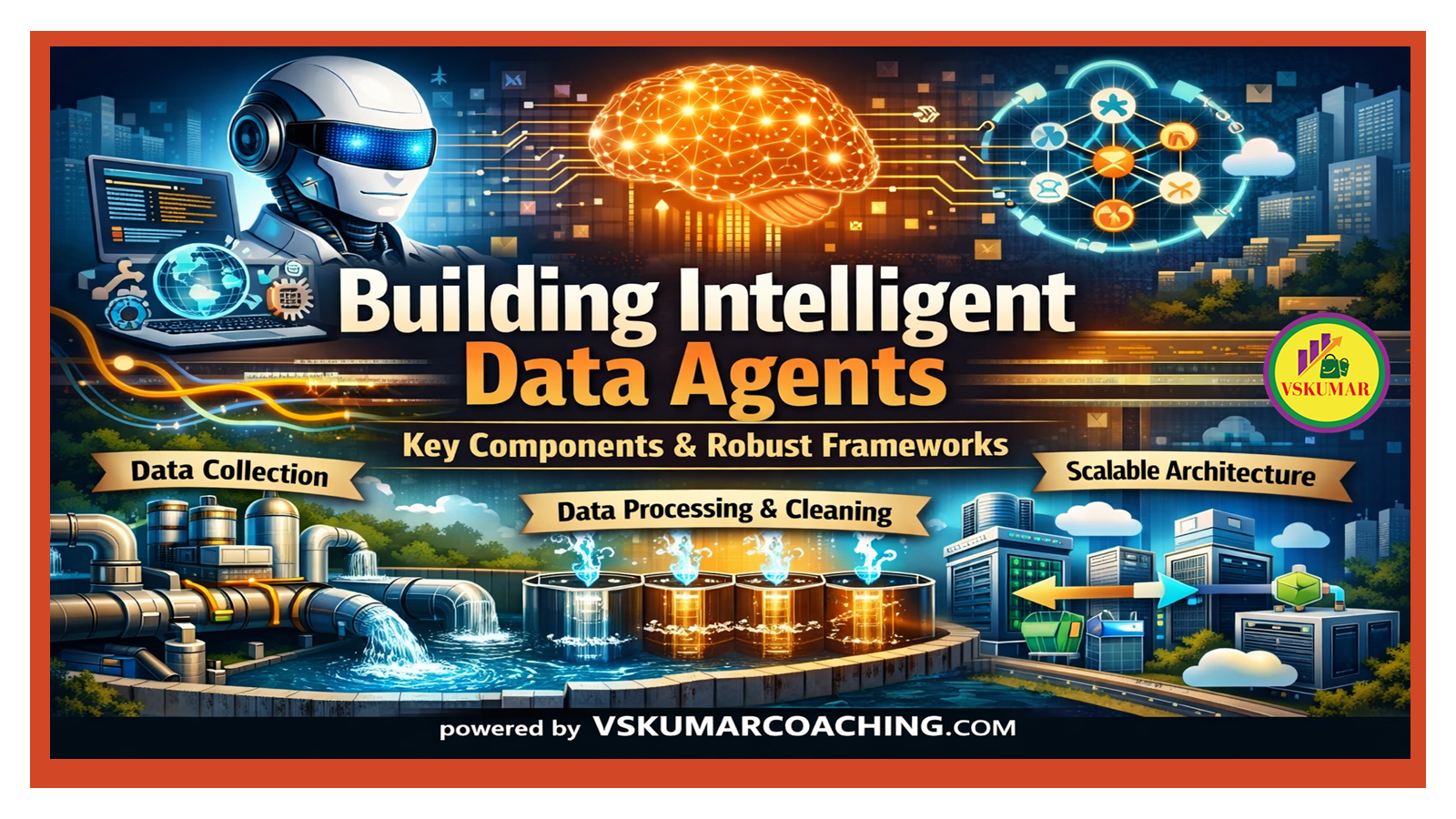
Fundamental Components
The sources identify several key elements that serve as the building blocks for effective AI data analysis agents:
- Effective Data Collection: This is considered the foundation of any AI agent. It involves gathering structured and real-time data through techniques such as web scraping, utilizing APIs, and implementing sensors.
- Machine Learning (ML) Algorithms: Acting as the “heart” of the agent, these algorithms—ranging from regression analysis to neural networks—are essential for making predictions and deriving insights from the collected data.
- Data Processing and Cleaning: Before analysis can occur, data must be cleaned to remove inaccuracies and transformed into a usable format. This step is critical for ensuring that the agent produces reliable results.
- Advanced Tooling: Choosing the correct programming languages and software platforms is vital, as these choices directly impact the productivity and effectiveness of the development process.
Architectural Frameworks
A well-designed architecture provides the structure necessary for the agent to function within a data-driven environment. Essential architectural considerations include:
- Core Workflow Framework: The architecture must establish a clear pipeline for data ingestion, processing, and output. This framework ensures the agent can handle complex tasks systematically.
- Flexibility and Scalability: As data volumes grow, the architecture must be designed to handle increased loads without compromising performance. Scalability is a significant concern for maintaining efficiency in data processing.
- Integration Capabilities: Modern architectures should prioritize seamless integration with existing systems, such as Enterprise Resource Planning (ERP) software and Customer Relationship Management (CRM) tools. This fosters data sharing and enriches the overall analysis.
- Testing and Validation Mechanisms: To ensure accuracy and reliability, the framework must include stages for cross-validation and A/B testing, alongside continuous monitoring to help the agent adapt to new data.
Ethical and Operational Essentials
Beyond technical components, building an intelligent agent requires addressing operational hurdles. Developers must prioritize ethical considerations, such as ensuring data privacy, avoiding bias, and maintaining transparency. Furthermore, identifying common pitfalls early—such as inadequate data preparation or overfitting models—is essential for a successful project outcome.
Analogy: Building an intelligent data agent is much like constructing a high-tech filtration system for a city’s water supply. The data collection is the network of pipes drawing in raw water; the cleaning and processing represent the initial filters that remove debris; the machine learning algorithms are the chemical sensors that identify the water’s quality; and the architectural framework is the plant’s overall design that ensures the system can scale up to meet the needs of a growing population while integrating with the city’s existing infrastructure.
How do AI agents enhance organizational decision-making and efficiency?
AI agents significantly enhance organizational decision-making and efficiency by automating the transformation of raw data into actionable intelligence. According to the sources, these agents are revolutionizing how organizations interpret and utilize information in a data-driven world.
Enhancing Decision-Making
AI agents improve the quality and speed of organizational decisions through several mechanisms:
• Accuracy and Timeliness: By providing timely and accurate insights, these agents reduce human error, ensuring that leadership bases their strategies on reliable data.
• Actionable Recommendations: Beyond mere analysis, agents extract valuable insights to provide actionable recommendations, allowing organizations to make data-driven decisions faster and more accurately.
• Predictive Analytics: Advanced algorithms enable predictive analytics, which helps organizations anticipate customer behavior and optimize operational strategies before market shifts occur.
• Informed Business Intelligence: Integration with existing enterprise systems, such as ERP and CRM software, fosters seamless data sharing,. This integration enriches the analysis, providing a deeper level of business intelligence that empowers organizations to maintain a competitive advantage.
Increasing Operational Efficiency
Efficiency is gained by streamlining complex workflows and maximizing the utility of resources:
• Automated Data Processing: AI agents automate data processing tasks that would otherwise require significant manual labor, freeing up human personnel for more strategic work.
• Scalability: Well-designed agents can handle increased data volumes without a compromise in performance. This scalability is essential for maintaining efficient data processing as an organization grows..
• Optimized Strategies: The versatility of these agents across sectors—such as finance, healthcare, and marketing—allows for the optimization of operational strategies tailored to specific industry needs.
• Continuous Improvement: Through stages like cross-validation, A/B testing, and continuous monitoring, agents adapt to new data, ensuring the organization’s efficiency does not degrade over time as the data landscape changes.
Analogy: Using AI agents in an organization is like upgrading from a manual telescope to an automated satellite system.
While a telescope requires a person to manually search the sky and interpret what they see, a satellite system automatically scans vast areas, filters out atmospheric noise, and sends back high-resolution maps and alerts. This allows the organization to see further, react to changes instantly, and navigate with a level of precision that manual observation could never achieve.


 Building Cloud/DevOps/AI/ML/Gen AI Architects