
The Silent Crisis of 2026: Why Corporate America is Slashing Over 1.1 Million Middle-Class Jobs
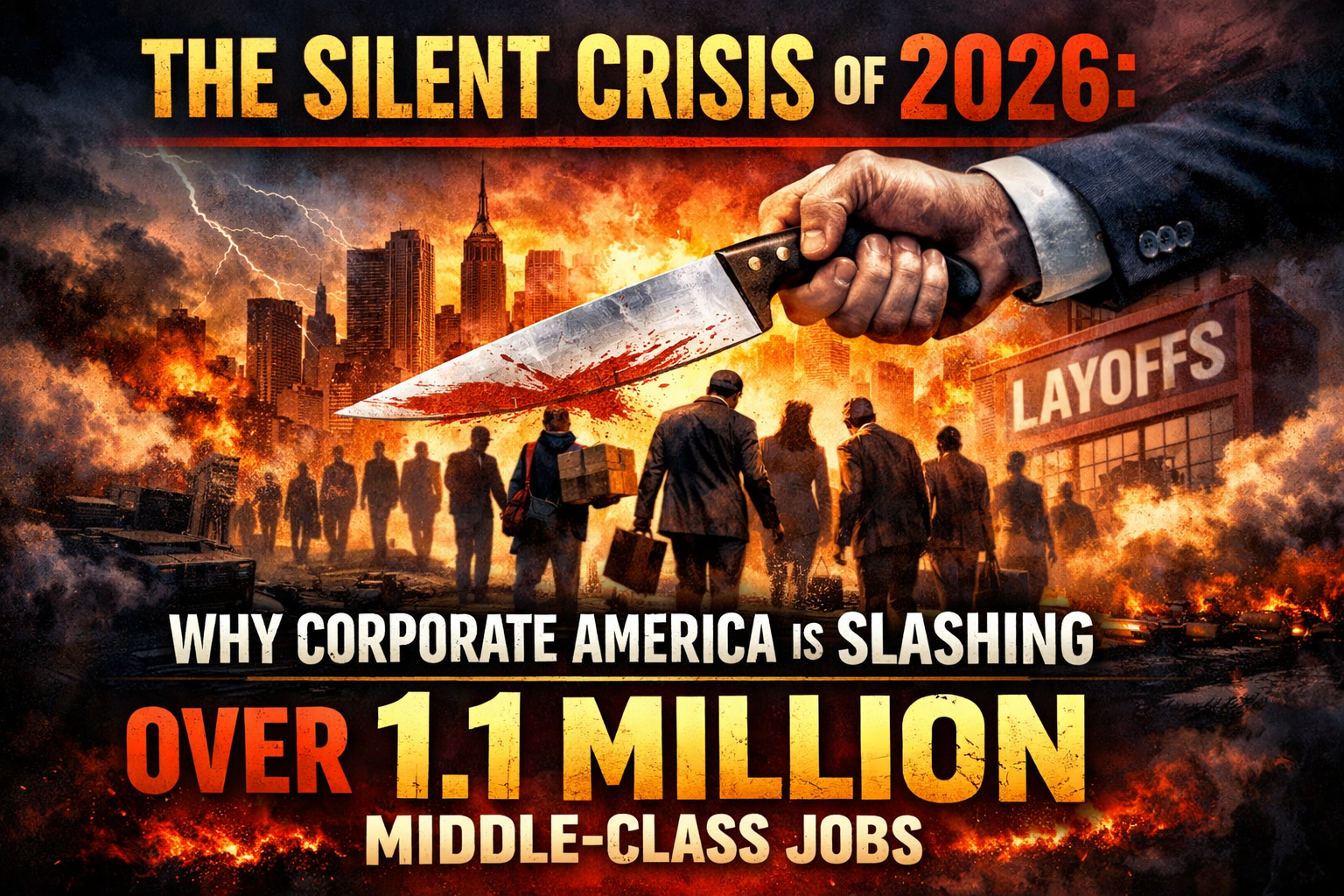
For decades, the “American Promise” was simple: work hard, remain loyal, and your experience will protect you. However, 2026 is emerging as a critical breaking point where this promise is being dismantled, not by a single villain, but by a cold transition toward machine efficiency. Over 1.1 million jobs are projected to disappear, primarily affecting the middle class and high-skilled professionals.
Reference: https://www.perplexity.ai/search/get-the-supporting-Mem2eHl7QIq.IgwOIjmL.g#0
The Retail and Logistics Seismic Shift
The crisis is most visible in the companies that serve as the “thermometer” of the American wallet.
- Walmart: Despite its status as an essential retailer, Walmart is cutting approximately 1,500 positions. These aren’t entry-level roles; they are logistics personnel and supply chain coordinators earning between $70,000 and $100,000 annually. As food prices have surged by 15% to 22%, consumers are buying less, leading to excess warehouse space and the rapid deployment of automated scanners and queuing robots that don’t require sick leave.
- UPS: In a “seismic” move, UPS is cutting 48,000 jobs, including drivers, warehouse staff, and middle management. By investing billions in sorting robots and smart warehouses, the company aims to save $3 billion annually, proving that even union-protected roles are no longer immune to automation.
- Amazon: Leading the rehearsal for a “new economy,” Amazon is cutting between 14,000 and 30,000 jobs across AWS, advertising, and logistics. With over $50 billion invested in AI and automation, Amazon is transitioning to a system where humans are no longer the center of operations.
The Erosion of Industrial Excellence
In sectors where safety and craftsmanship were once paramount, the balance sheet is beginning to take precedence over experience.
- Boeing: Facing over $31 billion in accumulated losses, Boeing is cutting 2,500 jobs. Critically, these cuts target engineers and quality control experts responsible for flight safety, who earn up to $140,000 a year. This raises concerns about whether safety standards are being sacrificed for financial adjustments.
- Intel: As a symbol of American industrial power, Intel’s cut of 20,000 jobs signals a massive shift. Despite national efforts for semiconductor independence, Intel is struggling to pivot from CPUs to the booming AI GPU market, leading to massive layoffs in communities dependent on these six-figure salaries.
- General Motors (GM): Despite a $35 billion investment in electric vehicles (EVs), GM is cutting 3,400 battery and software engineering jobs. The “green future” has collided with the reality that many Americans cannot afford $50,000+ EVs while facing high interest rates and rent.
The Tech Paradox: AI Replacing Its Creators
Perhaps the most unsettling trend is in the technology sector, where intellectual labor was once considered a “safe bastion”.
- Microsoft: Despite earning tens of billions in profit, Microsoft is cutting 6,000 jobs. In a modern paradox, AI is replacing the software engineers and cloud architects who helped create it. Because training AI models can cost up to $100 million, the company is cutting human personnel to compensate for massive infrastructure costs.
- IBM: Seeking to save $250 million annually, IBM is cutting 2,700 jobs in cloud and cybersecurity. The company estimates that internal AI can replace roughly 30% of its workload, making long-term experience a “burden” rather than an asset.
- Salesforce: Known for its “Ohana” (family) culture, Salesforce is cutting 4,000 positions. The company is pivoting to AI-driven CRM systems that can write emails and forecast revenue, saving $300 million in labor costs while signaling that “corporate culture” is often secondary to profit margins.
The Infrastructure Strain
Even the “blood vessels” of the economy are tightening. Verizon is cutting 15,000 jobs, including technicians and maintenance teams. While the company pours billions into 5G, consumers are downgrading to cheaper plans to manage mounting bills, forcing the company to view essential service personnel as a cost to be cut.
Conclusion: A New Reality
The year 2026 represents more than just a series of corporate restructurings; it is the end of an era where loyalty and degrees provided a shield against economic volatility. As companies prioritize machine efficiency to protect profit margins, the middle class finds itself increasingly positioned on the “assembly line” of automation.
The transition can be understood through the lens of a lighthouse: For a century, the middle class was the lighthouse keeper, essential for guiding the economy safely. Now, corporations are installing automated LED beacons. The light still shines, and the ships still move, but the keeper is being told their presence is no longer required for the system to function.
Based on the sources provided, the mass layoffs projected for 2026 are primarily targeting roles that have been transformed into “operating costs per machine hour”. To sustain a profession alongside AI, you must transition from performing replaceable tasks to overseeing the systems and strategies that machines cannot yet fully replicate.
The following are skill upgrades and the types of portfolio-proven experiences you can develop to remain essential:
1. AI-Assisted Development and Oversight
The sources indicate that AI can now write documents, test software, debug, and support operations. Instead of simply performing these tasks, you should upgrade to AI Systems Oversight.
- Skill Upgrade: Mastering the ability to direct AI tools for high-level software architecture and quality assurance.
- Portfolio Evidence: A collection of case studies or GitHub repositories demonstrating how you used AI to debug complex systems or optimize code. Your portfolio should highlight the human “judgment” aspect—showing where you caught errors or “bugs” that automated systems might have missed.
2. GPU and Next-Generation Hardware Architecture
A significant insight from the sources is the shift from traditional CPUs to GPUs for AI infrastructure. Professionals who understand this hardware transition are better positioned than those clinging to legacy systems.
- Skill Upgrade: Shifting from general IT or traditional semiconductor knowledge to specialized AI infrastructure management and GPU-based computing.
- Portfolio Evidence: Documentation of projects involving AI model training, GPU resource allocation, or high-performance computing infrastructure. This proves you are aligned with where companies like Intel and Microsoft are pouring billions of dollars in investment.
3. Strategic Business Consulting and AI Implementation
While IBM is cutting business consulting roles due to automation, the remaining value lies in implementing these efficiencies.
- Skill Upgrade: Learning to integrate AI-driven CRM systems (like those used by Salesforce) to forecast revenue and analyze customer behavior.
- Portfolio Evidence: Data-backed reports showing how you implemented automation to save a specific amount of labor costs (e.g., a “300 million dollar saving” equivalent for your scale) or how you used AI to forecast revenue trends that informed a successful business pivot.
4. Complex Problem Solving in Safety and Quality Control
The sources highlight that Boeing is cutting engineers and quality control experts to save money, even as “new bugs” appear. This suggests a vacuum for professionals who can handle high-stakes troubleshooting.
- Skill Upgrade: Deep specialization in safety standards, quality assurance, and ethical AI oversight—areas where “mistakes don’t get a second chance”.
- Portfolio Evidence: A “Safety Log” or “Crisis Management” section in your portfolio that details how you identified and resolved critical system vulnerabilities that could not be solved by a standard algorithm or automated scanner.
5. Moving into “Core” Technical and Strategic Teams
Salesforce specifically targeted “non-core” technical teams for layoffs. Staying relevant requires proving your work is essential to the company’s “center of the operating system”.
- Skill Upgrade: Moving from “replaceable services” (like basic customer service or sales ops) into Core Product Development or Direct Revenue Generation.
- Portfolio Evidence: Testimonials or project summaries that tie your work directly to the company’s primary revenue stream or its most critical technological infrastructure, such as Cloud Data or Cybersecurity.
Information Outside the Sources: To build a truly effective portfolio in these areas, you may want to use platforms like GitHub for technical code, Tableau for data visualization of your AI-driven savings, or LinkedIn Articles to demonstrate your thought leadership in “human-centered” AI strategy. These specific platform recommendations are not found in the sources and should be verified independently.
Analogy for Understanding: Think of the job market as a rising flood. If your skill set is like a ground-floor apartment (repetitive, predictable tasks), you are at risk. Upgrading your skills is like building additional stories on your house. Your portfolio is the blueprint and inspection report that proves to an employer that your “house” is now high enough to remain dry and functional while the “water” of automation rises around it.
U.S. employers announced over 1.1 million job cuts in the first 11 months of 2025, marking a 54% increase from 2024 and the highest since 2020. This “silent crisis” or “forever layoffs” trend involves rolling, smaller-scale reductions rather than massive one-time events, primarily affecting middle-class white-collar roles.youtubefortune+2
Key Statistics
Layoff announcements totaled 1,170,821 through November 2025, with November alone seeing 71,321 cuts—the highest for that month since 2022. Hiring plans lagged far behind at 497,151 announced positions, down 35% year-over-year. Tech led with over 150,000 cuts, followed by telecom, retail, and services.fortune+3
Primary Causes
Corporate restructuring, AI adoption (linked to 54,694-70,000+ cuts since 2023), economic conditions, tariffs, and business closures drove most reductions. Tariffs raised costs, especially for small businesses, while AI automated routine tasks. Surveys indicate 58% of companies plan further 2026 layoffs due to economic uncertainty (55%), tariffs/trade (39%), and AI (35%).cnbc+4
2026 Outlook
The trend signals a “jobless boom” or “K-shaped” recovery, with productivity gains from AI offsetting fewer workers amid ongoing insecurity. Small businesses bore heavy losses (e.g., 120,000 in November), while larger firms added roles selectively. Experts warn of chronic morale erosion and reduced bargaining power for workers into 2026.finance.yahoo+2
U.S. employers announced over 1.1 million job cuts in the first 11 months of 2025, marking a 54% increase from 2024 and the highest since 2020. This “silent crisis” or “forever layoffs” trend involves rolling, smaller-scale reductions rather than massive one-time events, primarily affecting middle-class white-collar roles.youtubefortune+2
Key Statistics
Layoff announcements totaled 1,170,821 through November 2025, with November alone seeing 71,321 cuts—the highest for that month since 2022. Hiring plans lagged far behind at 497,151 announced positions, down 35% year-over-year. Tech led with over 150,000 cuts, followed by telecom, retail, and services.fortune+3
Primary Causes
Corporate restructuring, AI adoption (linked to 54,694-70,000+ cuts since 2023), economic conditions, tariffs, and business closures drove most reductions. Tariffs raised costs, especially for small businesses, while AI automated routine tasks. Surveys indicate 58% of companies plan further 2026 layoffs due to economic uncertainty (55%), tariffs/trade (39%), and AI (35%).cnbc+4
2026 Outlook
The trend signals a “jobless boom” or “K-shaped” recovery, with productivity gains from AI offsetting fewer workers amid ongoing insecurity. Small businesses bore heavy losses (e.g., 120,000 in November), while larger firms added roles selectively. Experts warn of chronic morale erosion and reduced bargaining power for workers into 2026.finance.yahoo+2
- https://www.youtube.com/watch?v=TcJ_iRX45-Q
- https://fortune.com/2025/12/09/forever-layoffs-job-security-k-shaped-economy-white-collar-recession-challenger-glassdoor/
- https://www.emarketer.com/content/us-employers-shed-over-1-million-jobs-this-year-so-far
- https://www.cnbc.com/2025/12/04/layoff-announcements-this-year-top-1point1-million-the-most-since-2020-when-pandemic-hit-challenger-says.html
- https://finance.yahoo.com/news/forever-layoffs-era-hits-recession-150000108.html
- https://www.cbsnews.com/news/employers-cut-1-1-million-jobs-2025-why-layoffs-rising/
- https://www.aol.com/articles/jobless-boom-shaping-story-2026-014531927.html
- https://www.cpapracticeadvisor.com/2025/09/18/6-in-10-companies-are-planning-layoffs-in-2026-due-to-economic-uncertainty-survey-finds/169258/
 Building Cloud/DevOps/AI/ML/Gen AI Architects