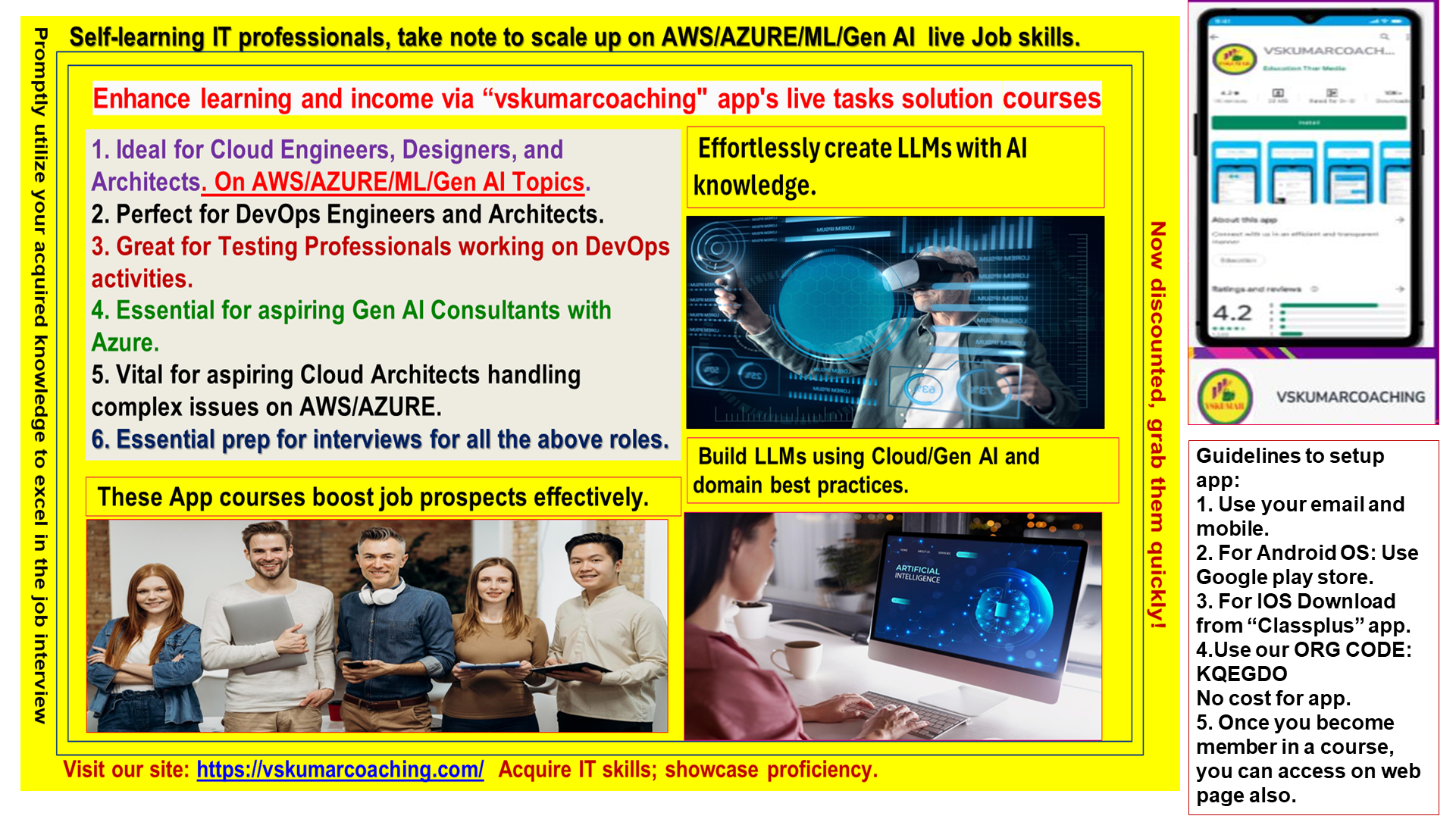
Do you want to Self-learn Azure Gen Ai [ AZ-102 Job live tasks? You might have the below questions also: 1. How does the Gen AI course integrate Azure Cognitive Services and Knowledge Mining for live task experience? 2. Can you elaborate on the types of scenarios typically covered under the Azure Cognitive Services discussed in this course? 3. What are some practical examples of how Conversational AI solutions are taught and applied within this course? 4. In what ways does the program focus on developing domain-specific knowledge for leveraging Natural Language Processing in real-world AI applications? 5. How does the course address practical applications of Computer Vision within the context of the AI-102 exam and live project experience? 6. What scenario-based questions related to Azure Cognitive Services can students expect to encounter in this comprehensive training? 7. How does this course prepare students to understand and create practical applications using Azure Cognitive Search in an AI-based environment? 8. Can you explain the approach to presenting and learning from the 50 scenario-based questions integrated into the AI-102 exam curriculum? 9. In what specific ways does the program work towards providing practical, domain-specific knowledge and real-world solutions for Azure Cognitive Services applied in a professional setting? 10. How does the integrated job coaching discussion videos add supplementary value to this comprehensive Gen AI course?
This course addresses all these aspects comprehensively to facilitate faster upskilling. See the content from this link: https://lnkd.in/gTAn_ZGF Avail the hectic discount for these live experiences gaining.
Exploring the Roles of GEN AI+ML Consultant/Lead and Solution Architect – GenAI & Cloud
In the rapidly evolving world of artificial intelligence (AI) and machine learning (ML), the demand for skilled professionals is greater than ever. Two key roles that stand out in this landscape are the GEN AI+ML Consultant/Lead and the Solution Architect – GenAI & Cloud. Let’s dive into what these roles entail, the responsibilities they carry, and the skills required to excel in them.
GEN AI+ML Consultant/Lead
Key Responsibilities:
Leadership and Management: Lead and manage AI teams, fostering a collaborative and innovative work environment.
Model Development and Deployment: Develop and deploy AI models, particularly those based on Generative AI frameworks.
Architectural Design: Define and oversee the implementation of AI architecture that aligns with business goals.
Innovation: Drive innovation in AI capabilities, generating new ideas and strategies to enhance performance.
Troubleshooting: Identify issues and improve current AI systems through effective troubleshooting.
Business to Technical Translation: Convert business use-cases into technical requirements and implement suitable algorithms.
Collaboration: Work alongside cross-functional teams to design and integrate AI systems.
Staying Updated: Keep abreast of the latest technology trends to ensure strategies remain relevant and effective.
Required Skills:
Leadership: Strong leadership abilities to guide and mentor your team.
Technical Proficiency: Expertise in programming languages such as Python, Node.Js, C#, HTML, and JavaScript.
AI Libraries and Frameworks: Familiarity with tools like TensorFlow, Pytorch, and NLTK.
Cloud Platforms: Understanding deployment frameworks and cloud services (AWS, Azure, Google Cloud).
AI Concepts: Knowledge in supervised and unsupervised learning, neural networks, and time-series forecasting.
Solution Architect – GenAI & Cloud
Key Responsibilities:
Project Leadership: Lead the development and implementation of Generative AI and Large Language Model (LLM) projects, ensuring they align with business objectives.
Proof of Concepts (POCs): Design and deploy POCs and Points of View (POVs) across various industry verticals to demonstrate the potential of Generative AI applications.
Customer Engagement: Engage effectively with customer CXOs and Business Unit heads to showcase and demonstrate the relevance of Generative AI applications.
Cross-Functional Collaboration: Collaborate with different teams to integrate AI/ML solutions into cloud environments effectively.
Required Skills:
Experience: At least 12 years of experience in AI/ML with a focus on Generative AI and LLMs.
Cloud Expertise: Proven track record working with major cloud platforms (Azure, GCP, AWS).
Model Deployment: Understanding of how to deploy models on cloud and on-premise environments.
API Utilization: Ability to leverage APIs to build industry solutions.
Common Tasks and Skills
Both roles share several common tasks and skills, including:
Leading and managing AI teams.
Developing and deploying AI models.
Designing AI architectures.
Collaborating with cross-functional teams.
Driving innovation and engaging with customers.
Troubleshooting and improving AI systems.
Converting business use-cases into technical requirements.
Integrating AI solutions into cloud environments.
Keeping up to date with technology trends.
Additional Skills:
Research Interpretation: Ability to interpret research literature and implement algorithms based on business needs.
Communication: Excellent verbal and written communication skills.
Mentorship: Proven ability to mentor and develop team members.
In summary, the roles of GEN AI+ML Consultant/Lead and Solution Architect – GenAI & Cloud are critical in advancing AI initiatives within organizations. These positions require a blend of technical expertise, leadership, and innovative thinking to drive successful AI projects. If you’re passionate about AI and ready to take on these challenges, these roles offer exciting opportunities to shape the future of technology.
Unlocking the Power of Retrieval-Augmented Generation (RAG): A Cost-Effective Approach to Enhance LLMs
Table of Contents:
Introduction
What is Retrieval-Augmented Generation (RAG)?
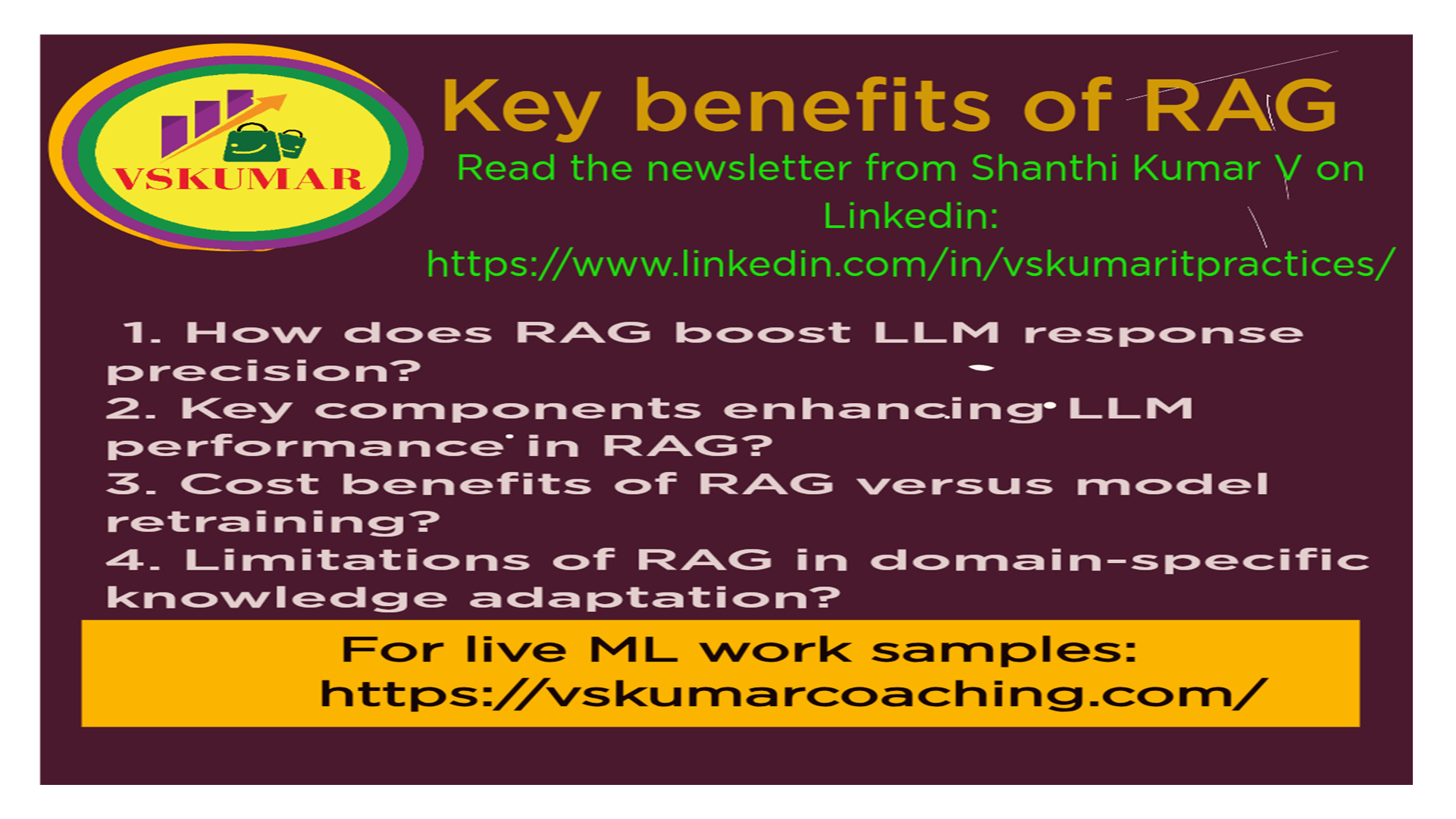
Key Benefits of RAG
Cost Benefits of Using RAG over Retraining Models
Limitations of RAG in Adapting to Domain-Specific Knowledge
Conclusion
About This Blog Post:
In today’s digital landscape, language models have become increasingly popular for their ability to generate human-like text. However, these models are not perfect and often struggle with accuracy and relevance. One approach to improve their performance is Retrieval-Augmented Generation (RAG), a cost-effective framework that enhances the quality and accuracy of large language model (LLM) responses by retrieving relevant information from an external knowledge base.
What is Retrieval-Augmented Generation (RAG)?
RAG is an AI framework that improves the quality and accuracy of LLM responses by retrieving relevant information from an external knowledge base to supplement the LLM’s internal knowledge. It has two main components: Retrieval and Generation. The Retrieval component searches for and retrieves snippets of information relevant to the user’s prompt or question from an external knowledge base. The Generation component appends the retrieved information to the user’s original prompt and passes it to the LLM, which then draws from this augmented prompt and its own training data to generate a tailored, engaging answer for the user.
Key Benefits of RAG
RAG offers several key benefits, including:
Providing LLMs access to the most current, reliable facts beyond their static training data
Allowing users to verify the accuracy of the LLM’s responses by checking the cited sources
Reducing the risk of LLMs hallucinating incorrect information or leaking sensitive data
Lowering the computational and financial costs of continuously retraining LLMs on new data
Cost Benefits of Using RAG over Retraining Models
Using RAG offers several cost benefits compared to traditional model retraining or fine-tuning. These benefits include:
Reduced Training Costs: RAG does not require the extensive computational resources and time associated with retraining models from scratch.
Dynamic Updates: RAG allows for real-time access to up-to-date information without needing to retrain the model every time new data becomes available.
Flexibility and Adaptability: RAG systems can easily adapt to new information and contexts by simply updating the external knowledge sources.
Minimized Hallucinations: RAG reduces the risk of hallucinations by grounding responses in retrieved evidence.
Lower Resource Requirements: RAG can work effectively with smaller models by augmenting their capabilities through retrieval, leading to savings in cloud computing expenses and hardware procurement.
Limitations of RAG in Adapting to Domain-Specific Knowledge
While RAG provides a flexible approach to integrating external knowledge, it has several limitations when it comes to adapting to domain-specific knowledge. These limitations include:
Fixed Passage Encoding: RAG does not fine-tune the encoding of passages or the external knowledge base during training, which can lead to less relevant or accurate responses in specialized contexts.
Computational Costs: Adapting RAG to domain-specific knowledge bases can be computationally expensive.
Limited Understanding of Domain-Specific Contexts: RAG’s performance in specialized domains is not well understood, and the model may struggle to accurately interpret or generate responses based on domain-specific nuances.
Hallucination Risks: RAG can still generate plausible-sounding but incorrect information if the retrieved context is not sufficiently relevant or accurate.
Context Window Limitations: RAG must operate within the constraints of the context window of the language model, which limits the amount of retrieved information that can be effectively utilized.
Conclusion
In conclusion, RAG is a cost-effective framework that can enhance the quality and accuracy of LLM responses by retrieving relevant information from an external knowledge base. While it has several limitations, RAG offers several key benefits, including reduced training costs, dynamic updates, flexibility, and minimized hallucinations. By understanding the limitations of RAG, developers and organizations can better implement and adapt this framework to meet their specific needs and improve the overall performance of their language models.
Title: “Revolutionizing IT Interviews with AI Chatbots: A Comprehensive Guide”
In today’s competitive IT landscape, AI chatbots offer a transformative approach to streamlining interview processes, utilizing Azure Cognitive Services to create intuitive and insightful interactions. Here’s how these chatbots can be leveraged for IT interviews:
Initial Screening: AI chatbots conduct preliminary interviews to filter out unqualified candidates and determine their background, skills, and interest in the role. Employing Azure QnA Maker, a knowledge base is established to address common interview questions and responses.
Interview Scheduling Automation: Chatbots seamlessly handle interview scheduling by engaging with candidates to find suitable times, integrating Azure Bot Service with calendar APIs for efficient meeting arrangements.
Technical Assessments: Chatbots facilitate technical evaluations by administering coding challenges and analyzing candidates’ technical knowledge. Leveraging Azure Cognitive Search, these chatbots compare responses against a model answer database.
Interview Feedback: Following interviews, chatbots provide candidates with personalized feedback, highlighting their strengths and areas for improvement. Utilizing Azure Text Analytics, these chatbots assess candidates’ responses for insightful feedback generation.
While AI chatbots offer significant benefits, it’s important to acknowledge limitations, such as the potential challenge in evaluating soft skills and the need for careful integration with HR systems. By optimizing the design using Azure Cognitive Services, AI chatbots can effectively enhance the interview process.
For further insights, explore the following resources:
This holistic guide emphasizes the potential of AI chatbots in revolutionizing IT interviews and provides valuable insights to maximize their efficacy.
Learning Guidelines for Generative AI Security Consultants
Understanding of Generative AI Technologies
Familiarize with Generative AI Frameworks: Gain proficiency in popular generative AI frameworks such as GPT-3, DALL-E, and Stable Diffusion. Understand their underlying architectures, capabilities, and limitations.
Master Natural Language Processing (NLP): Develop a strong understanding of NLP techniques, including text generation, language modeling, and sentiment analysis. Learn how these techniques are applied in generative AI systems.
Explore Deep Learning Fundamentals: Study the core concepts of deep learning, including neural networks, convolutional neural networks (CNNs), and recurrent neural networks (RNNs). Understand how these techniques power generative AI models.
Gain Hands-on Experience: Practice implementing and fine-tuning generative AI models using programming languages like Python and relevant libraries (e.g., TensorFlow, PyTorch).
Cybersecurity Fundamentals
Understand Cybersecurity Principles: Establish a solid foundation in cybersecurity concepts, including risk management, threat modeling, and incident response.
Tailor Cybersecurity to AI Applications: Learn how to apply traditional cybersecurity practices to the unique challenges and vulnerabilities of AI systems, such as model poisoning and adversarial attacks.
Study Secure Software Development Lifecycle: Familiarize yourself with secure software development practices, including secure coding, testing, and deployment, specifically for AI-powered applications.
Explore Incident Response for AI Systems: Develop skills in detecting, investigating, and responding to security incidents involving generative AI models and their associated data.
Data Privacy and Compliance
Understand Data Protection Regulations: Gain in-depth knowledge of data privacy regulations, such as GDPR and CCPA, and their implications for the use of generative AI technologies.
Learn Best Practices for Securing Sensitive Data: Study techniques for protecting sensitive data used in the training and deployment of generative AI models, including data anonymization, encryption, and access controls.
Develop Compliance Frameworks: Create and implement compliance frameworks to ensure that generative AI applications adhere to relevant data protection standards and industry-specific regulations.
Stay Updated on Regulatory Changes: Continuously monitor updates and changes in data privacy laws and regulations to maintain compliance for your organization’s generative AI initiatives.
Vulnerability Assessment
Identify AI-specific Vulnerabilities: Develop the skills to identify and assess vulnerabilities unique to generative AI systems, such as model biases, data poisoning, and adversarial attacks.
Conduct Penetration Testing: Learn how to perform comprehensive penetration testing on generative AI applications, simulating real-world attacks to uncover security weaknesses.
Implement Mitigation Strategies: Devise and implement effective mitigation strategies to address the identified vulnerabilities, ensuring the overall security and resilience of generative AI systems.
Stay Informed on Emerging Threats: Continuously research and stay updated on the latest security threats and attack vectors targeting generative AI technologies to proactively address them.
By mastering these technical skills, Generative AI Security Consultants can effectively secure AI applications, protect sensitive data, and ensure compliance with relevant regulations, while leveraging the capabilities of generative AI technologies to enhance their organization’s security posture.
Azure Security Consultant: Roles and Responsibilities
As an Azure Security Consultant, your primary responsibilities are to protect networks and systems from external or internal attacks, identify and prevent cyber threats, and ensure the security of clients’ Azure environments[1].
Role
Understand how attackers think, work, and act in order to effectively defend against threats[1]
Identify vulnerabilities in Azure systems and networks that attackers can exploit[1]
Use this vulnerability information to build robust security solutions to strengthen Azure environments[1]
Verify that clients’ Azure resources are secure and compliant with security best practices[1]
Responsibilities
Security Assessment and Recommendations
Conduct thorough security assessments of clients’ Azure deployments to identify risks and vulnerabilities[1]
Analyze security logs and monitoring data to detect potential threats and anomalies[3]
Provide actionable recommendations to improve the security posture of Azure resources[1]
Help clients prioritize and remediate security issues in a timely manner[1]
Security Implementation and Management
Design and implement security controls and solutions in Azure to protect against cyber threats[1]
Configure Azure security services like Azure Security Center, Azure Sentinel, and Azure Firewall[3]
Manage and maintain Azure security solutions to ensure continuous protection[1]
Automate security tasks and integrate Azure security with DevOps pipelines[3]
Compliance and Governance
Ensure clients’ Azure environments adhere to industry standards, regulations, and best practices[1]
Help clients define and implement Azure security policies and baselines[1]
Conduct regular security audits and generate compliance reports[1]
Assist with Azure resource management using Azure Resource Manager templates[2]
Incident Response and Disaster Recovery
Develop and test incident response and disaster recovery plans for Azure environments[1]
Provide guidance and support during security incidents and data breaches[1]
Coordinate with incident response teams to contain, eradicate, and recover from attacks[1]
Conduct post-incident reviews and implement lessons learned to improve security[1]
Client Engagement and Knowledge Sharing
Collaborate with clients to understand their security requirements and objectives[4]
Communicate security risks, recommendations, and solutions effectively to stakeholders[4]
Share Azure security best practices and knowledge with clients and team members[4]
Stay updated with the latest Azure security features, services, and industry trends[4]
As an Azure Security Consultant, you play a crucial role in protecting clients’ Azure environments and helping them achieve their security goals. By leveraging your expertise in Azure security, you can help organizations mitigate risks, ensure compliance, and build resilient cloud infrastructures.
### Transformation of Data Analyst Activities to Azure Machine Learning (Azure ML)
To adapt and enhance traditional data analyst activities using cutting-edge technologies like Azure Machine Learning (Azure ML), the following transformations and integrations can be implemented:
Data Collection and Preparation with Azure ML:
Utilize Azure ML capabilities for streamlined data collection from diverse sources with enhanced data quality checks and preprocessing steps, ensuring data integrity for reliable analyses[2][5].
Data Exploration and Analysis Using Azure ML:
Employ Azure ML tools for advanced exploratory data analysis, including machine learning algorithms for pattern recognition, clustering, and predictive modeling to derive deeper insights[2][5].
Data Visualization Enhancements with Azure ML:
Leverage Azure ML’s integrated visualization features to create interactive dashboards and reports that dynamically represent complex data findings and facilitate stakeholder understanding[2][5].
Reporting and Communication Efficiency via Azure ML:
Utilize Azure ML for automated report generation, real-time data updates, and seamless communication channels to share insights with non-technical audiences, enhancing decision-making processes[2][4].
Enhanced Collaborative Data Analysis in Azure ML Environment:
Collaborate seamlessly within Azure ML’s workspace, facilitating cross-functional team engagements, sharing data insights, and aligning analyses with organizational objectives for data-driven strategies[2][3].
Azure ML Data Collection and Preparation: Simplified data gathering with enhanced accuracy and relevance checks.
Azure ML Data Exploration and Analysis: Advanced analytics tools for pattern identification and predictive modeling.
Azure ML Data Visualization Enhancement: Dynamic visual representations for simplified data communication.
Azure ML Reporting and Communication: Automated reporting and efficient insights sharing for non-technical audiences.
Azure ML Collaborative Analysis: Seamless teamwork within Azure ML workspace for aligned data analysis.
Transformation of Data Analyst Activities to Azure Gen AI
Adapting traditional data analyst tasks into Azure Gen AI involves leveraging artificial intelligence capabilities offered by Azure to elevate data analysis practices. Here’s how the key activities can be transformed:
Data Analyst Statistical Analysis with Azure Gen AI:
Incorporate Azure Gen AI’s advanced statistical models for data examination, generating deeper insights through AI-driven analytics techniques.
Azure Gen AI Data Visualization Enhancements:
Utilize Azure Gen AI’s AI-powered visualization tools to create interactive dashboards and intuitive data representations, enhancing stakeholder understanding.
Data Cleaning and Preparation with Azure Gen AI:
Employ Azure Gen AI for automated data cleaning processes, anomaly detection, and data augmentation, ensuring data quality and usability.
Predictive Modeling and Forecasting Using Azure Gen AI:
Integrate Azure Gen AI’s predictive analytics capabilities to develop robust forecasting models, leveraging AI algorithms for accurate predictions and trend analysis.
Natural Language Processing (NLP) for Reporting with Azure Gen AI:
Harness Azure Gen AI’s NLP functionalities for automated report generation, storytelling, and natural language communication of data insights to diverse audiences.
Transformation towards Azure Gen AI – Key Activities Recap:
Azure Gen AI Statistical Analysis: Advanced AI-driven statistical modeling for comprehensive data examination.
Azure Gen AI Data Visualization: Interactive visualizations using AI-powered tools for enhanced data representation.
Azure Gen AI Data Cleaning and Preparation: Automated data cleaning and augmentation processes for improved data quality.
Azure Gen AI Predictive Modeling: AI-driven forecasting capabilities for accurate predictions and trend analysis.
Azure Gen AI NLP Reporting: Natural Language Processing for automated report generation and effective data storytelling.
By integrating Azure Machine Learning (Azure ML) and Azure Gen AI into traditional data analyst activities, organizations can unlock new possibilities for advanced data analysis, predictive modeling, and improved decision-making processes.
## Unveiling the Diverse Applications of Clustering Algorithms in Data Analysis
Clustering algorithms are indispensable tools in data analysis across numerous industries, showcasing their versatility and significance in generating insights. Here are key utilization scenarios where clustering algorithms excel:
Customer Segmentation
Marketing strategies leverage clustering to categorize customers based on their purchasing habits, demographics, or preferences. This segmentation enables businesses to craft targeted campaigns and personalized recommendations for each customer segment[1][4].
Market Basket Analysis
Retail establishments employ clustering to scrutinize sales data and identify correlated product purchases. This information informs product placement strategies, promotional activities, and cross-selling initiatives[5].
Social Network Analysis
Clustering techniques empower social media platforms to comprehend user behavior, facilitate content recommendations, and pinpoint influential users within the network[5].
Anomaly Detection
Clustering algorithms like DBSCAN play a pivotal role in identifying anomalies or outliers in real-time data streams. This capability is integral for fraud detection, network security, and fault diagnosis in manufacturing scenarios[2][5].
Image Segmentation
Medical imaging utilizes clustering for the identification of diseased regions or areas of interest in diagnostic images such as X-rays and MRIs. This aids in the early detection and monitoring of diseases[5].
Simplification of Complex Datasets
Clustering aids in representing intricate datasets through cluster IDs, simplifying data management, particularly when dealing with voluminous datasets. These cluster IDs serve as a condensed representation of the original feature set, enhancing data accessibility[5].
Exploratory Data Analysis
Data analysts rely on clustering during the preliminary phases of data exploration to unearth patterns, trends, and relationships within the dataset. This process facilitates hypothesis generation and identifies areas warranting further investigation[4].
These diverse applications underscore the pivotal role of clustering algorithms in extracting valuable insights from data, thereby bolstering decision-making processes across a spectrum of industries encompassing marketing, retail, healthcare, and social media.
Title: Exploring the World of Data Science and Machine Learning: An Insightful Journey
Data science and machine learning have become pivotal realms in today’s technological landscape, offering powerful tools and insights that drive informed decision-making and strategic planning. Whether you’re a curious beginner or a seasoned professional, embarking on a journey to explore these dynamic fields can open up a world of opportunities. In this article, we’ll dive into the offerings of free sessions on data science and machine learning while exploring compelling use cases that exemplify the practical applications of data science across diverse domains. Join us as we unravel the transformative potential of data-driven insights.
Unveiling the Essence of Data Science and Machine Learning
To embark on this journey, it’s essential to understand the core principles of data science and machine learning. Data science, as a multidisciplinary domain, leverages scientific techniques, algorithms, and systems to extract valuable insights from both structured and unstructured data. By combining expertise from statistics, computer science, and domain knowledge, data science enables organizations to analyze complex data and derive actionable insights that drive impactful decision-making.
Machine learning, a branch of artificial intelligence, empowers computers to learn from data autonomously, uncover patterns, and make informed predictions without explicit programming. This capability revolutionizes industries by enabling intelligent decision-making and predictive modeling, thus unlocking a wealth of opportunities for innovation and growth.
Exploring Real-World Use Cases
Detecting Financial Fraud: Data science techniques can be employed to analyze financial data, identifying irregular patterns and anomalies that signal potential fraudulent activities. This approach serves as a proactive measure to safeguard against financial losses and ensure the integrity of financial transactions, thereby bolstering trust and transparency in the financial realm.
Enhancing Healthcare through Predictive Analytics: By leveraging data science techniques, healthcare professionals can analyze patient data to predict disease outbreaks, enhance diagnosis accuracy, and optimize treatment outcomes. This proactive approach empowers healthcare management to make informed decisions, improve patient care, and foster a healthier society.
Anticipating Customer Churn in Telecom: Through the analysis of customer behavior and usage data, data science enables telecom companies to predict the likelihood of customer churn. Armed with these insights, proactive measures can be implemented to retain customers, fostering long-term relationships and enhancing customer satisfaction.
Optimizing Retail Operations through Demand Forecasting: Retail businesses harness data science to analyze sales data, customer demographics, and external factors to forecast product demand accurately. This not only improves inventory management and operational efficiency but also enables businesses to craft effective pricing strategies to meet consumer demands.
Personalizing Marketing and Recommendations: Data science facilitates the analysis of customer preferences and behaviors, enabling businesses to personalize marketing campaigns and develop sophisticated recommendation systems. By tailoring offerings to individual preferences, businesses can enhance customer engagement and drive brand loyalty.
Discovering the Free Sessions: A Glimpse into Practical Insights and Applications
The free sessions on data science and machine learning provide a comprehensive introduction to these domains, offering participants a deep dive into diverse use cases across different industries. Throughout these sessions, attendees can expect to gain insights into business and technical solution designs, understand the practical implementation of these solutions, and explore coding guidelines for executing these use cases effectively.
In essence, these sessions bridge the gap between theoretical knowledge and practical application, empowering participants to envision how data-driven insights can be transformed into real-world solutions. Whether you’re an aspiring data scientist or a business professional seeking to harness the potential of data-driven strategies, these sessions serve as a valuable gateway to embark on a transformative journey.
In conclusion, the world of data science and machine learning presents a tapestry of opportunities for innovation, growth, and informed decision-making. By immersing yourself in these dynamic disciplines, you can uncover the transformative potential of data-driven insights and pave the way for impactful solutions in your professional endeavors. Join us on this enlightening journey, and unlock the power of data science and machine learning to drive success and innovation in your ventures.



 Building Cloud/DevOps/AI/ML/Gen AI Architects