Daily Archives: August 9, 2024

The Roles of GEN AI+ML Consultant/Lead and Solution Architect – GenAI & Cloud

Exploring the Roles of GEN AI+ML Consultant/Lead and Solution Architect – GenAI & Cloud

In the rapidly evolving world of artificial intelligence (AI) and machine learning (ML), the demand for skilled professionals is greater than ever. Two key roles that stand out in this landscape are the GEN AI+ML Consultant/Lead and the Solution Architect – GenAI & Cloud. Let’s dive into what these roles entail, the responsibilities they carry, and the skills required to excel in them.

GEN AI+ML Consultant/Lead

Key Responsibilities:

  1. Leadership and Management: Lead and manage AI teams, fostering a collaborative and innovative work environment.
  2. Model Development and Deployment: Develop and deploy AI models, particularly those based on Generative AI frameworks.
  3. Architectural Design: Define and oversee the implementation of AI architecture that aligns with business goals.
  4. Innovation: Drive innovation in AI capabilities, generating new ideas and strategies to enhance performance.
  5. Troubleshooting: Identify issues and improve current AI systems through effective troubleshooting.
  6. Business to Technical Translation: Convert business use-cases into technical requirements and implement suitable algorithms.
  7. Collaboration: Work alongside cross-functional teams to design and integrate AI systems.
  8. Staying Updated: Keep abreast of the latest technology trends to ensure strategies remain relevant and effective.

Required Skills:

  • Leadership: Strong leadership abilities to guide and mentor your team.
  • Technical Proficiency: Expertise in programming languages such as Python, Node.Js, C#, HTML, and JavaScript.
  • AI Libraries and Frameworks: Familiarity with tools like TensorFlow, Pytorch, and NLTK.
  • Cloud Platforms: Understanding deployment frameworks and cloud services (AWS, Azure, Google Cloud).
  • AI Concepts: Knowledge in supervised and unsupervised learning, neural networks, and time-series forecasting.

Solution Architect – GenAI & Cloud

Key Responsibilities:

  1. Project Leadership: Lead the development and implementation of Generative AI and Large Language Model (LLM) projects, ensuring they align with business objectives.
  2. Proof of Concepts (POCs): Design and deploy POCs and Points of View (POVs) across various industry verticals to demonstrate the potential of Generative AI applications.
  3. Customer Engagement: Engage effectively with customer CXOs and Business Unit heads to showcase and demonstrate the relevance of Generative AI applications.
  4. Cross-Functional Collaboration: Collaborate with different teams to integrate AI/ML solutions into cloud environments effectively.

Required Skills:

  • Experience: At least 12 years of experience in AI/ML with a focus on Generative AI and LLMs.
  • Cloud Expertise: Proven track record working with major cloud platforms (Azure, GCP, AWS).
  • Model Deployment: Understanding of how to deploy models on cloud and on-premise environments.
  • API Utilization: Ability to leverage APIs to build industry solutions.

Common Tasks and Skills

Both roles share several common tasks and skills, including:

  • Leading and managing AI teams.
  • Developing and deploying AI models.
  • Designing AI architectures.
  • Collaborating with cross-functional teams.
  • Driving innovation and engaging with customers.
  • Troubleshooting and improving AI systems.
  • Converting business use-cases into technical requirements.
  • Integrating AI solutions into cloud environments.
  • Keeping up to date with technology trends.

Additional Skills:

  • Research Interpretation: Ability to interpret research literature and implement algorithms based on business needs.
  • Communication: Excellent verbal and written communication skills.
  • Mentorship: Proven ability to mentor and develop team members.

In summary, the roles of GEN AI+ML Consultant/Lead and Solution Architect – GenAI & Cloud are critical in advancing AI initiatives within organizations. These positions require a blend of technical expertise, leadership, and innovative thinking to drive successful AI projects. If you’re passionate about AI and ready to take on these challenges, these roles offer exciting opportunities to shape the future of technology.

See this discussion video:

#ArtificialIntelligence #MachineLearning #GenerativeAI #AIConsultant #SolutionArchitect #CloudComputing #AIArchitecture #DataScience #AIInnovation #TechLeadership #AIProjects #AIModels #CrossFunctionalTeams #AIIntegration #AITrends #CareerInTech #TechRoles #AICommunity #CloudSolutions #AIEngineering #FutureOfAI

Unlocking the Power of Retrieval-Augmented Generation (RAG): A Cost-Effective Approach to Enhance LLMs

Unlocking the Power of Retrieval-Augmented Generation (RAG): A Cost-Effective Approach to Enhance LLMs

Table of Contents:

  1. Introduction
  2. What is Retrieval-Augmented Generation (RAG)?
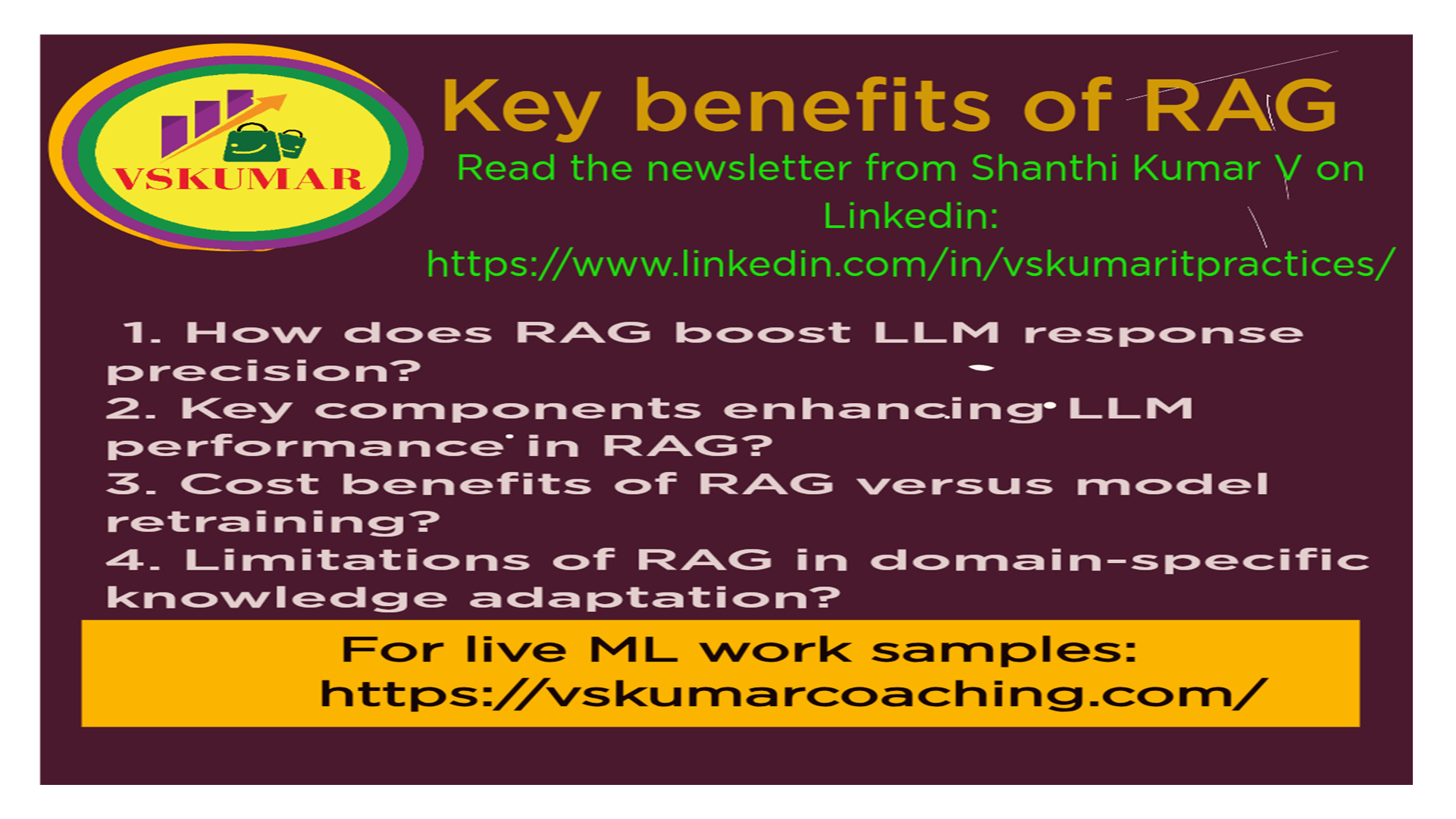
  3. Key Benefits of RAG
  4. Cost Benefits of Using RAG over Retraining Models
  5. Limitations of RAG in Adapting to Domain-Specific Knowledge
  6. Conclusion

About This Blog Post:

In today’s digital landscape, language models have become increasingly popular for their ability to generate human-like text. However, these models are not perfect and often struggle with accuracy and relevance. One approach to improve their performance is Retrieval-Augmented Generation (RAG), a cost-effective framework that enhances the quality and accuracy of large language model (LLM) responses by retrieving relevant information from an external knowledge base.

What is Retrieval-Augmented Generation (RAG)?

RAG is an AI framework that improves the quality and accuracy of LLM responses by retrieving relevant information from an external knowledge base to supplement the LLM’s internal knowledge. It has two main components: Retrieval and Generation. The Retrieval component searches for and retrieves snippets of information relevant to the user’s prompt or question from an external knowledge base. The Generation component appends the retrieved information to the user’s original prompt and passes it to the LLM, which then draws from this augmented prompt and its own training data to generate a tailored, engaging answer for the user.

Key Benefits of RAG

RAG offers several key benefits, including:

  • Providing LLMs access to the most current, reliable facts beyond their static training data
  • Allowing users to verify the accuracy of the LLM’s responses by checking the cited sources
  • Reducing the risk of LLMs hallucinating incorrect information or leaking sensitive data
  • Lowering the computational and financial costs of continuously retraining LLMs on new data

Cost Benefits of Using RAG over Retraining Models

Using RAG offers several cost benefits compared to traditional model retraining or fine-tuning. These benefits include:

  • Reduced Training Costs: RAG does not require the extensive computational resources and time associated with retraining models from scratch.
  • Dynamic Updates: RAG allows for real-time access to up-to-date information without needing to retrain the model every time new data becomes available.
  • Flexibility and Adaptability: RAG systems can easily adapt to new information and contexts by simply updating the external knowledge sources.
  • Minimized Hallucinations: RAG reduces the risk of hallucinations by grounding responses in retrieved evidence.
  • Lower Resource Requirements: RAG can work effectively with smaller models by augmenting their capabilities through retrieval, leading to savings in cloud computing expenses and hardware procurement.

Limitations of RAG in Adapting to Domain-Specific Knowledge

While RAG provides a flexible approach to integrating external knowledge, it has several limitations when it comes to adapting to domain-specific knowledge. These limitations include:

  • Fixed Passage Encoding: RAG does not fine-tune the encoding of passages or the external knowledge base during training, which can lead to less relevant or accurate responses in specialized contexts.
  • Computational Costs: Adapting RAG to domain-specific knowledge bases can be computationally expensive.
  • Limited Understanding of Domain-Specific Contexts: RAG’s performance in specialized domains is not well understood, and the model may struggle to accurately interpret or generate responses based on domain-specific nuances.
  • Hallucination Risks: RAG can still generate plausible-sounding but incorrect information if the retrieved context is not sufficiently relevant or accurate.
  • Context Window Limitations: RAG must operate within the constraints of the context window of the language model, which limits the amount of retrieved information that can be effectively utilized.

Conclusion

In conclusion, RAG is a cost-effective framework that can enhance the quality and accuracy of LLM responses by retrieving relevant information from an external knowledge base. While it has several limitations, RAG offers several key benefits, including reduced training costs, dynamic updates, flexibility, and minimized hallucinations. By understanding the limitations of RAG, developers and organizations can better implement and adapt this framework to meet their specific needs and improve the overall performance of their language models.

Here are the #tags for the blog post:

#RetrievalAugmentedGeneration, #RAG, #LLMs, #LanguageModels, #AI, #MachineLearning, #NaturalLanguageProcessing, #NLP, #CostEffective, #DomainSpecificKnowledge, #ExternalKnowledgeBase, #KnowledgeRetrieval, #GenerativeAI, #Chatbots, #ConversationalAI, #ArtificialIntelligence, #AIApplications, #AIinBusiness, #AIinIndustry