How to Build MLOPS Experience with Tailored coaching.
Why do you need to build MLOPS experience after training to get a competent Job Offer ?
Building MLOps experience through tailored coaching is essential for landing a competent job offer in this field. Here’s why and how you can achieve it:
Why Build MLOps Experience After Training Application of Knowledge:
Training provides you with theoretical knowledge and foundational skills. Practical experience is necessary to apply these concepts to real-world scenarios and understand the nuances of MLOps workflows.
Problem-Solving Skills:
Real-world projects expose you to unforeseen challenges and complex problems. Building experience helps you develop the problem-solving skills essential for efficiently managing MLOps pipelines.
Industry Standards and Best Practices:
Experience allows you to familiarize yourself with industry standards and best practices. This knowledge is crucial for ensuring that your MLOps solutions are reliable, scalable, and compliant with regulations.
Hands-On Tools and Technologies:
Gaining hands-on experience with MLOps tools and technologies is crucial for competence. Employers look for candidates who can confidently use platforms like Kubernetes, Docker, and CI/CD pipelines.
Demonstrable Results:
Practical experience results in a portfolio of projects and accomplishments. This demonstrable track record can significantly enhance your resume and make you a more attractive candidate to potential employers.
How to Build MLOps Experience with Tailored Coaching Identify Your Goals:
Define specific career objectives and skill gaps. Tailored coaching will help you focus on these areas, ensuring you get the most out of your learning experience.
Engage in Real-World Projects:
Work on real-world projects, either through internships, collaborations, or personal initiatives. Apply your training to build and manage MLOps pipelines, from data ingestion to model deployment and monitoring.
Seek Feedback and Iterate:
Use feedback from your coach and peers to refine your approach. Iterating on your work helps you improve and adapt to industry requirements.
Utilize MLOps Tools:
Gain proficiency with essential MLOps tools and platforms. Practical experience with tools like Jenkins, TensorFlow Extended (TFX), and Kubeflow will make you more competent and job-ready.
Stay Updated with Trends:
The field of MLOps is constantly evolving. Stay updated with the latest trends, technologies, and best practices by participating in workshops, webinars, and industry forums.
Network and Collaborate:
Build a professional network by connecting with industry experts and participating in MLOps communities. Collaboration can lead to new opportunities and valuable insights.
Documentation and Reporting:
Learn to document your work effectively. Clear documentation and reporting are crucial for maintaining reproducibility and transparency in MLOps processes.
AI Implementation in Global IT: Resourcing and Retention Guidelines
The global IT industry is undergoing a significant transformation with the integration of artificial intelligence (AI) practices. From automating repetitive tasks to enhancing data-driven decision-making, AI is revolutionizing operations across various sectors. However, the successful implementation of AI hinges on strategic resourcing and retention practices. This blog provides a comprehensive guide for IT organizations to navigate these challenges effectively.
1. Strategic Resourcing for AI Practices
Resourcing for AI requires a blend of technical expertise and domain knowledge. Organizations must invest in training and upskilling their workforce to bridge any skill gaps. Collaborations with academic institutions and partnerships with AI-focused firms can provide access to cutting-edge technology and research. Fostering a culture of continuous learning and adaptability is crucial, as AI technology rapidly evolves.
2. Implementing a Robust Performance Evaluation System
Ensuring that trained personnel deliver tangible results is key to successful AI implementation. A robust performance evaluation system should be established, incorporating regular assessments, feedback mechanisms, and performance metrics. This allows organizations to track progress, recognize high performers, and address underperformance proactively. By doing so, IT organizations can mitigate the risk of massive layoffs and ensure that their training investments translate into valuable outcomes.
3. Retaining Legacy IT Human Resources
The transition to AI can pose challenges in retaining legacy IT human resources. However, with the right strategies, a significant portion of these professionals can be reskilled to work with AI systems. Approximately 60-70% of legacy IT human resources could transition into AI roles with adequate training and support. This approach preserves valuable institutional knowledge and ensures a smooth transition into an AI-driven landscape.
4. Addressing Layoffs and Contingency Planning
Despite best efforts, some layoffs may be inevitable due to the rapid advancements in AI technology. IT organizations must have contingency plans in place to support affected employees. This can include offering severance packages, outplacement services, and further education and training opportunities. By prioritizing employee well-being and providing support during transitions, organizations can maintain a positive reputation and reduce the negative impact of layoffs.
5. Conclusion
The integration of AI practices in the global IT industry offers immense potential for innovation and efficiency. Strategic resourcing, robust performance evaluation systems, and effective retention strategies are essential for realizing this potential. By investing in the development and support of their workforce, IT organizations can navigate the challenges of AI implementation and create a sustainable and thriving future.
By following these guidelines, IT organizations can leverage the benefits of AI while ensuring that their human resources are adequately prepared and supported. This balanced approach will lead to a successful and sustainable integration of AI in the IT industry. 🌐
Hope this works for you! Ready to share this insightful piece? 🚀
Transform Your Career: Embrace AI New Technologies with Confidence
In today’s rapidly evolving job market, staying ahead means constantly updating your skills and knowledge. If you’re feeling overwhelmed by the plethora of new technologies, you’re not alone. However, there’s a structured, comprehensive way to navigate this journey and come out stronger on the other side.
Questions to Ponder:
How does mastering AWS job tasks enhance your competitiveness in the job market?
In what ways can IAC proficiency with Terraform, Python, and JSON give you an edge in DevOps roles?
How can mastering ML and Generative AI automation with business skills expand your career opportunities?
Why is continuous learning and handling job pressures by solving live project issues crucial for IT professionals?
How does quick self-job placement and real-world experience boost your confidence in interviews?
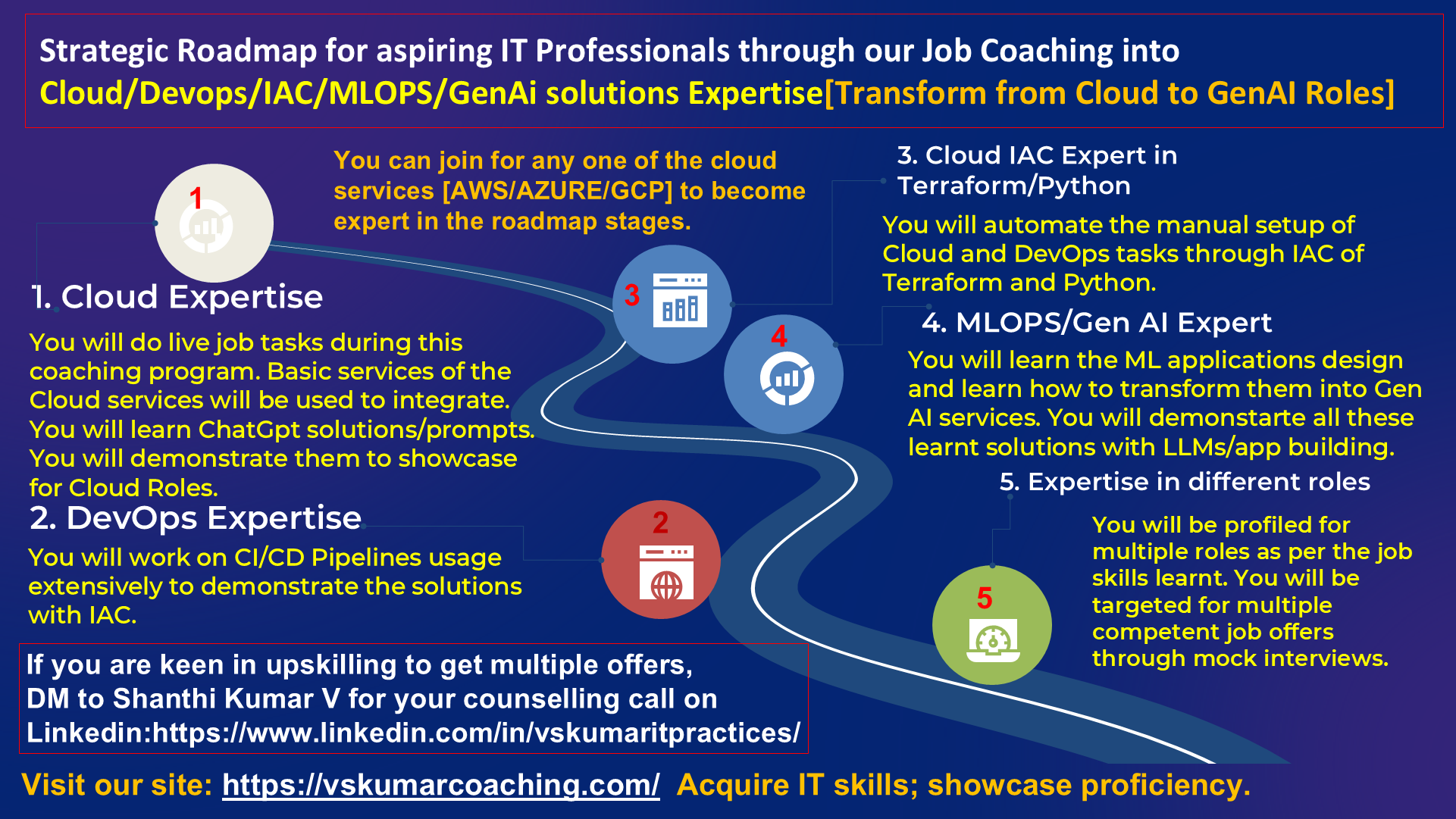
Join the 90-day AWS/Cloud/DevOps/ML/MLOPS/Gen AI Job Tasks Coaching and Enjoy These Benefits:
Master AWS Job Tasks: Gain expertise in AWS, a crucial skill for many IT roles.
IAC Proficiency: Learn Terraform (YAML), Python, and JSON to manage infrastructure as code.
DevOps Practices: Develop a deep understanding of DevOps practices that are essential for modern IT roles.
ML and Generative AI: Master machine learning and generative AI, including their applications in business.
MLOps Live Deployments: Get hands-on experience with MLOps, learning how to deploy models in real-world settings.
Continuous Learning: Build resilience and adaptability by tackling live project issues, ensuring you’re ready for job pressures.
Strategic Career Customization: Tailor your learning to your career goals, with proven skills and techniques.
Collaborate with ChatGPT: Enhance your solution engineering skills by collaborating with AI.
Structured Learning: Stick to a fixed-duration, structured program that ensures timely completion.
Effort Required: Commit 15 to 20 hours per week to develop a learn-and-prove attitude through mentoring, coaching, guidance, and reviews.
Tailored Resume Enhancement: Boost your resume with proof-of-concept projects as evidence of your skills.
Mock Interviews: Prepare thoroughly for real interviews with mock interview sessions.
Quick Self-Job Placements: Gain the confidence and experience to excel in interviews and secure job placements quickly.
Guaranteed Offers: Secure multiple job offers at competitive rates in the IT market.
Why This Matters: This comprehensive program is designed not just to teach you the skills but to transform you into a confident professional ready to take on the challenges of the modern IT world. With a focus on practical, hands-on learning and continuous improvement, you’ll be well-prepared to compete globally and secure top-notch job opportunities.
Ready to transform your career? Embrace the future with confidence. 🚀
What do you think? Ready to embark on this journey? 🌟
What are the key learning outcomes of the Ultimate AWS Solutions Toolkit course? The course aims to equip participants with the skills and resources to tackle 1,500 common challenges in AWS implementation, enhancing expertise in cloud architecture and management, troubleshooting, and best practices.
How does the course structure support both beginners and experienced professionals in AWS? The course is structured into focused learning modules that cover specific challenges, allowing learners of varying skill levels to concentrate on topics relevant to their roles.
Can you provide examples of the types of common challenges that will be covered in the course? Examples include AWS Security configurations, CloudWatch monitoring issues, Elastic Load Balancer setup challenges, RDS configurations, and disaster recovery scenarios.
How are the challenges organized within the course to facilitate efficient learning? The challenges are organized by AWS services and categories, allowing learners to quickly locate relevant information and solutions based on their immediate needs.
What practical solutions are provided for AWS Security issues in the course? Each security challenge is paired with actionable solutions, including best practices for IAM policies, VPC configurations, and security group settings.
How does the course address the needs of DevOps engineers specifically? The course includes modules focused on CI/CD pipelines, automation of monitoring and logging, and strategies to streamline deployment processes.
What role do real-world case studies play in the learning process of this course? Case studies provide concrete examples of challenges faced by AWS professionals, illustrating how the solutions can be effectively applied in practical scenarios.
How can Solution Architects benefit from the toolkit’s problem-solving resources? Solution Architects can master AWS implementation practices and gain confidence in designing resilient and secure cloud solutions using the toolkit’s extensive resources.
Are there specific modules dedicated to monitoring and logging in AWS? What do they cover? Yes, there are dedicated modules that cover AWS CloudWatch and logging best practices, including how to set up alarms, dashboards, and logging actions for increased visibility.
What strategies does the course offer for building resilient AWS architectures? The course covers fault tolerance strategies, such as redundancy, load balancing, and implementing auto-scaling to ensure architectures are resilient under various conditions.
How does this course help reduce the time spent on troubleshooting common AWS issues? By providing immediate access to 1,500 solutions and organized challenges, learners can quickly identify and implement fixes instead of spending hours searching for answers.
What resources are available to help IT professionals transitioning to AWS? The course offers comprehensive resources and support materials that guide IT professionals through AWS services, architectures, and best practices to ensure a smooth transition.
How does the course empower developers to enhance app performance in AWS? Developers will learn best practices for deploying applications, including performance optimization techniques that reduce delays and improve overall app responsiveness.
What are some of the best practices presented for data storage solutions in AWS? The course discusses data management strategies, including using S3 for unstructured data, RDS for relational databases, and DynamoDB for NoSQL needs, along with backup and recovery practices.
How can technical managers leverage the knowledge gained from this course for team improvement? Technical managers can use the course insights to create strategies that improve project delivery, reduce troubleshooting time, and foster better communication among team members.
Are there any hands-on projects or labs included in the curriculum? Yes, the course includes hands-on labs and projects that allow learners to apply the solutions and techniques learned in a practical setting.
What types of disaster recovery solutions are discussed in the course? The course covers various disaster recovery strategies, including backups, cross-region replication, and failover techniques to ensure business continuity.
How do the course materials facilitate collaboration among team members? By using a shared language of common challenges, the course fosters better communication, encouraging teamwork and collective problem-solving.
Can you explain how the course addresses issues related to AWS Elastic Load Balancers? The course provides detailed guidance on setting up and configuring ELBs, including addressing issues related to traffic distribution, SSL termination, and health checks.
What support is available for learners after they complete the course? Learners will have access to a community of AWS professionals and ongoing support for any questions or challenges they encounter after completing the course.
The Crucial Role of SRE in Implementing AI Practices: Key Skills and Activities
Site Reliability Engineering (SRE) has emerged as a critical function in the implementation of AI practices. SREs ensure that AI systems are reliable, scalable, and maintainable, bridging the gap between development and operations. This article explores the key activities and roles of SREs in AI practices implementation and the essential job skills required for success in this field.
1. Infrastructure Management
Provisioning Resources: SREs are responsible for setting up and managing the infrastructure required for AI workloads, including cloud services, GPUs, and data storage. This involves proficiency in cloud platforms like AWS, GCP, or Azure, and experience with containerization tools like Docker and Kubernetes. Familiarity with Infrastructure as Code (IaC) tools such as Terraform or CloudFormation is also crucial.
Scaling: To handle varying workloads efficiently, SREs implement auto-scaling and load balancing. These activities ensure that AI systems can dynamically adjust to changes in demand without compromising performance or reliability.
2. Monitoring and Observability
Metrics Collection: Establishing robust metrics and logging systems is essential for real-time performance monitoring of AI models. SREs need to be skilled in using tools like Prometheus, Grafana, or Datadog for metrics collection and visualization.
Alerting: Setting up alerting mechanisms for anomalies or performance degradation is another critical task. SREs must be adept at configuring alerting tools such as PagerDuty or Opsgenie to promptly address issues as they arise.
3. Deployment Automation
CI/CD Pipelines: Implementing continuous integration and continuous deployment (CI/CD) pipelines is vital for automating the deployment of AI models and updates. Proficiency in tools like Jenkins, GitLab CI, or CircleCI is necessary.
Version Control: Managing versioning for models and datasets ensures reproducibility and rollback capabilities. Strong skills in Git for code and model versioning are essential for SREs.
Scripting: Scripting abilities, particularly in Python and Bash, are critical for automating various deployment tasks and processes.
4. Performance Optimization
Load Testing: Conducting load testing helps SREs understand how AI systems perform under stress and make necessary adjustments. Familiarity with tools like JMeter or Gatling is beneficial.
Latency Reduction: Identifying bottlenecks in AI workflows and optimizing them for better performance is a key responsibility. This requires skills in profiling and tuning AI systems to reduce latency.
5. Incident Management
Response Plans: Developing incident response plans specific to AI systems, including rollback procedures and diagnostics, is crucial for minimizing downtime and maintaining system reliability.
Post-Mortems: Conducting post-mortem analyses after incidents helps SREs learn and improve future practices. Skills in root cause analysis and implementing lessons learned are essential.
6. Collaboration with Data Science Teams
Cross-functional Teams: SREs work closely with data scientists and machine learning engineers to understand their needs and constraints. Strong communication skills are necessary to facilitate effective collaboration.
Best Practices: Advocating for best practices in model development, deployment, and monitoring ensures that AI systems are built and maintained to high standards. Basic knowledge of machine learning principles and model lifecycle is beneficial.
7. Security and Compliance
Data Protection: Ensuring that data used for AI practices complies with privacy regulations and security standards is a key responsibility. SREs need to understand data protection regulations (e.g., GDPR, HIPAA) and implement security best practices.
Access Controls: Implementing access controls to protect sensitive data and models is essential. Skills in configuring role-based access control (RBAC) and permissions are necessary.
8. Documentation and Knowledge Sharing
Documentation: Maintaining thorough documentation of infrastructure, processes, and incident responses is critical for knowledge sharing and transparency. Technical writing skills are essential.
Training: Providing training for teams on SRE practices and tools relevant to AI implementation helps foster a culture of reliability and continuous improvement. Experience in training and mentoring is beneficial.
9. Capacity Planning
Forecasting Needs: Analyzing usage patterns and forecasting future resource needs for AI applications helps prevent outages and ensure scalability. Analytical skills are crucial for this task.
Cost Management: Monitoring resource utilization and costs associated with AI workloads is essential for efficient resource management. Skills in cost optimization and budgeting are necessary.
10. Feedback Loops
User Feedback: Collecting feedback from users of AI systems helps SREs continuously improve reliability and performance. A user-centric approach is beneficial for gathering actionable insights.
Iterative Improvements: Using data from operations to iteratively improve AI models and their deployment ensures that systems evolve and adapt to changing requirements. Familiarity with agile methodologies is advantageous.
The Future of SRE in AI Practices
As AI technologies continue to evolve, the role of SREs will likely expand and adapt. Here are some trends and considerations for the future:
1. Increased Complexity of AI Systems
As AI models become more sophisticated, the infrastructure required to support them will also grow in complexity. SREs will need to develop advanced monitoring and observability tools to manage this complexity effectively. This may involve integrating AI-driven solutions for anomaly detection and automated incident response.
2. Integration of MLOps
The convergence of SRE and MLOps (Machine Learning Operations) will become more pronounced. SREs will play a crucial role in the MLOps lifecycle, ensuring that AI models are not only deployed but also continuously monitored, retrained, and optimized based on real-world data.
3. Focus on Ethical AI
With growing concerns about bias, fairness, and transparency in AI systems, SREs will need to be involved in ensuring that ethical considerations are integrated into the deployment and monitoring of AI applications. This may involve implementing checks and balances to ensure compliance with ethical standards.
4. Automation and AI in SRE Practices
The adoption of AI and machine learning within SRE practices will likely increase. SREs can leverage AI-driven tools for predictive maintenance, automated incident response, and even capacity planning, allowing them to focus on more strategic initiatives.
5. Enhanced Collaboration Across Teams
As AI becomes a core component of many organizations, SREs will need to collaborate more closely with data scientists, product teams, and business stakeholders. This cross-functional collaboration will be essential for aligning AI initiatives with business goals and ensuring that reliability and performance are prioritized throughout the AI lifecycle.
6. Emphasis on Continuous Learning
The field of AI and SRE is constantly evolving. Continuous learning and professional development will be essential for SREs to stay updated with the latest technologies, tools, and best practices. This could involve pursuing certifications, attending workshops, and engaging in community discussions to share knowledge and experiences.
Conclusion
The integration of Site Reliability Engineering into AI practices is vital for ensuring that AI systems are robust, efficient, and effective. As organizations continue to leverage AI for competitive advantage, the demand for skilled SREs will grow. By mastering the necessary skills and adapting to future trends, SREs can play a pivotal role in shaping the success of AI initiatives, driving innovation, and ultimately delivering value to their organizations.
In summary, the collaboration between SRE and AI is not just about maintaining systems; it’s about fostering a culture of reliability, performance, and ethical responsibility in the ever-evolving landscape of artificial intelligence. By embracing these challenges and opportunities, SREs can ensure that AI technologies are not only powerful but also trustworthy and sustainable.
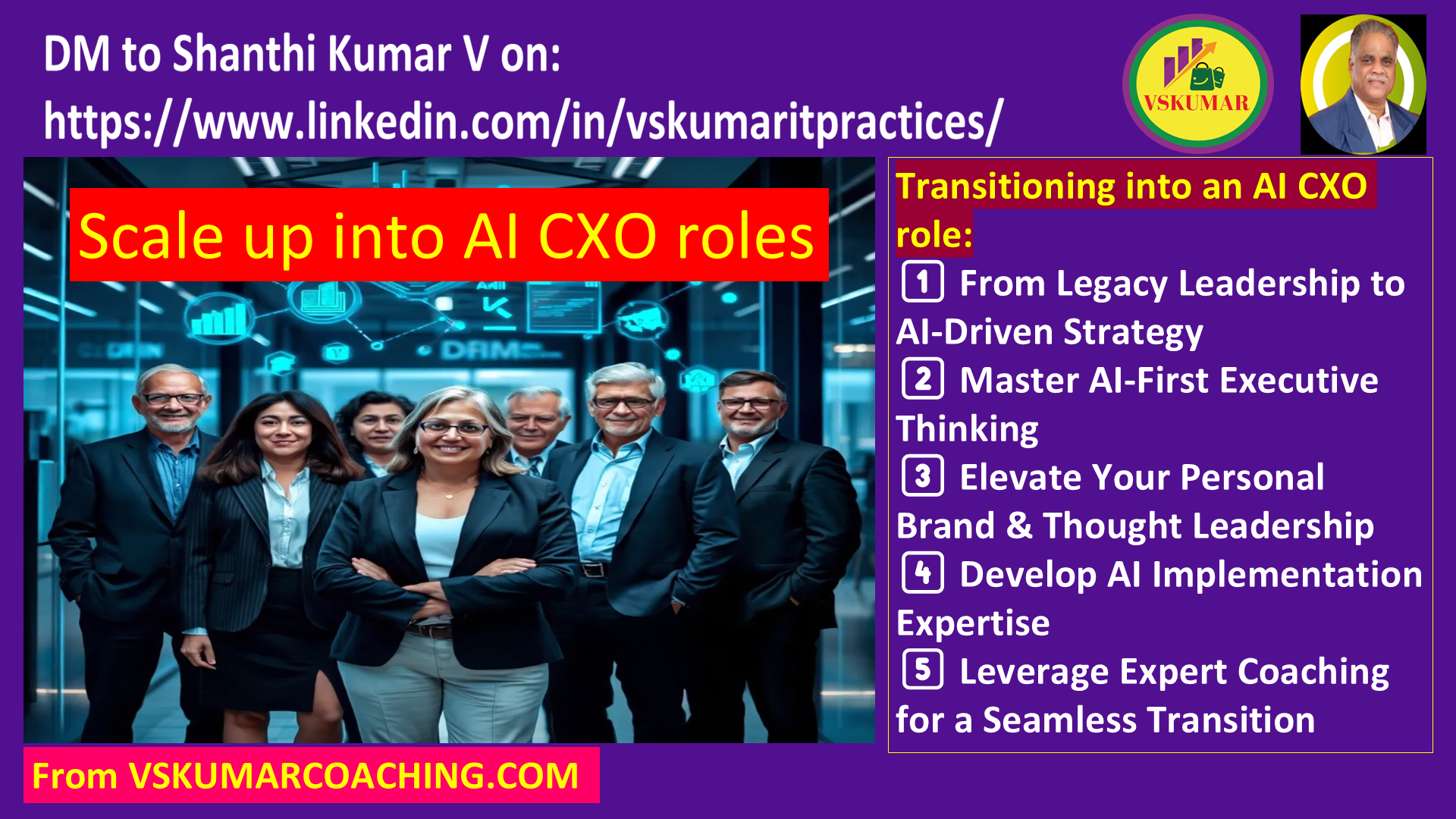
The AI revolution is here, and it’s imperative for CXOs to rise to the occasion.
By committing to their own development and fostering a culture of innovation, they can drive meaningful change that benefits not only their organizations but also their customers and stakeholders.
The future is bright for those who are willing to adapt and lead the charge into the AI era.
What are the feasible roles in AI era for an IT Consultant ? —->
An IT consultant can transition into various roles within the AI domain by leveraging their technical expertise, business acumen, and understanding of IT infrastructure. Here are some key roles an IT consultant might pursue in AI solutions:
AI Solutions Architect: Focuses on designing and implementing AI systems that meet business needs, integrating AI technologies with existing IT infrastructure.
Machine Learning Engineer: Develops algorithms and machine learning models, requiring programming skills and expertise in data analysis.
Data Scientist: Analyzes and interprets complex data to derive insights, using statistical methods and machine learning techniques to inform business strategies.
AI Product Manager: Oversees the development of AI products, aligning technological capabilities with market demands and coordinating between technical teams and business stakeholders.
AI Consultant: Provides strategic advice to organizations on AI implementation, helping them understand AI opportunities and challenges within their business context.
NLP Engineer: Specializes in creating applications that can understand and process human language, often working on chatbots and virtual assistants.
Computer Vision Engineer: Focuses on developing AI solutions that enable machines to interpret and analyze visual data, such as images and videos.
Robotics Engineer: Works on designing and programming robotic systems that incorporate AI for automation and intelligent behavior.
AI Trainer: Develops and executes training programs for employees to enhance their understanding of AI tools and methodologies within the organization.
Security Consultant for AI Systems: Ensures that AI systems are secure by assessing risks, implementing safeguards, and complying with data protection regulations.
To transition effectively, IT consultants should enhance their knowledge of AI technologies, pursue relevant certifications, and engage in continuous learning to stay updated with industry trends.




 Building Cloud/DevOps/AI/ML/Gen AI Architects