
Mastering Machine Learning Interviews: Key Topics and Questions
Preparing for ML job interviews can be challenging, but with the right approach, you can master the process and ace your interviews. Here’s a list of 20 questions covering key topics in machine learning, along with how our course can help you prepare effectively.
Data Handling and Preprocessing
- How can you handle imbalanced datasets in machine learning?
- How do you effectively handle categorical variables in a dataset?
- How can you handle missing values in a dataset?
Our course provides hands-on experience with techniques like SMOTE for balancing datasets, one-hot encoding for categorical variables, and methods for dealing with missing data.
Machine Learning Concepts and Algorithms
- What is ensemble learning, and how can it improve model performance?
- What are the differences between bagging and boosting?
- How can transfer learning be applied?
Learn how to leverage ensemble learning techniques like bagging and boosting, and understand the principles of transfer learning through practical examples and case studies.
Model Evaluation and Selection
- How do you choose the right evaluation metric for a machine learning problem?
- How do you evaluate the performance of a clustering algorithm?
- How do you handle hyperparameter tuning?
Our course teaches you how to select appropriate evaluation metrics, assess clustering algorithms, and perform hyperparameter tuning using grid search, random search, and Bayesian optimization.
Optimization and Regularization
- Can you explain the difference between L1 and L2 regularization?
- What techniques can reduce overfitting in machine learning models?
- How do you choose the right activation function for a neural network?
Gain insights into regularization techniques, strategies for reducing overfitting, and selecting the optimal activation function for neural networks to enhance model performance.
Neural Networks and Deep Learning
- What is the difference between a feedforward neural network and a recurrent neural network?
- How do you evaluate the performance of a recommendation system?
- How do you process large-scale data for machine learning?
Our course provides comprehensive knowledge of neural network architectures, evaluation techniques for recommendation systems, and methods for handling large-scale data processing.
Specific Techniques and Applications
- What are common techniques for data augmentation, and why are they important?
- What are some applications of natural language processing (NLP)?
- How do you handle outliers in a dataset?
Learn about various data augmentation techniques, explore practical NLP applications, and discover ways to manage outliers effectively in your dataset.
General Knowledge and Comparisons
- What is the difference between a generative and a discriminative model?
- How can you compare logistic regression and linear regression?
Understand the distinctions between different machine learning models and algorithms, and learn how to apply them in real-world scenarios.
How the Course Can Help You Prepare
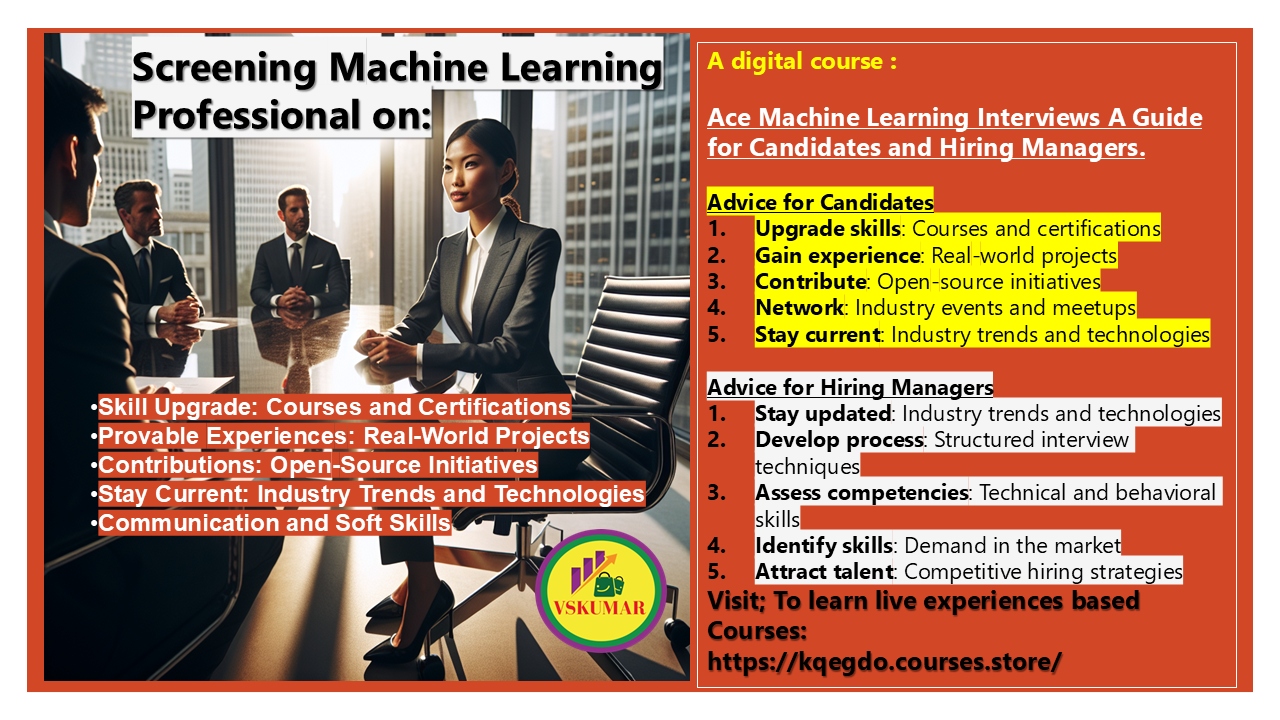
Our comprehensive digital course, “Ace Machine Learning Interviews: A Guide for Candidates and Hiring Managers,” is designed to help you master these topics and more. Here’s how it can assist you:
- Technical Mastery: Deep dive into core ML concepts like handling imbalanced datasets, ensemble learning, and choosing evaluation metrics.
- Behavioral Insights: Learn to effectively articulate experiences and technical knowledge using the STAR method. Master common behavioral questions.
- Practical Assessments: Prepare for real-world scenarios and case studies that test your ML knowledge. Tips on analyzing case studies and performing practical assessments.
- Resume Crafting: Create standout resumes highlighting your technical and soft skills, tailored for specific ML roles.
- Interview Practice: Engage in mock interviews to refine responses, receive constructive feedback, and build confidence.
- Role Clarity for Hiring Managers: Understand various ML roles and develop strategies to assess both technical and behavioral competencies.
- Effective Interview Techniques: Design case studies and practical assessments tailored to your organization’s needs.
- Candidate Evaluation: Evaluate resumes and identify key attributes indicating strong candidates. Conduct remote interviews efficiently.
- Building a Talent Pipeline: Leverage networking and job search strategies to attract top talent. Utilize online platforms and industry events.
- Continuous Learning: Access a wealth of resources, including books, online courses, webinars, and expert guidance.
Whether you’re an aspiring ML professional looking to land your dream job or a hiring manager seeking to refine your interview process, our course provides the tools and insights needed to excel. By addressing both candidates and hiring managers, this course offers a holistic approach to mastering ML interviews.
Join us today and take the first step towards mastering the art of ML interviews.
How the Course Can Help You Prepare
Our comprehensive digital course, “Ace Machine Learning Interviews: A Guide for Candidates and Hiring Managers,” is designed to help you master these topics and more. Here’s how it can assist you:
- Technical Mastery:
- Deep dive into core ML concepts like handling imbalanced datasets, ensemble learning, and choosing evaluation metrics.
- Hands-on experience with techniques such as data augmentation, L1 and L2 regularization, and feature scaling using tools like TensorFlow and PyTorch.
- Behavioral Insights:
- Learn to effectively articulate experiences and technical knowledge using the STAR method.
- Master common behavioral questions to demonstrate skills in teamwork, problem-solving, and adaptability.
- Practical Assessments:
- Prepare for real-world scenarios and case studies that test your ML knowledge.
- Tips on analyzing case studies and performing practical assessments, such as evaluating clustering algorithms and recommendation systems.
- Resume Crafting:
- Create standout resumes highlighting your technical and soft skills, tailored for specific ML roles.
- Learn to present relevant projects, such as those involving NLP applications and handling missing data.
- Interview Practice:
- Engage in mock interviews to refine your responses, receive constructive feedback, and build confidence.
- Role Clarity for Hiring Managers:
- Understand various ML roles and develop strategies to assess both technical and behavioral competencies.
- Effective Interview Techniques:
- Design case studies and practical assessments tailored to your organization’s needs.
- Assess candidate’s technical and behavioral competencies effectively.
- Candidate Evaluation:
- Evaluate resumes and identify key attributes that indicate strong candidates.
- Conduct remote interviews efficiently, ensuring a smooth process.
- Building a Talent Pipeline:
- Leverage networking and job search strategies to attract top talent.
- Utilize online platforms and industry events to expand professional networks.
- Continuous Learning:
- Access a wealth of resources, including books, online courses, webinars, and expert guidance.
Whether you’re an aspiring ML professional looking to land your dream job or a hiring manager seeking to refine your interview process, our course provides the tools and insights needed to excel.
By addressing both candidates and hiring managers, this course offers a holistic approach to mastering ML interviews. Join us today and take the first step towards mastering the art of ML interviews.
Check out the course here: ML Interview Guide
 Building Cloud/DevOps/AI/ML/Gen AI Architects