
The Rise of AI-Driven IT Professionals: Why Upskilling is Essential for Legacy Experts
Introduction
The IT industry is experiencing a massive transformation, with artificial intelligence (AI) driving automation, decision-making, and data-driven insights. Employers are no longer looking for traditional IT professionals—they need AI-savvy experts who can manage end-to-end AI projects.
If you’re an IT professional with 10+ years of experience working with legacy systems, the time to upskill is now. Businesses demand specialists who can integrate AI into existing IT infrastructures, develop machine learning models, and automate processes.
Let’s explore the key roles employers are hiring for and why AI upskilling is a game-changer for legacy IT professionals.
Key Multi-Role AI Job Demands in IT
1. AI Integration Specialist
📌 Bridging AI with legacy IT systems
✅ Employers need experts who can seamlessly integrate AI into existing IT infrastructures without disrupting operations.
🔹 Required Skills: Cloud AI services, APIs, AI-powered automation, and data pipeline integration.
🔹 Why Upskill? To ensure AI-driven solutions work harmoniously with legacy infrastructure instead of requiring complete replacements.
2. Data Management & AI Engineer
📌 Transforming raw data into AI-ready assets
✅ Businesses depend on clean, structured data to power machine learning models and predictive analytics.
🔹 Required Skills: Data wrangling, big data technologies (Hadoop, Spark), and data preprocessing for AI.
🔹 Why Upskill? To prepare and manage high-quality data that feeds AI models for accurate insights.
3. Machine Learning Engineer
📌 Developing, training, and deploying AI models
✅ Companies expect IT professionals to build, train, and optimize machine learning models that drive automation.
🔹 Required Skills: Python, TensorFlow, PyTorch, MLOps, model deployment strategies.
🔹 Why Upskill? To take control of end-to-end AI projects rather than relying on data scientists alone.
4. AI Ethics & Compliance Officer
📌 Ensuring fairness, transparency, and legal compliance in AI
✅ AI solutions must be free from bias, secure, and ethically aligned with regulations.
🔹 Required Skills: AI ethics frameworks, bias detection techniques, compliance standards (GDPR, HIPAA).
🔹 Why Upskill? To develop responsible AI solutions that align with industry regulations and prevent bias-related risks.
5. AI-Powered Automation Architect
📌 Optimizing IT operations through AI-driven automation
✅ Organizations demand automated IT workflows, cybersecurity, and intelligent monitoring powered by AI.
🔹 Required Skills: AI-driven IT automation, DevOps, AIOps, predictive maintenance.
🔹 Why Upskill? To future-proof IT operations by implementing AI-driven optimizations for cost and efficiency.
Why Employers Prefer AI-Skilled IT Professionals
🚀 Future-Proofing IT Careers: AI adoption is skyrocketing, and IT professionals without AI expertise risk becoming obsolete.
💼 Higher Salary & Job Security: AI-integrated IT roles command premium salaries and have greater job stability compared to traditional IT jobs.
📊 End-to-End AI Expertise in Demand: Companies want professionals who can manage AI projects from data preparation to deployment—not just IT specialists handling individual tasks.
🌍 Global AI Adoption: Organizations across industries—including finance, healthcare, and manufacturing—are actively hiring AI-skilled IT experts to enhance operational efficiency and innovation.
Challenges Faced & Solved Through AI Upskilling
Legacy IT professionals face several challenges while transitioning to AI-driven roles. Here’s how upskilling resolves them:
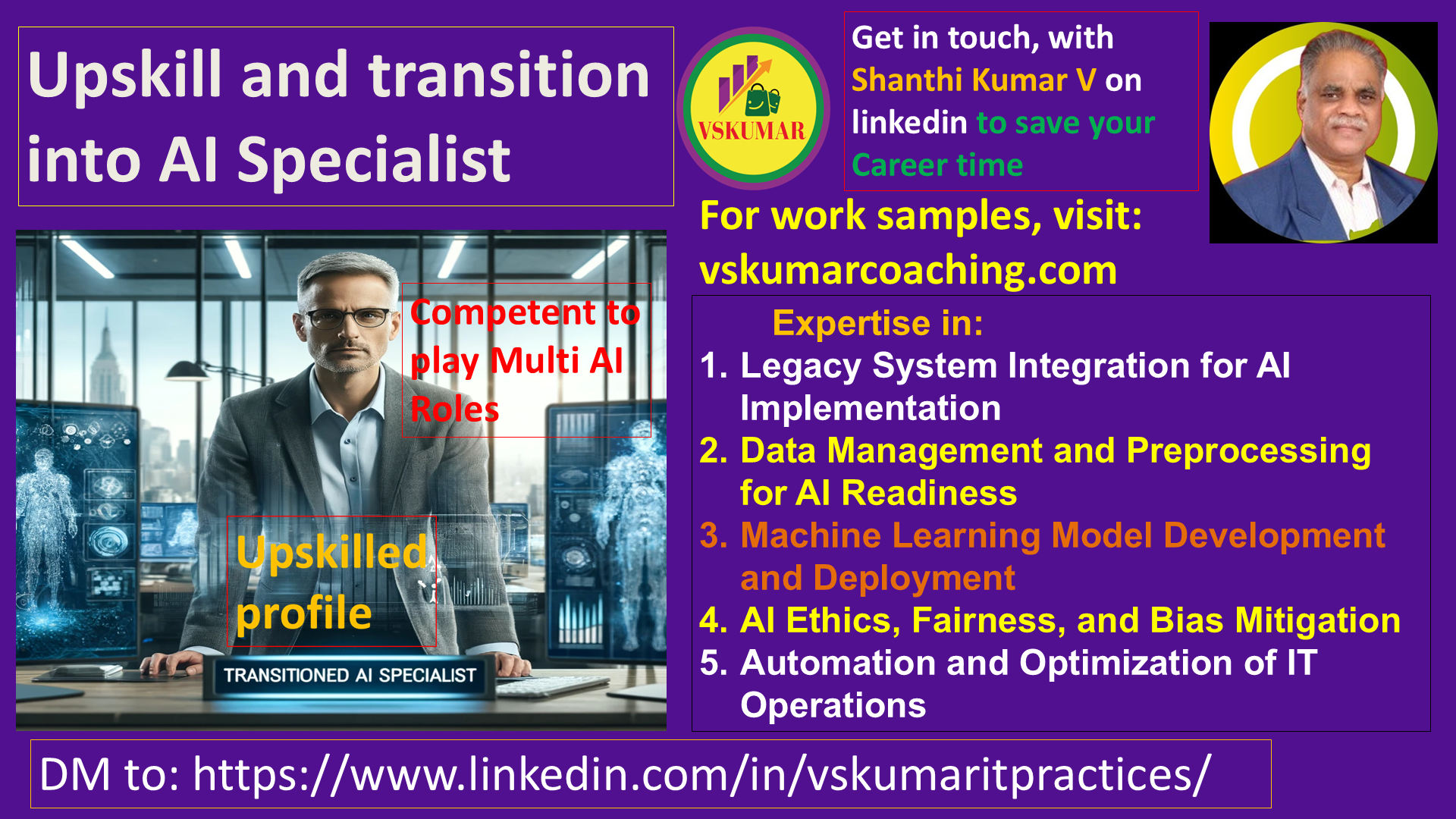
1. Legacy System Integration for AI Implementation
✅ Challenge: Difficulty in integrating AI with outdated IT infrastructure.
✅ Solution: Learn modern API development and cloud migration to bridge the gap.
2. Data Management and Preprocessing for AI Readiness
✅ Challenge: Struggling to handle and structure unorganized data.
✅ Solution: Gain expertise in data engineering, preprocessing, and AI-driven analytics.
3. Machine Learning Model Development and Deployment
✅ Challenge: Limited knowledge of AI model development.
✅ Solution: Master ML algorithms, deep learning frameworks, and real-world deployment.
4. AI Ethics, Fairness, and Bias Mitigation
✅ Challenge: Bias in AI models due to poor data selection.
✅ Solution: Learn fairness principles, bias reduction techniques, and ethical AI implementation.
5. Automation and Optimization of IT Operations
✅ Challenge: Manual IT operations are time-consuming.
✅ Solution: Leverage AI-powered automation for cybersecurity, IT monitoring, and business intelligence.
Final Thoughts: The Path to Becoming a Transitioned AI Specialist
If you’ve spent a decade or more in IT, now is the perfect time to evolve your skill set and transition into AI.
🔹 Start Learning AI Technologies: Get hands-on experience with machine learning, AI automation, and data management.
🔹 Certifications & Courses: Enroll in AI-focused programs that cover AI ethics, cloud AI, and ML model deployment.
🔹 Real-World Projects: Work on AI-powered IT automation, intelligent monitoring, and AI-integrated cybersecurity.
By upskilling, you can secure high-demand AI roles, future-proof your career, and become a Transitioned AI Specialist—the professional every employer is looking for. 🚀
Are you ready to transform your career with AI? Start your AI upskilling journey today!
 Building Cloud/DevOps/AI/ML/Gen AI Architects