
Transforming Traditional Project Management into an AI-Driven Discipline
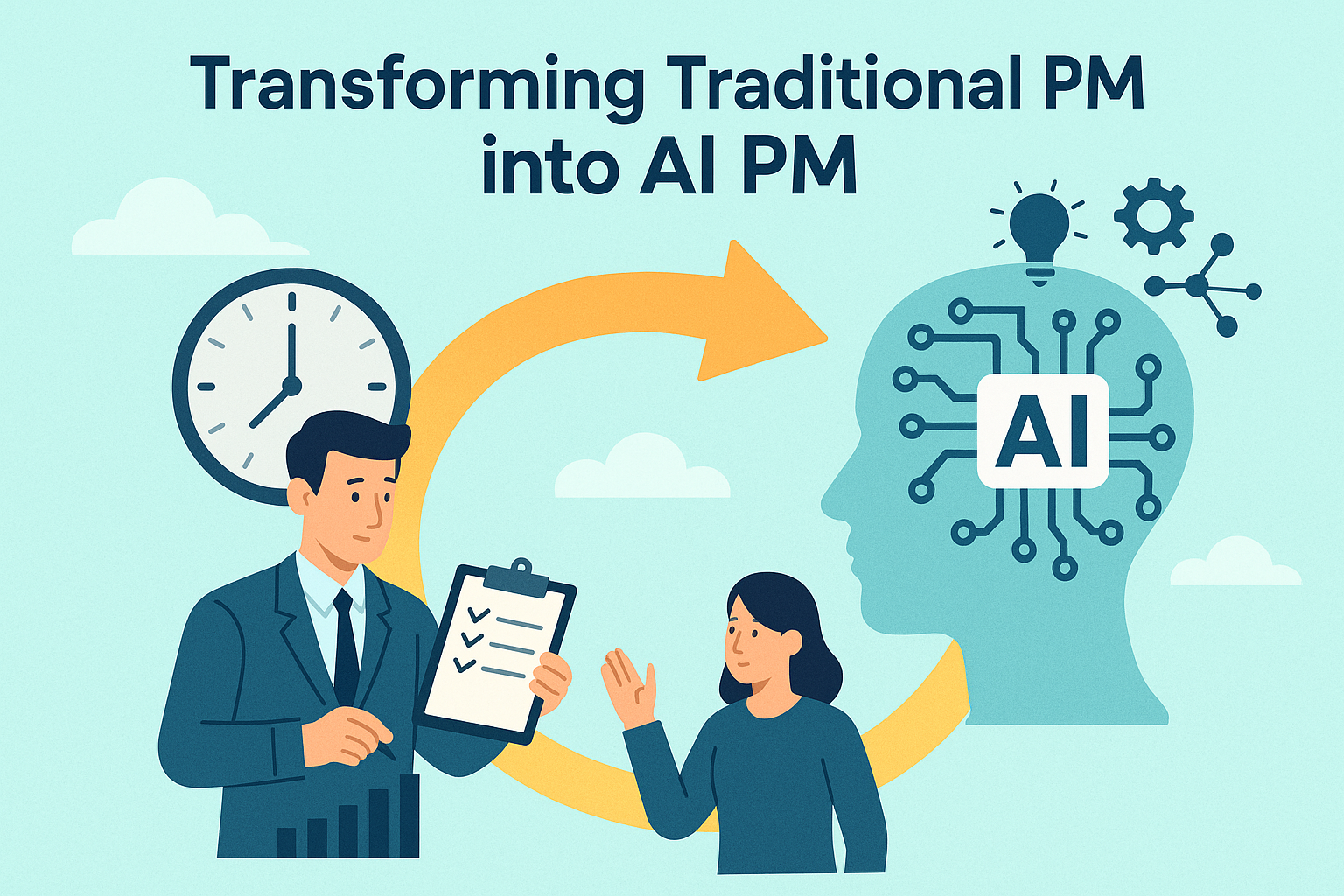
In today’s rapidly evolving business landscape, project management is no longer confined to Gantt charts, rigid timelines, and manual risk assessments. While traditional project management methodologies such as Waterfall, Critical Chain Project Management (CCPM), and Program Evaluation Review Techniques (PERT) remain foundational,(Sciforma) organizations are increasingly harnessing the power of Artificial Intelligence (AI) to boost efficiency, accuracy, and strategic decision-making. This comprehensive article explores the fundamentals of traditional project management, the transformative role of AI, the emerging skill sets required for AI project managers, and a step-by-step guide on how to convert a seasoned Traditional Project Manager (PM) into an AI Project Manager (AI PM).
The Foundations of Traditional Project Management
Traditional project management, often called predictive or plan-driven management, emphasizes detailed upfront planning, structured processes, and tight control over scope, time, and cost. Among the most widely applied methodologies are:
- Waterfall: A linear approach where each project phase must be completed before the next begins. Waterfall excels in projects with well-defined requirements and minimal expected changes.(Sciforma)
- Critical Chain Project Management (CCPM): Focuses on managing buffer times and resource constraints, ensuring the project completes as quickly as possible while protecting against uncertainties.(Sciforma)
- Program Evaluation and Review Technique (PERT): Utilizes probabilistic time estimates (optimistic, pessimistic, and most likely) to calculate expected durations and identify critical paths in complex projects.(Sciforma)
- Gantt Charts: Visual timelines that map tasks, durations, dependencies, and milestones, offering clarity on project schedules and resource allocation.(Sciforma)
These methodologies have served industries like construction, manufacturing, and defense for decades, providing predictability and control. However, traditional approaches can be labor-intensive and reactive when sudden changes occur.
Core Skills for Traditional Project Managers
To succeed in a plan-driven environment, project managers need a balanced skill set combining technical proficiency and interpersonal abilities:
- Portfolio Management and Project Scoping: Defining objectives, deliverables, and aligning projects with organizational strategy.(Asana)
- Risk Management: Identifying, analyzing, and mitigating risks through contingency plans and ongoing monitoring.(Coursera)
- Budgeting and Cost Control: Estimating costs accurately, tracking expenditures, and implementing corrective actions.(Coursera)
- Scheduling and Resource Allocation: Creating realistic timelines, optimizing resource usage, and resolving bottlenecks.(Coursera)
- Communication and Stakeholder Management: Facilitating clear, consistent communication among diverse stakeholders and managing expectations.(Asana)
- Leadership and Team Management: Motivating teams, resolving conflicts, and fostering a collaborative culture.(ProjectManager.com)
- Quality Management: Ensuring deliverables meet predefined standards and customer satisfaction metrics.(ProjectManager.com)
While these skills remain vital, the integration of AI demands an expanded toolkit.
The Rise of AI in Project Management
Artificial Intelligence has emerged as a game-changer for modern projects, offering capabilities that transcend manual processes:
- Automation of Routine Tasks: AI bots handle repetitive duties like status updates, meeting scheduling, and time tracking, freeing PMs to focus on strategic activities.(DataCamp)
- Predictive Analytics for Risk Mitigation: Machine learning models analyze historical data to forecast risks, delays, and cost overruns with higher accuracy.(Harvard Business Review)
- Resource Optimization: AI algorithms recommend optimal resource assignments, identify skill gaps, and balance workloads in real time.(Celoxis®)
- Enhanced Decision-Making: Natural Language Processing (NLP) tools synthesize stakeholder communications, project documents, and external data to surface actionable insights.(DataCamp)
- Adaptive Planning: AI-driven systems dynamically adjust project plans in response to evolving requirements, supply chain disruptions, or team performance.(Harvard Business Review)
These AI-driven capabilities not only accelerate project delivery but also elevate the strategic value of the PM role.
Benefits of AI Integration
- Increased Efficiency: Automated reporting, real-time dashboards, and AI chatbots streamline communication and reduce administrative overhead.(Shopify)
- Improved Accuracy: Advanced algorithms minimize human error in cost estimates, schedules, and risk assessments.(Harvard Business Review)
- Greater Agility: AI systems enable rapid scenario modeling, allowing PMs to pivot quickly when project variables change.(DataCamp)
- Enhanced Collaboration: AI-powered collaboration platforms facilitate knowledge sharing, conflict detection, and cross-functional alignment.(Techpoint Africa)
- Data-Driven Decisions: Predictive insights derived from big data empower PMs to make proactive, evidence-based choices.(Celoxis®)
Organizations embracing AI in project management report up to 30% reduction in time spent on administrative tasks and a 20–25% increase in project success rates.
Key Skills for AI Project Managers
Transitioning from a traditional PM role to an AI PM role requires building on core competencies while acquiring new proficiencies in technology and data science:
- Fundamentals of Machine Learning (ML) and Natural Language Processing (NLP)
Understanding supervised and unsupervised learning, model validation, and text analytics.(ProjectManagement.com) - Data Literacy and Analytics
Interpreting datasets, leveraging visualization tools (e.g., Power BI, Tableau), and drawing actionable insights.(Forbes) - AI Tools and Platforms
Hands-on experience with AI-enabled PM tools like Asana, ClickUp, Wrike, and Hive.(Zapier) - Technical Integration Skills
Working with APIs, cloud platforms (AWS, Azure), and ensuring seamless integration of AI modules.(DataCamp) - Change Management and Organizational Adoption
Guiding teams through AI-driven process changes, addressing resistance, and measuring adoption metrics.(Healthcare Finance News) - Ethical and Regulatory Awareness
Ensuring AI solutions comply with data privacy laws (e.g., GDPR, CCPA) and ethical AI principles.(Forbes) - Resilience and Adaptability
Embracing continual learning, pivoting strategies swiftly, and fostering an AI-first mindset.(Forbes)
Cultivating these capabilities prepares PMs to not only manage AI projects effectively but also to leverage AI within any project context.
Leading AI Project Management Tools
Successful AI PMs rely on specialized platforms to streamline workflows:
- Asana: Automates task assignments, priority scoring, and project health insights.(Zapier)
- ClickUp: Offers AI-generated summaries, intelligent scheduling, and predictive due dates.(Zapier)
- Wrike: Provides AI-based risk detection, resource optimization, and automated status reporting.(Zapier)
- Hive: Features AI-driven time forecasting, sentiment analysis in team communications, and workload balancing.(Zapier)
- Forecast: Uses machine learning to automate scheduling, budget forecasting, and scenario planning.(Forecast App)
- Shopify’s AI PM Integrations: Integrates with project pipelines to trigger workflows based on sales forecasts and inventory levels.(Shopify)
Evaluating these solutions based on organization size, industry needs, and existing tech stacks ensures optimal adoption and ROI.
Training and Certification Pathways
Professional bodies and training providers have launched AI-focused curricula:
- Project Management Institute (PMI): Offers certification courses on Generative AI for Project Professionals and advanced data analytics modules free for members.(Fortune)
- Coursera: Hosts specializations in AI for Project Management, covering ML fundamentals, data visualization, and deployment.(Coursera)
- Simplilearn: Delivers a “What Is an AI Project Manager? (And How to Become One)” program, focusing on role-specific responsibilities and emerging best practices.(Simplilearn.com)
- LinkedIn Learning: Features courses on AI for PMs, API integrations, and ethical AI governance.(LinkedIn)
- PMI Infinity™: An AI co-pilot platform that acquaints PMs with generative AI workflows and project automation frameworks.(PMI)
Pursuing these credentials demonstrates commitment to the AI PM role and equips practitioners with practical skills.
Industry Adoption and Case Studies
Several sectors are pioneering AI-driven project management:
- Healthcare: Project managers use AI to coordinate complex IT rollouts, predict resource demand, and monitor patient safety initiatives.(Healthcare Finance News)
- Construction: AI-powered scheduling platforms reduce delays by analyzing weather data, supply chain conditions, and labor availability.(Netguru)
- Software Development: Agile teams employ AI to generate backlog grooming recommendations, automate code review assignments, and forecast sprint velocity.(Elmhurst University)
- E-commerce: Retail PMs integrate AI tools to adjust promotions, predict stock shortages, and synchronize cross-border shipments.(Shopify)
- Banking and Finance: AI-driven risk models inform compliance projects, fraud prevention initiatives, and digital transformation roadmaps.(World Bank)
These case studies illustrate AI’s capacity to enhance agility, reduce waste, and drive project success across diverse environments.
Challenges and Considerations
While AI offers significant advantages, practitioners must address:
- Data Quality and Governance: Ensuring clean, secure, and compliant datasets for model training.(ResearchGate)
- Ethical AI and Bias Mitigation: Implementing fairness checks, transparency measures, and human oversight to avoid discriminatory outcomes.(Forbes)
- Integration Complexity: Balancing legacy systems with modern AI platforms and APIs.(DataCamp)
- Change Resistance: Overcoming skepticism among stakeholders and promoting user adoption through training and communication.(Refresh Miami)
- Cost and ROI Measurement: Calculating total cost of ownership for AI tools and quantifying benefits in time savings or improved outcomes.(Simplilearn.com)
Addressing these challenges proactively ensures that AI initiatives deliver sustainable value.
How to Convert a Traditional PM into an AI PM Role
Transitioning from a traditional project management role to become an AI Project Manager involves a structured pathway:
- Assess Current Skill Set
• Inventory existing strengths in planning, communication, and leadership.(LinkedIn)
• Identify gaps in data literacy, AI concepts, and technical integration. - Acquire Foundational AI Knowledge
• Complete introductory courses in ML and NLP through Coursera or LinkedIn Learning.(Coursera)
• Read authoritative guides on AI ethics, data governance, and algorithmic bias. - Gain Hands-On Experience with AI Tools
• Pilot AI-enabled PM platforms like Asana’s AI features or ClickUp’s predictive scheduling.(Zapier)
• Collaborate with data scientists or developers to implement proof-of-concept projects. - Pursue Certifications and Specialized Training
• Enroll in PMI’s AI for Project Professionals certificate.(Fortune)
• Obtain vendor-specific badges for tools (e.g., AWS Machine Learning, Azure AI). - Network and Engage in AI Communities
• Join PMI’s AI interest groups, attend HIMSS conferences, and participate in online forums.(Healthcare Finance News)
• Share project experiences and lessons learned to build credibility. - Integrate AI into Current Projects
• Introduce AI-based risk forecasting or resource optimization modules into ongoing projects.
• Measure impact through key performance indicators (KPIs) like time saved or error reduction. - Demonstrate Value and Scale
• Present case studies of AI-driven improvements to leadership.
• Advocate for organization-wide adoption and contribute to AI governance frameworks. - Cultivate Continuous Learning
• Stay updated on emerging AI trends, regulatory changes, and new tool releases.
• Mentor colleagues and lead internal workshops on AI in project management.
By following this structured approach, Traditional Project Managers can evolve into AI-savvy leaders, driving innovation and delivering superior project outcomes.
Transitioning from a traditional project management discipline to an AI-empowered role is not merely about adopting new software—it requires a shift in mindset, skill development, and strategic collaboration across teams. As AI continues to reshape the way projects are planned, executed, and monitored, those who embrace these technologies and methodologies will lead the next generation of project success.
How to get Work Experience for AI PM Role ?:
vskumarcoaching.com offers methodical scale-up programs to help IT professionals transition into AI Project Management roles. These programs enable individuals to showcase demonstrated work samples completed during job coaching, customizable to their specific profile background. For more details,
visit: Shanthi Kumar V – (Kumar) I Build AI Competencies/Practices scale up AICXOs | LinkedIn and study the ‘About’ section” to book a call.
 Building Cloud/DevOps/AI/ML/Gen AI Architects