
NOTE:
If you are looking for solutions on building products with Quantum computing, come for job coaching to build business applications.
You can showcase them well. This can help you to get the Competent Job also.
Building an application using quantum computing for bioinformatics, specifically for genomics systems, involves integrating quantum algorithms to handle complex biological data more efficiently than classical computers. Here’s a structured approach to help you get started:
Step 1: Understand the Problem and Quantum Benefit in Genomics
- Identify specific genomics problems where quantum computing could provide advantage, such as:
- Sequence alignment and comparison
- Genetic variant analysis
- Protein folding simulations
- Optimization of gene expression models
- Understand which tasks are computationally intensive on classical systems and may benefit from quantum speedups.
Step 2: Learn Basics of Quantum Computing
- Concepts to master: quantum bits (qubits), superposition, entanglement, quantum gates, measurement.
- Quantum algorithms relevant to bioinformatics: Grover’s algorithm (search), Quantum Approximate Optimization Algorithm (QAOA), Variational Quantum Eigensolver (VQE), quantum machine learning models.
Step 3: Choose Quantum Development Framework
- Popular frameworks:
- IBM Qiskit (Python-based, with simulators and real quantum hardware access)
- Google Cirq
- Microsoft Quantum Development Kit (Q#)
- Most have libraries or extensions for quantum machine learning and optimization.
Step 4: Prepare Bioinformatics Data for Quantum Processing
- Convert genomic data into forms suitable for quantum algorithms (often binary encoding of sequences or feature vectors).
- Normalize and reduce data complexity for current quantum hardware limitations.
Step 5: Develop Quantum Algorithms for Genomic Tasks
- Example: Build a quantum-enhanced sequence alignment by encoding sequences as quantum states and using Grover’s algorithm for faster search.
- Develop hybrid quantum-classical algorithms where quantum processors handle the hardest subproblems.
Step 6: Simulation and Testing
- Use quantum simulators to test algorithms before deploying them on real quantum devices due to current hardware noise and size limits.
- Evaluate accuracy, speed, and resource requirements.
Step 7: Integrate with Classical Bioinformatics Pipeline
- Build interfaces between classical genomics data processing workflows and quantum components.
- Use classical systems for preprocessing and postprocessing, quantum for optimization or pattern recognition.
Step 8: Deployment and Continuous Improvement
- When real quantum machines are available, run experiments and refine algorithms.
- Monitor improvements over classical baselines.
Case Example: Quantum-Assisted Genetic Variant Detection
- Objective: Improve speed and accuracy in detecting rare genetic variants.
- Approach: Use QAOA to optimize search for variant locations in a large dataset represented as a quantum state.
- Result: Simulations indicate potential reduction in computational complexity, enabling faster analysis as quantum hardware matures.
Tools and Resources
- IBM Quantum Experience (free access to real quantum computers)
- Qiskit tutorials on quantum bioinformatics
- Bioinformatics datasets (e.g., NCBI, 1000 Genomes Project)
- Python libraries: Biopython, along with Qiskit’s machine learning modules
If you’d like, I can generate an infographic showing the workflow of building a quantum bioinformatics application!
Explain quantum algorithms used in bioinformatics
Quantum algorithms are powerful tools that can potentially transform bioinformatics by tackling problems too complex for classical computers. Here’s an explanation of the main quantum algorithms used or considered in bioinformatics, focusing on genomics systems:
1. Grover’s Algorithm
- Purpose: Quadratically speeds up unstructured search problems.
- Use in Bioinformatics:
- Searching large genomic databases to find specific sequences or motifs.
- Faster pattern matching in DNA or protein sequences, accelerating sequence alignment.
- Why it’s useful: Classic search algorithms scale linearly with dataset size, but Grover’s algorithm reduces the search time to the square root of the number of elements.
2. Quantum Approximate Optimization Algorithm (QAOA)
- Purpose: Solves combinatorial optimization problems approximately but efficiently.
- Use in Bioinformatics:
- Optimizing gene regulatory network models.
- Finding optimal alignments or clusterings in large datasets.
- Variant detection by optimization of search space for mutations.
- Why it’s useful: Many bioinformatics problems map naturally to optimization tasks where exact classical solutions are computationally expensive.
3. Variational Quantum Eigensolver (VQE)
- Purpose: Hybrid quantum-classical algorithm to find the lowest energy state of a quantum system.
- Use in Bioinformatics:
- Protein folding simulations to find minimum energy conformations.
- Molecular modeling of biological macromolecules.
- Why it’s useful: Classical methods for these problems can be very slow; VQE leverages quantum states to explore energy landscapes efficiently.
4. Quantum Machine Learning (QML) Algorithms
- Purpose: Enhance or speed up traditional machine learning tasks via quantum computing.
- Use in Bioinformatics:
- Classifying genetic data, predicting disease markers.
- Clustering genomic datasets.
- Accelerated feature selection and dimensionality reduction.
- Examples: Quantum Support Vector Machines, Quantum Neural Networks.
5. Quantum Fourier Transform (QFT)
- Purpose: Central to many quantum algorithms, enabling efficient frequency domain analysis.
- Use in Bioinformatics:
- Analyzing periodicities and patterns in genomics data (e.g., repeated motifs).
- Signal processing tasks relevant to gene expression analysis.
Why Quantum Algorithms Matter in Genomics
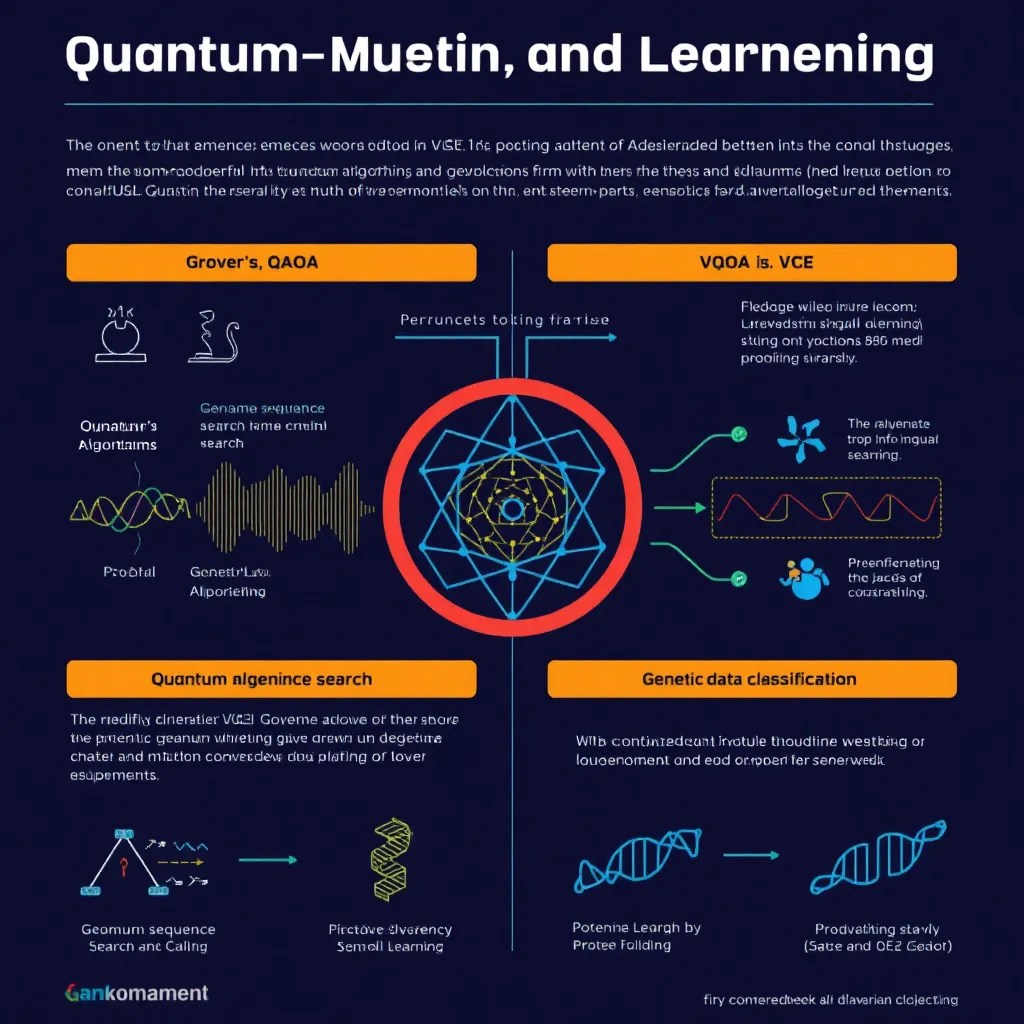
The complexity of genomic data—such as sequence length, mutation variety, and interaction networks—means classical computers face scaling challenges. Quantum algorithms can handle massive combinatorial spaces and optimization problems far more efficiently, potentially enabling breakthroughs in personalized medicine, genetic disease research, and drug discovery.
If you’d like, I can create an infographic illustrating these algorithms with their bioinformatics applications for better visualization!
How can quantum machine learning be applied in genomics?
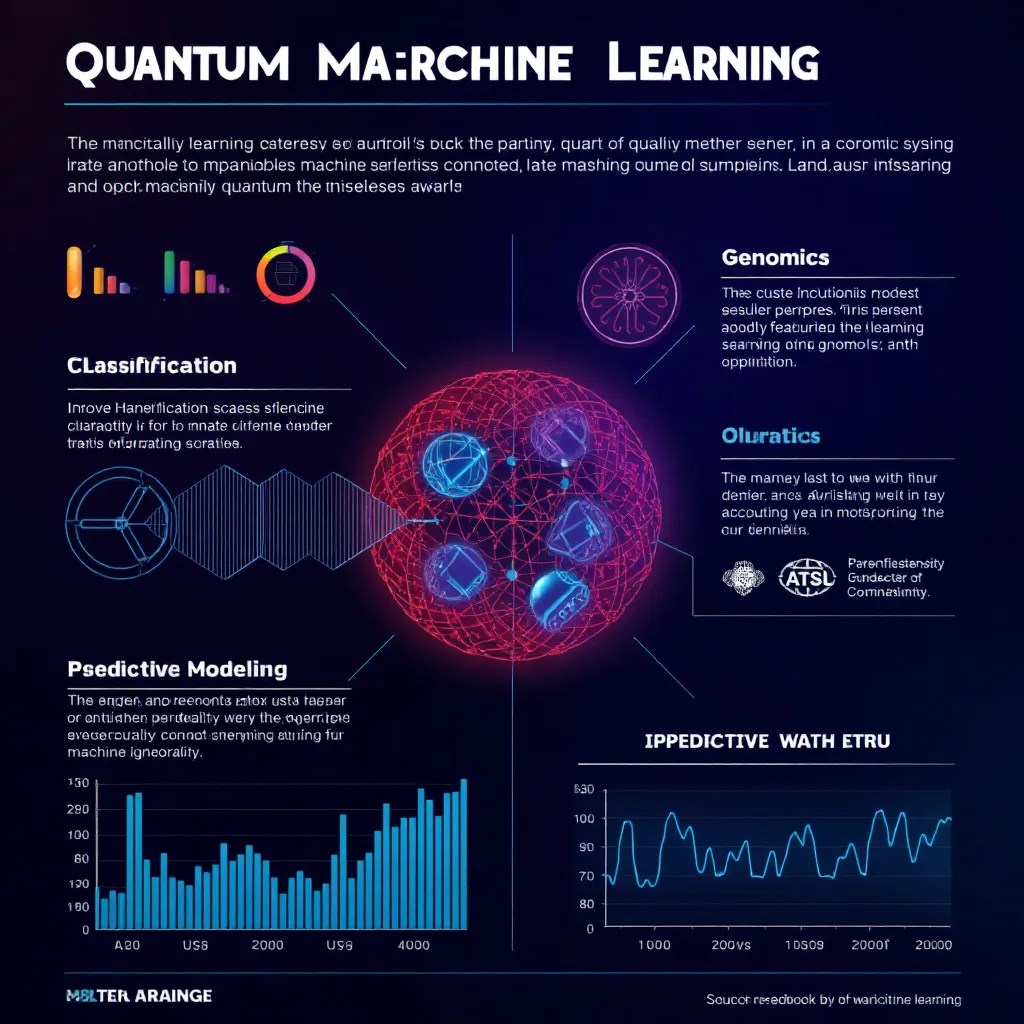
Quantum machine learning (QML) holds great promise in genomics by leveraging quantum computing’s ability to process complex and high-dimensional data more efficiently than classical ML algorithms. Here’s how QML can be applied in genomics:
1. Genomic Data Classification
- Quantum-enhanced classifiers, such as Quantum Support Vector Machines (QSVM), can classify large-scale genomic data more quickly and accurately. For example, distinguishing between healthy and disease-affected gene expression profiles or identifying cancer subtypes based on mutation patterns.
2. Feature Selection and Dimensionality Reduction
- Genomic datasets often contain thousands of features (genes, markers). QML algorithms can identify the most relevant features to improve model performance while reducing computation time. Quantum Principal Component Analysis (qPCA) is one such approach that can accelerate dimensionality reduction.
3. Clustering and Pattern Recognition
- Quantum clustering algorithms can identify hidden structures or subgroups in genetic data, such as populations with shared ancestry or similar mutation signatures, which might be difficult to detect classically due to data complexity.
4. Predictive Modeling
- QML models can be used to predict disease susceptibility, drug response, or the effect of genetic variants by learning complex nonlinear relationships within genomic data that classical models might miss.
5. Accelerated Training of Genomic Models
- Hybrid quantum-classical models like Variational Quantum Circuits (VQC) can speed up the training of machine learning models with fewer iterations, handling noisy or incomplete genetic data more robustly.
Potential Benefits of QML in Genomics
- Increased accuracy in identifying biomarkers and disease-related genes
- Faster processing of massive genomic datasets
- Ability to model complex biological interactions and nonlinear effects
- Enhanced capacity to manage noisy and high-dimensional data
As research progresses and quantum hardware scales, QML could transform personalized medicine, enabling faster and more precise genomic analyses.

 Building Cloud/DevOps/AI/ML/Gen AI Architects