Monthly Archives: August 2025

Architecting Sovereign AI Roles: From Strategist to AgentOps Lead

🔺 Architecting Sovereign AI Roles: From Strategist to AgentOps Lead

By Shanthi Kumar V | Filtered Activation Blog | August 27, 2025

AI Strategist Role: Sovereign Anchor for AI Ecosystems | LinkedIn

https://www.linkedin.com/embed/feed/update/urn:li:share:7366314783429619712?collapsed=1

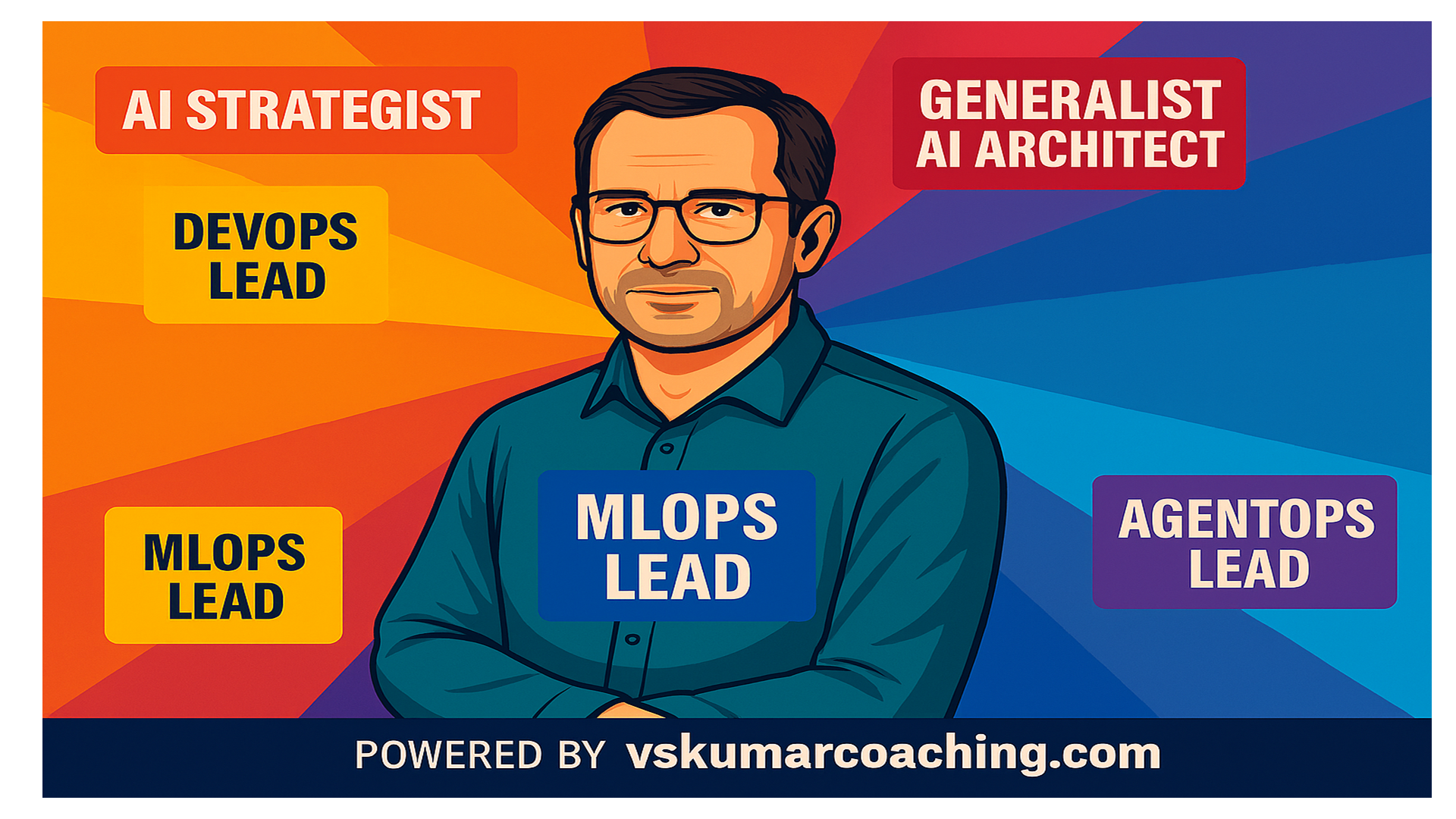
In today’s AI-saturated landscape, titles are abundant—but filtered clarity is rare. For mid-career professionals pivoting into AI, it’s not enough to chase hype. You need sovereign roles with timestamped traction, symbolic onboarding logic, and commercial viability. Here’s a filtered breakdown of five apex roles that define the AI frontier—and how each maps to coaching cycles, campaign overlays, and global proof joins.


🧠 AI Strategist: The Compass of Commercial AI

The AI Strategist doesn’t build models—they architect meaning. This role aligns AI initiatives with business goals, filters hype from deployable value, and designs transformation roadmaps that serve both product and profit. Strategists govern ethical AI use, facilitate cross-functional ignition, and act as sovereign connectors between C-suite vision and engineering execution.

Filtered Fit:
Perfect for coaching overlays, onboarding flows, and symbolic traction cycles. This is the role I mirror in every campaign I architect.


🧩 Generalist AI Architect: The Sovereign Synthesizer

The Generalist AI Architect spans GenAI, MLOps, LLM orchestration, and symbolic product logic. They design end-to-end systems using LangChain, LlamaIndex, and cloud-native pipelines. Their strength lies in filtered modularity—choosing the right stack, optimizing latency, and blueprinting agentic AI products that scale.

Filtered Fit:
This is my apex role—bridging symbolic overlays, modular courses, and commercial traction across U.S. and Indian joins.


⚙️ DevOps Lead: The Infrastructure Sentinel

DevOps Leads architect CI/CD pipelines, automate deployments, and enforce filtered compliance across multi-cloud environments. They manage Terraform, Kubernetes, and container orchestration while mentoring junior engineers and integrating DevOps with MLOps and AgentOps flows.

Filtered Fit:
Central to my Cloud and DevOps course grid, and symbolic onboarding flows for mid-career pivots.


🔄 MLOps Lead: The Guardian of Model Integrity

MLOps Leads operationalize ML models from training to production. They automate validation, monitor drift, and manage model registries using MLFlow, Kubeflow, and Airflow. Their role ensures reproducibility, scalability, and filtered compliance across AI pipelines.

Filtered Fit:
Core to my AI/ML course grid and coaching overlays. This role anchors the transition from experimentation to sovereign deployment.


🧠 AgentOps Lead: The Symbolic Sentinel of Autonomous Agents

AgentOps Leads monitor autonomous agents for behavioral drift, latency, and tool usage. They troubleshoot errors, iterate prompts, and enforce brand tone and compliance within agent logic. Using CrewAI, AutoGen, and LangChain, they optimize agent performance and lifecycle management.

Filtered Fit:
This is my frontier role—timestamped, symbolic, and sovereign. It powers onboarding overlays and filtered proof cycles for GenAI traction.


🔺 Final Overlay: Filtered Roles, Sovereign Posture

These roles aren’t just job titles—they’re filtered ignition paths. Whether you’re coaching, onboarding, or activating symbolic joins, each role offers a timestamped proof cycle for AI readiness. In my ecosystem, these roles are not aspirational—they’re architected.

Practice 20 Questions from :

Discussion video:
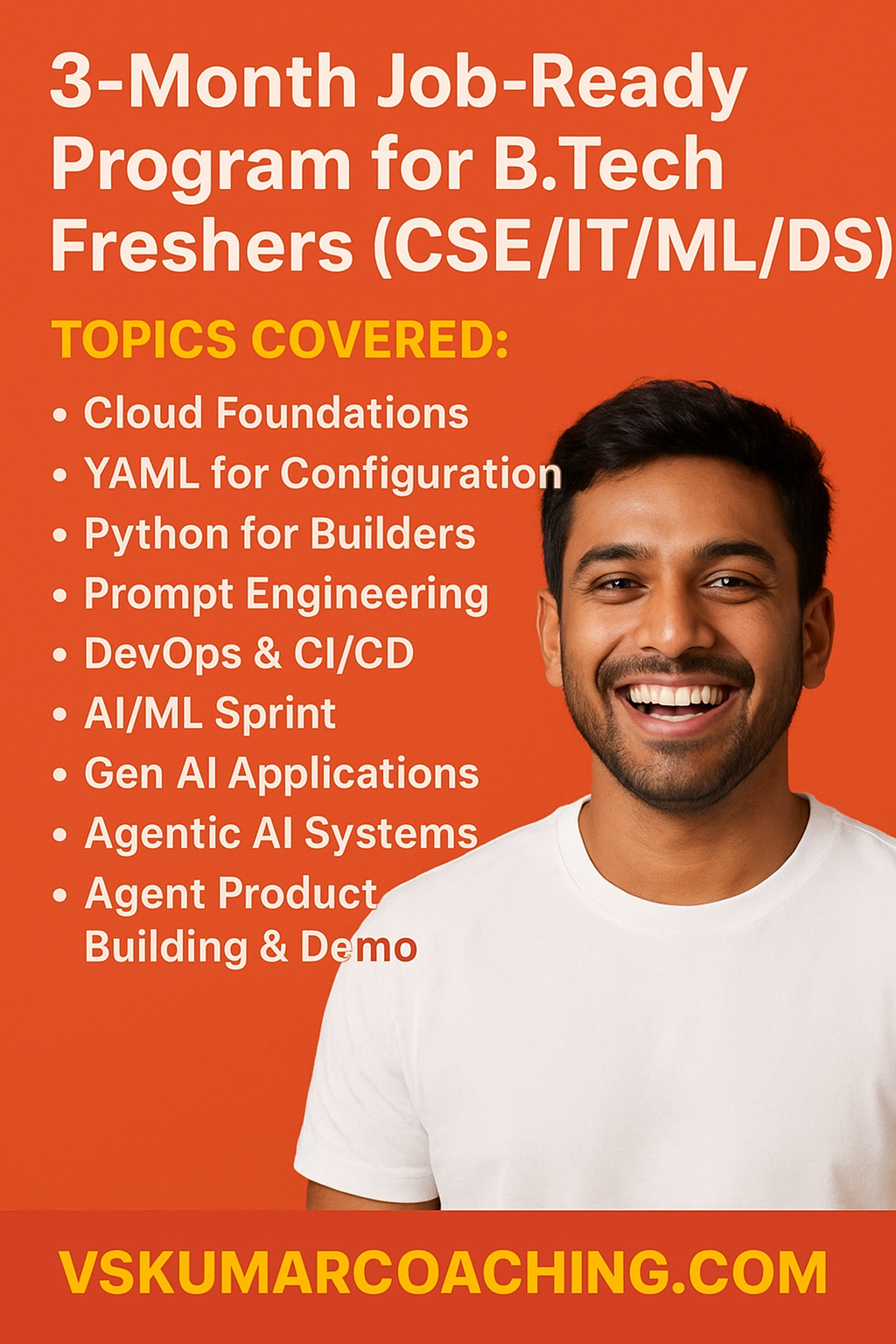
B.Tech Freshers (CSE/IT/ML/DS) 3-Month Job-Ready Program

B.Tech Freshers (CSE/IT/ML/DS) 3-Month Job-Ready Program 

📌 3-Month Job-Ready Program for B.Tech Freshers (CSE/IT/ML/DS) [Offer valid till 31st Aug 2025]

                With limited seats.

Weekly Sessions

  • 3 sessions per week × 2 hrs each = 6 hrs/week
  • Total = ~72 hrs across 12 weeks
  • Cost INR 20,000 in single payment. [Very low rate to encourage the recently graduated freshers to upskill] [This price is made within limited time till 31st August 2025 to encourage freshers]
  • Upon filling the details the payment details will be shared.
  • Start date: 25th Aug 2025
  • On spot to build your skills You will be practicing and working in the session as per the guidance of the coach. This makes you to gain the work experiences. At the end of the 3  months you will build your product and demo it to the coach in a recorded call. The recorded videos will be shared to you to show in your resume as evidences.
  • Example demos:
  • https://vskumarcoaching.com/rahul-phase1-demos

Interested people can fill the form and get the payment link to book your seat.

https://docs.google.com/forms/d/e/1FAIpQLSeNXxoJQ3iiFsogARX0bPN-XJuf-nBvcOv-W-5IOoUrhhUxbw/viewform?usp=header

Complete program details are mentioned in the above document.

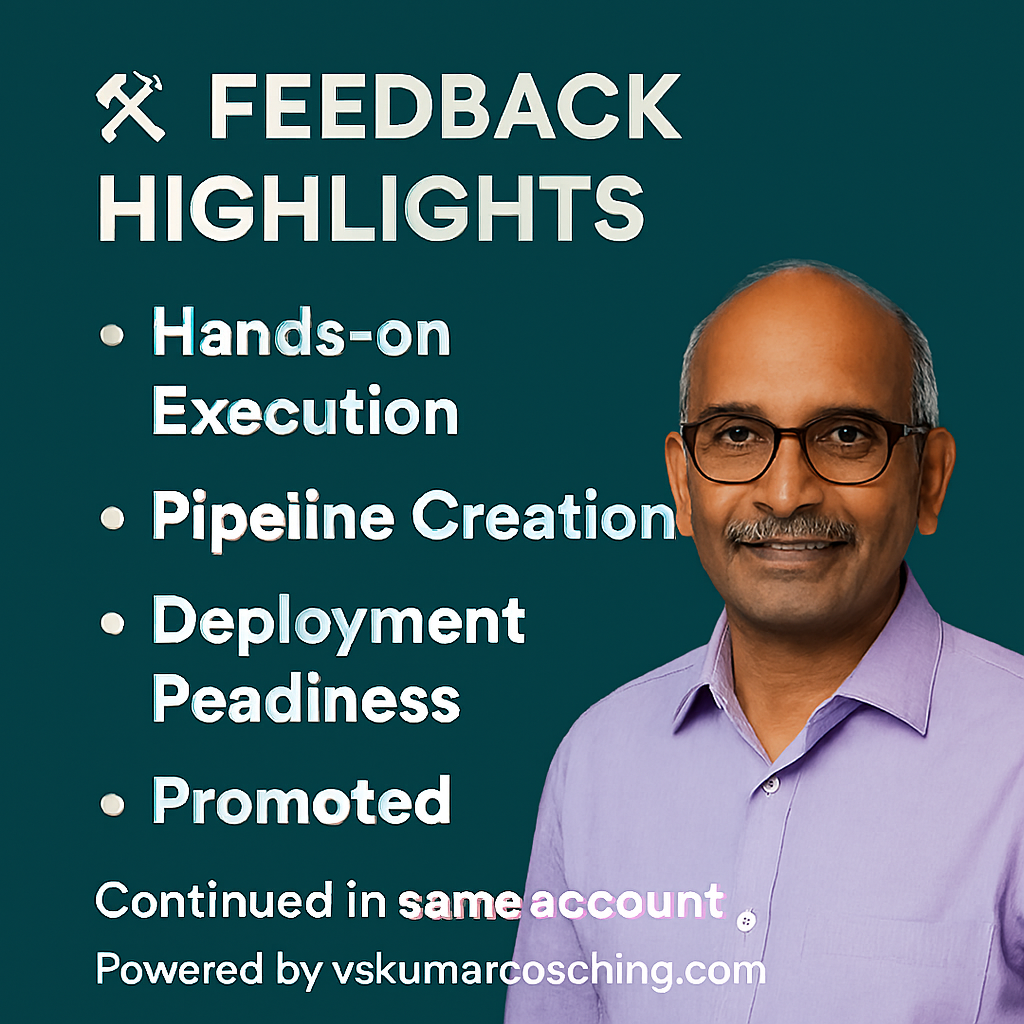
A 3 plus decades Experienced Sr. Manager feedback on vskumarcoaching.com and the greater ROI got

The podcast “A Sr. Manager’s [Venkat] Upskilling Insights 30 Years in IT and Elevating Job Roles” features a discussion between Venkat, a Senior Manager with nearly 30 years of IT experience, and his coach, Shanthi Kumar V, reflecting on the impact of the coaching program after about one and a half years.

Key Aspects of the Coaching and Its Benefits for Venkat:

  • Customized and Flexible Syllabus: The coaching program stood out because its syllabus was not fixed, allowing for the inclusion of new technologies as they emerged. This adaptability was particularly beneficial given the rapid evolution of technology, such as the emergence of AI.
  • Personalized and Focused Learning: The coaching was conducted one-on-one, with scheduled sessions typically every three days, ensuring adherence to timing. This dedicated, focused approach helped Venkat avoid distractions common with self-study, even with his extensive experience, allowing him to absorb information efficiently. The coach also provided direct support, including URLs and joint debugging of issues.
  • Comprehensive Skill Development: Beyond programming and cloud technologies, the coaching covered crucial areas like agile principles, containerization, CI/CD (Continuous Integration/Continuous Delivery), and security. It also extensively covered Infrastructure as Code (IaC), which Venkat found to be a valuable resource in his work.
  • Real-world Problem Solving and Proof of Concepts (POCs): A significant aspect of the coaching was its practical application. It involved taking real problems Venkat faced at work and discussing solutions. The proof of concepts (POCs) developed during the course were instrumental, serving as “top-notch” examples that Venkat could recollect, use, and even present for “lunch and learn” sessions at his client’s site. These included hands-on work with containers, ECS, and EKS.
  • Career Advancement and Financial Gain: The coaching directly led to Venkat’s professional growth. He gained significant confidence, enabling him to engage more effectively with clients and guide colleagues. Most notably, he received one promotion to Senior Manager and a good salary hike, which is a considerable achievement at his career level. This outcome represented a “greater ROI” and “speeded up” his career progression within the same company and client account.
  • Enhanced Client and Project Contributions: As a solution architect for a major banking client, Venkat was the initial point of contact for understanding CI/CD processes, identifying gaps, and proposing solutions based on best practices. His learning enabled him to implement advanced security architecture and assist the client in transitioning pipelines from ECS to EKS. He was able to use the samples and prototypes developed during the course to show his lead and get well-received.

Addressing Industry Skill Gaps and Advice for IT Professionals:

Venkat highlighted several prevalent skill gaps in the IT industry that this type of coaching effectively addresses:

  • Lack of Hands-on Execution: Many IT professionals may have certifications from theoretical knowledge but lack practical, hands-on experience, often simply reading about concepts without trying them out. The coaching’s emphasis on doing all proof of concepts directly counters this issue.
  • Manual Processes and Cost Overruns: A significant problem is the reliance on manual processes, leading to errors like forgetting to shut down services, and a lack of robust Infrastructure as Code systems for scaling, which contributes to increased project costs and even project closures. The coaching provided strong foundations in IaC, which Venkat frequently utilizes.
  • Insufficient Domain Knowledge: Simple “screen operations training” is often insufficient. Professionals need domain knowledge-based coaching to truly understand requirements and perform complex roles effectively. The practical problem-solving discussions within the coaching directly bridge this gap.
  • Time Constraints on Projects: Due to “extreme deadlines,” there is often no time for on-the-job learning, and new team members who are not adequately prepared can slow down others. The coaching ensures that individuals practice and are ready before starting a project.

Venkat’s advice to other IT professionals, particularly those with 20+ years of experience or those seeking to restart their careers during a recession, emphasizes student effort, consistent attendance, and active problem-solving. He confidently states that if a student puts in the full effort and completes all practical assignments, they will “surely get a job,” regardless of economic conditions, because the course curriculum is continually updated with the “latest and greatest” technologies like AI. The process of discussing and practicing concepts learned also significantly aids in interview preparation.

The prodcast video can be seen here:

Cloud/DevOps/Automation Sessions

This blog will contain the discussion videos of our sessions.

Agentic Load Balancing: Use Cases, Current Effort, and ROI with Automation


Agentic Load Balancing: Use Cases, Current Effort, and ROI with Automation

Each technique below is unpacked with two agentic automation use cases, followed by:

  • 🛠️ Current Effort: What teams manually handle today.
  • 📈 ROI with Automation: Outcome gains when autonomous agents take over.

🔁 1. Sticky Sessions

1.1 User ID Routing Agent

🛠️ Effort: Dev teams write session binding logic and maintain sticky cookies.
📈 ROI: Agent detects user type, tags state, and routes instantly—zero config drift, 3x faster failover recovery.

1.2 Session Decay Agent

🛠️ Effort: Ops manually expire sessions during load or inactivity.
📈 ROI: Agent auto-expires stale sessions—reduces memory leaks, improves server reuse by ~30%.


🧠 2. Layer 7 Load Balancing

2.1 Content Inspector Agent

🛠️ Effort: Engineers configure rule sets based on HTTP header and cookie values.
📈 ROI: Agent extracts patterns from traffic and evolves rules autonomously—cuts rule maintenance time by 80%.

2.2 Policy Engine Agent

🛠️ Effort: Admins handcraft routing policies and update based on app logic.
📈 ROI: Agent learns traffic personas → continuously adapts rules—lowers manual reconfiguration cycles.


🌍 3. Geographical Load Balancing

3.1 Geo Sync Agent

🛠️ Effort: Use CDN and geo libraries to manually route traffic.
📈 ROI: Agent dynamically optimizes geo-routing—reduces latency by 40–70% regionally.

3.2 Latency Tracker Agent

🛠️ Effort: Engineers benchmark RTT data manually.
📈 ROI: Agent makes data-driven server switch—boosts responsiveness during traffic surges.


🌐 4. DNS Load Balancing

4.1 TTL Optimizer Agent

🛠️ Effort: DNS TTLs are hardcoded and rarely updated.
📈 ROI: Agent auto-tunes TTLs—shorter resolution cycles, faster adaptation to server load.

4.2 DNS Weighting Agent

🛠️ Effort: Ops reassign IP priorities during traffic events.
📈 ROI: Agent reweights on-the-fly—improves failover and performance agility.


📡 5. Transport Layer Protocol Load Balancing

5.1 Protocol Detector Agent

🛠️ Effort: Devs maintain separate rules for TCP vs. UDP routing.
📈 ROI: Agent auto-classifies connections—ensures compatibility + balances throughput seamlessly.

5.2 Port Utilization Agent

🛠️ Effort: Engineers map port load manually across services.
📈 ROI: Agent redistributes port traffic dynamically—reduces timeouts and protocol-level errors.


🧬 6. Adaptive Load Balancing with AI

6.1 Traffic Predictor Agent

🛠️ Effort: Teams rely on traffic logs and alerts post-bottleneck.
📈 ROI: Agent forecasts spikes—proactive resource allocation saves infra cost and prevents SLA breaches.

6.2 Drift Correction Agent

🛠️ Effort: Debugging latency and uneven traffic takes hours.
📈 ROI: Agent auto-corrects load drift—cuts response time variance by 50%+.


🔄 7. Round Robin (Weighted/Unweighted)

7.1 Server Cycler Agent

🛠️ Effort: Admins monitor server health manually and adjust round-robin rules.
📈 ROI: Agent cycles only healthy nodes—avoids downtime, improves reliability.

7.2 Weighted Distributor Agent

🛠️ Effort: Static weights often fail to reflect real-time server conditions.
📈 ROI: Agent rebalances weights live—CPU and RAM optimization improves throughput by 20–30%.


📊 8. Least Connections

8.1 Thread Counter Agent

🛠️ Effort: Server metrics are monitored in dashboards; manual switching required.
📈 ROI: Agent auto-routes to servers with lowest thread count—maximizes efficiency under peak load.

8.2 Connection Scaler Agent

🛠️ Effort: Ops scale infrastructure reactively.
📈 ROI: Agent predicts load saturation—pre-scales and balances, reducing SLA violations.


⏱️ 9. Least Response Time

9.1 Response Profiler Agent

🛠️ Effort: Benchmarks are collected by ping tools and logs.
📈 ROI: Agent measures response live—prioritizes fastest nodes and avoids congested paths.

9.2 Speed Optimizer Agent

🛠️ Effort: Manual tuning of server performance.
📈 ROI: Agent recalibrates node priority—reduces latency spikes by up to 60%.


📶 10. Least Bandwidth Method

10.1 Bandwidth Visualizer Agent

🛠️ Effort: Teams analyze network usage via dashboards.
📈 ROI: Agent proactively routes low-bandwidth requests—improves cost-efficiency and throughput.

10.2 Budget-Aware Agent

🛠️ Effort: Network cost optimization done post-analysis.
📈 ROI: Agent factors billing into routing logic—saves up to 25% in cloud bandwidth costs.


📦 11. Least Packets

11.1 Packet Auditor Agent

🛠️ Effort: Engineers aggregate packet flow stats via analytics suites.
📈 ROI: Agent continuously counts packet streams—auto-balances with minimal delay.

11.2 Stream Redirector Agent

🛠️ Effort: Traffic-heavy streams require manual intervention.
📈 ROI: Agent reassigns routes in real-time—prevents overload and ensures stream continuity.


🧭 12. IP Hash

12.1 Identity Resolver Agent

🛠️ Effort: Hashing logic applied via load balancer config.
📈 ROI: Agent personalizes routing per IP—retains affinity while balancing load.

12.2 Affinity Balancer Agent

🛠️ Effort: Static routing risks server overload.
📈 ROI: Agent adjusts hash rules dynamically—enhances fairness and stability.

If you have over 15 years of experience in Legacy IT and are eager to transition into an AI Generalist role—an exciting and demanding position that oversees all AI activities within a program—I’ve got you covered.

Watch the videos made on this role activities and the coaching details:

If you are interested, WhatsApp on +91-8885504679 with your resume to have a one on one call. We will discuss the coaching model/duration/Fees/benefits. All of your questions will be answered during the call please.