
The podcast “A Sr. Manager’s [Venkat] Upskilling Insights 30 Years in IT and Elevating Job Roles” features a discussion between Venkat, a Senior Manager with nearly 30 years of IT experience, and his coach, Shanthi Kumar V, reflecting on the impact of the coaching program after about one and a half years.
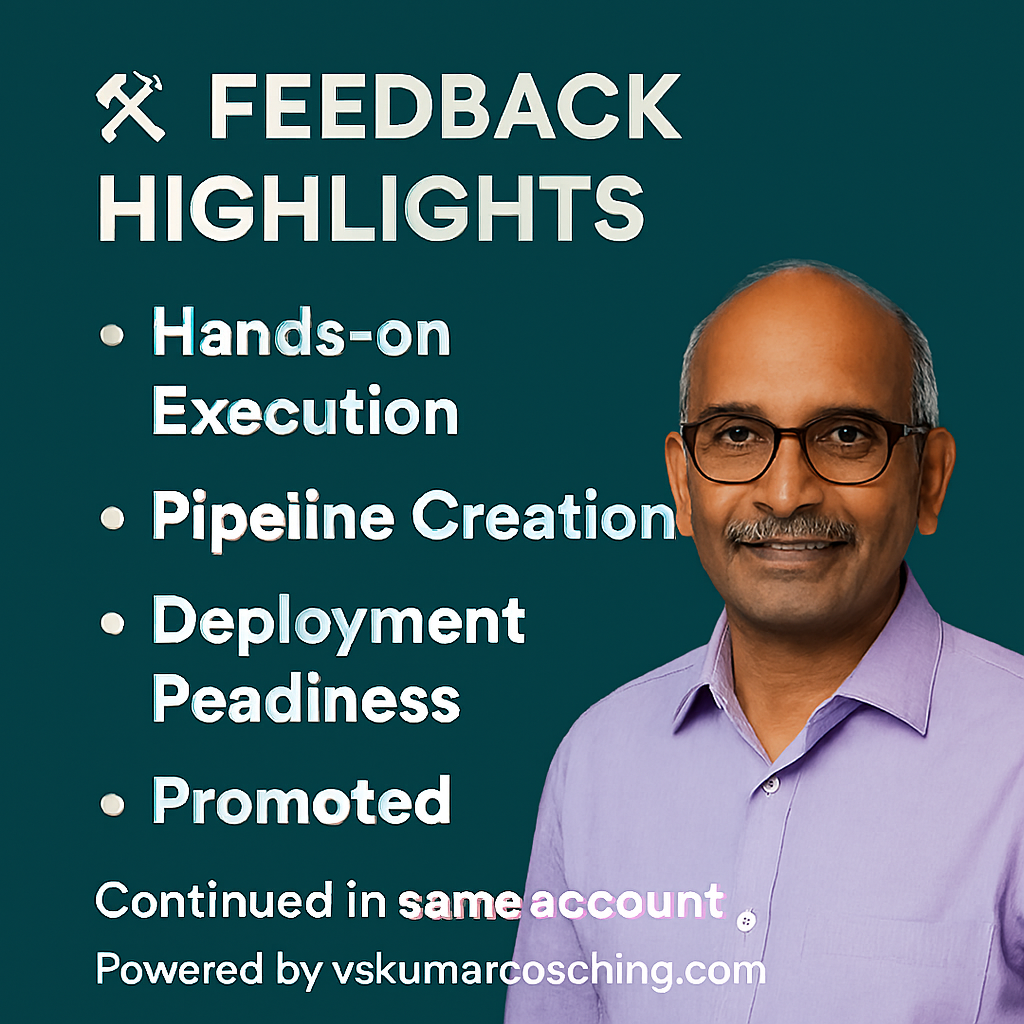
Key Aspects of the Coaching and Its Benefits for Venkat:
- Customized and Flexible Syllabus: The coaching program stood out because its syllabus was not fixed, allowing for the inclusion of new technologies as they emerged. This adaptability was particularly beneficial given the rapid evolution of technology, such as the emergence of AI.
- Personalized and Focused Learning: The coaching was conducted one-on-one, with scheduled sessions typically every three days, ensuring adherence to timing. This dedicated, focused approach helped Venkat avoid distractions common with self-study, even with his extensive experience, allowing him to absorb information efficiently. The coach also provided direct support, including URLs and joint debugging of issues.
- Comprehensive Skill Development: Beyond programming and cloud technologies, the coaching covered crucial areas like agile principles, containerization, CI/CD (Continuous Integration/Continuous Delivery), and security. It also extensively covered Infrastructure as Code (IaC), which Venkat found to be a valuable resource in his work.
- Real-world Problem Solving and Proof of Concepts (POCs): A significant aspect of the coaching was its practical application. It involved taking real problems Venkat faced at work and discussing solutions. The proof of concepts (POCs) developed during the course were instrumental, serving as “top-notch” examples that Venkat could recollect, use, and even present for “lunch and learn” sessions at his client’s site. These included hands-on work with containers, ECS, and EKS.
- Career Advancement and Financial Gain: The coaching directly led to Venkat’s professional growth. He gained significant confidence, enabling him to engage more effectively with clients and guide colleagues. Most notably, he received one promotion to Senior Manager and a good salary hike, which is a considerable achievement at his career level. This outcome represented a “greater ROI” and “speeded up” his career progression within the same company and client account.
- Enhanced Client and Project Contributions: As a solution architect for a major banking client, Venkat was the initial point of contact for understanding CI/CD processes, identifying gaps, and proposing solutions based on best practices. His learning enabled him to implement advanced security architecture and assist the client in transitioning pipelines from ECS to EKS. He was able to use the samples and prototypes developed during the course to show his lead and get well-received.
Addressing Industry Skill Gaps and Advice for IT Professionals:
Venkat highlighted several prevalent skill gaps in the IT industry that this type of coaching effectively addresses:
- Lack of Hands-on Execution: Many IT professionals may have certifications from theoretical knowledge but lack practical, hands-on experience, often simply reading about concepts without trying them out. The coaching’s emphasis on doing all proof of concepts directly counters this issue.
- Manual Processes and Cost Overruns: A significant problem is the reliance on manual processes, leading to errors like forgetting to shut down services, and a lack of robust Infrastructure as Code systems for scaling, which contributes to increased project costs and even project closures. The coaching provided strong foundations in IaC, which Venkat frequently utilizes.
- Insufficient Domain Knowledge: Simple “screen operations training” is often insufficient. Professionals need domain knowledge-based coaching to truly understand requirements and perform complex roles effectively. The practical problem-solving discussions within the coaching directly bridge this gap.
- Time Constraints on Projects: Due to “extreme deadlines,” there is often no time for on-the-job learning, and new team members who are not adequately prepared can slow down others. The coaching ensures that individuals practice and are ready before starting a project.
Venkat’s advice to other IT professionals, particularly those with 20+ years of experience or those seeking to restart their careers during a recession, emphasizes student effort, consistent attendance, and active problem-solving. He confidently states that if a student puts in the full effort and completes all practical assignments, they will “surely get a job,” regardless of economic conditions, because the course curriculum is continually updated with the “latest and greatest” technologies like AI. The process of discussing and practicing concepts learned also significantly aids in interview preparation.
The prodcast video can be seen here:
 Building Cloud/DevOps/AI/ML/Gen AI Architects