Monthly Archives: October 2025

AI Landscape Briefing: Key Developments and Strategic Shifts

AI Landscape Briefing: Key Developments and Strategic Shifts

Executive Summary

The artificial intelligence sector is experiencing a period of intense and rapid evolution, characterized by a strategic battle for dominance in emerging markets, significant leaps in model capabilities, and the expansion of AI into physical and cognitive realms. Major technology corporations are engaged in a fierce competition for the Indian market, which has become a critical strategic battleground. OpenAI has made its premium ChatGPT Go plan free for one year in India, while Google is investing $15 billion in a massive AI facility, and Anthropic is establishing a major presence in Bengaluru.

Simultaneously, product innovation is accelerating. Google unveiled a suite of coordinated updates spanning quantum computing, robotics with internal monologue capabilities, and healthcare breakthroughs. Anthropic has expanded its ecosystem with a desktop application for Claude, introducing “Skills” and cloud-based coding to create a more integrated user experience, alongside a significantly cheaper and faster model, Haiku 4.5. OpenAI is shifting its focus towards action-oriented AI with the launch of its web agent, Atlas, and the acquisition of the team behind the on-screen assistant Sky.

This progress is mirrored by advancements in AI’s application in the physical world, exemplified by Figure AI’s mass-producible humanoid robot, Figure 03, designed for domestic work. In the cognitive domain, MIT’s Neurohat project demonstrates the first integration of an LLM with real-time brain data to create adaptive learning experiences. However, these advancements are accompanied by significant challenges, highlighted by a real-world incident where an AI security system misidentified a bag of chips as a gun, underscoring the critical need for human oversight. The overarching narrative raises a fundamental question about the future of work: whether AI will serve to augment human capability or automate it, making human roles indispensable or replaceable.

——————————————————————————–

1. The Strategic Battleground: India’s AI Market

India has emerged as the second-largest market for major AI companies after the United States, prompting an aggressive push for user acquisition and infrastructure development.

  • OpenAI’s Market Saturation Strategy: OpenAI has made its premium “ChatGPT Go” plan, normally priced at 399 rupees per month, completely free for a full year in India, starting November 4th. This plan includes access to GPT-5 and offers 10 times the capacity for messages, image generation, and file uploads compared to the standard free tier. This move is a direct response to competitors, such as Perplexity’s partnership with Airtel and Google’s free Gemini Pro access for students, and aims to solidify OpenAI’s foothold in a market where its user base tripled in the last year.
  • Google’s Foundational Investment: Google is undertaking a monumental infrastructure project in India, investing $15 billion to build its second-largest data center outside the U.S. in Visakhapatnam (Visag). In partnership with Adani Group and Bharti Airtel, the project is a 1-gigawatt AI facility designed as an entire campus, powered by 80% clean energy and connected by subsea cables. This investment is poised to create thousands of jobs and fundamentally impact India’s technology economy.
  • Anthropic’s Expansion: Following the identification of India as the second-largest global user base for its model, Claude, in its 2025 economic index report, Anthropic is establishing a major presence in Bengaluru in early 2026. CEO Dario Amadei’s recent visit to meet with government officials signals a focus on developing real-world AI applications in Indian education, healthcare, and agriculture.

2. Innovations in AI Models and Platforms

Leading AI labs are releasing a flurry of updates that enhance model capabilities, improve user accessibility, and introduce novel functionalities across various domains.

Google’s Coordinated Releases

Google announced four major updates simultaneously, demonstrating a multi-faceted approach to AI development.

CategoryDevelopmentDetails
Quantum ComputingWillow Quantum ChipSolved a quantum computing benchmark 13,000 times faster than conventional supercomputers using a verifiable algorithm called “quantum echoes.” This has significant implications for complex problems like drug discovery.
HealthcareGemma 2-Based Cancer ResearchIn collaboration with Yale and DeepMind, a new AI model discovered a drug combination that, in lab tests on human cells, made tumors 50% more visible to the immune system.
RoboticsGemini Robotics 1.5Introduces “thinking via,” an internal monologue in natural language that allows robots to reason through multi-step tasks like folding origami or preparing a salad before taking action.
Developer ToolsVibe Coding in AI StudioA drag-and-drop application creation tool. Features include “annotation mode” for making changes via voice commands and an “I’m feeling lucky” button for generating app ideas.
User ExperienceNotebook LM Visual StylesThe note-taking tool can now transform study notes into narrated videos with six new visual styles, including anime, watercolor, and papercraft. The AI generates contextual illustrations that match the content.

Anthropic’s Claude Ecosystem Expansion

Anthropic has focused on deeply integrating its Claude model into user workflows while making its technology more accessible and powerful.

  • Desktop Integration: Claude is now available as a desktop application for Windows and Mac, allowing users to access it with a keyboard shortcut without switching context.
  • Desktop Extensions & Skills: Using a “Model Context Protocol,” the desktop app can connect to local files, databases, and code. “Claude Skills” are custom, reusable folders of instructions and scripts that Claude can automatically load to perform specialized tasks, creating an AI that remembers a user’s specific workflows.
  • Cloud-Based Coding: Users can now assign coding tasks to Claude, which it will execute in the cloud, even from a mobile phone (currently iOS-only).
  • Claude Haiku 4.5: This new model reportedly matches the performance of Anthropic’s previous top-tier model but is three times cheaper and runs twice as fast. It is the first Haiku model to feature “extended thinking,” enabling it to solve complex problems more efficiently.

OpenAI’s Push Towards Action-Oriented AI

OpenAI is evolving ChatGPT from a conversational tool into an agent capable of performing tasks on behalf of the user.

  • Atlas Web Agent: OpenAI launched Atlas, an AI designed to browse the web and take actions such as booking flights, conducting research, clicking buttons, and filling out forms.
  • Acquisition of Sky: OpenAI acquired Software Applications Incorporated, the company behind the Mac application Sky. Sky is an AI assistant that can see what is on a user’s screen and interact with it by clicking buttons. The team, which previously created Workflow (the precursor to Apple’s Shortcuts), will integrate this technology into ChatGPT.

Emerging Challengers

New and specialized models are entering the market, challenging established players in unique ways.

  • xAI’s Grokipedia: Elon Musk launched an AI-powered encyclopedia intended to rival Wikipedia, with the stated goal of delivering “the whole truth.” It launched with 885,000 articles, compared to Wikipedia’s 7 million. The platform is controversial; while supporters praise its unfiltered approach to sensitive topics, critics allege bias, poor search functionality, and content heavily derived from Wikipedia without proper citation.
  • Alibaba’s Qwen 3VL: Alibaba released a small but powerful vision-language model in 2-billion and 32-billion parameter versions. The 32B model has shown superior performance to larger models like GPT-5 mini and Claude 4 Sonnet in specific benchmarks for science problems, video understanding, and agentic tasks.

3. AI in the Physical and Cognitive Worlds

Advancements are extending beyond software, with AI now being integrated into advanced robotics and directly with the human brain.

Humanoid Robotics: Figure 03

The robotics company Figure AI has made significant strides toward creating a commercially viable humanoid robot for domestic use.

  • Design for Mass Manufacturing: Figure 03, featured on the cover of Time magazine’s Best Inventions of 2025, is engineered for mass production. The company has built a factory (“Bot-Q”) to manufacture 12,000 units this year, scaling to 100,000 over four years.
  • Hardware and AI Synergy: The robot runs on Helix AI, a proprietary vision-language-action system. Its hardware is purpose-built to support this AI, featuring cameras with double the frame rate and a 60% wider field of view than its predecessor, embedded palm cameras for work in confined spaces, and fingertip sensors that can detect forces as small as 3 grams (the weight of a paperclip).
  • Human-Centric Design: The robot is 9% lighter than Figure 02, covered in soft, washable textiles, and features wireless charging via coils in its feet.
  • Data Collection Methodology: Figure is employing human pilots in VR headsets to perform household tasks, generating massive training datasets for Helix AI by learning from every success and failure.

Neuro-adaptive Technology: MIT’s Neurohat

Researchers at the MIT Media Lab have created the first system to directly integrate a large language model with real-time brain data.

  • Brain-Computer Interface: The “Neurohat” is a headband that continuously monitors a user’s brain activity to calculate an “engagement index,” determining if the user is focused, overloaded, or bored.
  • Adaptive Conversation: Based on this index, the integrated LLM (GPT-4) automatically adjusts its conversational style—altering the complexity, tone, and pacing of information. It presents more challenging material when the user is engaged and simplifies explanations when focus dips.
  • Pilot Study Findings: A preliminary study confirmed that Neurohat significantly increased both measured and self-reported user engagement. However, it did not produce an immediate improvement in short-term learning outcomes, such as quiz scores, suggesting it simplifies the learning process rather than making users “smarter overnight.”

4. Critical Challenges and Societal Implications

The rapid deployment of AI technologies brings to light profound ethical questions and concerns about safety and the future of human labor.

The Perils of Automation without Oversight

A recent event in Baltimore serves as a stark warning about the risks of deploying AI in critical, real-world scenarios without robust human verification.

  • The “Doritos Gun” Case Study: A 16-year-old was apprehended by eight police cars with guns drawn after an AI gun detection system from the company Omnilert misidentified his crumpled Doritos bag as a firearm. The incident highlights the failure of the human systems responsible for verifying the AI’s alert before initiating a high-stakes police response, turning an algorithm’s error into a traumatic event.

The Future of Work: Augmentation vs. Automation

The discourse around AI’s economic impact is crystallizing around a central question: whether humans will use AI to become more capable or be replaced by it.

  • Replaceable or Indispensable: Insights from Anthropic’s upcoming economic index report frame the critical choice facing the workforce. It questions whether individuals are using AI merely to get answers faster or to become “fundamentally smarter” and augment themselves into “irreplaceable” positions.
  • Business Automation Trends: The report notes that 77% of global businesses are already deploying AI to automate complete tasks, targeting not just simple, low-cost work but also “high-value, complex work.” This indicates a widening gap between those who leverage AI for augmentation and those whose roles are being automated.
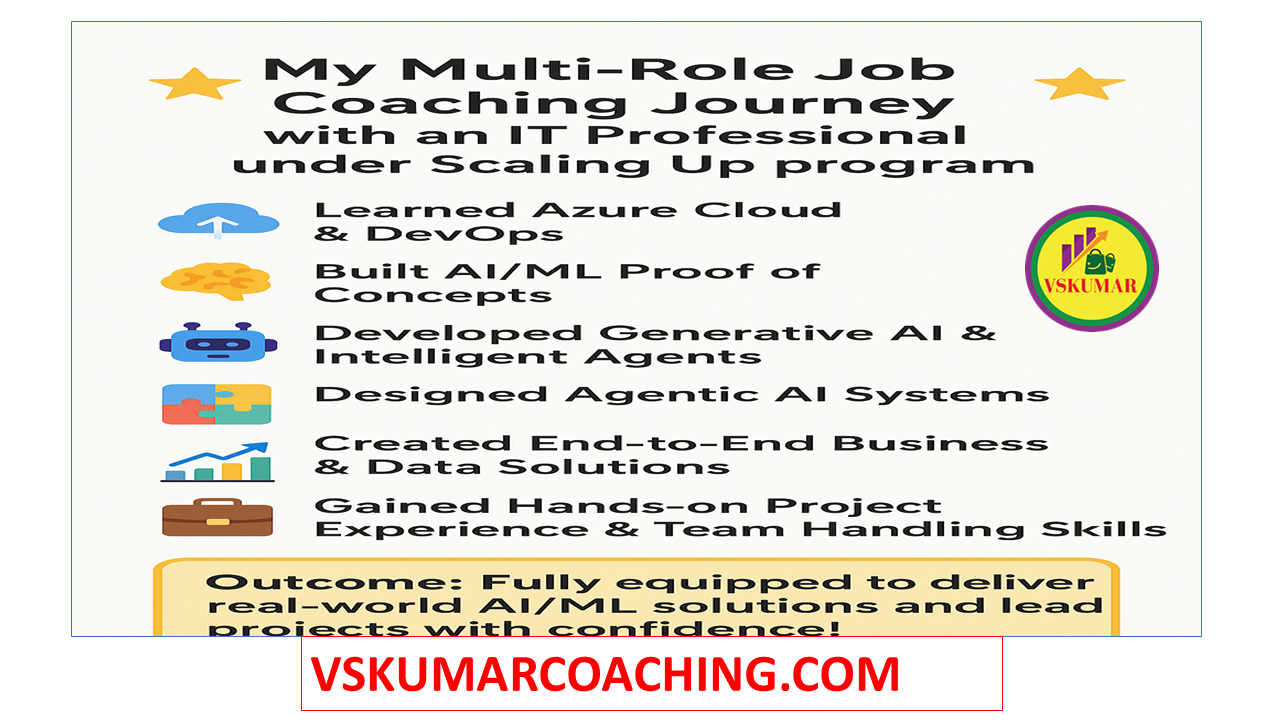
My Multi-Role Job Coaching Journey with an IT Professional under Scaling Up Program

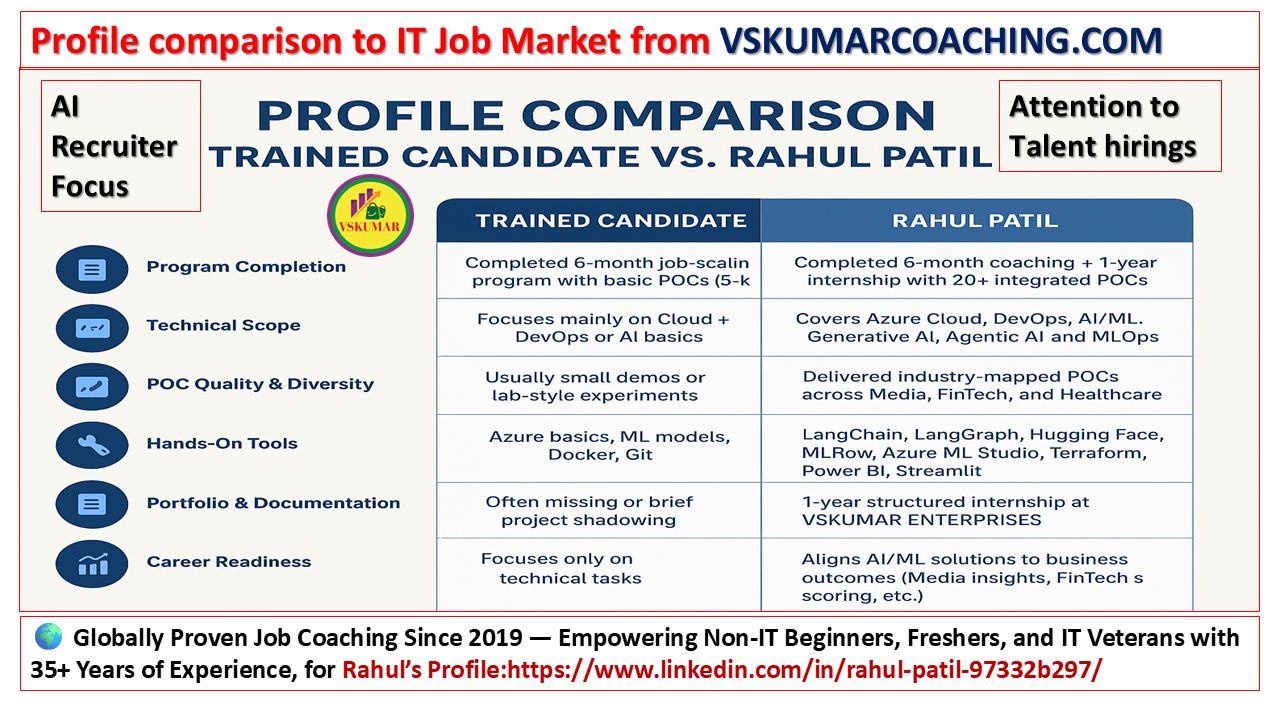
🌟 My Multi-Role Job Coaching Journey with an IT Professional under Scaling Up Program 🌟


🚀 Mastered Azure Cloud & DevOps fundamentals through hands-on learning.
🧠 Built AI/ML Proof of Concepts showcasing innovation and creativity.
🤖 Developed Generative AI & Intelligent Agents for real-world business use cases.
🧩 Designed and implemented Agentic AI Systems with automation workflows.
📊 Delivered End-to-End Business & Data Solutions integrating AI insights.
💼 Enhanced Team Leadership & Project Delivery capabilities.
🔍 Strengthened problem-solving skills across Cloud, AI, and DevOps domains.
✨ Outcome: Ready to lead and deliver cutting-edge AI/ML projects with confidence
🚀 Mastered Azure Cloud & DevOps fundamentals through hands-on learning.
🧠 Built AI/ML Proof of Concepts showcasing innovation and creativity.
🤖 Developed Generative AI & Intelligent Agents for real-world business use cases.
🧩 Designed and implemented Agentic AI Systems with automation workflows.
📊 Delivered End-to-End Business & Data Solutions integrating AI insights.
💼 Enhanced Team Leadership & Project Delivery capabilities.
🔍 Strengthened problem-solving skills across Cloud, AI, and DevOps domains.
✨ Outcome: Ready to lead and deliver cutting-edge AI/ML projects with confidence!

For Rahul Patil’s Profile:https://www.linkedin.com/in/rahul-patil-97332b297/

His Agentic AI solution demo:

Exploring simple Live POCs for Vibe Coding: A Journey into Innovation

Hey there! So, you’re curious about live POCs (Proof of Concepts) for vibe coding, huh? Well, you’ve come to the right place. Let’s dive into this fascinating world where creativity meets technology. You’re gonna love it!

What Exactly is Vibe Coding?

Before we get into the nitty-gritty of live POCs, let’s talk about vibe coding itself. Imagine being able to translate emotions, atmospheres, or even the general “feel” of a moment into code. It’s like capturing lightning in a bottle, but with a keyboard. Vibe coding is all about this magical transformation. It’s a digital symphony where sensory inputs are transformed into interactive experiences.

Picture a scenario where the ambiance of a room adjusts to the collective mood of its occupants, or music selections adapt to your emotional state. Vibe coding is not just about coding; it’s about creating an experience that resonates with the human psyche.

The Role of Live POCs

Now, you might be wondering, what’s the big deal with live POCs? Why are they so essential in vibe coding?

Live POCs serve as a practical demonstration of how vibe coding can be applied in real-world scenarios. They offer a glimpse into the possibilities, helping developers and creators understand the potential and limitations of their ideas. It’s like a dress rehearsal before the big show.

Live POCs provide a sandbox environment where ideas can be tested and refined in real-time, allowing for immediate feedback and iteration. This is crucial in a field like vibe coding, where the intangible nature of feelings and emotions must be accurately captured and expressed through technology. The process not only validates concepts but also inspires further innovation by highlighting what works and what doesn’t.

The Magic of Real-Time Interaction

One of the things that make live POCs so captivating is the element of real-time interaction. You see, when we’re coding for vibes, we’re not just dealing with static data. We’re talking about dynamic, ever-changing inputs that can shift from moment to moment. It’s like trying to catch a wave—exciting, unpredictable, and incredibly rewarding when you get it right.

Real-time interaction allows developers to tweak and adjust their code on the fly, responding to changes in the environment or user input. It’s this flexibility and adaptability that make live POCs such a powerful tool in the world of vibe coding. By facilitating a dialogue between technology and its users, real-time interaction enhances user engagement and provides a richer, more immersive experience.

A Personal Touch: My First Encounter with Vibe Coding

Let me share a little story with you. I remember my first encounter with vibe coding like it was yesterday. I was at a tech conference, surrounded by innovators and creators from all around the world. There was this energy in the air—palpable, electric. And then, I saw a live POC demonstration.

The developer had set up a simple environment where the lighting and music changed based on the audience’s mood. As people laughed, clapped, or even just chatted among themselves, the atmosphere shifted seamlessly. It was like watching magic unfold right before my eyes. That was the moment I realized the true potential of vibe coding.

The room was alive, responding to us in a way that felt almost human. It was a powerful reminder of technology’s potential to connect us more deeply to our surroundings and to each other.

Applications of Vibe Coding in Everyday Life

Alright, let’s get practical. You might be thinking, “This all sounds cool, but how does vibe coding actually fit into my life?” Well, let me tell you, the applications are endless.

Imagine walking into your home, and the lights automatically adjust to match your mood. Feeling stressed? The lighting turns a soothing blue. Celebrating a personal victory? The room fills with vibrant, energizing colors. Or consider a concert where the lighting and effects change based on the crowd’s energy. It’s all possible with vibe coding.

In the realm of healthcare, vibe coding could be used to create calming environments for patients, enhancing recovery through personalized atmospheres. Retail spaces might adapt to customer emotions, optimizing the shopping experience by aligning the environment with consumer moods, potentially influencing purchasing behavior. Even educational settings could benefit, with classroom environments adapting to student engagement levels, fostering more effective learning.

Challenges and Considerations

Of course, like any innovative technology, vibe coding isn’t without its challenges. One major hurdle is accurately interpreting and translating human emotions into code. After all, feelings are complex and often subjective.

There’s also the technical side of things. Developing a live POC requires a solid understanding of both coding and user experience. It’s a delicate balance that demands creativity, technical skill, and a dash of intuition.

Furthermore, privacy concerns must be addressed, as vibe coding systems often rely on collecting personal data to function effectively. Ethical considerations regarding data use and emotional manipulation are paramount. Developers must ensure that their creations enhance user experiences without infringing on personal freedoms or privacy.

Getting Started with Your Own POC

If you’re feeling inspired and ready to dive into the world of vibe coding, you’re gonna want to start with a POC of your own. But where do you begin?

First, identify the vibe or emotion you want to capture. Is it joy, tranquility, excitement? Once you have that in mind, think about the inputs you’ll need. Will you use sound, light, or perhaps even temperature to convey the vibe?

Gather your tools, and start experimenting. Begin with simple setups and gradually introduce more complexity as you become comfortable with the process. Engage with communities of like-minded creators to share insights and challenges. This collaborative approach can offer new perspectives and solutions, enriching your learning journey.

Remember, there’s no right or wrong way to create a live POC. It’s all about exploration and discovery. So don’t be afraid to try new things, make mistakes, and learn along the way.

Final Thoughts: The Future of Vibe Coding

As we wrap up this exploration of live POCs for vibe coding, it’s clear that we’re just scratching the surface of what’s possible. The potential applications are as diverse as they are exciting, and I, for one, can’t wait to see where this journey takes us.

So, whether you’re a seasoned coder or a curious newcomer, I encourage you to dive into the world of vibe coding. Who knows what amazing experiences you’ll create? The future of vibe coding is a frontier of limitless potential, where technology and human experience converge in harmonious synergy. Happy coding!

Mastering Vibe Coding: A Beginner’s Guide

Mastering Vibe Coding: A Beginner’s Guide

Welcome to the world of vibe coding! This blog post will cover everything you need to get started with vibe coding successfully. Imagine having the power of AI models like GPT or Claude at your fingertips, generating code for you while you sip your coffee. Yes, it’s as magical as it sounds!

What is Vibe Coding?

Simply put, vibe coding is the art of creating code by heavily relying on AI models or LLMs (Large Language Models). As a beginner, you might feel like you’re in a scene from “The Matrix,” but don’t worry, this is real and it’s happening now. Instead of wrestling with syntax and technical jargon, you tell the AI what you want in plain English, and voila, it generates the code for you!

Getting Started with Vibe Coding

First things first, you’ll need a code editor. Think of it as your digital canvas where the magic happens. Just like you’d use Microsoft Word or Google Docs for writing essays, we have specific tools called IDEs (Integrated Development Environments) for coding. One popular choice is Cursor, an AI-powered code editor that’s free to use. And no, this isn’t a sponsored post, I just genuinely think it’s great!

Choosing the Right Tools

Now, let’s talk about the tools you’ll need. In the world of coding, there are languages and frameworks, much like choosing between different cuisines at a buffet. For our example, we’ll use HTML, CSS, and JavaScript, combined with a framework called Kaboom.js. If you’re wondering which one to pick, it’s as easy as choosing your favorite ice cream flavor – just go with what feels right!

Setting Up Your Coding Environment

After downloading your code editor, you’ll need to create a new project. Think of it as opening a new sketchbook. Create a folder where you can easily find it later, and name it something memorable, like “Vibe Coding Adventure.” Once you’re set up, it’s time to dive into the world of coding with AI.

Debugging: The Art of Problem Solving

Ah, debugging – the part where you feel like a detective solving a mystery. When things don’t work as expected, don’t panic. Just like solving a puzzle, it’s all about finding the missing piece. Use tools like the browser console to identify errors and rely on your trusty AI model to help you fix them. Remember, even seasoned coders face bugs, so embrace the process!

Utilizing AI Models Effectively

When working with AI models, you’ll encounter different modes: ask, agent, and manual. The ask mode is like having a chat with a friend, while the agent mode gives the AI more control to make changes. Choose wisely, and don’t be afraid to experiment. If one model struggles, try another – it’s like switching lanes in traffic to find the fastest route.

Embrace the Journey

Vibe coding is not just about writing code; it’s about embracing the journey of learning and discovery. With AI as your co-pilot, you’ll navigate the world of coding with ease. So, grab your virtual toolkit and start creating amazing projects. Remember, the only limit is your imagination!

Happy vibe coding!

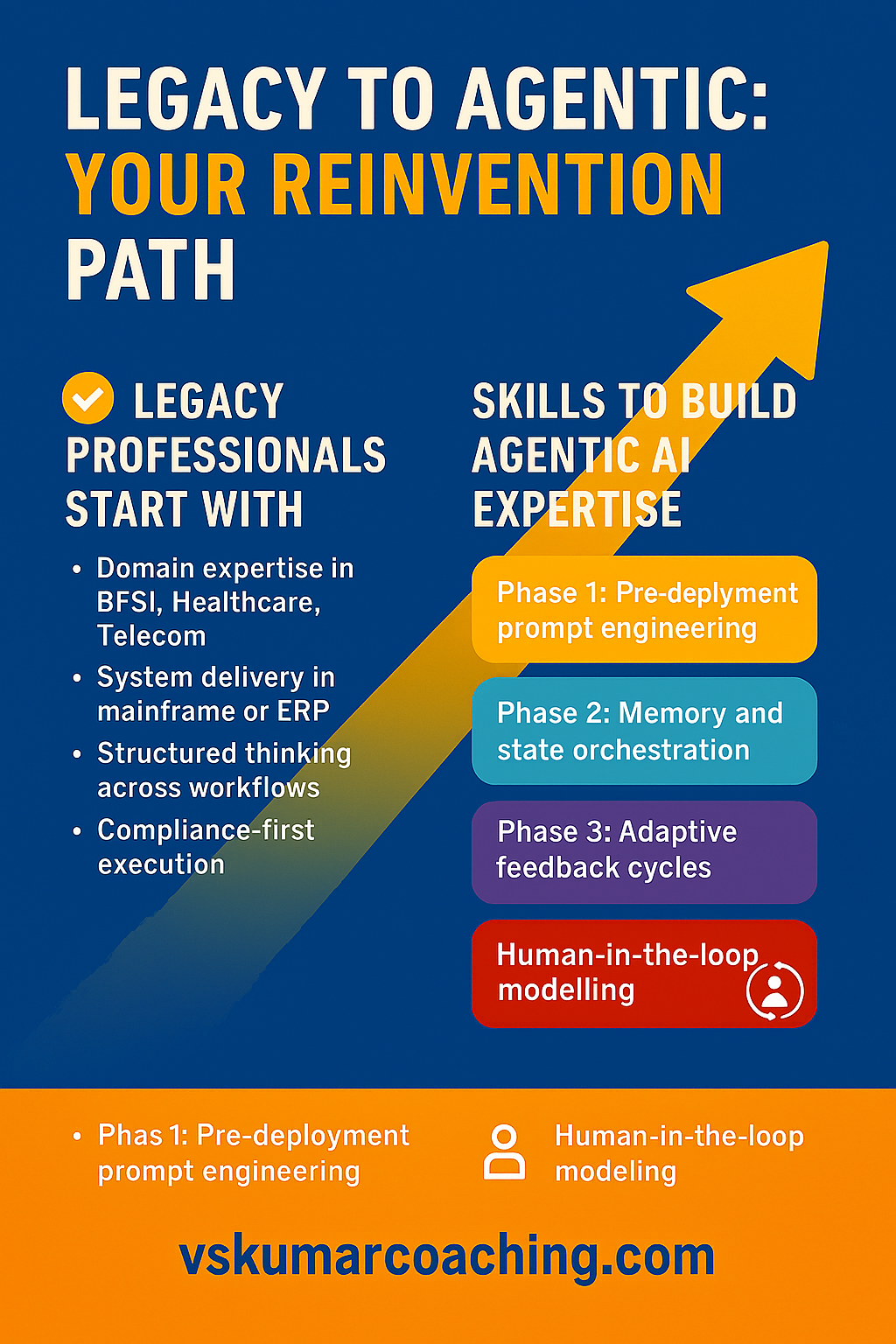
🧭 From Legacy to Agentic: The Career Reinvention Path

🧭 From Legacy to Agentic: The Career Reinvention Path

Legacy professionals don’t start from scratch—they start from depth.
But to thrive in the agentic AI era, they must pivot from static systems to adaptive intelligence.

🔹 What Legacy Professionals Start With:

  • ✅ Deep domain knowledge in BFSI, Healthcare, Telecom, or Ecommerce
  • ✅ Proven delivery across ERP, mainframes, or legacy stacks
  • ✅ Structured thinking and compliance-first execution
  • ✅ Experience with workflows, SLAs, and stakeholder orchestration

These are assets, not obstacles. The key is to reframe and evolve.


🚀 Skills to Build Agentic AI Expertise

🧠 Phase 1: Foundation & Framing

  • Prompt engineering for structured task flows
  • RAG (Retrieval-Augmented Generation) for context-rich responses
  • LLM behavior tuning and compliance alignment

🛠️ Phase 2: Architecture & Orchestration

  • LangChain, LangGraph, or AutoGen for multi-agent workflows
  • Memory and state management across sessions
  • API integration for tool use and real-world actions

🔍 Phase 3: Coaching & Adaptability

  • AgentOps mindset: post-deployment coaching cycles
  • Feedback loop design for edge case refinement
  • Human-in-the-loop judgment modeling

🌱 Legacy + Agentic = Strategic Reinvention

Legacy professionals already know how systems work.
Agentic AI teaches them how systems learn.

🚀 Legacy IT Professionals: Reinvent Your Career with Precision

🚀 Legacy IT Professionals: Reinvent Your Career with Precision

Are you navigating outdated tech stacks or roles that no longer reflect your true potential?

It’s time to activate your next chapter—with strategic coaching tailored for legacy transformation.

🎯 FREE Counselling Slots Now Open

Get expert guidance on:

🔄 Career pivots from legacy systems to AI and automation

🧠 Skill mapping for agentic workflows and CXO visibility

📈 Recruiter-grade elevation for BFSI, Healthcare, Telecom, and Ecommerce

💡 This isn’t generic advice—it’s rhythm-based, proof-backed, and built for activation.

📅 Limited slots. High-impact clarity.

💰 ₹5,000 value—yours free for a limited time.

🔗 Book now at vskumarcoaching.com

👤 Shanthi Kumar V

📬 DM me with your profile on LinkedIn: linkedin.com/in/vskumaritpractices

🧠 AI Job Experiences for Legacy IT Professionals


🧠 AI Job Experiences for Legacy IT Professionals

Build recruiter-grade proof with vibe coding in 3–4 months


🔍 Why Legacy Professionals Must Pivot Now

If you’ve spent years in Java, .NET, testing, support, or COBOL, your experience is valuable — but not yet visible in the AI job market. Recruiters today aren’t just scanning for keywords. They’re looking for proof-backed, AI-assisted workflows that show you’ve made the leap from legacy to modern.

The good news? You don’t need to start from scratch. You need to reframe your legacy experience using vibe coding — the new standard for AI-assisted development.


🚀 What Is Vibe Coding?

Vibe coding is the art of using natural language prompts to scaffold, refactor, and optimize code with AI tools like ChatGPT, Claude, GitHub Copilot, or LangChain agents. It’s not just about writing code — it’s about orchestrating workflows with AI as your co-pilot.


🧩 What Recruiters Expect in 2025

Here’s what top recruiters now demand from transitioning professionals:

✅ 1. AI-Augmented Development Projects

  • Scaffold Python modules using prompt engineering
  • Refactor legacy codebases (e.g., .NET to Python)
  • Auto-generate test cases, documentation, and UI flows
  • Deliver GitHub repos with before/after snapshots

✅ 2. Data-Driven Workflows

  • Clean, transform, and visualize data using Pandas, Matplotlib, Seaborn
  • Query real-world datasets with SQL
  • Integrate legacy systems into AI pipelines (e.g., log analysis, ticket triage)

✅ 3. Prompt Engineering & Modular Vibe Coding

  • Create structured prompt templates for code generation
  • Build multi-turn workflows for debugging and optimization
  • Use LangChain, AutoGen, or similar tools for modular orchestration

✅ 4. AI-Assisted Legacy Modernization

  • Recast past roles with AI overlays:
    • “Converted VB6 modules into Python microservices”
    • “Audited legacy SQL procedures using AI agents”
    • “Built a chatbot for ERP workflows using prompt chaining”

✅ 5. Portfolio & Recruiter Visibility

  • GitHub repos with README, screenshots, and prompt logs
  • Visual overlays showing AI-assisted workflows
  • Before/after comparisons of legacy vs. AI-refactored modules

🎓 How VSKumar Coaching Helps You Deliver

At vskumarcoaching.com, we specialize in helping legacy professionals build provable, recruiter-grade AI experiences in just 3 to 4 months.

What You Get:

  • Structured coaching with weekly activation goals
  • Real-world projects using vibe coding and prompt engineering
  • GitHub-ready portfolios with recruiter visibility
  • Career reframing strategies for multiple job offers

Whether you’re from a support background or a legacy dev role, we help you convert your past into proof — with AI overlays, prompt logs, and visual scaffolds that recruiters trust.


📌 Final Thought: Reframe, Don’t Restart

You don’t need to erase your legacy — you need to reframe it with AI.
Vibe coding is your bridge from legacy to leadership.
Let’s build your job-market-ready profile, starting now.


📞 Book Your Career Counselling Call

An initial career counselling call is mandatory to review the gaps in your current skills and design your personalized roadmap.
This is a paid session and the first step to move forward with structured coaching and job-grade activation.

👉 Book your call now at vskumarcoaching.com


🚀 AI Engineering Starts Here: Build Job-Grade Skills & Vibe-Coded Projects

For aspiring AI engineers:


As prompt engineering and vibe coding become mainstream, building a strong foundation is no longer optional—it’s essential. Core skills like Python programming, mathematics, and statistics remain critical for understanding model behavior and optimization. Proficiency in data handling—cleaning, structuring, and visualizing—is equally vital.


📌 Beyond these skills, AI engineers are now expected to deliver real-world projects using vibe coding.
Companies actively seek candidates with hands-on experience in AI-assisted development workflows. This is the new standard for job readiness.
At https://vskumarcoaching.com/,
we help you build provable, recruiter-grade experiences that lead to multiple job offers. Our coaching is structured, activation-ready, and trusted across domains.


🎓 Data Science Roadmap for Freshers
To qualify for our job coaching and attend the evaluation call, the following modules are mandatory:
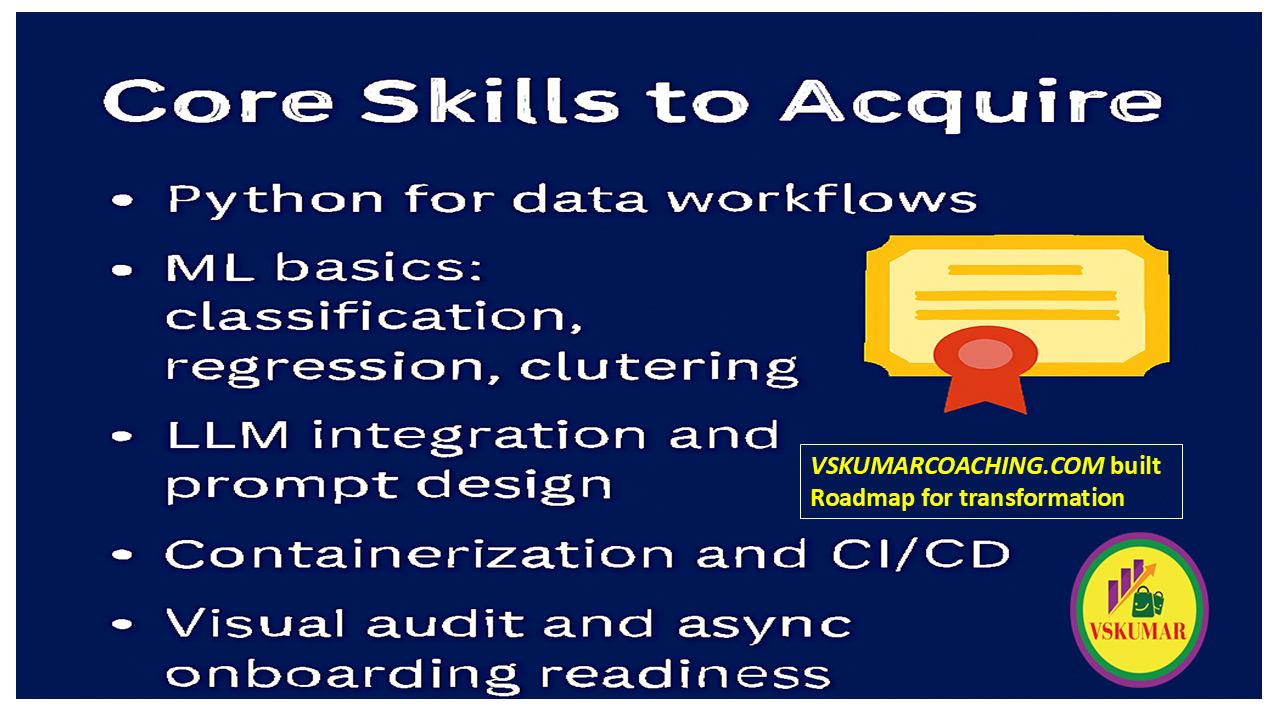
✅ Python Programming – Basics to advanced
✅ Mathematics & Statistics – Core concepts for ML
✅ Data Analysis & Visualization – Pandas, Matplotlib, Seaborn
✅ SQL & Databases – Querying real-world data
✅ Machine Learning – Supervised & Unsupervised algorithms
✅ Deep Learning & AI – Optional but valuable skills
✅ Projects & Portfolio – Real-world projects to impress employers
✅ Career Tips & Job Preparation – Land your first Data Science job
📌 Completion of these modules is required to build job-grade experiences and unlock recruiter visibility.

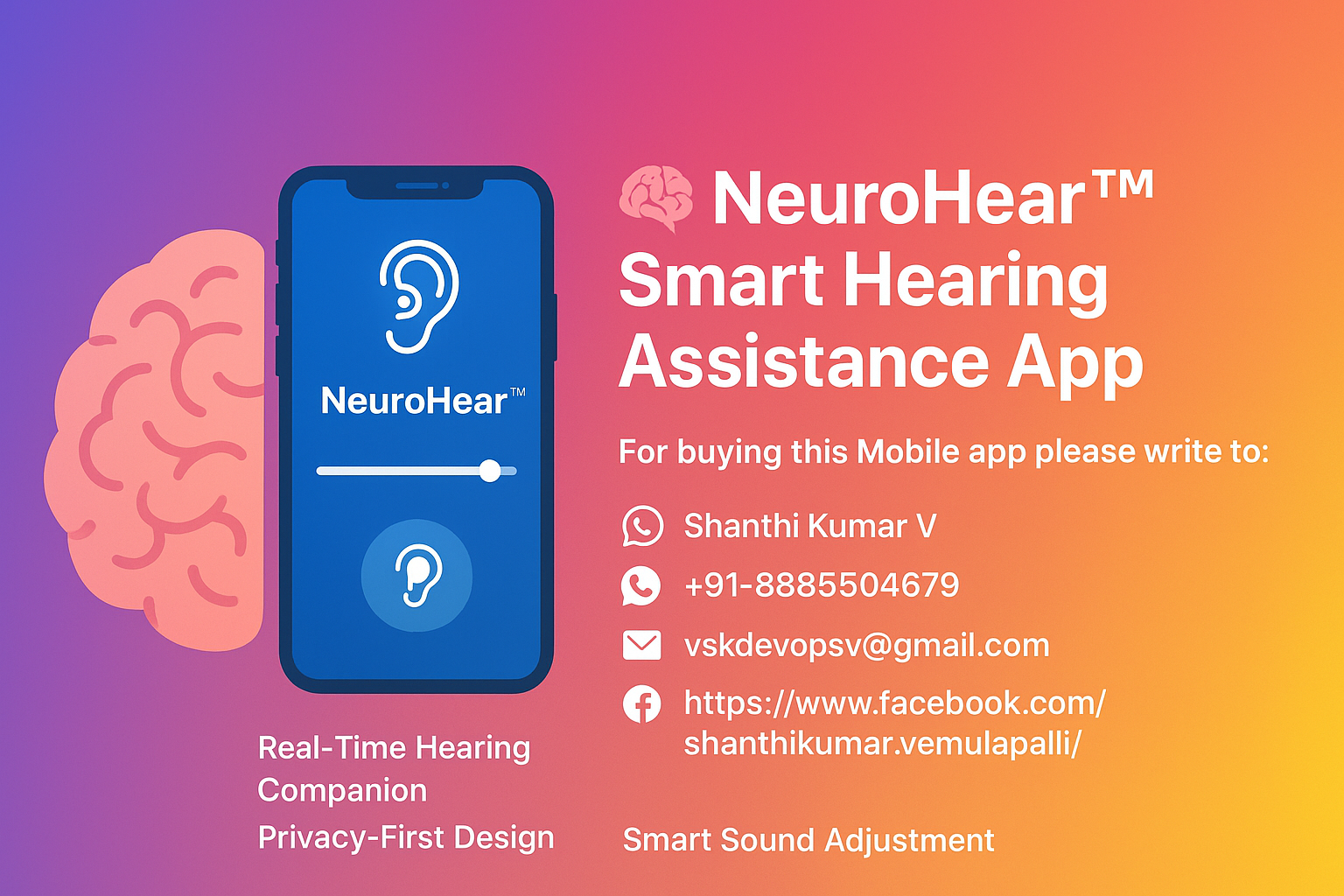
🧠 NeuroHear™ Smart Hearing Assistance App


🧠 NeuroHear™ Smart Hearing Assistance App

Empowering Ears, Preserving Privacy, and Enhancing Everyday Life

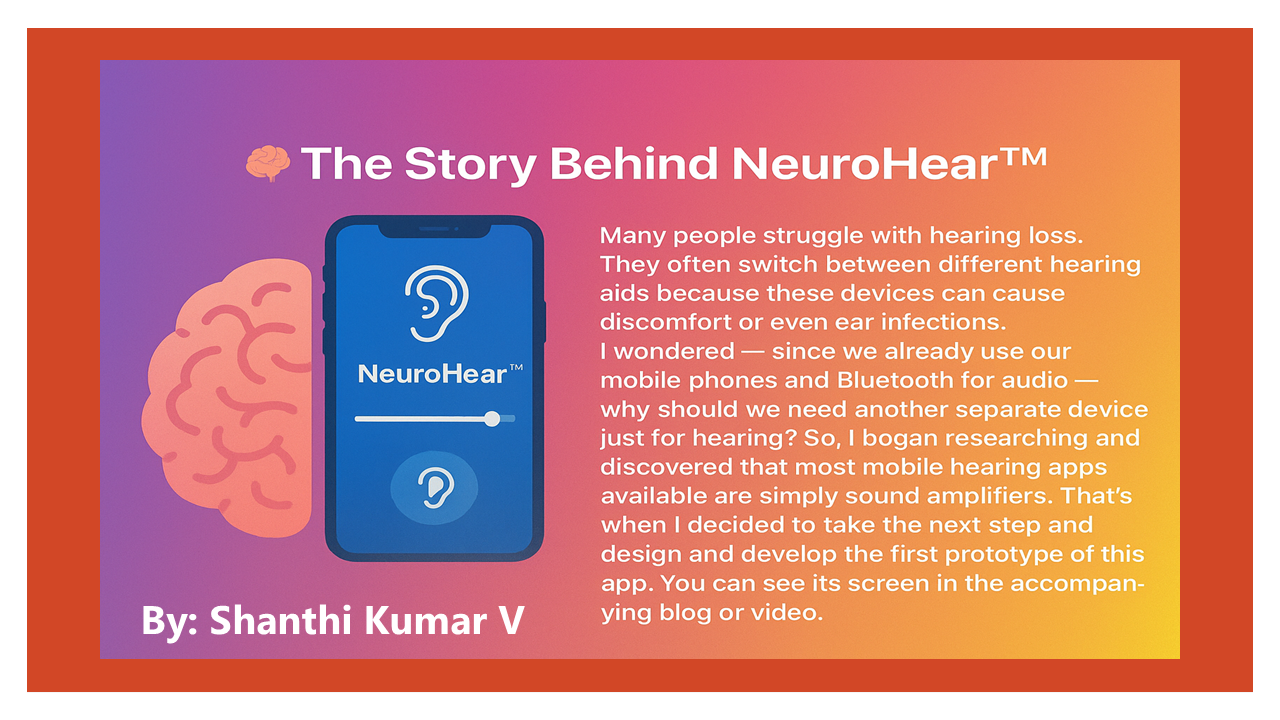
In a world filled with noise, clarity is a gift. The NeuroHear™ Smart Hearing Assistance App transforms your smartphone into a real-time hearing companion — designed for seniors, clinics, and everyday users who value simplicity, privacy, and precision.


🎧 What Is NeuroHear™?

NeuroHear™ is a mobile app that turns any smartphone into a smart hearing assistant. Whether you’re watching TV, having a conversation, or listening to music, NeuroHear™ amplifies and adjusts sound in real time — without recording, streaming, or compromising your privacy.


🔍 Key Benefits

1. Instant Hearing Support

  • No setup required. Just install, tap Start, and you’re ready.
  • Ideal for seniors, clinics, and first-time users.

2. Privacy-First Technology

  • NeuroHear™ never records your voice.
  • No internet or cloud streaming — all processing happens locally.

3. Bluetooth-Ready Playback

  • Works with wireless earphones or hearing aids.
  • Less than 50ms delay ensures smooth, real-time sound.

4. Smart Sound Adjustment

  • Detects ambient noise and auto-adjusts volume.
  • Manual gain control lets users fine-tune their experience.

5. Multiple Audio Profiles

  • Choose from Conversation, TV/Movie, or Music modes.
  • Each profile is optimized for clarity and comfort.

👂 Bluetooth & Ear Health: What You Should Know

Using Bluetooth for hearing assistance is not only convenient — it’s also safe when used correctly. Here’s how NeuroHear™ supports healthy listening:

✅ Low-Energy Bluetooth

  • NeuroHear™ uses standard Bluetooth protocols that emit very low radiation, well within international safety limits.

✅ Controlled Volume

  • The app auto-adjusts volume based on your environment, preventing sudden spikes or prolonged exposure to loud sounds.

✅ No Continuous Streaming

  • Unlike music apps, NeuroHear™ doesn’t stream audio from the internet — reducing battery drain and exposure time.

✅ Comfortable Listening

  • With profiles tailored for different scenarios, users can enjoy steady, non-fatiguing sound throughout the day.

🛒 How to Get NeuroHear™

To purchase the NeuroHear™ app, please contact:

  • 👤 Shanthi Kumar V
  • 📞 WhatsApp: +91-8885504679
  • 📧 Email: vskdevopsv@gmail.com
  • 🔗 Facebook: shanthikumar.vemulapalli

🌟 Final Thoughts

NeuroHear™ isn’t just a hearing app — it’s a bridge to clearer conversations, richer entertainment, and safer listening. Whether you’re a senior seeking simplicity or a clinic looking for scalable support, NeuroHear™ delivers clarity with compassion.

Please Note:

For the buyer we are offering 2 next releases free.

You can tell your hearing issues also. We will try to accommodate in your free app releases.

Here are hashtag suggestions to accompany your blog or promotional post for the NeuroHear™ app:


📢 General Promotion

#NeuroHear
#SmartHearingApp
#HearingCompanion
#AccessibleTech
#RealTimeAudio


👵 Senior & Clinic Focus

#SeniorFriendly
#ClinicReady
#EasyToUseTech
#HearingSupport
#NoSetupNeeded


🔐 Privacy & Safety

#PrivacyFirst
#NoRecording
#OfflineApp
#SafeListening
#BluetoothSafe


🎧 Audio Features

#BluetoothHearing
#SmartSoundAdjustment
#AudioProfiles
#TVMode
#ConversationMode
#MusicMode


🛒 Purchase & Contact

#BuyNeuroHear
#ContactShanthi
#WhatsappSupport
#AffiliateReady
#OnboardingOverlay

The Ultimate AI Duo for 2025: NotebookLM + Perplexity


🚀 The Ultimate AI Duo for 2025: NotebookLM + Perplexity

From Chaos to Clarity: How AI Tools Are Reshaping Content Creation in 202

🔍 Research Smarter. Create Faster.

If you’re juggling blogs, offers, videos, and campaigns — but struggling to keep up — this AI combo is your new secret weapon. Most tools feel like chatbots. These two deliver a full system.


🤝 Meet the Power Pair

Together, these tools transform your notes, research, and documents into polished content — in minutes.

  • Perplexity = Real-time research assistant
  • NotebookLM = Content creation from your own sources

💡 Why Small Businesses Should Care

Whether you’re launching a product, running a workshop, or building a brand, this duo helps you:

  • Save hours on research
  • Repurpose old content
  • Create blogs, emails, videos, and podcasts
  • Understand your market and competitors

🧠 What Perplexity Does

Think of it as Google with clarity. Ask a question → get one clear answer with citations.

Key capabilities:

  • Real-time research with sources
  • Summaries, outlines, and reports
  • Trend spotting and competitor analysis
  • Customer sentiment insights

📚 What NotebookLM Does

Upload PDFs, articles, notes, or even YouTube links — and it turns them into usable content.

Key capabilities:

  • Summarises long documents
  • Creates FAQs, guides, and checklists
  • Converts files into podcasts
  • Writes content based on your sources
  • No guesswork — only your data

🔗 Why They’re Better Together

Used in tandem, they create a seamless workflow:

  1. Research with Perplexity
  2. Paste into NotebookLM
  3. Summarise, explain, and repurpose
  4. Create blogs, emails, videos, and more

🛠️ Step-by-Step Workflow

  1. Ask Perplexity: “Summarise 2025 marketing trends with sources”
  2. Copy the answer
  3. Paste into NotebookLM
  4. Ask:
    • “What are the top 3 trends?”
    • “Explain this simply”
    • “Write this as a blog/email/video”
  5. Use Audio Overview for podcast-style output
  6. Share across channels

♻️ Use Case 1: Repurpose Old Content

Challenge:
A mid-sized SaaS firm had hundreds of outdated blog posts and whitepapers from 2020–2022. Their marketing team struggled to keep up with fresh content demands for LinkedIn, newsletters, and webinars.

Solution via AI Duo:

  • Uploaded old PDFs and blogs into NotebookLM
  • Extracted key points, FAQs, and checklist formats
  • Used Perplexity to validate and update stats or trends
  • Repurposed each document into 3–5 LinkedIn carousels, 1 podcast script, and 2 email sequences

Effort Saved:
✅ Cut content creation time by 70%
✅ Revived 40+ legacy assets into multi-channel campaigns
✅ No manual rewriting or re-research needed


📈 Use Case 2: Smarter Campaign Research

Challenge:
A D2C skincare brand was prepping a winter launch but lacked fresh insights on customer pain points and trending ingredients.

Solution via AI Duo:

  • Used Perplexity to research 2025 skincare trends, Reddit complaints, and YouTube reviews
  • Fed the findings into NotebookLM to summarise pain points and generate campaign angles
  • Created a launch outline, email drip sequence, and influencer brief — all from one research session

Effort Saved:
✅ Reduced research time from 12 hours to 90 minutes
✅ Got real-time consumer language and objections
✅ Created 5 campaign assets in one workflow


🕵️ Use Case 3: Customer & Competitor Insights

Challenge:
A fintech startup wanted to improve its onboarding UX but lacked clarity on what users disliked in competitor apps.

Solution via AI Duo:

  • Asked Perplexity to analyse reviews of 5 competitor apps on Reddit, Trustpilot, and YouTube
  • Pasted results into NotebookLM and asked:
    • “What do users hate most?”
    • “What features are missing?”
    • “How can we improve onboarding?”

Effort Saved:
✅ Identified 3 UX flaws and 2 missing features in under 2 hours
✅ Used insights to redesign onboarding flow
✅ Created a new landing page with validated pain-point copy


📚 Use Case 4: Learn Fast, Apply Faster

Challenge:
A solopreneur wanted to understand affiliate marketing but was overwhelmed by scattered blogs and videos.

Solution via AI Duo:

  • Used Perplexity to find top guides, YouTube explainers, and blog posts
  • Imported them into NotebookLM
  • Asked it to:
    • Summarise into a study guide
    • Explain jargon in plain English
    • Apply examples to her niche (wellness coaching)

🎧 Bonus: Used Audio Overview to learn while commuting

Effort Saved:
✅ Learned core concepts in 1 day
✅ Created her first affiliate funnel with AI-generated copy
✅ Reduced overwhelm and accelerated execution


📣 Where to Use the Content You Create

From one research session, you can generate:

  • LinkedIn posts
  • Newsletters
  • Blog articles
  • Podcasts
  • YouTube scripts
  • Lead magnets
  • Email sequences
  • Sales page copy

AI does the groundwork. You bring the voice.


🧠 Pro Tips for Best Results

  • Ask Perplexity specific questions
  • Paste only the best bits into NotebookLM
  • Use NLM for outlines and summaries
  • Try Audio Overview for human-style learning
  • Always verify key facts before publishing

✅ Final Thoughts: Your Free Content Engine

No more:

❌ Endless Googling
❌ Blank pages
❌ Content paralysis

Yes to:

✅ Smarter research
✅ Faster creation
✅ Clear workflows
✅ Free tools that deliver

SOA to AI – Career Recalibration Blueprint


🟦 SOA to AI – Career Recalibration Blueprint

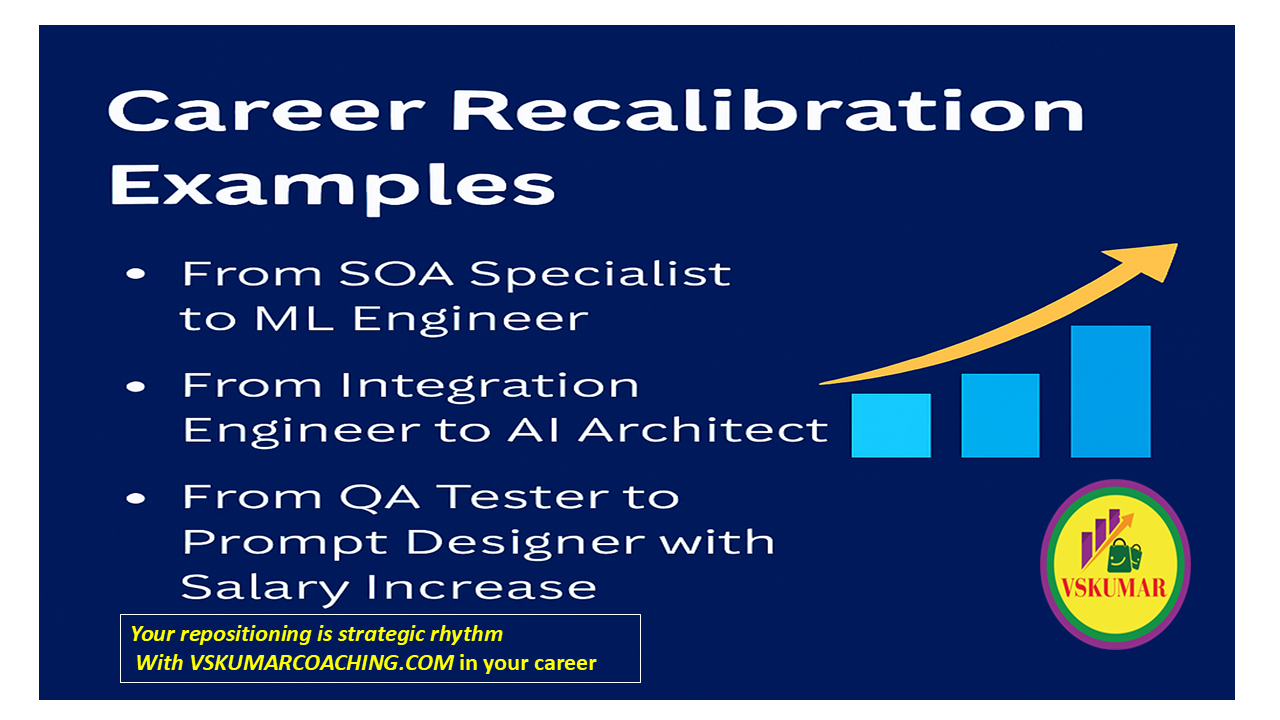
Legacy SOA (Service-Oriented Architecture) systems are being replaced by AI-driven architectures. Static rules are giving way to learning systems. This page outlines a structured transition path for mid-career IT professionals to reposition into AI-aligned roles.


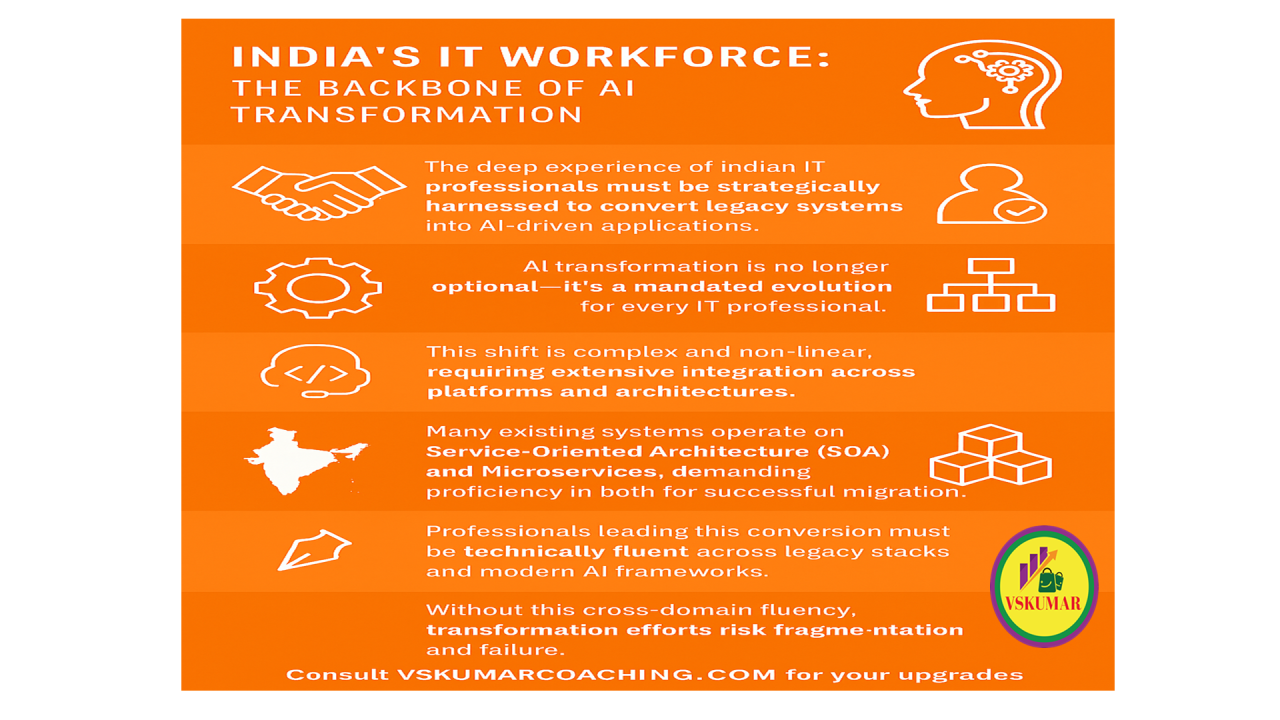
🇮🇳 Beyond Survival: The AI Roadmap Every Indian Tech Professional Must Activate Now

🚀 From Legacy to Leadership: India’s IT Professionals in the AI Transition

By Shanthi Kumar V | Fractional AI Strategist & Agentic Automation Architect

India’s IT workforce stands at a historic inflection point. The shift from legacy systems to AI-powered ecosystems isn’t just technical—it’s strategic, career-defining, and globally consequential. With over 4 million professionals across domains, India has the potential to lead the global AI transformation wave—if it activates the right roadmap.

This blog breaks down the transition into seven actionable phases, each with key questions to guide professionals, recruiters, and CXOs toward sovereign execution.


🔹 Phase 1: Legacy Leverage

Harnessing Experience for AI Migration

India’s IT talent pool holds decades of legacy expertise—COBOL, .NET, Oracle, and more. This isn’t obsolete; it’s fuel for AI modernization.

  • What legacy systems are still mission-critical in your organization?
  • Which modules can be re-engineered using AI workflows?
  • How can past migration experience be repurposed for AI transformation?
  • What tribal knowledge must be preserved before conversion?
  • Are your teams trained to audit legacy code for AI readiness?

🧭 Action: Document legacy workflows and map them to AI augmentation opportunities.


🔹 Phase 2: Mandated Evolution

AI Transformation as a Career Imperative

AI is no longer optional—it’s a mandated evolution for every IT professional, regardless of domain.

  • Have you mapped your current role to emerging AI responsibilities?
  • What AI tools or platforms are relevant to your domain?
  • Are you actively upskilling or waiting for organizational push?
  • How do recruiters evaluate AI-readiness in your profile?
  • What certifications or proof-points validate your AI evolution?

🧭 Action: Build a weekly AI upskilling ritual and showcase it through visible deliverables.


🔹 Phase 3: Integration Complexity

Navigating the Non-Linear Shift

AI transformation isn’t plug-and-play. It demands deep integration across stacks, platforms, and workflows.

  • Which systems require API-level integration with AI modules?
  • Are your teams equipped to handle data interoperability challenges?
  • What orchestration tools are being used for multi-platform alignment?
  • How do you validate integration success across legacy and AI layers?
  • What risks emerge from partial or siloed integration?

🧭 Action: Audit your tech stack for integration gaps and build agentic orchestration demos.


🔹 Phase 4: Architecture Fluency

Mastering SOA and Microservices for Migration

Most legacy systems run on SOA and Microservices. Fluency in both is non-negotiable for seamless AI migration.

  • Can your team distinguish between SOA and Microservices in current systems?
  • What AI frameworks integrate best with these architectures?
  • Are you using containerization (e.g., Docker, Kubernetes) for deployment?
  • How do you handle service discovery and orchestration in AI contexts?
  • What benchmarking tools validate architecture fluency?

🧭 Action: Build containerized AI modules and validate them with service orchestration flows.


🔹 Phase 5: Tech Stack Mastery

Cross-Domain Fluency as a Strategic Asset

Conversion leaders must be fluent across legacy stacks and modern AI frameworks. This is the new currency of transformation.

  • What legacy languages (e.g., COBOL, .NET) still dominate your environment?
  • Which AI frameworks (e.g., TensorFlow, PyTorch) are being adopted?
  • How do you bridge the gap between old and new tech stacks?
  • Are your teams trained in hybrid deployment models?
  • What proof-points validate your cross-stack fluency?

🧭 Action: Build hybrid POCs that span legacy and AI stacks, and document them with GitHub dispatch logs.


🔹 Phase 6: Risk of Fragmentation

Avoiding Failure Through Full-Spectrum Capability

Without full-spectrum fluency, transformation efforts risk fragmentation, delays, and systemic failure.

  • What are the top three failure points in past transformation efforts?
  • How do you audit for fragmentation risks before deployment?
  • Are your teams aligned on transformation KPIs and outcomes?
  • What governance models ensure cross-team accountability?
  • How do you recover from partial or failed AI rollouts?

🧭 Action: Create a transformation scorecard and align it with cross-team rituals.


🔹 Phase 7: India’s Opportunity

Redefining Global Tech Leadership

This challenge is also India’s moment. With the right strategy, India can lead the global AI transformation wave.

  • What global benchmarks can India surpass in AI deployment?
  • How do Indian professionals position themselves as AI leaders?
  • What role do coaching and mentoring play in this transformation?
  • How can recruiters be educated to recognize AI-ready talent?
  • What platforms amplify India’s AI success stories?

🧭 Action: Build sovereign proof-points and share them across LinkedIn, GitHub, and coaching platforms.


🚀 Final Note: Sovereignty Over Survival

India’s IT workforce is not just adapting—it’s architecting the future. The transition from legacy to leadership demands clarity, coaching, and demonstrable execution.

🔧 Build Demonstrable Cloud + DevOps + AI POCs
🧑‍💻 Use Python + Prompt Engineering to Guide Intelligent Tasks
📁 Document Every Project as Verifiable Experience


🧭 Ready to Transform?

At vskumarcoaching.com, professionals are scaled into multi-role AI specialists within 4–6 months through:

  • 15–20 focused hours per week
  • Prompt-first execution using structured assignments
  • Role-ready resumes based on real deliverables
  • Alignment with spiritual timing and personal intent

This isn’t a bootcamp. It’s a sovereignty platform for those ready to transform with dignity, focus, and verifiable power.

30 Strategic questions From Legacy to Agentic

Here are 30 strategic questions designed to probe, reflect, and activate the key insights from this article “From Legacy to Agentic: How AI Is Reshaping IT Careers and Creating Proof-Driven Pathways”. https://www.linkedin.com/pulse/ai-disruption-transition-sovereign-reinvention-shanthi-kumar-v-rgomc/?trackingId=hT0gTeZByHidirEScO1X8A%3D%3D


🖥️ System Administrators

  1. How does predictive maintenance with AIOps differ from traditional monitoring?
  2. What are the benefits of self-healing infrastructure in reducing downtime?
  3. How does AI-driven drift detection improve configuration management?
  4. What legacy SysAdmin tasks are most vulnerable to AI automation?
  5. How can SysAdmins reposition themselves in agentic infrastructure roles?

🧪 QA/Test Engineers

  1. What role does AI play in generating automated test cases from user flows?
  2. How does Vision AI enhance visual regression testing across devices?
  3. What advantages do synthetic user simulations offer over manual edge-case testing?
  4. How can QA engineers transition into AI-powered testing orchestration?
  5. What skills are needed to audit AI-generated test suites effectively?

☎️ Technical Support Agents

  1. How do NLP-powered chatbots handle Tier-1 support tasks?
  2. What makes emotion-aware voice AI more effective in customer escalation?
  3. How does auto-documentation reduce manual ticket processing?
  4. What human support skills remain irreplaceable in an AI-first support model?
  5. How can support agents upskill into bot orchestration and training?

🗃️ Data Entry & Processing

  1. How does OCR + NLP parsing automate document digitization?
  2. What impact does ML-driven ETL automation have on data pipeline efficiency?
  3. How does entity recognition improve data structuring across domains?
  4. What legacy data entry roles are most at risk, and how can they evolve?
  5. How can professionals build AI-augmented data ingestion POCs?

🎨 Basic Front-End Developers

  1. How do GenAI tools generate HTML/CSS layouts from prompts?
  2. What is responsive design automation, and how does it reduce manual coding?
  3. How does dynamic component expansion enable scalable UI generation?
  4. What front-end skills remain relevant in a low-code/GenAI environment?
  5. How can developers pivot into prompt engineering for UI workflows?

📡 Network Engineers

  1. How does AI-driven SDN reroute traffic based on real-time conditions?
  2. What role does anomaly detection play in proactive network security?
  3. How does predictive load balancing optimize performance across nodes?
  4. What new roles are emerging for network engineers in autonomous environments?
  5. How can legacy engineers build agentic network orchestration demos?

🔗 From Legacy to Leadership: Transforming RDB & NoSQL into Vector-Powered Dashboards for ML Decisions

Here are 20 strategic questions designed to probe, validate, and activate the full scope of your Vector-Driven Execution Blueprint.

Before attempting the questions visit this post:

These questions can be used for agentic onboarding assessments:


🔍 Phase 1: Data Extraction & Preprocessing

  1. 🧠 What are the key differences in preprocessing structured RDBMS data vs. semi-structured NoSQL data?
  2. ⚙️ How does Apache NiFi compare to Airbyte for ETL orchestration in high-volume pipelines?
  3. 🧹 Why is tokenization critical before embedding tabular or textual data?
  4. 🗄️ What challenges arise when flattening nested NoSQL documents for ML readiness?
  5. 📊 How do deduplication and normalization impact downstream embedding quality?

🧠 Phase 2: Embedding & Vectorization

  1. ✨ What criteria should guide the selection between OpenAI Ada, BGE, and Instructor models?
  2. 📦 How does sentence-style row conversion enhance tabular embedding semantics?
  3. 🔗 What role does LangChain or LlamaIndex play in orchestrating embedding workflows?
  4. 🧬 How do Faiss and HuggingFace differ in vector generation performance and scalability?
  5. 🧠 What are the risks of embedding without metadata context?

🗃️ Phase 3: Vector DB Ingestion

  1. 🧭 How do Pinecone and Qdrant differ in handling metadata-rich vector payloads?
  2. 🏷️ Why is metadata mapping (e.g., source ID, timestamp) essential for agentic workflows?
  3. 🔍 What indexing strategy (HNSW vs. IVF vs. Flat) best suits real-time semantic search?
  4. 📊 How does vector DB ingestion impact latency in ML model inference?
  5. 🧠 What are the implications of poor indexing on agentic decision accuracy?

🤖 Phase 4: ML / Agentic Processing

  1. 🧠 How do LangChain Agents differ from AutoGen in multi-step reasoning?
  2. 📊 What ML models are best suited for agentic workflows in BFSI or Healthcare?
  3. 🔁 How does semantic query chaining improve contextual decision-making?

📈 Phase 5: Dashboarding & Decision Support

  1. 🧩 What advantages does RAG offer over traditional query layers in dashboards?
  2. 📊 How can ROI-grade insights be validated through interactive drilldowns?

🤯 Why Most AI Content Leaves You More Confused Than Inspired

🤯 Why Most AI Content Leaves You More Confused Than Inspired

You’ve seen the headlines:
“Learn GenAI in 30 days.”
“Become a Prompt Engineer overnight.”
“Master DevOps with one YouTube playlist.”

But here’s the truth:
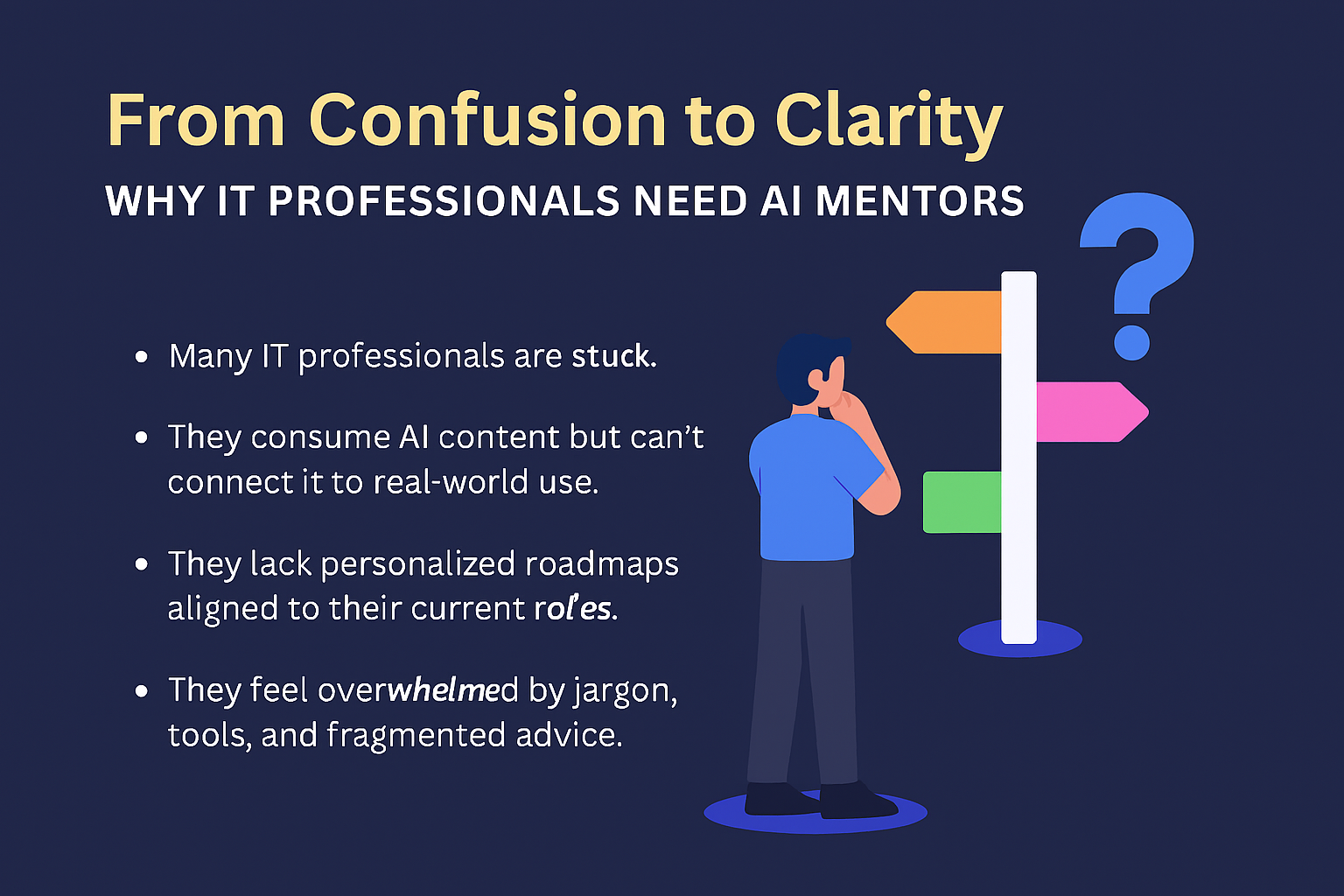
Most AI content is not built for mid-career IT professionals. It’s scattered, role-agnostic, and lacks recruiter-grade clarity.


🔍 What’s Missing in Today’s AI Learning Landscape

  • 🎯 No mapping to your current IT role
  • 🧠 No personalized roadmap
  • 📉 No recruiter visibility or asset planning
  • 🔁 No feedback loops or execution rituals

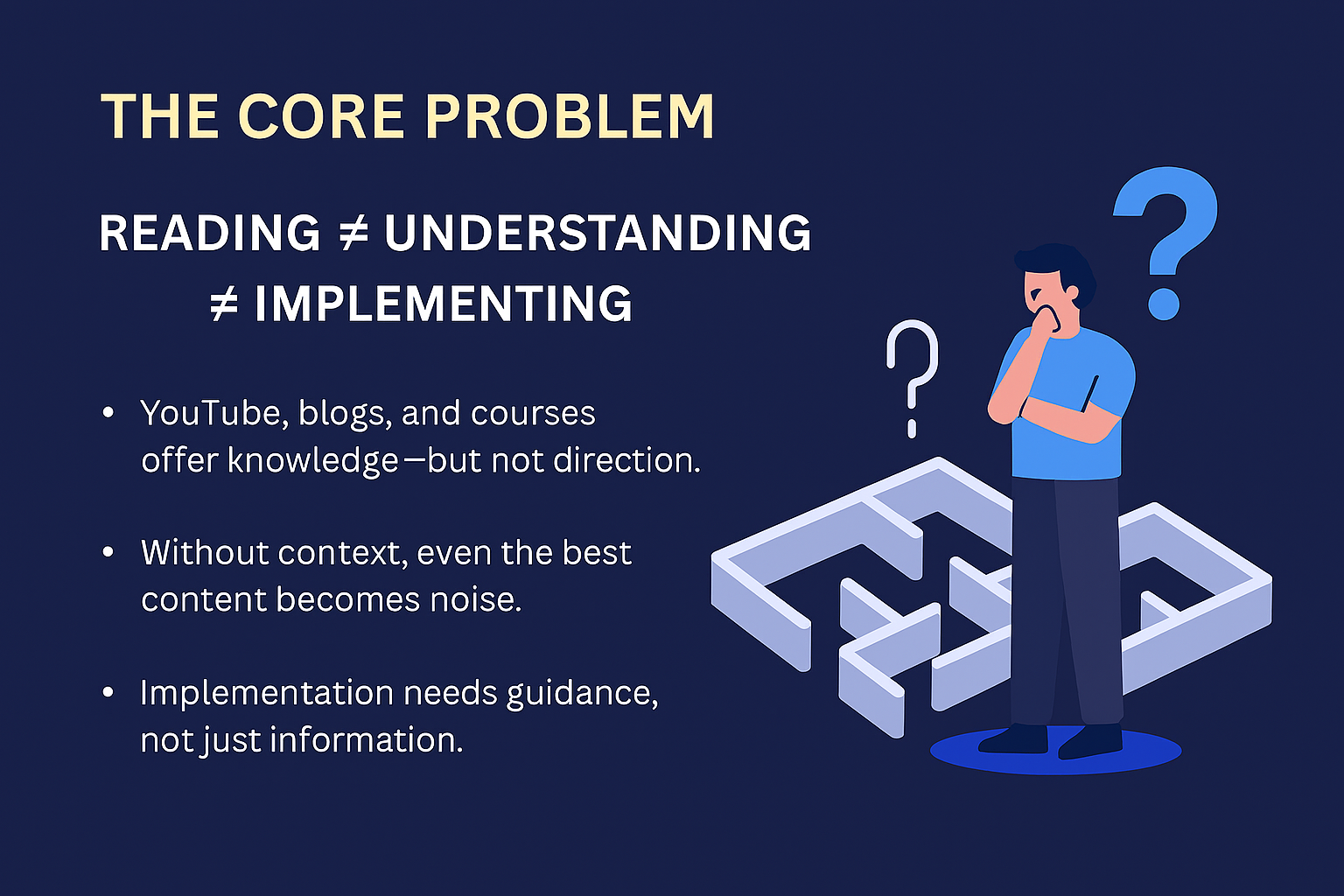
🧠 The Core Problem: Why Learning Alone Doesn’t Lead to Execution

You’ve read the blogs.
You’ve watched the tutorials.
You’ve taken the courses.
But your career hasn’t moved. Why?

Because:
READING ≠ UNDERSTANDING ≠ IMPLEMENTING


🔍 What’s Really Happening

  • 📚 Content offers knowledge—but not direction
  • 🧩 Without context, even the best tutorials become noise
  • 🌀 You’re stuck in a maze of tools, jargon, and fragmented advice
  • 🚫 Traditional learning doesn’t scale you into multiple roles

🚀 What You Actually Need

You need guided implementation—not just information.
You need a mentor who maps your role, builds recruiter-grade assets, and walks with you till execution.

📌 See this upskilled profile:
Ravi Kumar Kangne – Agentic AI Product Designer
He’s confident in answering design-level questions. Are you?

That’s what we do at VSKUMARCOACHING.COM


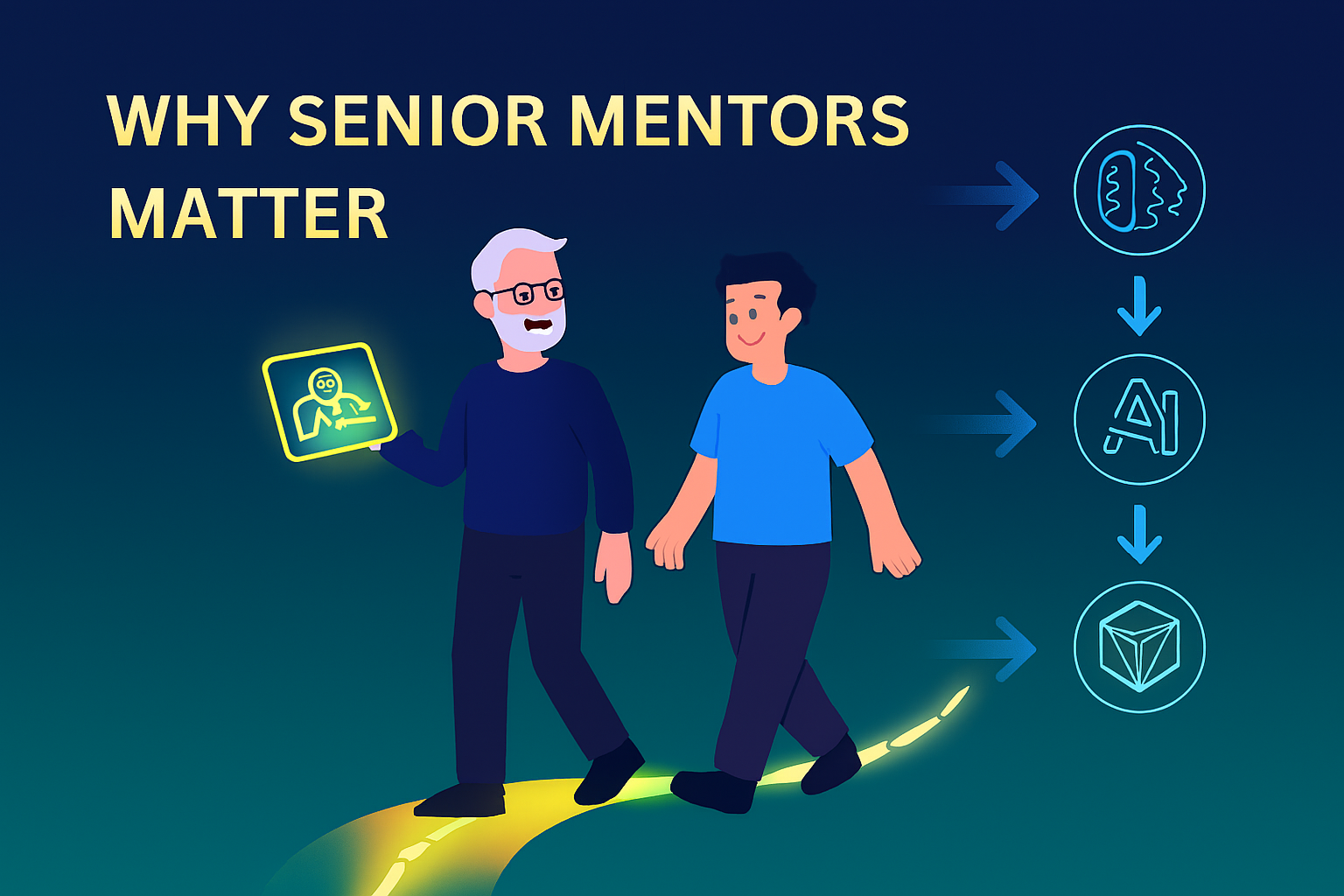
🧓 Why Senior Mentors Matter in Your AI Career Journey

AI isn’t just about tools and tutorials.
It’s about execution—and that demands experienced guidance.


🔍 What Most Professionals Miss

  • 🧠 You can’t navigate AI transitions alone
  • 🧭 You need someone who’s walked the path
  • 🧱 You need help breaking through blockers—technical, strategic, and recruiter-facing

🚀 What Senior Mentors Actually Do

  • 📍 Map your AI career based on your current role
  • 🛠️ Guide you through implementation—not just planning
  • 📄 Help you build recruiter-grade assets with proof
  • 🔁 Stay with you till execution—not just advice

At VSKUMARCOACHING.COM, mentorship is a walk-together model—from roadmap to recruiter traction.


🛣️ What a Recruiter-Desired AI Roadmap Actually Looks Like

Still stuck in role confusion?
Still browsing AI content without clarity?

You need a mapped route—not scattered learning.


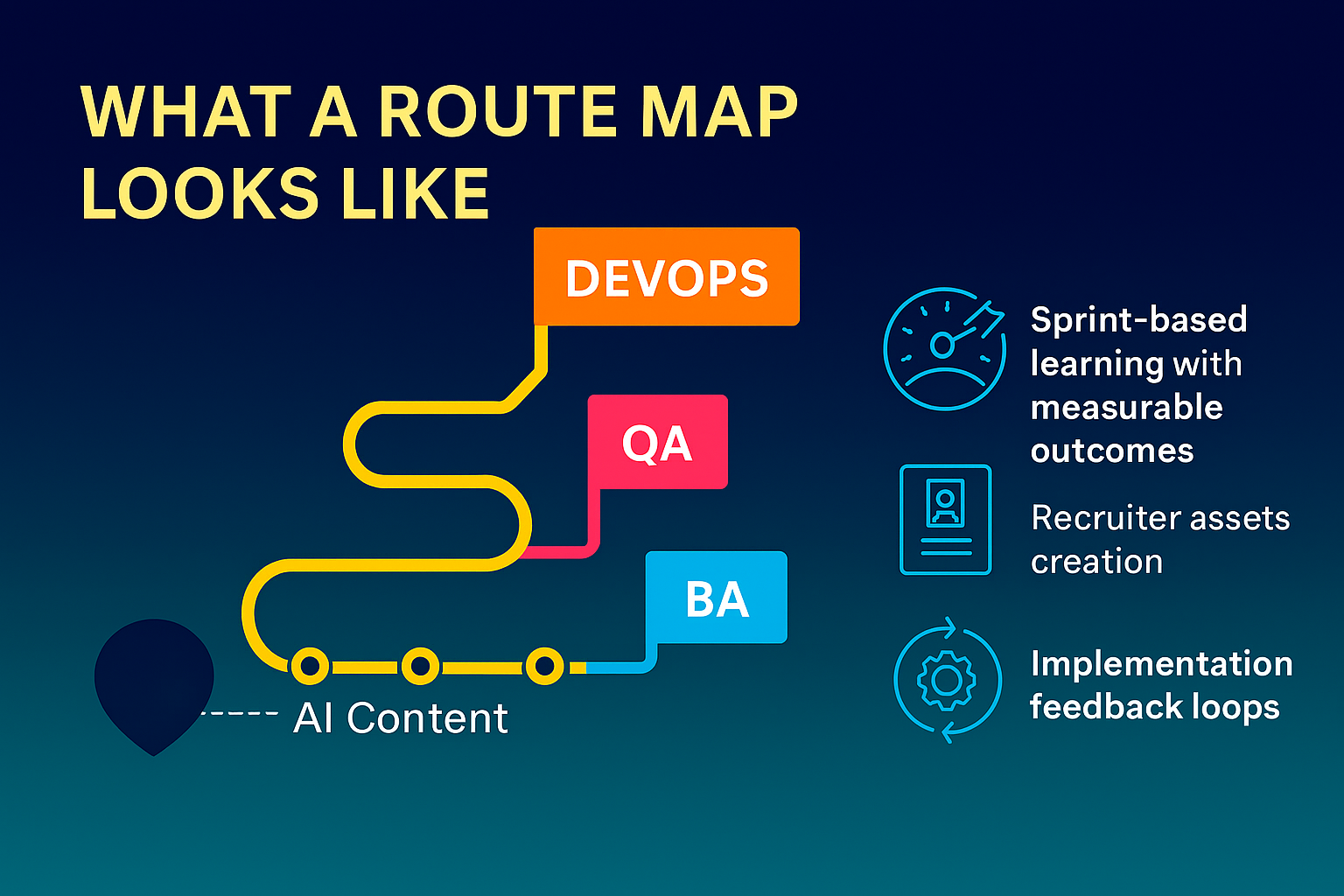
🔍 A Proven Route Map

  • 🧠 BA → QA → DevOps → AI Content
  • 🏁 Sprint-based learning with measurable outcomes
  • 📄 Recruiter asset creation for visibility and traction
  • 🔁 Implementation feedback loops for refinement and proof

This isn’t a generic career path.
It’s a custom roadmap built around your current role, domain, and recruiter goals.

That’s what we design at VSKUMARCOACHING.COM


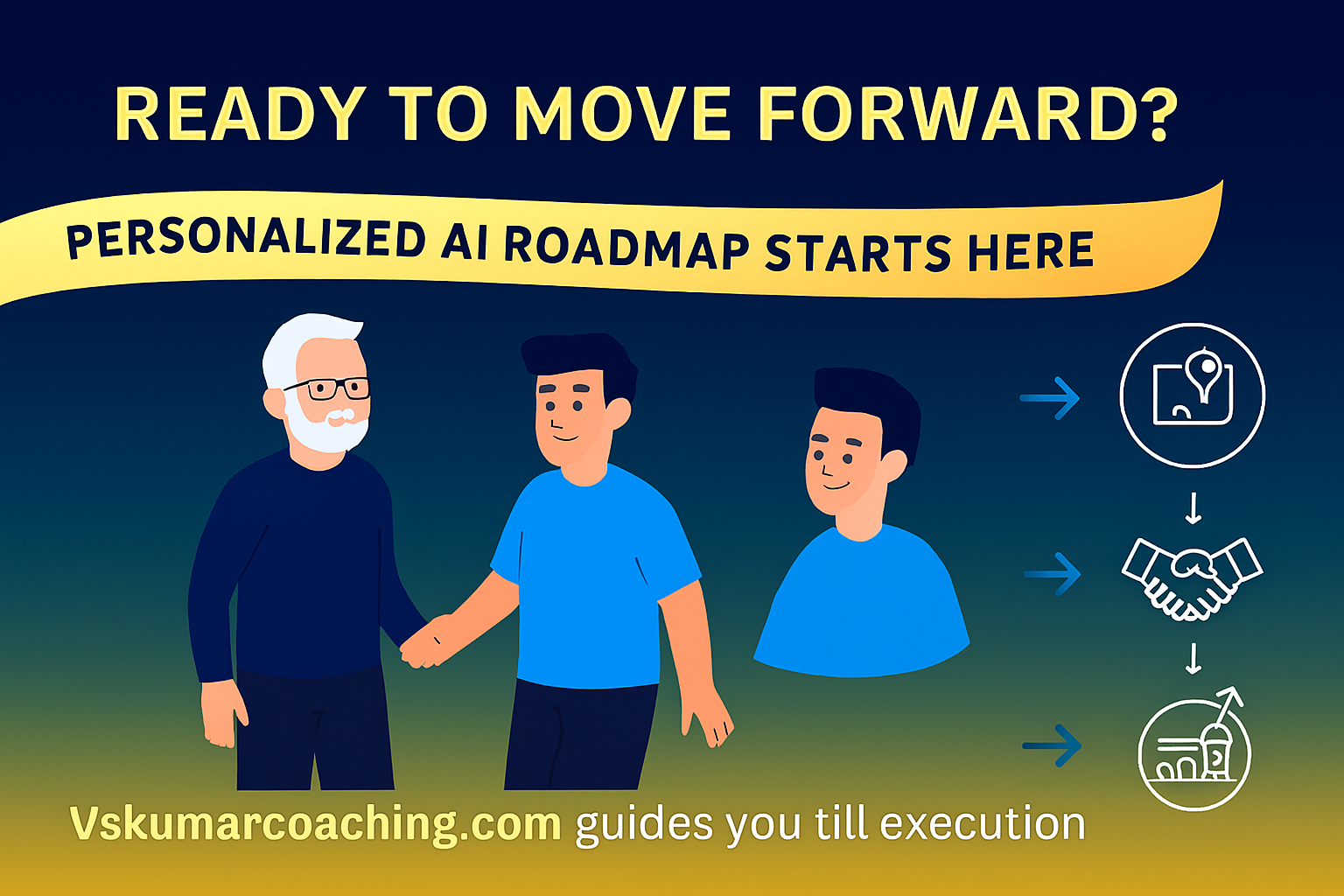
🚀 Ready to Move Forward? Your Personalized AI Roadmap Starts Here

Enough browsing.
Enough confusion.
It’s time to activate your AI career—with clarity, proof, and recruiter traction.


🔍 What This Step Unlocks

You’re not aiming for one job.
You’re mandated to get multiple offers across multiple locations.

That means your roadmap must be:

  • ✅ Personalized
  • ✅ Proof-backed
  • ✅ Recruiter-validated

At VSKUMARCOACHING.COM, we don’t just plan your AI career.
We walk with you till it’s implemented.


📞 Book your career counselling call when you’re ready to move forward:
Ravi Kumar Kangne – LinkedIn Profile


$6.6 Trillion in Play: GAI Skills, Roles, and Industries That Will Shape the Future:

https://www.linkedin.com/pulse/indias-workforce-phase-wise-ai-transformation-roadmap-v-qzw2c/?trackingId=LQaN0YpqSWuOe5W9I9%2BaIw%3D%3D

#AIcareers #CareerCounselling #ITtoAI #GenAI #DevOps #QA #BusinessAnalysis #RecruiterAssets #VSKumarCoaching #CareerTransformation #LinkedInCarousel