Daily Archives: October 5, 2025

🇮🇳 Beyond Survival: The AI Roadmap Every Indian Tech Professional Must Activate Now

🚀 From Legacy to Leadership: India’s IT Professionals in the AI Transition
By Shanthi Kumar V | Fractional AI Strategist & Agentic Automation Architect

India’s IT workforce stands at a historic inflection point. The shift from legacy systems to AI-powered ecosystems isn’t just technical—it’s strategic, career-defining, and globally consequential. With over 4 million professionals across domains, India has the potential to lead the global AI transformation wave—if it activates the right roadmap.

This blog breaks down the transition into seven actionable phases, each with key questions to guide professionals, recruiters, and CXOs toward sovereign execution.


🔹 Phase 1: Legacy Leverage

Harnessing Experience for AI Migration

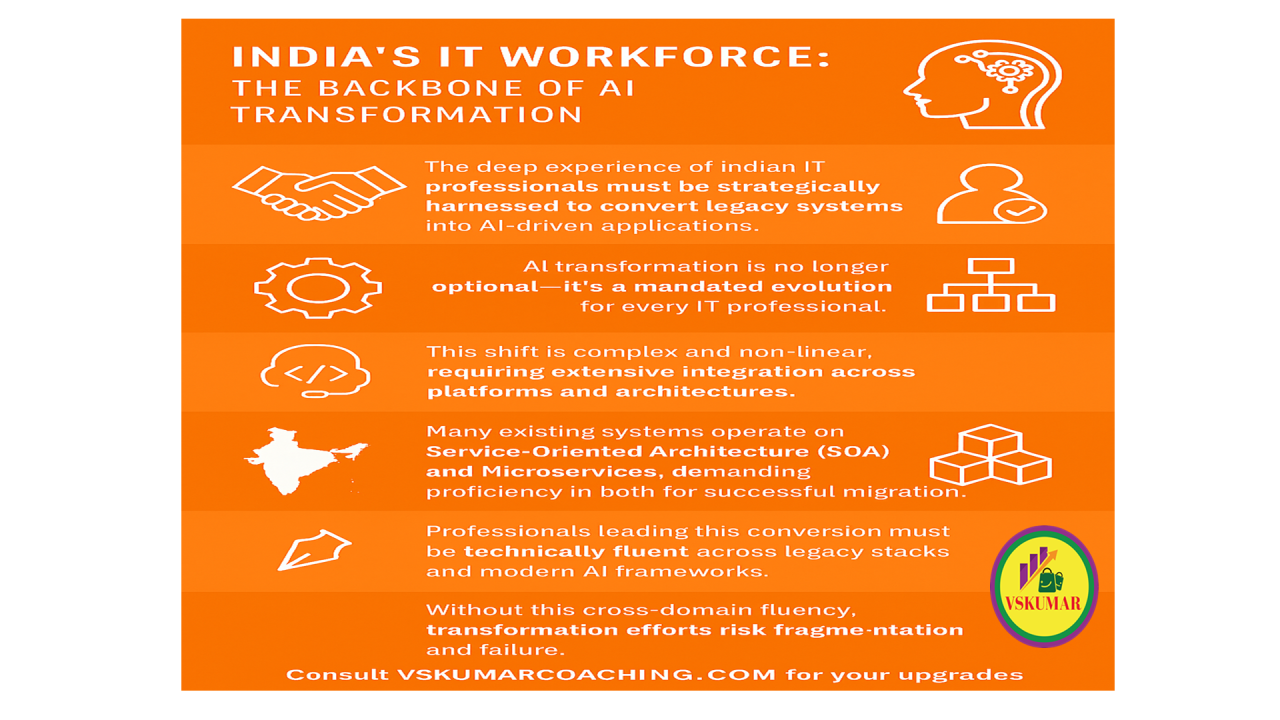
India’s IT talent pool holds decades of legacy expertise—COBOL, .NET, Oracle, and more. This isn’t obsolete; it’s fuel for AI modernization.

  • What legacy systems are still mission-critical in your organization?
  • Which modules can be re-engineered using AI workflows?
  • How can past migration experience be repurposed for AI transformation?
  • What tribal knowledge must be preserved before conversion?
  • Are your teams trained to audit legacy code for AI readiness?

🧭 Action: Document legacy workflows and map them to AI augmentation opportunities.


🔹 Phase 2: Mandated Evolution

AI Transformation as a Career Imperative

AI is no longer optional—it’s a mandated evolution for every IT professional, regardless of domain.

  • Have you mapped your current role to emerging AI responsibilities?
  • What AI tools or platforms are relevant to your domain?
  • Are you actively upskilling or waiting for organizational push?
  • How do recruiters evaluate AI-readiness in your profile?
  • What certifications or proof-points validate your AI evolution?

🧭 Action: Build a weekly AI upskilling ritual and showcase it through visible deliverables.


🔹 Phase 3: Integration Complexity

Navigating the Non-Linear Shift

AI transformation isn’t plug-and-play. It demands deep integration across stacks, platforms, and workflows.

  • Which systems require API-level integration with AI modules?
  • Are your teams equipped to handle data interoperability challenges?
  • What orchestration tools are being used for multi-platform alignment?
  • How do you validate integration success across legacy and AI layers?
  • What risks emerge from partial or siloed integration?

🧭 Action: Audit your tech stack for integration gaps and build agentic orchestration demos.


🔹 Phase 4: Architecture Fluency

Mastering SOA and Microservices for Migration

Most legacy systems run on SOA and Microservices. Fluency in both is non-negotiable for seamless AI migration.

  • Can your team distinguish between SOA and Microservices in current systems?
  • What AI frameworks integrate best with these architectures?
  • Are you using containerization (e.g., Docker, Kubernetes) for deployment?
  • How do you handle service discovery and orchestration in AI contexts?
  • What benchmarking tools validate architecture fluency?

🧭 Action: Build containerized AI modules and validate them with service orchestration flows.


🔹 Phase 5: Tech Stack Mastery

Cross-Domain Fluency as a Strategic Asset

Conversion leaders must be fluent across legacy stacks and modern AI frameworks. This is the new currency of transformation.

  • What legacy languages (e.g., COBOL, .NET) still dominate your environment?
  • Which AI frameworks (e.g., TensorFlow, PyTorch) are being adopted?
  • How do you bridge the gap between old and new tech stacks?
  • Are your teams trained in hybrid deployment models?
  • What proof-points validate your cross-stack fluency?

🧭 Action: Build hybrid POCs that span legacy and AI stacks, and document them with GitHub dispatch logs.


🔹 Phase 6: Risk of Fragmentation

Avoiding Failure Through Full-Spectrum Capability

Without full-spectrum fluency, transformation efforts risk fragmentation, delays, and systemic failure.

  • What are the top three failure points in past transformation efforts?
  • How do you audit for fragmentation risks before deployment?
  • Are your teams aligned on transformation KPIs and outcomes?
  • What governance models ensure cross-team accountability?
  • How do you recover from partial or failed AI rollouts?

🧭 Action: Create a transformation scorecard and align it with cross-team rituals.


🔹 Phase 7: India’s Opportunity

Redefining Global Tech Leadership

This challenge is also India’s moment. With the right strategy, India can lead the global AI transformation wave.

  • What global benchmarks can India surpass in AI deployment?
  • How do Indian professionals position themselves as AI leaders?
  • What role do coaching and mentoring play in this transformation?
  • How can recruiters be educated to recognize AI-ready talent?
  • What platforms amplify India’s AI success stories?

🧭 Action: Build sovereign proof-points and share them across LinkedIn, GitHub, and coaching platforms.


🚀 Final Note: Sovereignty Over Survival

India’s IT workforce is not just adapting—it’s architecting the future. The transition from legacy to leadership demands clarity, coaching, and demonstrable execution.

🔧 Build Demonstrable Cloud + DevOps + AI POCs
🧑‍💻 Use Python + Prompt Engineering to Guide Intelligent Tasks
📁 Document Every Project as Verifiable Experience


🧭 Ready to Transform?

At vskumarcoaching.com, professionals are scaled into multi-role AI specialists within 4–6 months through:

  • 15–20 focused hours per week
  • Prompt-first execution using structured assignments
  • Role-ready resumes based on real deliverables
  • Alignment with spiritual timing and personal intent

This isn’t a bootcamp. It’s a sovereignty platform for those ready to transform with dignity, focus, and verifiable power.
30 Strategic questions From Legacy to Agentic

Here are 30 strategic questions designed to probe, reflect, and activate the key insights from this article “From Legacy to Agentic: How AI Is Reshaping IT Careers and Creating Proof-Driven Pathways”. https://www.linkedin.com/pulse/ai-disruption-transition-sovereign-reinvention-shanthi-kumar-v-rgomc/?trackingId=hT0gTeZByHidirEScO1X8A%3D%3D


🖥️ System Administrators

  1. How does predictive maintenance with AIOps differ from traditional monitoring?
  2. What are the benefits of self-healing infrastructure in reducing downtime?
  3. How does AI-driven drift detection improve configuration management?
  4. What legacy SysAdmin tasks are most vulnerable to AI automation?
  5. How can SysAdmins reposition themselves in agentic infrastructure roles?

🧪 QA/Test Engineers

  1. What role does AI play in generating automated test cases from user flows?
  2. How does Vision AI enhance visual regression testing across devices?
  3. What advantages do synthetic user simulations offer over manual edge-case testing?
  4. How can QA engineers transition into AI-powered testing orchestration?
  5. What skills are needed to audit AI-generated test suites effectively?

☎️ Technical Support Agents

  1. How do NLP-powered chatbots handle Tier-1 support tasks?
  2. What makes emotion-aware voice AI more effective in customer escalation?
  3. How does auto-documentation reduce manual ticket processing?
  4. What human support skills remain irreplaceable in an AI-first support model?
  5. How can support agents upskill into bot orchestration and training?

🗃️ Data Entry & Processing

  1. How does OCR + NLP parsing automate document digitization?
  2. What impact does ML-driven ETL automation have on data pipeline efficiency?
  3. How does entity recognition improve data structuring across domains?
  4. What legacy data entry roles are most at risk, and how can they evolve?
  5. How can professionals build AI-augmented data ingestion POCs?

🎨 Basic Front-End Developers

  1. How do GenAI tools generate HTML/CSS layouts from prompts?
  2. What is responsive design automation, and how does it reduce manual coding?
  3. How does dynamic component expansion enable scalable UI generation?
  4. What front-end skills remain relevant in a low-code/GenAI environment?
  5. How can developers pivot into prompt engineering for UI workflows?

📡 Network Engineers

  1. How does AI-driven SDN reroute traffic based on real-time conditions?
  2. What role does anomaly detection play in proactive network security?
  3. How does predictive load balancing optimize performance across nodes?
  4. What new roles are emerging for network engineers in autonomous environments?
  5. How can legacy engineers build agentic network orchestration demos?

🔗 From Legacy to Leadership: Transforming RDB & NoSQL into Vector-Powered Dashboards for ML Decisions

Here are 20 strategic questions designed to probe, validate, and activate the full scope of your Vector-Driven Execution Blueprint.

Before attempting the questions visit this post:

These questions can be used for agentic onboarding assessments:


🔍 Phase 1: Data Extraction & Preprocessing

  1. 🧠 What are the key differences in preprocessing structured RDBMS data vs. semi-structured NoSQL data?
  2. ⚙️ How does Apache NiFi compare to Airbyte for ETL orchestration in high-volume pipelines?
  3. 🧹 Why is tokenization critical before embedding tabular or textual data?
  4. 🗄️ What challenges arise when flattening nested NoSQL documents for ML readiness?
  5. 📊 How do deduplication and normalization impact downstream embedding quality?

🧠 Phase 2: Embedding & Vectorization

  1. ✨ What criteria should guide the selection between OpenAI Ada, BGE, and Instructor models?
  2. 📦 How does sentence-style row conversion enhance tabular embedding semantics?
  3. 🔗 What role does LangChain or LlamaIndex play in orchestrating embedding workflows?
  4. 🧬 How do Faiss and HuggingFace differ in vector generation performance and scalability?
  5. 🧠 What are the risks of embedding without metadata context?

🗃️ Phase 3: Vector DB Ingestion

  1. 🧭 How do Pinecone and Qdrant differ in handling metadata-rich vector payloads?
  2. 🏷️ Why is metadata mapping (e.g., source ID, timestamp) essential for agentic workflows?
  3. 🔍 What indexing strategy (HNSW vs. IVF vs. Flat) best suits real-time semantic search?
  4. 📊 How does vector DB ingestion impact latency in ML model inference?
  5. 🧠 What are the implications of poor indexing on agentic decision accuracy?

🤖 Phase 4: ML / Agentic Processing

  1. 🧠 How do LangChain Agents differ from AutoGen in multi-step reasoning?
  2. 📊 What ML models are best suited for agentic workflows in BFSI or Healthcare?
  3. 🔁 How does semantic query chaining improve contextual decision-making?

📈 Phase 5: Dashboarding & Decision Support

  1. 🧩 What advantages does RAG offer over traditional query layers in dashboards?
  2. 📊 How can ROI-grade insights be validated through interactive drilldowns?

🤯 Why Most AI Content Leaves You More Confused Than Inspired

🤯 Why Most AI Content Leaves You More Confused Than Inspired

You’ve seen the headlines:
“Learn GenAI in 30 days.”
“Become a Prompt Engineer overnight.”
“Master DevOps with one YouTube playlist.”

But here’s the truth:
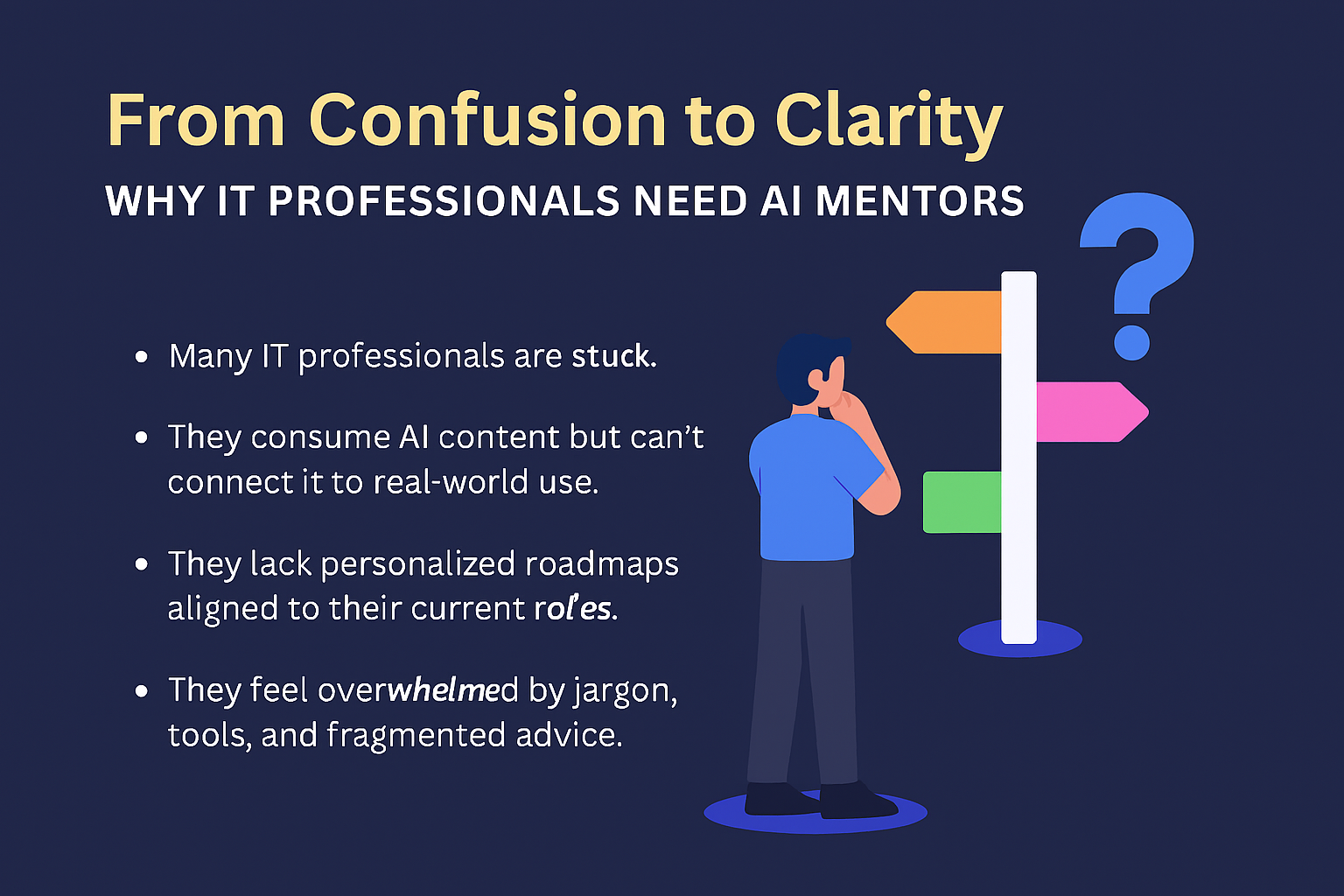
Most AI content is not built for mid-career IT professionals. It’s scattered, role-agnostic, and lacks recruiter-grade clarity.


🔍 What’s Missing in Today’s AI Learning Landscape

  • 🎯 No mapping to your current IT role
  • 🧠 No personalized roadmap
  • 📉 No recruiter visibility or asset planning
  • 🔁 No feedback loops or execution rituals

🧠 The Core Problem: Why Learning Alone Doesn’t Lead to Execution

You’ve read the blogs.
You’ve watched the tutorials.
You’ve taken the courses.
But your career hasn’t moved. Why?

Because:
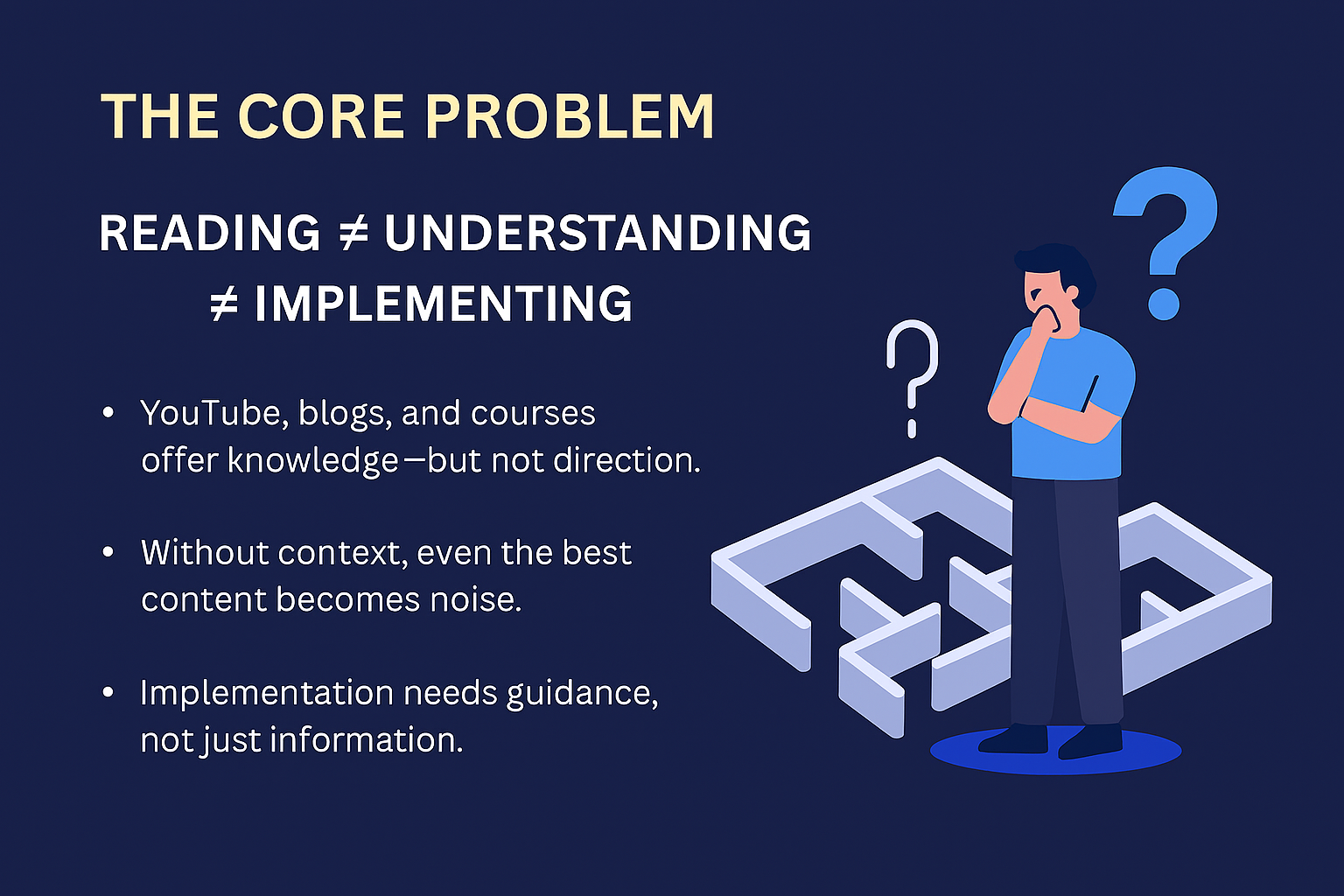
READING ≠ UNDERSTANDING ≠ IMPLEMENTING


🔍 What’s Really Happening

  • 📚 Content offers knowledge—but not direction
  • 🧩 Without context, even the best tutorials become noise
  • 🌀 You’re stuck in a maze of tools, jargon, and fragmented advice
  • 🚫 Traditional learning doesn’t scale you into multiple roles

🚀 What You Actually Need

You need guided implementation—not just information.
You need a mentor who maps your role, builds recruiter-grade assets, and walks with you till execution.

📌 See this upskilled profile:
Ravi Kumar Kangne – Agentic AI Product Designer
He’s confident in answering design-level questions. Are you?

That’s what we do at VSKUMARCOACHING.COM


🧓 Why Senior Mentors Matter in Your AI Career Journey

AI isn’t just about tools and tutorials.
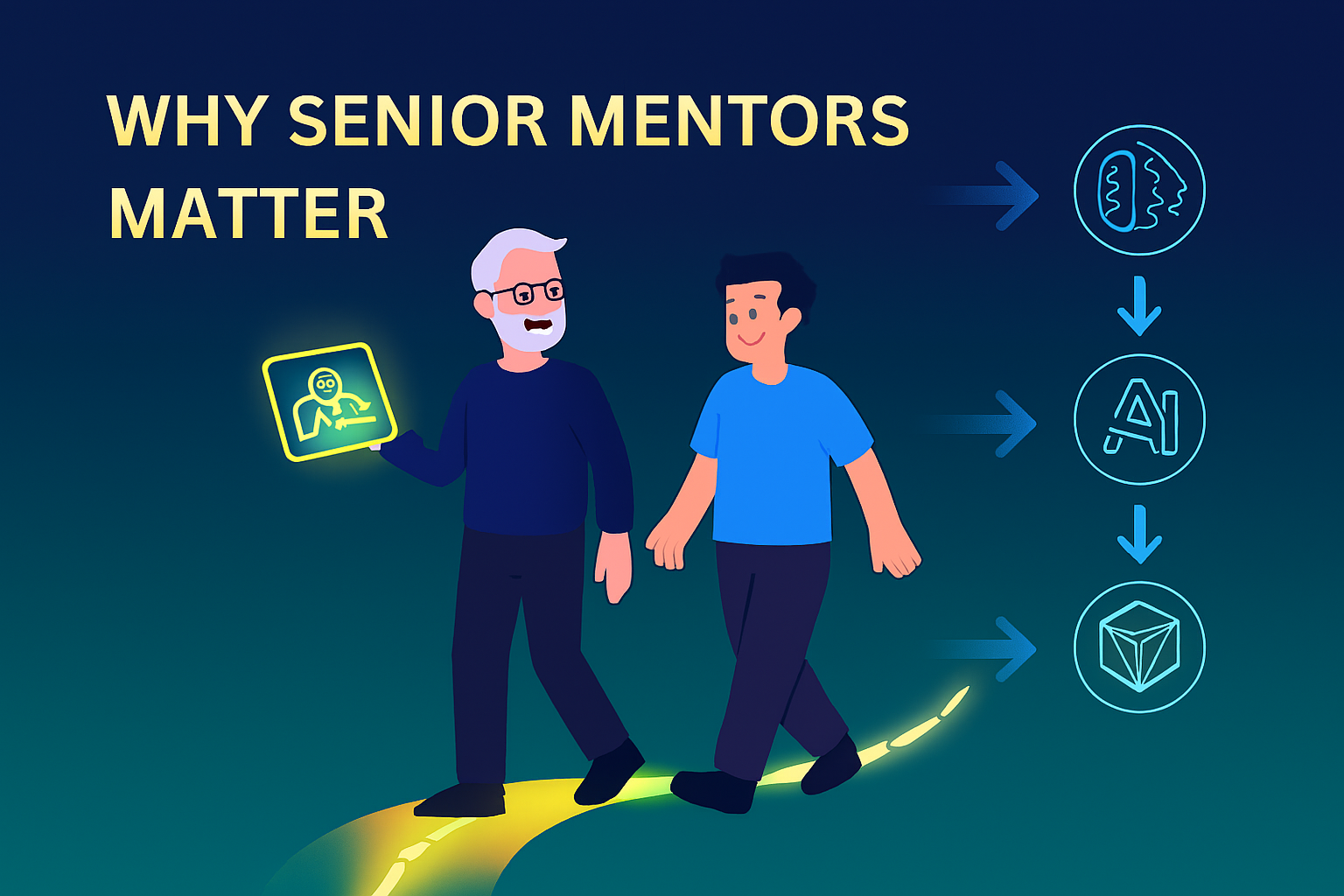
It’s about execution—and that demands experienced guidance.


🔍 What Most Professionals Miss

  • 🧠 You can’t navigate AI transitions alone
  • 🧭 You need someone who’s walked the path
  • 🧱 You need help breaking through blockers—technical, strategic, and recruiter-facing

🚀 What Senior Mentors Actually Do

  • 📍 Map your AI career based on your current role
  • 🛠️ Guide you through implementation—not just planning
  • 📄 Help you build recruiter-grade assets with proof
  • 🔁 Stay with you till execution—not just advice

At VSKUMARCOACHING.COM, mentorship is a walk-together model—from roadmap to recruiter traction.


🛣️ What a Recruiter-Desired AI Roadmap Actually Looks Like

Still stuck in role confusion?
Still browsing AI content without clarity?

You need a mapped route—not scattered learning.


🔍 A Proven Route Map

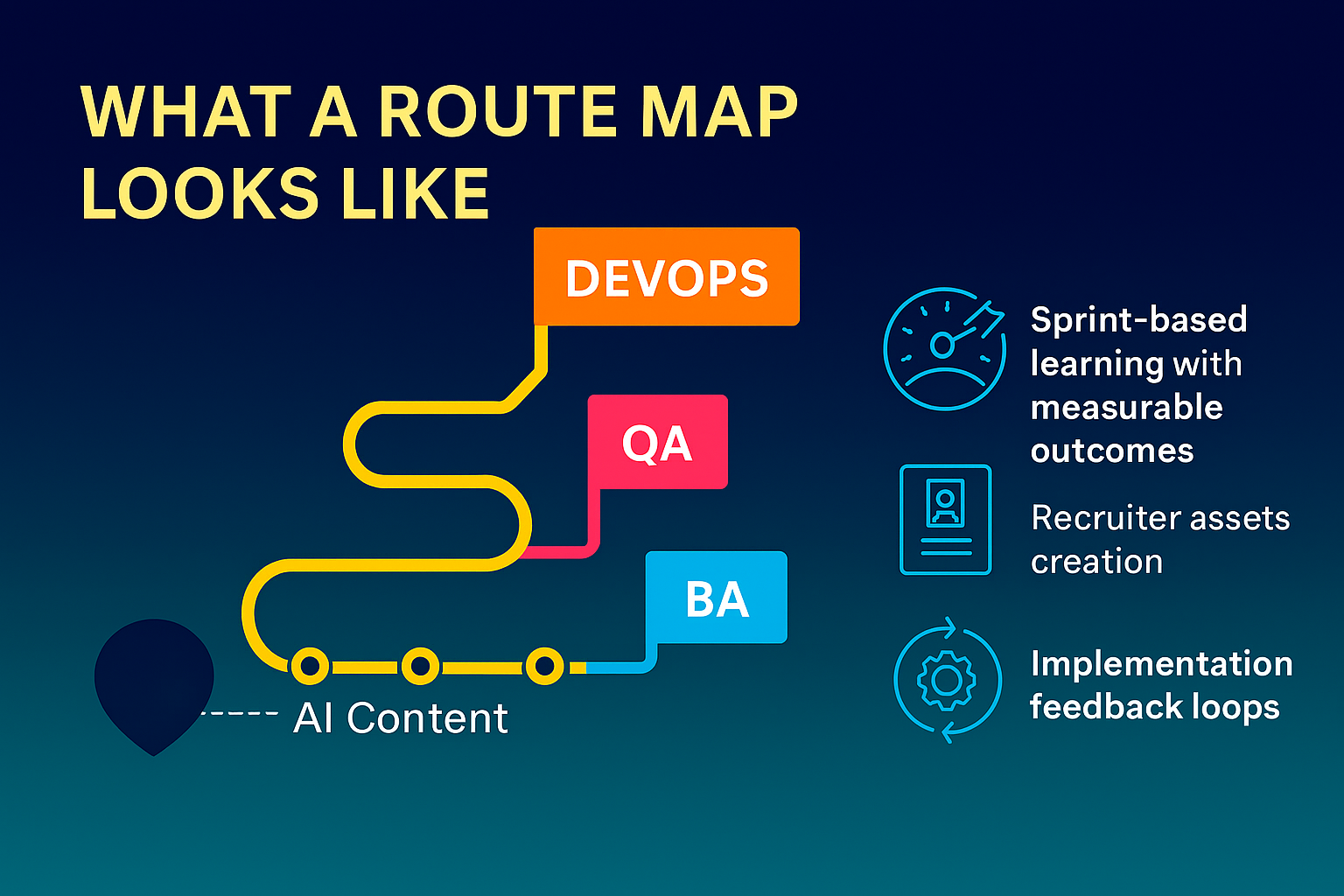
  • 🧠 BA → QA → DevOps → AI Content
  • 🏁 Sprint-based learning with measurable outcomes
  • 📄 Recruiter asset creation for visibility and traction
  • 🔁 Implementation feedback loops for refinement and proof

This isn’t a generic career path.
It’s a custom roadmap built around your current role, domain, and recruiter goals.

That’s what we design at VSKUMARCOACHING.COM


🚀 Ready to Move Forward? Your Personalized AI Roadmap Starts Here

Enough browsing.
Enough confusion.
It’s time to activate your AI career—with clarity, proof, and recruiter traction.


🔍 What This Step Unlocks

You’re not aiming for one job.
You’re mandated to get multiple offers across multiple locations.

That means your roadmap must be:

  • ✅ Personalized
  • ✅ Proof-backed
  • ✅ Recruiter-validated

At VSKUMARCOACHING.COM, we don’t just plan your AI career.
We walk with you till it’s implemented.


📞 Book your career counselling call when you’re ready to move forward:
Ravi Kumar Kangne – LinkedIn Profile


$6.6 Trillion in Play: GAI Skills, Roles, and Industries That Will Shape the Future:

https://www.linkedin.com/pulse/indias-workforce-phase-wise-ai-transformation-roadmap-v-qzw2c/?trackingId=LQaN0YpqSWuOe5W9I9%2BaIw%3D%3D

#AIcareers #CareerCounselling #ITtoAI #GenAI #DevOps #QA #BusinessAnalysis #RecruiterAssets #VSKumarCoaching #CareerTransformation #LinkedInCarousel