
🚀 From Legacy to Leadership: India’s IT Professionals in the AI Transition
By Shanthi Kumar V | Fractional AI Strategist & Agentic Automation Architect
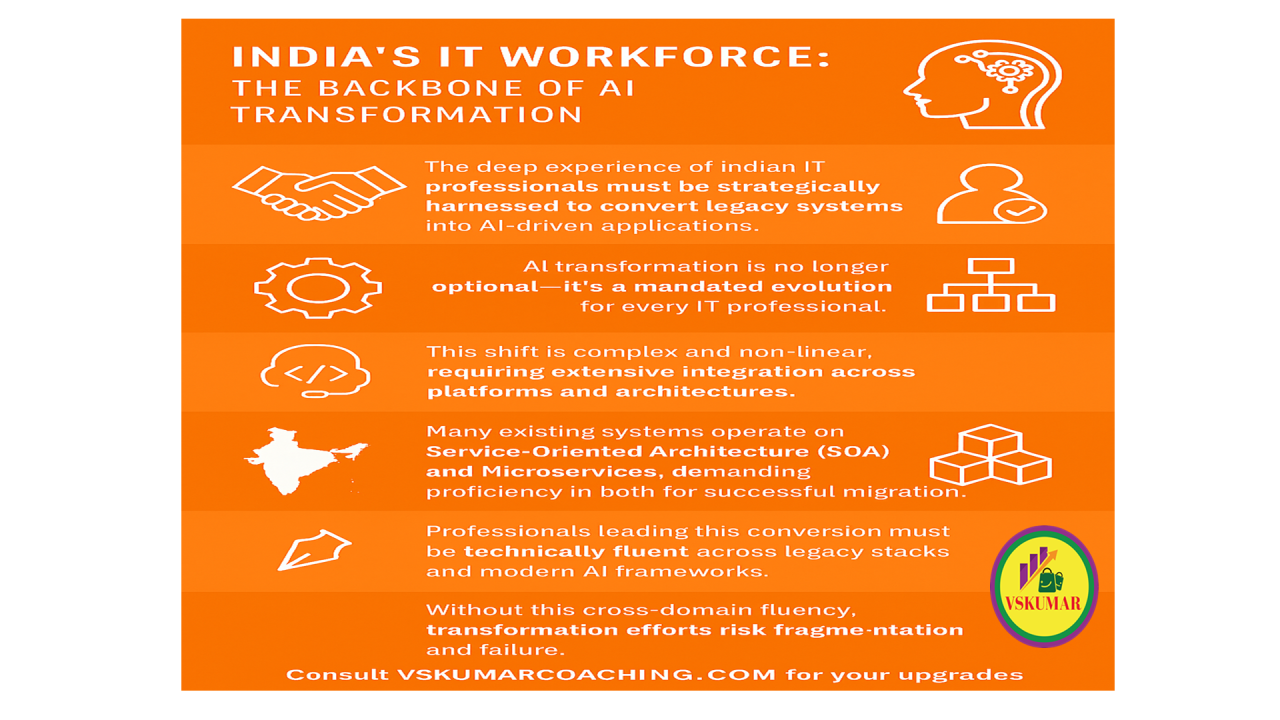
India’s IT workforce stands at a historic inflection point. The shift from legacy systems to AI-powered ecosystems isn’t just technical—it’s strategic, career-defining, and globally consequential. With over 4 million professionals across domains, India has the potential to lead the global AI transformation wave—if it activates the right roadmap.
This blog breaks down the transition into seven actionable phases, each with key questions to guide professionals, recruiters, and CXOs toward sovereign execution.
🔹 Phase 1: Legacy Leverage
Harnessing Experience for AI Migration
India’s IT talent pool holds decades of legacy expertise—COBOL, .NET, Oracle, and more. This isn’t obsolete; it’s fuel for AI modernization.
- What legacy systems are still mission-critical in your organization?
- Which modules can be re-engineered using AI workflows?
- How can past migration experience be repurposed for AI transformation?
- What tribal knowledge must be preserved before conversion?
- Are your teams trained to audit legacy code for AI readiness?
🧭 Action: Document legacy workflows and map them to AI augmentation opportunities.
🔹 Phase 2: Mandated Evolution
AI Transformation as a Career Imperative
AI is no longer optional—it’s a mandated evolution for every IT professional, regardless of domain.
- Have you mapped your current role to emerging AI responsibilities?
- What AI tools or platforms are relevant to your domain?
- Are you actively upskilling or waiting for organizational push?
- How do recruiters evaluate AI-readiness in your profile?
- What certifications or proof-points validate your AI evolution?
🧭 Action: Build a weekly AI upskilling ritual and showcase it through visible deliverables.
🔹 Phase 3: Integration Complexity
Navigating the Non-Linear Shift
AI transformation isn’t plug-and-play. It demands deep integration across stacks, platforms, and workflows.
- Which systems require API-level integration with AI modules?
- Are your teams equipped to handle data interoperability challenges?
- What orchestration tools are being used for multi-platform alignment?
- How do you validate integration success across legacy and AI layers?
- What risks emerge from partial or siloed integration?
🧭 Action: Audit your tech stack for integration gaps and build agentic orchestration demos.
🔹 Phase 4: Architecture Fluency
Mastering SOA and Microservices for Migration
Most legacy systems run on SOA and Microservices. Fluency in both is non-negotiable for seamless AI migration.
- Can your team distinguish between SOA and Microservices in current systems?
- What AI frameworks integrate best with these architectures?
- Are you using containerization (e.g., Docker, Kubernetes) for deployment?
- How do you handle service discovery and orchestration in AI contexts?
- What benchmarking tools validate architecture fluency?
🧭 Action: Build containerized AI modules and validate them with service orchestration flows.
🔹 Phase 5: Tech Stack Mastery
Cross-Domain Fluency as a Strategic Asset
Conversion leaders must be fluent across legacy stacks and modern AI frameworks. This is the new currency of transformation.
- What legacy languages (e.g., COBOL, .NET) still dominate your environment?
- Which AI frameworks (e.g., TensorFlow, PyTorch) are being adopted?
- How do you bridge the gap between old and new tech stacks?
- Are your teams trained in hybrid deployment models?
- What proof-points validate your cross-stack fluency?
🧭 Action: Build hybrid POCs that span legacy and AI stacks, and document them with GitHub dispatch logs.
🔹 Phase 6: Risk of Fragmentation
Avoiding Failure Through Full-Spectrum Capability
Without full-spectrum fluency, transformation efforts risk fragmentation, delays, and systemic failure.
- What are the top three failure points in past transformation efforts?
- How do you audit for fragmentation risks before deployment?
- Are your teams aligned on transformation KPIs and outcomes?
- What governance models ensure cross-team accountability?
- How do you recover from partial or failed AI rollouts?
🧭 Action: Create a transformation scorecard and align it with cross-team rituals.
🔹 Phase 7: India’s Opportunity
Redefining Global Tech Leadership
This challenge is also India’s moment. With the right strategy, India can lead the global AI transformation wave.
- What global benchmarks can India surpass in AI deployment?
- How do Indian professionals position themselves as AI leaders?
- What role do coaching and mentoring play in this transformation?
- How can recruiters be educated to recognize AI-ready talent?
- What platforms amplify India’s AI success stories?
🧭 Action: Build sovereign proof-points and share them across LinkedIn, GitHub, and coaching platforms.
🚀 Final Note: Sovereignty Over Survival
India’s IT workforce is not just adapting—it’s architecting the future. The transition from legacy to leadership demands clarity, coaching, and demonstrable execution.
🔧 Build Demonstrable Cloud + DevOps + AI POCs
🧑💻 Use Python + Prompt Engineering to Guide Intelligent Tasks
📁 Document Every Project as Verifiable Experience
🧭 Ready to Transform?
At vskumarcoaching.com, professionals are scaled into multi-role AI specialists within 4–6 months through:
- 15–20 focused hours per week
- Prompt-first execution using structured assignments
- Role-ready resumes based on real deliverables
- Alignment with spiritual timing and personal intent
This isn’t a bootcamp. It’s a sovereignty platform for those ready to transform with dignity, focus, and verifiable power.
 Building Cloud/DevOps/AI/ML/Gen AI Architects