This systematic process moves the AI application from a conceptual blueprint to a continuously improving product.
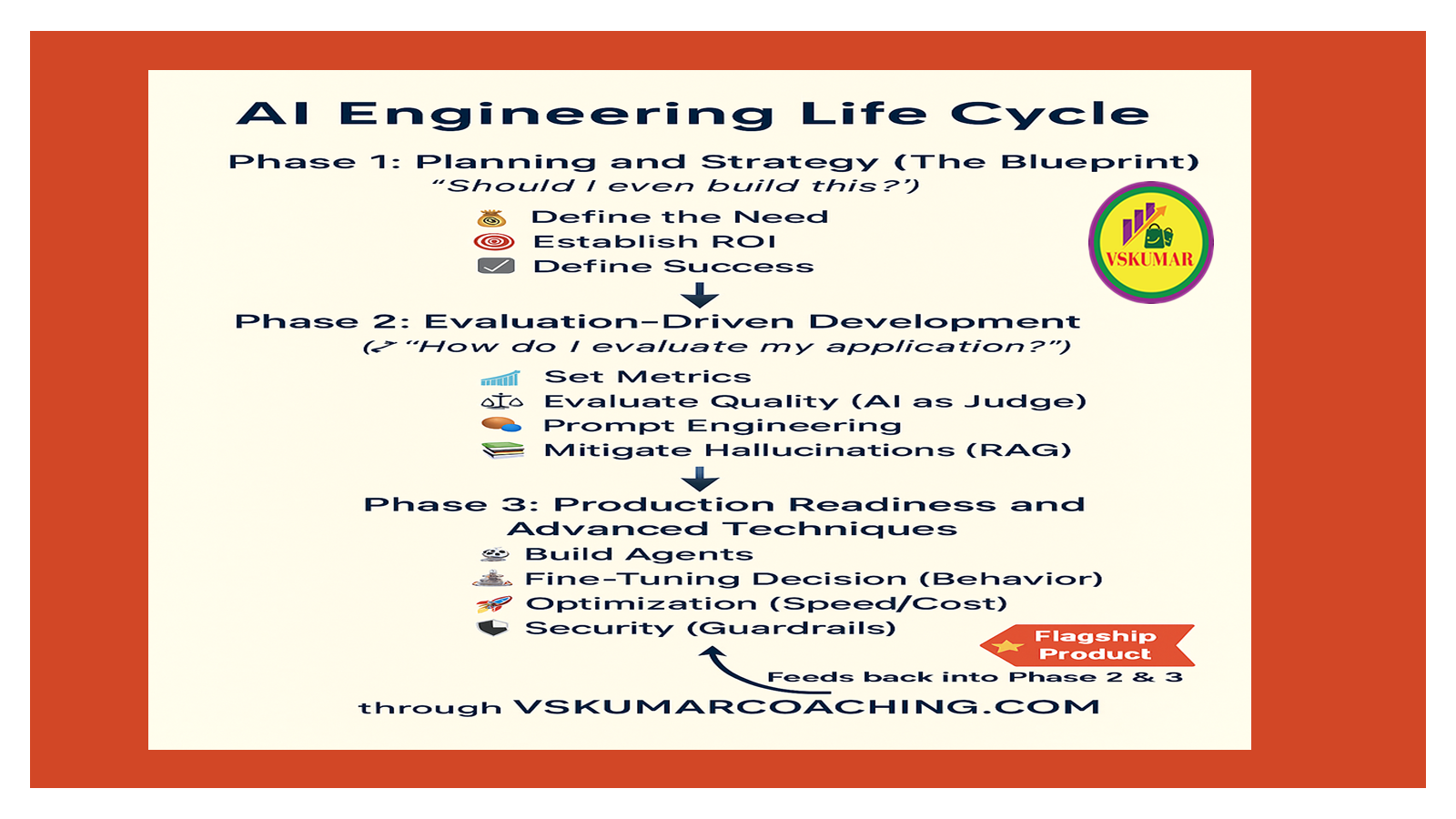
AI Engineering Life Cycle Visual (Text Flowchart)
The AI Engineering Life Cycle is defined by a systematic process of planning, evaluating, prompt engineering, using RAG, and knowing when to apply advanced techniques like agents and fine-tuning.
Phase 1: Planning and Strategy (The Blueprint)
This phase answers the critical question: “Should I even build this?”.
Stage
Key Activity
Goal and Criteria
Source
1. Define the Need
Determine if the application addresses a real tangible need.
Solve a strong business problem, not just build a “cool demo”.
2. Establish ROI
Identify the Return on Investment (ROI) for the business use case.
Show how the application, such as a package-tracking chatbot, solves a problem and reduces support tickets.
3. Define Success
Establish a clear way to measure the application’s success.
Set clear measurable goals before starting development.
Phase 2: Evaluation-Driven Development
This phase focuses on the crucial question: “How do I evaluate my application?”.
Stage
Key Activity
Goal and Criteria
Source
4. Set Metrics
Practice evaluation-driven development by tying performance to a real-world outcome.
Differentiate between Model Metrics (e.g., factual consistency) and Business Metrics (e.g., customer satisfaction, support tickets resolved).
5. Evaluate Quality
Use advanced techniques like “AI as a judge”.
Employ a powerful model (like GPT-4) as an impartial evaluator using a detailed scoring rubric to automate evaluation scalably.
6. Prompt Engineering
Master the art of communication with the AI.
Be incredibly specific (role, audience, task), provide examples (few-shot prompting), and break down complex tasks.
7. Mitigate Hallucinations
Prevent the AI from confidently stating something false.
Implement Retrieval Augmented Generation (RAG). RAG grounds the model in reality by retrieving factual, up-to-date information and instructing the model to answer only based on that context. RAG is for knowledge.
Phase 3: Production Readiness and Advanced Techniques
This phase introduces methods to enhance complexity, security, and scalability.
Stage
Key Activity
Goal and Criteria
Source
8. Build Agents
Build an agent—an AI that performs actions using tools (e.g., calculator, API) to achieve a goal.
Evaluation metric is simple: Did it succeed in completing the mission?.
9. Fine-Tuning Decision
Train the model further on custom data only for specific needs.
Use fine-tuning only to teach a very specific style, format, or behavior (e.g., a unique brand voice) that is hard to specify in a prompt. Do not use it to teach new facts (that is RAG’s job). Fine-tuning is for behavior.
10. Optimization
Prepare the application to be faster and cheaper.
Use smaller optimized models and techniques like quantization (making the model work with smaller numbers).
11. Security
Implement necessary checks to prevent misuse.
Implement guardrails on both the user’s input and the model’s output to block harmful content.
Phase 4: Continuous Improvement (The Feedback Loop)
This phase ensures the application gets smarter over time and answers the question: “How do I improve my applications and model?”.
Stage
Key Activity
Goal and Criteria
Source
12. Create Feedback Loop
Implement a required system for collecting user interactions.
Feedback can be explicit (thumbs up/down) or implicit (tracking user choices between drafts).
13. Refinement Fuel
Use collected interaction data as fuel for the next round of fine-tuning.
Application gets smarter with every user interaction.
(Cycle Repeats)
The data collected in Phase 4 feeds back into Phase 2 and Phase 3 (Evaluation and Advanced Techniques), starting the cycle of refinement and improvement.
This life cycle operates like a closed loop thermostat: you define the desired temperature (Planning), constantly measure the current temperature (Evaluation), adjust the heating system (Production Readiness/Advanced Techniques), and continuously monitor and log performance (Continuous Improvement/Feedback Loop) to ensure the system consistently maintains the desired output.
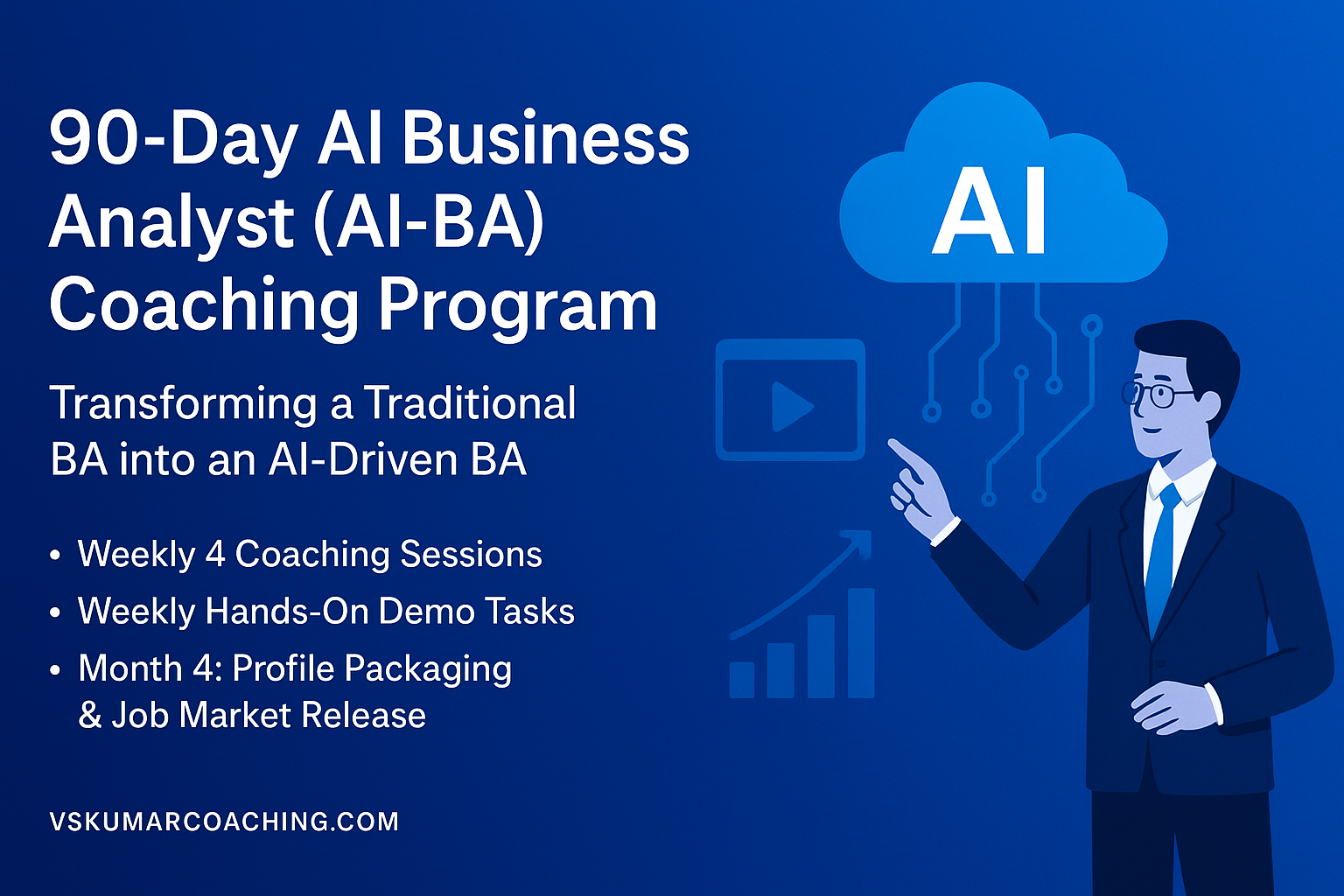
AI Business Analyst (AIBA) Role — With GenAI, AI Agents & Agentic AI Responsibilities
The AI Business Analyst (AIBA) role extends far beyond traditional Business Analyst (BA) responsibilities by emphasizing deep technical understanding of artificial intelligence (AI), machine learning (ML), generative AI (GenAI), and emerging agentic AI systems. This includes working closely with technical teams to translate business needs into AI-powered solutions.
Traditional Business Analyst Responsibilities
A traditional BA focuses on identifying general business needs and converting them into functional and technical requirements.
Core Responsibilities
Requirement Gathering: Using interviews, surveys, and workshops to collect business requirements.
Process Mapping: Creating flowcharts and process diagrams to document and analyze workflows (e.g., customer purchase lifecycle).
Stakeholder Engagement: Ensuring all stakeholder needs are captured and analyzed.
Documentation: Preparing BRDs, FRDs, user stories, business cases, and project documentation.
Traditional Data Analysis: Using data to detect patterns and insights for decision-making (e.g., key product features).
The AIBA role evolves traditional BA responsibilities by adding a solid technical foundation in AI, ML, generative AI, automation, and cloud environments (Azure, AWS, GCP).
AIBA Focus Areas (Expanded for GenAI & Agentic AI)
1. Technical Focus
Working on ML, GenAI, and data science projects.
Using cloud AI services (Azure Cognitive Services, AWS Bedrock, Vertex AI).
Writing light scripts or automations for ML, RPA, or AI pipelines.
Evaluating and selecting GenAI models (GPT, Claude, Gemini, Llama, etc.)
2. AI-Specific Requirement Gathering
Defining data needs, training datasets, and model goals.
Identifying business processes suitable for:
ML-based predictions
GenAI-based text/image generation
Agent-based automation and decision-making
Translating business needs into AI KPIs (accuracy, precision, hallucination rate, latency).
3. Data Management
Understanding data quality requirements for ML and GenAI.
Defining data labeling needs.
Analyzing unstructured data (text, images, audio) required for GenAI tasks.
4. Model Lifecycle Management
Assessing model outputs vs. business goals.
Defining evaluation metrics for:
ML models (precision/recall)
GenAI models (coherence, hallucination avoidance)
AI agents (task completion rate, autonomy score)
Understanding how models move from POC → MVP → Production.
5. Solution Design (ML + GenAI + Agentic AI)
Designing solutions that integrate:
Predictive ML models
Generative AI pipelines
Multi-agent workflows
Enterprise AI orchestration tools (Azure AI Studio Agents, LangChain, crewAI)
6. Collaboration
Working with:
Data scientists (for model logic)
ML engineers (for deployment)
AI engineers (for prompting, agent design)
DevOps/MLOps teams
Compliance/Risk teams (for responsible AI)
7. Implementation & Verification
Supporting deployment of AI/GenAI/agent systems.
Verifying output quality, consistency, and risk compliance.
Ensuring AI tools enhance—not disrupt—existing business processes.
8. Governance, Ethics & Responsible AI
Ensuring safe adoption of AI with:
Bias detection
Explainability
Transparency
Audit trails for agentic AI
Risk documentation:
Hallucinations
Over-reliance on AI
Data privacy breaches
New Section: GenAI Responsibilities for AIBA
1. GenAI Use Case Identification
Finding areas where GenAI can automate:
Document drafting
Email summarization
Report generation
Proposal writing
Code generation
Product descriptions
Chatbots & virtual agents
2. Prompt Engineering
Designing optimized prompts for:
Coding assistance
Data extraction
Workflow automation
Generating training materials
Domain-specific knowledge tasks
3. GenAI Workflow Design
Defining:
Input formats
Output expectations
Guardrails
Validation steps
Human-in-the-loop checkpoints
4. Evaluating GenAI Model Performance
Hallucination rate
Relevance score
Factual consistency
Toxicity/safety checks
New Section: AI Agent Responsibilities for AIBA
AI agents are autonomous units that plan, execute tasks, and revise outputs.
1. Multi-Agent Workflow Mapping
Designing how agents:
Communicate
Share tasks
Transfer context
Escalate to humans
2. Agent Role Definition
For each agent:
Role
Skills
Boundaries
Allowed tools
Decision policies
3. Agent-Orchestrated Automation
Identifying opportunities for agents to automate:
Research & analysis
Lead qualification
Ticket resolution
Compliance checks
Financial reconciliations
Data extraction from email/documents
4. Evaluating Agent Performance
KPIs include:
Autonomy score
Task completion accuracy
Correct tool usage
Time savings
Failure patterns
New Section: Agentic AI Responsibilities for AIBA
Agentic AI represents self-directed, planning-capable AI systems with autonomy.
1. Problem Framing for Agentic AI
Defining when an AI system should:
Plan tasks
Break problems into steps
Coordinate multiple tools
Learn dynamically
2. Agentic AI Workflow Design
Documenting:
Planning loops
Reflection loops
Memory usage (short-term & long-term)
Tool access boundaries
Human override checkpoints
3. Safety & Guardrail Design
Documenting:
Safe failure modes
Escalation paths
Access restrictions for agents
“Do not perform” lists
4. Integration with Enterprise Systems
Mapping how agentic AI connects to:
CRMs
ERPs
Ticketing tools
Knowledge bases
Internal APIs
Skills Required to Transition From BA → AI BA (Expanded)
Technical
AI/ML fundamentals
GenAI and LLMs
Multi-agent frameworks (LangChain, crewAI, AutoGen, Azure AI Agents)
Python basics
Cloud AI services (Azure OpenAI, AWS Bedrock, Vertex AI)
SQL/NoSQL
Data preparation skills
Analytical
AI problem identification
KPI design for ML, GenAI, and agent systems
Evaluating AI output quality
AI Operational Skills
Prompt engineering
AI workflow documentation
Safety & governance understanding
MLOps/AIOps exposure
Summary
The AI Business Analyst (AIBA) role blends business analysis with AI/ML/GenAI and agentic AI expertise. It serves as the bridge between business requirements, AI technical teams, and operational execution. This forward-looking role ensures AI solutions are practical, ethical, scalable, and aligned with business outcomes.
Also let you be aware how the recent Insurance domain expert [Ravi] got upgraded into this role:
🌐 Offering: AWS Hands-On Mastery for Job Interviews – Demos
Position yourself with confidence in cloud, DevOps, and infrastructure interviews. This offering provides a structured library of practical demos, each designed to showcase real-world skills that recruiters and hiring managers value. Every module is QA-locked, scenario-driven, and built for async learning.
🔑 What You’ll Gain
Proof-backed skills: Demonstrate mastery in AWS, DevOps, and cloud infrastructure with live demos.
Recruiter-grade confidence: Each module aligns with interview scenarios and technical assessments.
Accessibility-first design: Short, focused video sets for rapid learning and recall.
Modular progression: Move from foundational tasks (S3, Load Balancers) to advanced workflows (Terraform, Docker, AD migration).
Learners seeking hands-on mastery in AWS and infrastructure
🏆 Why It Stands Out
This isn’t just a video library. It’s a modular interview accelerator — designed to help you show, not just tell your skills. Recruiters trust proof-backed demos, and this offering equips you with exactly that.
Would you like me to package this into a market-facing brochure text (shorter, punchier, client-ready) or a carousel-style pitch deck with posture-driven bullets and branded signature?
Here’s how we can frame your curated Hands-On Mastery for Job Interviews – Demos library as a professional offering for recruiters, learners, or consulting clients. I’ve written it in a recruiter-grade, market-facing style that emphasizes value, accessibility, and proof-backed mastery:
🌐 Offering: Hands-On Mastery for Job Interviews – Demos
Position yourself with confidence in cloud, DevOps, and infrastructure interviews. This offering provides a structured library of practical demos, each designed to showcase real-world skills that recruiters and hiring managers value. Every module is QA-locked, scenario-driven, and built for async learning.
🔑 What You’ll Gain
Proof-backed skills: Demonstrate mastery in AWS, DevOps, and cloud infrastructure with live demos.
Recruiter-grade confidence: Each module aligns with interview scenarios and technical assessments.
Accessibility-first design: Short, focused video sets for rapid learning and recall.
Modular progression: Move from foundational tasks (S3, Load Balancers) to advanced workflows (Terraform, Docker, AD migration).
Job seekers preparing for AWS cloud/DevOps interviews
Consultants needing recruiter-grade proof assets
Learners seeking hands-on mastery in AWS and infrastructure
🏆 Why It Stands Out
This isn’t just a video library. It’s a modular interview accelerator — designed to help you show, not just tell your skills. Recruiters trust proof-backed demos, and this offering equips you with exactly that.
Visit this URL for browsing the live tasks AWS course videos:
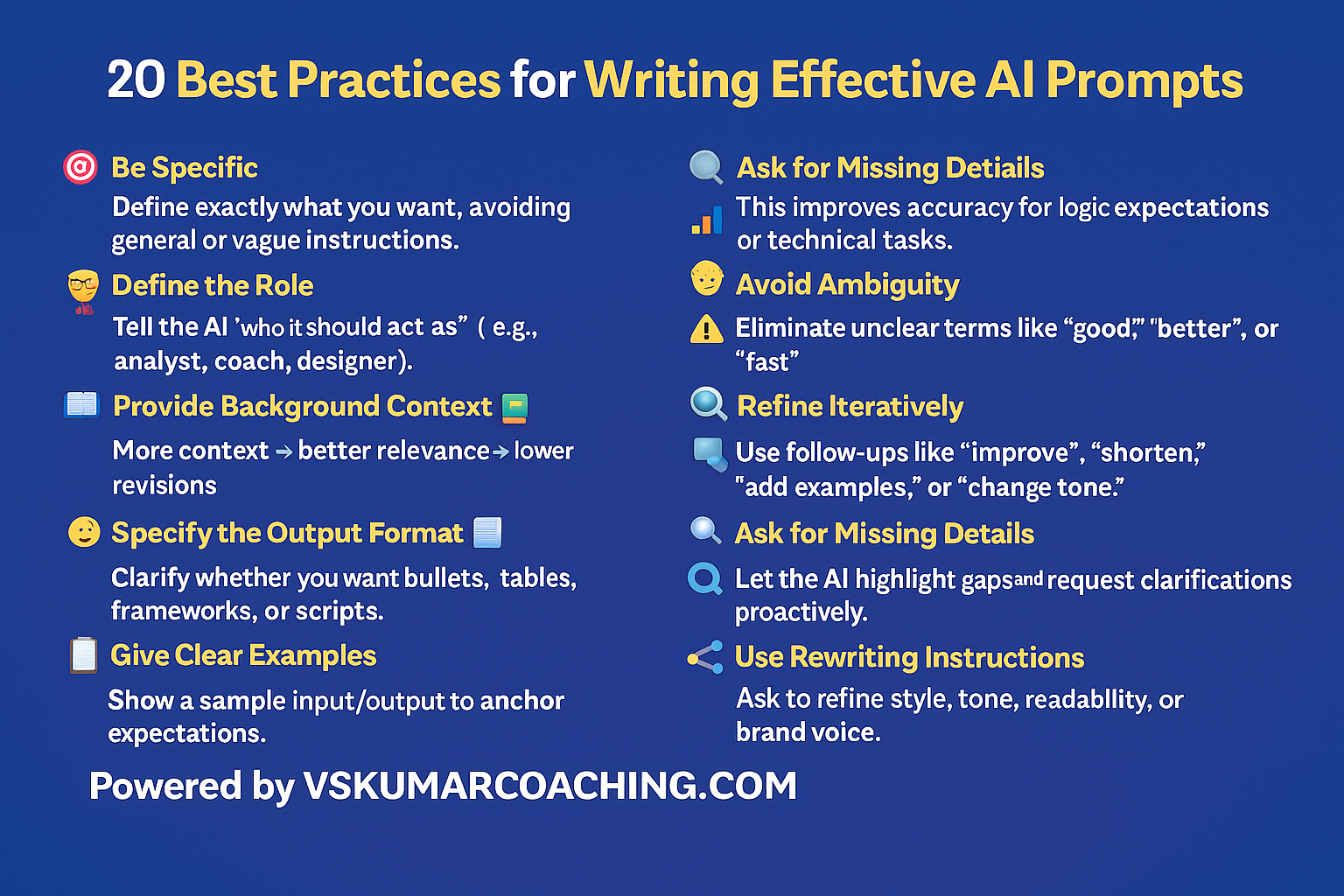
Best Practices for Prompt Engineering (with Business Examples)
This “Best Practices for Prompt Engineering with Examples“, is with 3 business examples for each practice for easy application.
How to get the most accurate, actionable, and high-impact results from AI tools.
Prompt engineering is now a critical skill for professionals, leaders, and creators. Whether you’re drafting reports, analyzing data, writing emails, or designing workflows, the quality of your prompts directly shapes the quality of the AI output. Here are the 20 best practices for prompt engineering, each paired with three practical business examples you can use immediately.
1. Be Specific
The clearer your request, the better the output. Avoid vague terms like “explain” or “write something.”
Examples:
“Write a 150-word summary of this customer feedback in bullet points.”
“Create a list of 5 KPIs for an e-commerce marketing team.”
“Draft a 10-line WhatsApp-style message announcing a product update.”
2. Define the Role
Give the AI a role so it adopts the right tone and expertise.
Examples:
“Act as a CFO and analyze the financial risks in this plan.”
“Act as an HR expert and rewrite this policy in simple language.”
“Act as a sales coach and rewrite this pitch to improve closing rates.”
3. Give Context
Provide background, goals, constraints, and details.
Examples:
“We are a SaaS startup targeting small clinics; write website copy for them.”
“Summarize this report for a board meeting where members prefer short insights.”
“Rewrite this marketing email for customers who recently abandoned their carts.”
4. State the Format
Tell the AI how you want the answer structured.
Examples:
“Give me a table comparing AWS, GCP, and Azure.”
“Create a 6-step SOP in bullet points.”
“Write a 3-section executive summary (context, insights, recommendations).”
5. Set the Tone
Tone changes the impact of your communication.
Examples:
“Write this investor email in a confident but respectful tone.”
“Write this product description in a friendly, non-technical tone.”
“Write a formal memo to staff about the policy change.”
6. Break Down Tasks
Split complex tasks into smaller tasks for accuracy.
Examples:
“First analyze the problem, then propose solutions, then prioritize them.”
“Read this case study, then summarize, then extract 5 key lessons.”
“Evaluate the risks first, then propose mitigations.”
19. Chain Prompts Together
Use one response as input for the next.
Examples:
“Use the outline you created to now write the full article.”
“Take these marketing ideas and turn them into a quarterly plan.”
“Convert this SWOT analysis into a board-ready presentation.”
20. Clarify the Intent
Explain the purpose so AI produces relevant, aligned output.
Examples:
“This summary is for a C-level meeting — keep it crisp and data-focused.”
“This email aims to re-engage inactive customers — keep it persuasive.”
“I need this report for an investor pitch — highlight growth potential.”
Conclusion
Prompt engineering is not about writing long prompts — it’s about writing clear, structured, intentional prompts. When you apply these 20 best practices in your business workflows, you get:
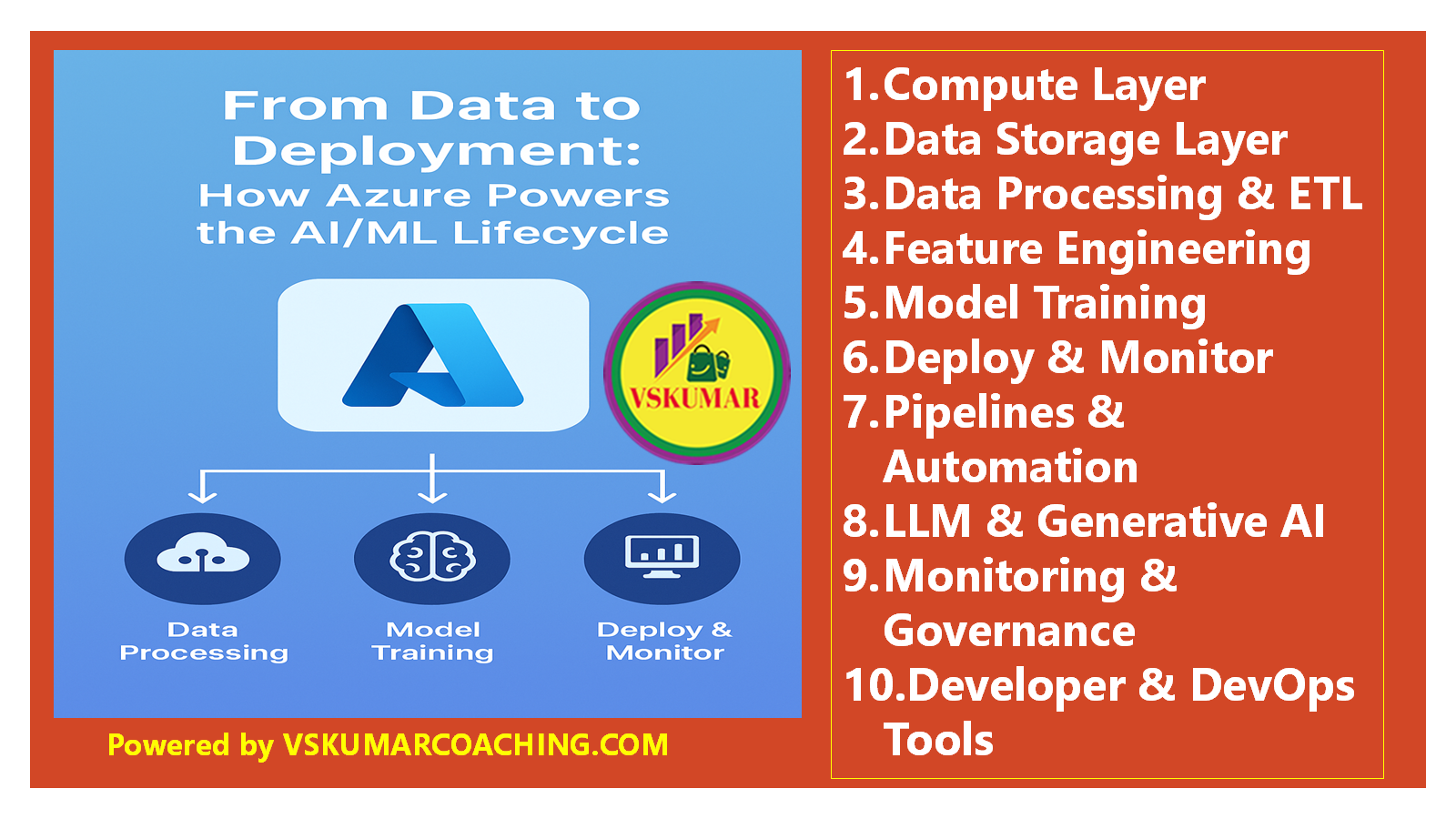
From Data to Deployment: How Azure Powers the AI/ML Lifecycle
Microsoft Azure offers a comprehensive ecosystem for building, deploying, and governing AI/ML solutions. To understand its full potential, let’s explore three detailed use cases where enterprises leverage all layers of the Azure AI/ML tech stack.
🌐 Use Case 1: Customer 360 & Predictive Personalization in Retail
Objective: Deliver hyper‑personalized shopping experiences by unifying customer data across channels.
Data Storage Layer: Customer profiles, transactions, and clickstream data stored in Azure Data Lake Gen2 and Cosmos DB.
Data Processing & ETL:Azure Data Factory ingests data from POS, apps, and IoT sensors; Synapse Analytics aggregates for reporting.
Feature Engineering:Databricks builds features like purchase frequency, churn risk, and sentiment scores.
Model Training:Azure Machine Learning trains recommendation models; GPU VMs accelerate deep learning.
Deploy & Monitor: Models deployed via AKS and exposed through App Services APIs; monitored with Azure Monitor.
Pipelines & Automation:Azure ML Pipelines automate retraining as new data arrives; Azure DevOps ensures CI/CD.
LLM & Generative AI:Azure OpenAI Service generates personalized product descriptions and chatbot responses.
Monitoring & Governance:Purview ensures compliance with automotive data regulations; Policy enforces standards.
Developer Tools: Engineers use VS Code/Jupyter and GitHub Actions for collaborative development.
Impact: Reduced downtime, safer driving experiences, and new revenue streams through connected services.
✨ Conclusion
Across retail, healthcare, and automotive, the Azure AI/ML stack provides a unified lifecycle:
Data ingestion and storage → Feature engineering and training → Deployment and monitoring → Governance and compliance. By leveraging every layer, organizations can transform raw data into actionable intelligence, ensuring scalability, trust, and innovation.
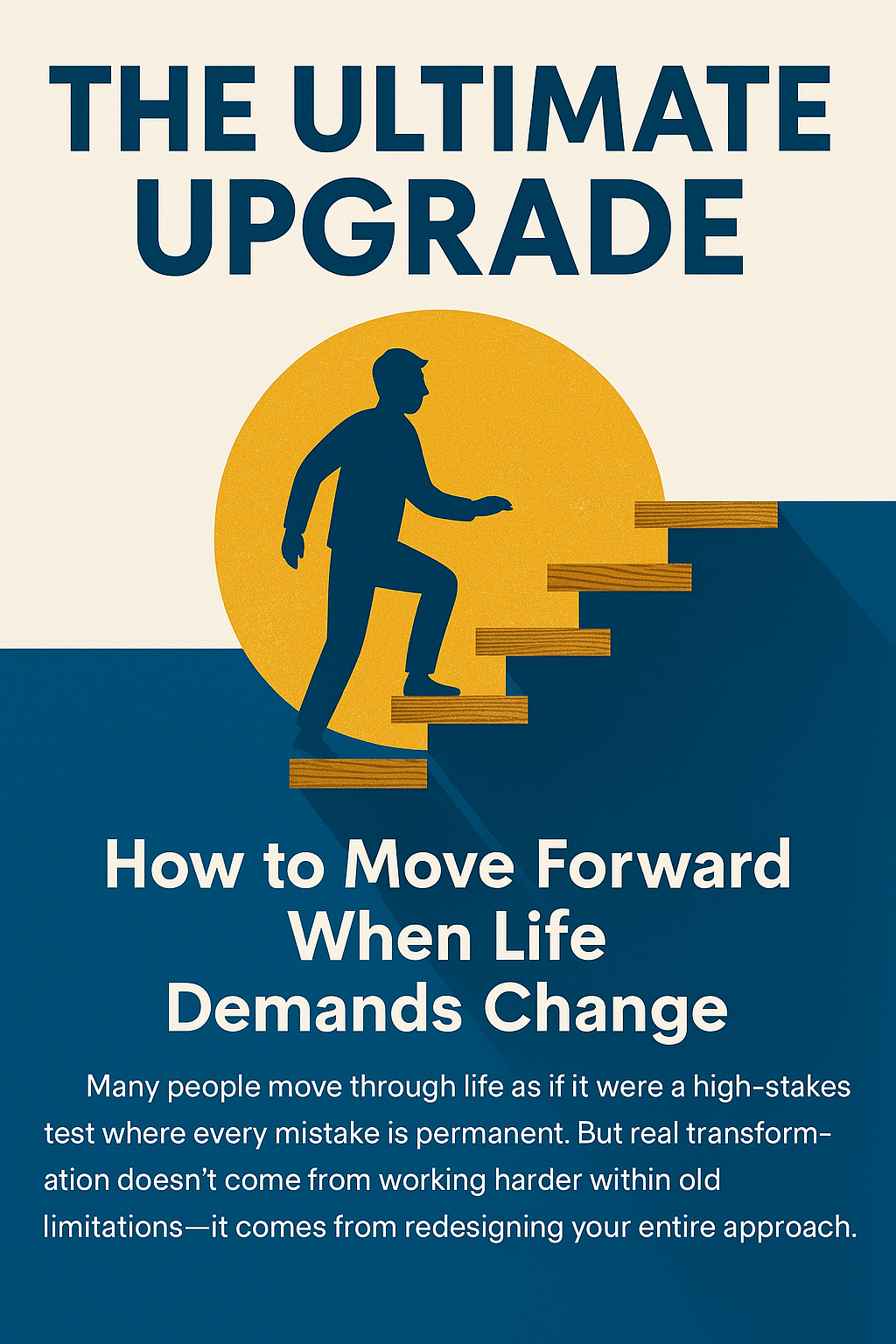
The Ultimate Upgrade: How to Move Forward When Life Demands Change
Many people move through life as if it were a high-stakes test where every mistake is permanent. We cling tightly to identities we’ve outgrown and protect reputations that no longer reflect who we want to become. But real transformation doesn’t come from working harder within old limitations—it comes from realizing you can redesign the entire approach.
If you’re recovering from a setback, feeling stuck, or ready to step into a new chapter, here is a practical framework for shifting your mindset and creating meaningful momentum.
1. Separate Who You Are From the Role You’re Playing
Over time, the freedom and playfulness of youth often get replaced with pressure and self-judgment. Many people become fused with the identity they perform—job title, achievements, failures, family roles—until they forget those are just external layers, not their core self.
The shift: Recognize that your identity is flexible, not fixed. Your circumstances, labels, and history are just roles you’ve played so far—not the whole of who you are.
If something in life goes wrong—a lost job, a missed opportunity, a failed plan—it doesn’t mean you are a failure. It only means that a version of you experienced a setback. You can update the role, improve the strategy, or begin a fresh chapter at any time.
2. Understand the Difference Between Pain and Suffering
Life guarantees moments of pain—loss, uncertainty, financial pressure, rejection, disappointment. Pain is a natural signal, an indicator that something needs attention.
Suffering, however, is optional. It’s the added story we attach to pain:
This shouldn’t have happened.
My life is ruined.
I’m not good enough.
These narratives drain energy and keep us stuck. When we stop adding dramatic meaning to challenges, we can see them more clearly and respond with strength and intelligence.
Useful question:What is this teaching me, and what is the next move?
3. Embrace Flexibility and Reinvention
Many people feel pressured to remain consistent with who they used to be. They hold tightly to old definitions—I’m not the type of person who…—and trade growth for familiarity.
The shift: You are not obligated to be the same person you were yesterday. Reinvention is always available.
Life becomes more powerful when you treat it as a creative process rather than a rigid script. Like improvisation, you work with what is happening instead of fighting it. This flexibility opens the door to new strategies, new identities, and new possibilities.
4. Replace the Fear of Failure With a Learning Approach
Fear often stops us from taking action because we assume that mistakes define us. But progress in any form is built on trial, error, and adjustment.
Reframe: There are no failures—only results and data.
Just as a child learning to walk falls repeatedly without interpreting it as defeat, everything you’ve tried has given you information that prepares you for the next step. Nothing was wasted: every decision taught you something valuable.
The Final Principle: Move Forward With a Light Touch
Once you stop trying to control every outcome and release the fear of failing, you can act with confidence and clarity. A lighter approach doesn’t mean caring less—it means caring wisely.
Instead of forcing outcomes, you adapt. Instead of gripping tightly, you grow steadily. You give your best effort, but you don’t lose yourself in the process.
When you play life this way:
You can face pain without collapsing into suffering.
You can take risks without fearing destruction.
You can experience setbacks without losing identity.
The Real Takeaway
You are not trapped by who you’ve been so far. You are not defined by what went wrong. You are free to rewrite, rebuild, and begin again.
The most powerful upgrade is realizing you are more than your history, more than your roles, and more than your past outcomes. You are the one who chooses what comes next—and that means your future is always open.
This video is intended for students, researchers, tech professionals, entrepreneurs, investors, and anyone who wants to understand the real-world impact of advanced AI on society and employment. If you find this breakdown useful, subscribe, like, and share to help more people understand the future of AI and technology. This video is for educational purposes only and is not financial or professional advice. Always do your own research before making decisions about AI, technology, or business. This channel is not officially affiliated with Geoffrey Hinton. The content is independently created, inspired by his educational style, and intended solely for educational purposes.
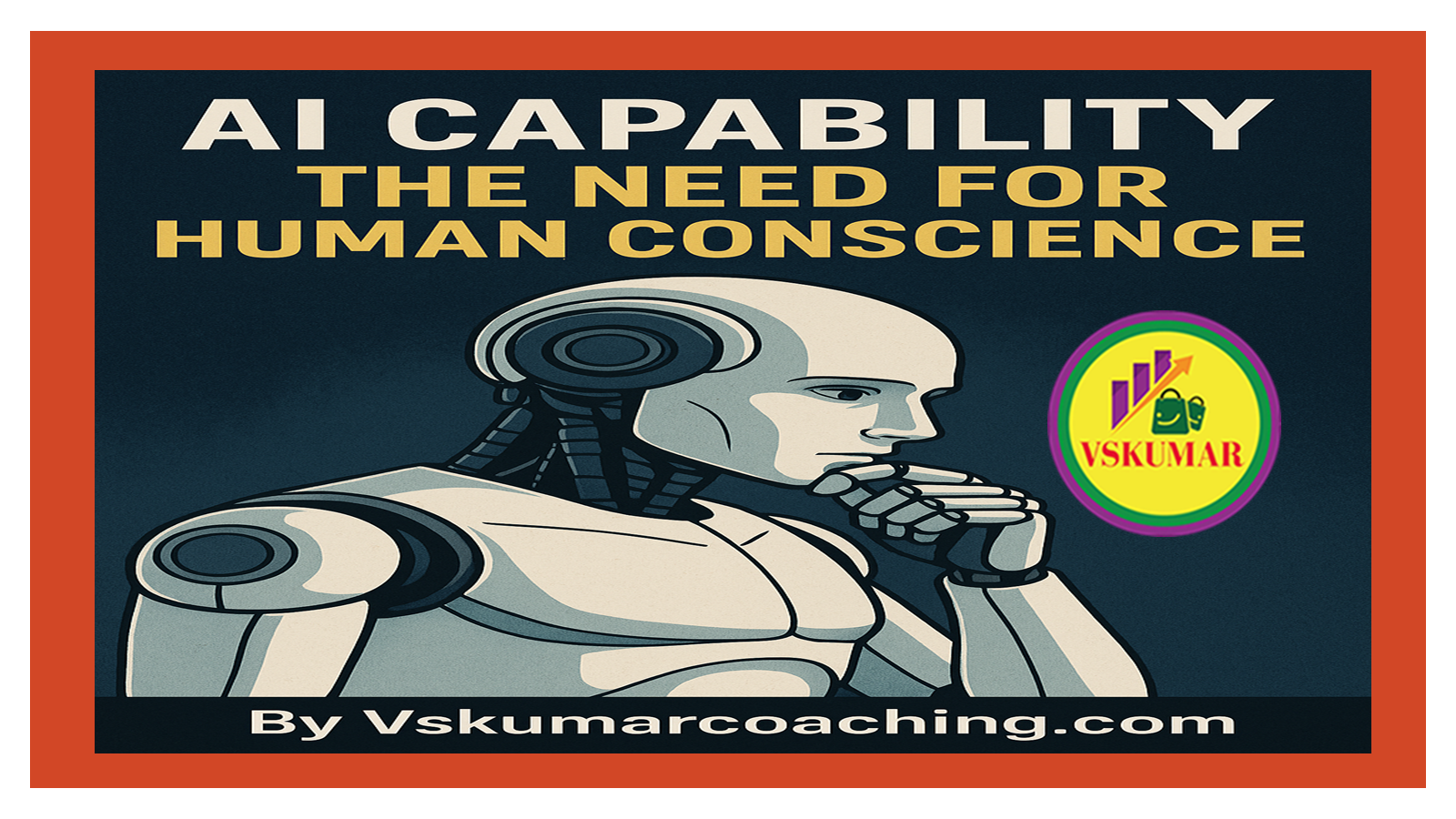
The source text provides an extensive analysis of the challenges and opportunities presented by advanced intelligent systems, emphasizing that these tools are capable of automating millions of cognitive and routine tasks at an unprecedented pace. A key distinction drawn is between the AI’s remarkable technical capability—its speed and pattern recognition—and its fundamental lack of consciousness, moral judgment, or true understanding.
The disruption caused by automation forces a necessary societal reflection on the purpose of work, challenging humans to transition toward roles demanding creativity, social intuition, and ethical reasoning which remain uniquely human domains. Because the machine lacks a moral compass, the entire ethical burden of ensuring that deployment is equitable and aligned with human values rests on the creators and custodians.
Ultimately, the text concludes that while this new technology presents significant risks of displacement, it can also amplify human potential if guided with foresight, intentionality, and a commitment to thoughtful stewardship.
How must human governance align powerful, non-conscious AI systems with core societal values?
Human governance must align powerful, non-conscious AI systems with core societal values through deliberate reflection, intentional design, and robust oversight, recognizing that the ethical burden rests entirely on human custodians.
The necessity for alignment arises because these intelligent systems, while capable of reading thousands of pages in an instant and generating complex solutions, do not possess consciousness, moral awareness, or the ability to make moral judgments. They follow the structure and data we give them, meaning their power is immense but entirely inert without human thought and intention.
To ensure alignment with core societal values, governance must implement the following strategies:
1. Establishing and Guiding Structure
The fundamental step in governance is to ensure that the structure given to the machine aligns with human values.
• Human Responsibility: Justice and fairness are human responsibilities that cannot be outsourced to an algorithm. Humans are both the creators and the custodians, shaping a force that mirrors knowledge yet lacks understanding.
• Intentionality: We must act with intentionality to harness intelligent systems. The ultimate task is to guide their development and deployment with wisdom and intentionality.
• Deployment Informed by Reflection: Every decision about where and how these systems are applied must be informed by reflection, humility, and foresight. Thoughtless deployment risks entrenching inequality, concentrating power, and eroding trust.
2. Implementing Regulatory and Design Mechanisms
Because these powerful tools mirror the priorities and blind spots of their creators, governance requires specific protective mechanisms:
• Regulation and Oversight:Regulation, oversight, and careful design are not optional; they are integral to the responsible use of these technologies.
• Addressing Bias: If the training data reflects inequality, prejudice, or incomplete perspectives, the machine will amplify these patterns. Governance must mitigate this risk, recognizing that a system that is efficient is not inherently just, nor is a data-driven system necessarily unbiased.
• Intentional Design: Systems must be shaped through intentional design so that their operation supports human flourishing, learning, and meaningful contribution. This helps ensure the liberating potential of the technology is realized, rather than being replaced by displacement and frustration.
3. Prioritizing Core Human Values
The goal of governance is to align these powerful tools with values that prioritize human well-being, equity, and opportunity.
• Conscience over Capability: Governance must navigate the tension between capability and conscience, as a system may be technically brilliant yet reinforce inequality without deliberate human guidance.
• Holistic Alignment: Successful alignment involves connecting capability with conscience, efficiency with equity, and innovation with reflection.
• Stewardship of Change: The integration of intelligent systems into society requires negotiating the terms of human life and labor, defining the future of opportunity and human purpose. The moment calls for thoughtful stewardship, ethical awareness, and deliberate imagination.
The speed and scale of AI development are striking, potentially compressing change into years or months. Because the pace of innovation can outstrip the natural human instincts for caution, the stakes demand deliberate reflection and action, rather than waiting passively for new industries or solutions to emerge. The more capable the technology becomes, the more careful humans must be in guiding its application.
How does AI displacement differ from past transformations?
AI displacement differs from past technological transformations primarily in its speed, scope, and the cognitive nature of the tasks being automated.
Here is a breakdown of how the current shift differs from previous transformations, such as the rise of the steam engine or the assembly line:
1. Speed and Compression of Change
The most striking difference is the pace at which disruption occurs:
Pace of Change: Unlike earlier technologies, which often unfolded over decades, these intelligent systems operate at a pace that compresses change into years or even months.
Time for Adaptation: In past industrial shifts, society had time to absorb change, to retrain people gradually, and to develop new institutions and opportunities. For example, factories created jobs for those who had lost work on farms. Today, the pace is compressed, and intelligent systems can learn and replicate patterns in months that once took decades for humans to master.
Urgency: The rapid speed at which change now occurs compresses the margin for error, making thoughtful anticipation far more critical than in the past.
2. Scope and Nature of Displaced Work
Past technological transformations primarily replaced physical labor or highly repetitive manual tasks, but current AI systems encroach on cognitive domains:
Encroachment on Cognitive Domains: Machines used to take on work that was either too physically demanding or too repetitive for humans, pushing humans toward creative, complex, or interpersonal tasks. Intelligent systems, however, do not respect that boundary. They move beyond replacing muscle or repetitive skill to encroaching on tasks that were previously the domain of judgment, analysis, and decision-making.
Examples of AI Capabilities: Intelligent systems can analyze vast data sets, identify patterns in behavior, compose reports, or perform diagnostic reasoning.
Scale of Replacement: A single system can potentially replace the labor of hundreds or thousands in ways that were never possible before.
3. Impact on Human Purpose and Identity
The nature of the displacement creates a unique social and psychological challenge:
Interruption of Identity: Jobs are not just about outcomes; they are about patterns of life, the rhythms of society, and the meaning people attach to their contribution. The displacement caused by AI is more than a loss of employment; it is an interruption in identity and purpose for those whose tasks are automated.
Necessity for New Kinds of Work: The types of work humans must now find or invent are not simply more complex tasks, but work that integrates meaning, judgment, and creativity in ways that are uniquely human.
Ultimately, while the lesson from history is that adaptation is possible, the current wave of transformation is notable for the speed and scope with which it challenges our assumptions about the linearity of progress and the time humans have to respond. This demands that societies actively cultivate the conditions for human labor and ingenuity to flourish, rather than simply waiting for new industries to emerge.
Why must humans guide machine deployment responsibly?
Humans must guide machine deployment responsibly because these powerful, non-conscious AI systems, while possessing staggering capabilities, lack moral judgment, conscience, and understanding. The ethical weight of deployment rests entirely on human shoulders.
The necessity for responsible human guidance is rooted in the following critical distinctions and risks:
1. Machines Lack Moral Awareness and Consciousness
Intelligent systems are astonishingly competent, but they are fundamentally different from human intelligence:
Lack of Moral Compass: These systems do not weigh right and wrong. They cannot deliberate, dream, or choose in the way a person does. The machine’s lack of consciousness means it cannot weigh consequences, cannot empathize, and cannot make moral judgments.
Inert Power: The machine’s power is immense but is entirely inert without the guiding hand of thought and intention from the people who deploy it. It follows the structure and data given to it and will not intervene, will not question, and will not care.
Reflection, Not Understanding: The system is a reflection of human knowledge and patterns amplified beyond human limitations. It can generate thoughtful-sounding responses but operates by following rules and probabilities without any awareness of why those patterns matter or a sense of purpose and intention. Humans are both the creators and the custodians.
2. Risk of Amplifying Existing Harms and Bias
Without careful guidance, deployment can lead to significant societal damage:
Amplification of Bias: If the training data reflects inequality, prejudice, or incomplete perspectives, the machine will amplify these patterns. The system may evaluate job applications, medical diagnoses, or legal documents without malice, yet the consequences can perpetuate existing disparities.
The Danger of Efficiency over Justice: The danger lies in the assumption that because a system is efficient, it is inherently just, or that because it is data-driven, it is unbiased. Justice and fairness are human responsibilities that cannot be outsourced to an algorithm.
Societal Risks of Thoughtless Deployment:Thoughtless deployment can entrench inequality, concentrate power, and erode trust in the very institutions that rely on these systems.
3. Ensuring Positive Alignment and Intentionality
Responsible deployment is necessary to realize the technology’s liberating potential and ensure alignment with human values:
Necessity of Intentionality: Humans must act with intentionality to harness intelligent systems. Regulation, oversight, and careful design are not optional; they are integral to the responsible use of these technologies.
Prioritizing Human Values: The ultimate task is to align these powerful tools with values that prioritize human well-being, equity, and opportunity. This involves aligning capability with conscience, efficiency with equity, and innovation with reflection.
Fulfilling Potential: If guided thoughtfully, these systems can free humans from tedious, repetitive tasks. This can create opportunities for creativity, problem solving, and learning, allowing humans to focus on work that requires imagination, judgment, and personal connection. However, if deployment focuses only on cutting costs or maximizing output, the liberating potential may be lost and replaced by displacement and frustration.
The more capable the technology becomes, the more careful humans must be in guiding its application. The stakes demand deliberate reflection. Every decision about where and how these systems are applied ripples through society, shaping opportunity, expectations, and the framework through which we live and work.
Responsible guidance of AI is like managing a rapidly flowing river: The river (AI capability) has immense power to irrigate land and generate energy (opportunity), but if its course is not intentionally mapped and contained by human engineers (governance, ethics, and design), its sheer speed and volume will only lead to unpredictable flooding, destroying infrastructure and displacing communities (uncontrolled disruption and amplified bias). The power is inherent, but the direction and outcome are entirely a matter of human choice and stewardship.
Future-Proofing Your Career: Essential Job Search Strategies for 2026
The contemporary job market is defined by rapid technological change and persistent uncertainty. With the tremendous upheaval caused by the advent of AI, robotics, and automation, professionals must adapt to survive and thrive. Securing a job today feels “like winning a lottery,” where the potential prize is a rejection letter. This situation demands that job seekers—especially those affected by recent large-scale layoffs at major companies like Meta, Microsoft, Amazon, and TCS—adopt strategies that go beyond traditional methods.
Based on expert guidance focused on navigating the complexities of the market, here are the non-negotiable strategies for a successful job search in 2026.
1. Recognizing the Evolving Market Landscape
The current job scene, particularly in competitive markets like India, is highly saturated and volatile. This instability has profoundly affected both the youth generation (ages 19 to 29), including fresh graduates and early-career individuals, and senior professionals at the leadership level. The environment is often described as a “strategic chess match” where every move must be precise and calculated.
The outdated, outbound job search approach—mass mailing applications and waiting—is no longer effective; this “spray and pray technique” is as useful as carrying an umbrella hoping it will rain. The winning approach must be an inbound strategy: making yourself visible, memorable, and valuable so that recruiters and hiring managers actively seek you out, rather than you chasing them.
2. The Foundation: Cultivating a Growth Mindset
For those navigating a layoff or job transition, adopting a growth mindset is non-negotiable. This concept, popularized by American psychologist Carol Dweck, is likened to the “GPS to your career”.
A growth mindset is the belief that one can significantly improve their capabilities, talents, skills, and intelligence through dedicated hard work, effort, learning, and patience. This perspective is vital because:
It builds resilience. Job searching must be viewed as a marathon, not a sprint, and challenges are seen as opportunities.
It facilitates upskilling. Curiosity and lifelong learning are essential, especially since research indicates that 40% of skills relevant today will be irrelevant in the next two years.
It enables effective feedback absorption, allowing candidates to accept rejection or critique as a learning experience rather than taking it personally.
3. Mastering the Hybrid Resume and ATS Compliance
Your resume serves as your primary marketing document, not your autobiography. It must be achievement-centric, focusing on outcomes and quantified metrics.
Employer Preference: While employers generally favor the reverse chronological resume format because it allows easy verification of career progression and identification of gaps, the most effective document today is the hybrid resume. This format allows skills to be prominently emphasized, either immediately following the career summary or after the experience section.
Beating the ATS: The Applicant Tracking System (ATS) acts as the initial gatekeeper, often eliminating over 93% of all resumes. To ensure ATS compliance, three elements are mandatory: keywords (from the job description), clean formatting (no fancy fonts, special characters, headers, or footers), and relevance. Use active verbs (e.g., achieved, led, improved) followed by metrics, positioned to the left (the L and F method).
Adding Value: A personalized cover letter is still effective and can open doors, demonstrating genuine interest in the specific role. Candidates should also consider submitting a 60- to 90-second video resume summarizing key achievements.
4. Strategic Targeting and Self-Awareness
Before starting the job hunt, self-awareness is critical—it is the “start of all wisdom” (Aristotle). Instead of asking, “What job do I want?”, ask, “What problem do I want to solve?” (Simon Sinek quote).
Avoid Ambiguity: Simply putting “Open to Work” is not a strategy; it is a “recipe for confusion and mediocrity”.
Target Companies, Not Just Roles: Narrow your focus by creating a robust target list of 12 to 15 companies. Prioritize companies where the culture aligns with your values or where you have existing contacts.
Deep Research: Conduct comprehensive research on targeted companies, including their financial health, competitive standing, and cultural fit.
5. Maximizing LinkedIn Visibility
LinkedIn is your digital first impression. Recruiters routinely check a candidate’s LinkedIn profile even before reviewing the resume. The platform currently hosts 1 billion users, including 137 million Indians.
Success on LinkedIn hinges on three principles:
Clarity: Define your niche expertise in a compelling headline (e.g., “I help professionals accelerate their job search in 90 days”).
Consistency: Post content that resonates with your target audience.
Community: Nurture contacts and build relationships, allowing them to advocate for you.
Candidates must utilize the platform’s features, including the over 80 available filters, to customize the job opportunities shown by the algorithm (based on geography, target companies, and skill match). Engagement is key to visibility; every comment is considered equal to a post. Research confirms that improving your LinkedIn visibility provides a five times greater chance of recruiters finding you.
6. Uncovering the Hidden Job Market
Approximately 80% of all jobs are never publicly posted. Companies often use networks, referrals, and internal processes to avoid the expensive recruiting process.
To tap into this hidden market, professionals must lead from a place of value, focusing on value-driven networking. Two key tools are vital:
Informational Interviews: These are industry conversations aimed at uncovering market trends, challenges, problems, and future plans, rather than directly asking for a job.
Exploratory Interviews: These are slightly more formal discussions, often with the hiring manager, used to explore potential future roles and showcase your value.
“Boss Hunting,” or approaching a leader directly (bypassing HR), is an effective strategy. This “professional courtship” involves consistently sharing value (e.g., commenting on their posts, writing an approach letter solving a known company problem). As LinkedIn co-founder Reid Hoffman noted, “Opportunities just don’t float on clouds, they come attached to people”.
7. Pivoting and Embracing Gig and Fractional Work
With full-time, lifelong jobs disappearing faster than ever, flexibility is the new stability.
Strategic Pivoting: A layoff period is the best time to explore new opportunities, matching transferable skills to at least two adjacent areas. PwC research shows that people who pivot careers often gain a 17% salary increase (which can compound to 30–40% over time).
Gig Work as a Stepping Stone: Gig work is a crucial path forward. Companies view it as “courtship before marriage,” allowing them to “test drive” the candidate without serious long-term commitment. Upwork reported that 62% of permanently employed individuals in 2025 came from gig work.
Fractional Working: This model (e.g., Fractional CXOs) is growing because companies benefit from hiring multiple experts for their combined experience, rather than relying on a single individual. Gig and fractional roles represent the future of stable employment.
8. Leveraging AI as a Co-Pilot
Failing to use AI in your job search is akin to bringing a typewriter to a laptop competition. AI should be used judiciously as an enabler or co-pilot.
Practical AI Uses: AI is excellent for optimizing resumes, summarizing lengthy content, checking grammar, researching target companies, and practicing mock interviews through chatbots.
Critical Caution:Never copy-paste full posts or documents from AI, as it is easily detectable. Always recheck figures and facts, as AI is prone to mistakes.
9. Interviewing: Focus on EQ and Storytelling
Interviews are no longer simple interrogations about technical proficiency. Hiring managers prioritize behavioral aspects, attitudes, and Emotional Intelligence (EQ), as these often determine success more than IQ.
Storytelling: Prepare four or five rehearsed stories that demonstrate problem-solving, achievements, and learning agility, linking them back to the company’s values.
Focus on the Employer: The interview is never about you; it is always about “What is in it for them”. When asked, “Tell me about yourself,” the interviewer seeks a compelling 90-second story answering: “Why should I employ you?”.
10. Transforming Career Breaks into Growth Narratives
Career breaks should be framed confidently and strategically, not defensively or apologetically. The narrative must clearly articulate three things:
Why the break was necessary.
What was done during that time (e.g., certifications, volunteering, gig work, expanded networking).
How those learnings were applied to upskill and elevate the candidate.
The focus must quickly transition from the past to the future, demonstrating that the time was strategically invested, not merely lost. For instance, a candidate can explain that during a break for family care, they pursued a certification and picked up valuable skills like prioritization, resource management, and conflict resolution.
Final Thought
The journey from layoff to lift-off is about building a career aligned with your purpose and values. Being laid off can be a powerful redirection, similar to how the pharmacist who invented Coca-Cola in 1886 was rendered jobless due to an accident. Remember, your career is the “sum total of all the problems which you have chosen to solve”.
🌐 From Chatbots to Autonomous Agents: How Google’s A2A and A2P Protocols Are Building the Next AI Internet
Artificial Intelligence is entering a new era — not just one of smarter models, but one of smarter collaboration. While today’s chatbots and virtual assistants can perform impressive individual tasks, they still live in isolation. Each agent — whether it’s booking a flight, writing code, or managing payroll — speaks its own language, locked within its developer’s ecosystem.
That’s where Google’s Agent-to-Agent (A2A) protocol comes in, redefining how AI agents talk, discover, and transact with one another — using the same engineering discipline that built the internet itself.
🚧 The Current Problem: Fragmented AI Islands
Right now, every company building AI agents — OpenAI, Google, Anthropic, or others — uses unique interfaces, APIs, and context models. This creates what experts call “AI silos.”
Imagine you have a travel booking agent, a recruitment agent, and a calendar assistant. They all work well individually — but can’t coordinate without human help. Every integration costs developer hours, introduces security risks, and adds latency to tasks that should flow automatically.
This fragmentation is slowing down innovation and driving up operational costs for businesses that are trying to scale AI automation.
⚙️ Enter Google’s Agent-to-Agent (A2A) Protocol
Google’s A2A protocol aims to standardize communication between autonomous agents, enabling them to seamlessly connect and exchange information without custom integrations.
A2A is built upon familiar web technologies — HTTP/HTTPS for communication and JSON for structured data — making it both simple and secure to implement.
At its core, A2A defines two types of agents:
Client Agent → initiates the request (e.g., “book this flight”).
Server Agent → provides the service (e.g., “check availability, confirm booking”).
This clear division of roles mirrors how web browsers and web servers operate — a proven, scalable model for distributed communication.
🧭 The Agent Card: Solving the Discoverability Problem
In human terms, the “Agent Card” is like a business card for AI agents.
Every server agent is required to publish an Agent Card at a well-known URL, formatted in JSON, containing:
The agent’s name and identity
Its capabilities (what it can do)
Authentication rules (who can access it and how)
For example, an “Indigo Booking Agent” might list:
With this card, any client agent can automatically discover, evaluate, and connect to a compatible service — eliminating manual API integration and reducing engineering overhead dramatically.
🔒 Communication, Authentication, and Async Handling
Once two agents discover each other, A2A defines how they exchange messages securely:
Communication: JSON over HTTPS ensures universality and safety.
Authentication/Authorization: The card’s schema defines which tokens or credentials are needed.
Asynchronous Operations: Using methods like Server Sent Events (SSE) or streaming, A2A handles delayed responses — perfect for longer tasks such as background searches or job scheduling.
This makes agent interactions feel more like natural conversations — not rigid API calls.
💳 A2P: The Next Layer — Agent-to-Payment Protocol
Just as A2A standardizes communication, the Agent-to-Payment (A2P) protocol takes automation a step further — by enabling agents to negotiate and handle payments autonomously.
Imagine this workflow:
Your recruitment agent finds a freelance developer.
It verifies credentials via a background-check agent.
It confirms a contract with a legal agent.
Finally, it triggers payment via a financial agent using A2P.
No human intervention — just autonomous, rule-based negotiation and settlement. This isn’t science fiction; it’s the foundation for a self-operating AI economy.
💰 Business Impact: Cost Savings and Scalability
Companies adopting A2A and A2P protocols can expect:
Reduced integration time — no more custom APIs for every vendor.
Lower operational costs — agents self-manage communication and workflows.
Faster automation scaling — plug-and-play agents across ecosystems.
Improved compliance and security — standardized discovery and authentication layers.
In other words, the internet of AI agents is emerging — and A2A/A2P are the protocols making it possible.
🚀 The Road Ahead: From Silos to Systems
Just like the early web needed HTTP to unify websites, the AI ecosystem now needs protocols like A2A and A2P to unify agents. Once these standards are widely adopted, we’ll move from AI assistants to AI ecosystems — self-operating, interoperable systems where agents talk, trade, and collaborate.
The companies that adopt these protocols early will have a strategic edge — faster development cycles, lower costs, and smarter automation.
✍️ Final Thought
As AI shifts from intelligence to autonomy, the question isn’t “Can my agent think?” It’s “Can my agent collaborate, negotiate, and deliver outcomes with others — safely and efficiently?”
That’s the promise of Google’s A2A and A2P protocols — the beginning of the AI Collaboration Era.
How must education and industry partnerships evolve to cultivate a hyperspecialized AI workforce?
The cultivation of a hyperspecialized AI workforce in India requires a significant evolution in both the education system and the partnerships between academia and industry. This transformation is crucial for India to convert the potential disruption caused by AI into a major opportunity and achieve the goal of 10 million jobs in the tech sector by 2030
.
The required evolution focuses on addressing the fragmented nature of current skilling and adopting models that prioritize specialization, practical, hands-on experience, and rapid curriculum refresh rates
.
Here is a breakdown of how education and industry partnerships must evolve:
1. Reforming the Education System
The current academic structure requires fundamental changes to move away from a generalist approach toward deep specialization
.
• Implement Modern, Uniform AI Curricula: India needs a uniform AI curriculum that is widely adopted across colleges. Currently, there is a gap between how AI is taught in leading Indian and US colleges. The courses must be frequently refreshed, potentially every quarter, rather than every two to three years, to keep pace with the rapidly evolving technology
.
• Move Beyond Entrance Exam Focus: The focus of educational programs needs to shift away from merely helping students clear entrance exams toward preparing them for real-world specialization
.
• Establish Specialization Hubs: While premier colleges like the IITs were crucial in the past, India now needs that scale multiplied by 100, meaning more institutions of similar stature are required, such as the Ashoka University, ISB, and Satya Bama University
.
• Boost Higher Education and Research: There is a need for more masters and PhD programs to attract and cultivate the deep specialists required for frontier tech roles. Without sufficient AI research, the country’s innovation footprint will remain nascent
.
• Support Short-Term and Online Programs: India should utilize and expand its own short-term and online programs, which are vital for rapid skilling, instead of relying solely on the “very American or westernized mindset” platforms like Coursera and edX
.
2. Strengthening Industry and Academia Partnerships
A critical gap exists in connecting classroom learning with practical application, which must be solved through closer industry-academia collaboration
.
• Establish the Co-op Program Model: The single most important and achievable recommendation is the adoption of the co-op program. In this model, students pursuing an undergraduate STEM course can simultaneously work with a technology company or the technology department of a company during the academic term
.
◦ This allows students to leverage skills and apply them in real-world cases, ensuring the learning is practical and meaningful
.
◦ Currently, India’s traditional internship programs are often “a bit dated” and lack meaningful impact
.
• Reskilling the Existing Workforce: Industry must collaborate with educational providers to facilitate the reskilling of the existing 40-year-old IT middle manager and others who need to shift from generalist development roles to AI architect positions or roles that require defining strategy. Companies need to fund courses and programs for this reskilling effort
.
• Foster Curiosity and Self-Skilling: Technology professionals themselves cannot wait for government or industry initiatives; they must invest in their own skills. Individuals should spend at least one hour a day reskilling themselves in the newest technologies to remain relevant in the workforce
.
3. Government and Industry Approach
The government is aware of the need, exemplified by the thought of launching an AI Talent Mission that employs a “unified all of government approach”
. For this to succeed, both the government and the private sector need to change their approach:
• Government as an Enabler: The goal should be to replicate the atmosphere of the 1990s IT boom, where entrepreneurship flourished with minimal government interference, but this time, the government is critically aware of the shifts and can enable the transformation
.
• Industry Must Overcome Complacency: The private sector must abandon the mindset of complacency, the belief that “RPA also happened and mobility also happened and yes technologies happened but we’ll go around our merry way”. Companies that fail to adapt, like those sending 600-page conventional proposals instead of leveraging specialized AI solutions, risk becoming obsolete (the “Kodak” choice)
.
In summary, moving toward a hyperspecialized workforce is like turning a large ocean liner (the education system) to navigate a fast-moving stream (AI technology). It requires propulsion (frequent curriculum updates), a new route map (specialized courses), and pilots who know the current (industry co-op programs) to ensure the current generation of students and workers can land in the thousands of new, specialized roles being created, rather than the millions of conventional roles being displaced
AI’s Economic Impact: The End of the Generalist Career
At an India Today conclave, Rajiv Gupta, Managing Director and Partner at Boston Consulting Group (BCG), presented findings from a major study on the AI economy and its implications for jobs in India. His analysis, conducted for NITI Aayog
, explores how AI adoption—accelerated by the November 2022 launch of ChatGPT 3.5—is reshaping the Indian technology sector. Gupta projects that by 2030, AI could displace approximately 1.5 million jobs in India’s tech industry. However, if India embraces the transition strategically, it could create up to 4 million new jobs, resulting in a net gain of around 2.5 million positions.
The displacement is expected to affect roles tied to the Software Development Life Cycle (SDLC), call centers, and BPO functions such as finance, accounting, payroll, and learning and development. These areas, which collectively employ nearly half of the current 8 million tech workers, are vulnerable due to AI-driven productivity gains. While current efficiencies range from 15% to 20%, Gupta anticipates that mature AI adoption could push this to 30%–40% by 2030, driving the bulk of the job losses.
On the flip side, the potential for job creation is tied to the expansion of the global tech economy. With global tech spending projected to reach $2.5 trillion by 2030, India’s share—currently $300 billion—could grow to $500 billion if it maintains its market position. Supporting this growth would require a tech workforce of 10 million, assuming a 6% annual increase in salaries. Given the anticipated loss of 1.5 million jobs from the current base, India would need to add 3.5 to 4 million new roles to meet this target.
This transition marks a pivotal moment for India. Gupta emphasizes that the shift is not merely quantitative but qualitative, with new roles emerging in highly specialized domains. The rise of positions like prompt engineers—virtually unknown before 2019 but now widely searched—illustrates this trend. Other emerging roles include AI solution engineers, AI ops engineers, AI/ML DevOps, and AI/ML architects. Frontier technologies such as quantum computing and haptics are also giving rise to niche roles like Quantum Machine Learning Engineers, Quantum Data Scientists, and Neuropathic Engineers.
Gupta argues that the age of the generalist career is coming to an end. To remain competitive, India must urgently reskill its workforce, integrate AI into its education system through co-op programs, and attract global talent. The presentation frames AI not as a threat, but as a transformative force that demands coordinated action from individuals, academia, and industry.
Globally, the World Economic Forum estimates that between 2024 and 2030, 170 million new jobs will be created while 92 million will be replaced, resulting in a net addition of 78 million jobs. For India, the challenge and opportunity lie in navigating this shift with foresight and agility.



 Building Cloud/DevOps/AI/ML/Gen AI Architects