
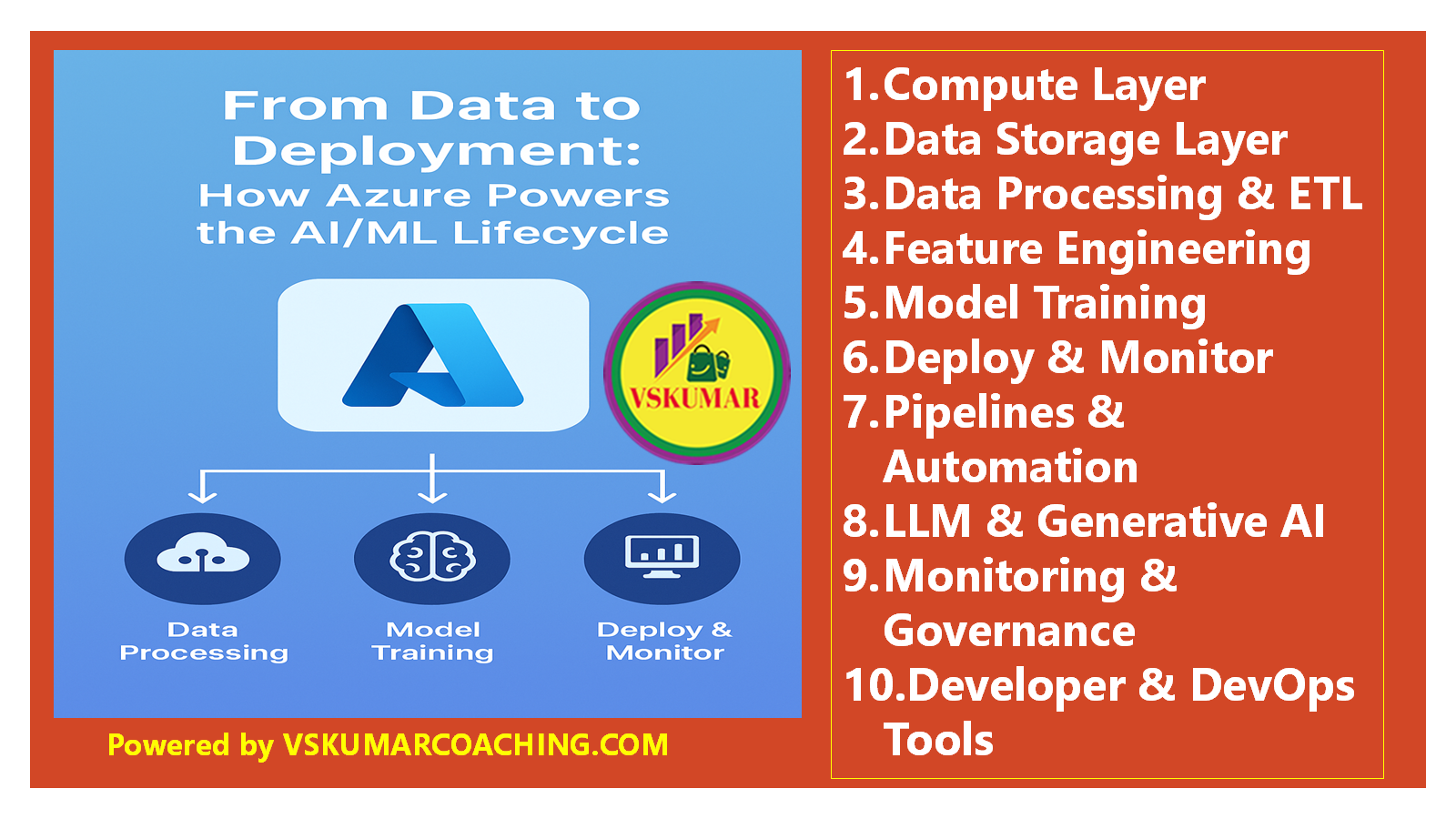
From Data to Deployment: How Azure Powers the AI/ML Lifecycle
Microsoft Azure offers a comprehensive ecosystem for building, deploying, and governing AI/ML solutions. To understand its full potential, let’s explore three detailed use cases where enterprises leverage all layers of the Azure AI/ML tech stack.
🌐 Use Case 1: Customer 360 & Predictive Personalization in Retail
Objective: Deliver hyper‑personalized shopping experiences by unifying customer data across channels.
- Data Storage Layer: Customer profiles, transactions, and clickstream data stored in Azure Data Lake Gen2 and Cosmos DB.
- Data Processing & ETL: Azure Data Factory ingests data from POS, apps, and IoT sensors; Synapse Analytics aggregates for reporting.
- Feature Engineering: Databricks builds features like purchase frequency, churn risk, and sentiment scores.
- Model Training: Azure Machine Learning trains recommendation models; GPU VMs accelerate deep learning.
- Deploy & Monitor: Models deployed via AKS and exposed through App Services APIs; monitored with Azure Monitor.
- Pipelines & Automation: Azure ML Pipelines automate retraining as new data arrives; Azure DevOps ensures CI/CD.
- LLM & Generative AI: Azure OpenAI Service generates personalized product descriptions and chatbot responses.
- Monitoring & Governance: Azure Purview catalogs sensitive customer data; Azure Policy enforces compliance.
- Developer Tools: Teams collaborate via GitHub Actions and VS Code/Jupyter notebooks.
Impact: Retailers achieve real‑time personalization, boosting conversion rates and customer loyalty.
🏥 Use Case 2: Predictive Healthcare & Diagnostics
Objective: Improve patient outcomes by predicting disease risks and supporting clinicians with AI insights.
- Data Storage Layer: Medical imaging, EHRs, and lab results stored in Blob Storage and SQL Database.
- Data Processing & ETL: Azure Data Factory integrates hospital systems; HDInsight processes large genomic datasets.
- Feature Engineering: Synapse Analytics extracts features like lab trends; Databricks builds embeddings from imaging data.
- Model Training: GPU VMs train CNNs for radiology scans; Azure ML manages experiments and hyperparameter tuning.
- Deploy & Monitor: Models deployed securely on Confidential VMs and AKS; inference triggered via Azure Functions.
- Pipelines & Automation: Automated retraining pipelines ensure models stay current with new patient data.
- LLM & Generative AI: Azure Cognitive Services for speech‑to‑text in doctor notes; Azure OpenAI generates patient summaries.
- Monitoring & Governance: Azure Policy enforces HIPAA compliance; Purview tracks lineage of sensitive data.
- Developer Tools: Clinicians and data scientists collaborate via RStudio and GitHub Copilot for reproducible workflows.
Impact: Faster diagnostics, reduced clinician workload, and improved patient care quality.
🚗 Use Case 3: Smart Mobility & Predictive Maintenance in Automotive
Objective: Enable connected vehicles with predictive maintenance and intelligent driver assistance.
- Data Storage Layer: Telemetry from vehicles stored in Cosmos DB and Data Lake Gen2.
- Data Processing & ETL: Stream Analytics processes real‑time sensor feeds; Databricks aggregates historical data.
- Feature Engineering: Azure ML extracts features like vibration anomalies; Synapse builds driver behavior profiles.
- Model Training: Predictive maintenance models trained on GPU VMs; reinforcement learning for driver assistance in AKS.
- Deploy & Monitor: Models deployed to edge devices via Azure Functions; monitored centrally with Azure Monitor.
- Pipelines & Automation: Azure DevOps automates OTA updates; ML Pipelines retrain models with new telemetry.
- LLM & Generative AI: Azure OpenAI powers in‑car assistants; Cognitive Services enable voice commands.
- Monitoring & Governance: Purview ensures compliance with automotive data regulations; Policy enforces standards.
- Developer Tools: Engineers use VS Code/Jupyter and GitHub Actions for collaborative development.
Impact: Reduced downtime, safer driving experiences, and new revenue streams through connected services.
✨ Conclusion
Across retail, healthcare, and automotive, the Azure AI/ML stack provides a unified lifecycle:
- Data ingestion and storage → Feature engineering and training → Deployment and monitoring → Governance and compliance.
By leveraging every layer, organizations can transform raw data into actionable intelligence, ensuring scalability, trust, and innovation.
 Building Cloud/DevOps/AI/ML/Gen AI Architects