This systematic process moves the AI application from a conceptual blueprint to a continuously improving product.
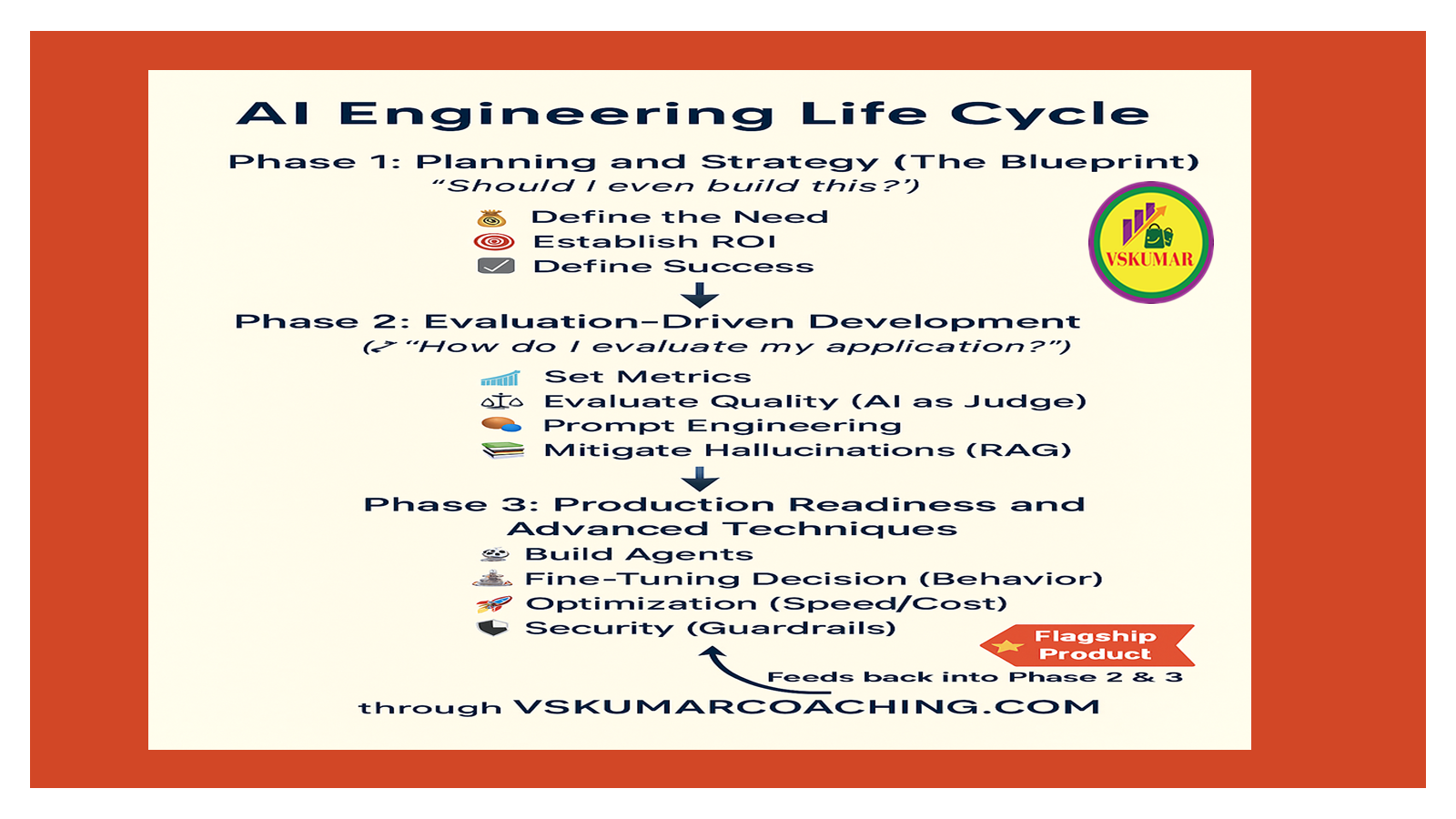
AI Engineering Life Cycle Visual (Text Flowchart)
The AI Engineering Life Cycle is defined by a systematic process of planning, evaluating, prompt engineering, using RAG, and knowing when to apply advanced techniques like agents and fine-tuning.
Phase 1: Planning and Strategy (The Blueprint)
This phase answers the critical question: “Should I even build this?”.
Stage
Key Activity
Goal and Criteria
Source
1. Define the Need
Determine if the application addresses a real tangible need.
Solve a strong business problem, not just build a “cool demo”.
2. Establish ROI
Identify the Return on Investment (ROI) for the business use case.
Show how the application, such as a package-tracking chatbot, solves a problem and reduces support tickets.
3. Define Success
Establish a clear way to measure the application’s success.
Set clear measurable goals before starting development.
Phase 2: Evaluation-Driven Development
This phase focuses on the crucial question: “How do I evaluate my application?”.
Stage
Key Activity
Goal and Criteria
Source
4. Set Metrics
Practice evaluation-driven development by tying performance to a real-world outcome.
Differentiate between Model Metrics (e.g., factual consistency) and Business Metrics (e.g., customer satisfaction, support tickets resolved).
5. Evaluate Quality
Use advanced techniques like “AI as a judge”.
Employ a powerful model (like GPT-4) as an impartial evaluator using a detailed scoring rubric to automate evaluation scalably.
6. Prompt Engineering
Master the art of communication with the AI.
Be incredibly specific (role, audience, task), provide examples (few-shot prompting), and break down complex tasks.
7. Mitigate Hallucinations
Prevent the AI from confidently stating something false.
Implement Retrieval Augmented Generation (RAG). RAG grounds the model in reality by retrieving factual, up-to-date information and instructing the model to answer only based on that context. RAG is for knowledge.
Phase 3: Production Readiness and Advanced Techniques
This phase introduces methods to enhance complexity, security, and scalability.
Stage
Key Activity
Goal and Criteria
Source
8. Build Agents
Build an agent—an AI that performs actions using tools (e.g., calculator, API) to achieve a goal.
Evaluation metric is simple: Did it succeed in completing the mission?.
9. Fine-Tuning Decision
Train the model further on custom data only for specific needs.
Use fine-tuning only to teach a very specific style, format, or behavior (e.g., a unique brand voice) that is hard to specify in a prompt. Do not use it to teach new facts (that is RAG’s job). Fine-tuning is for behavior.
10. Optimization
Prepare the application to be faster and cheaper.
Use smaller optimized models and techniques like quantization (making the model work with smaller numbers).
11. Security
Implement necessary checks to prevent misuse.
Implement guardrails on both the user’s input and the model’s output to block harmful content.
Phase 4: Continuous Improvement (The Feedback Loop)
This phase ensures the application gets smarter over time and answers the question: “How do I improve my applications and model?”.
Stage
Key Activity
Goal and Criteria
Source
12. Create Feedback Loop
Implement a required system for collecting user interactions.
Feedback can be explicit (thumbs up/down) or implicit (tracking user choices between drafts).
13. Refinement Fuel
Use collected interaction data as fuel for the next round of fine-tuning.
Application gets smarter with every user interaction.
(Cycle Repeats)
The data collected in Phase 4 feeds back into Phase 2 and Phase 3 (Evaluation and Advanced Techniques), starting the cycle of refinement and improvement.
This life cycle operates like a closed loop thermostat: you define the desired temperature (Planning), constantly measure the current temperature (Evaluation), adjust the heating system (Production Readiness/Advanced Techniques), and continuously monitor and log performance (Continuous Improvement/Feedback Loop) to ensure the system consistently maintains the desired output.
AI Business Analyst (AIBA) Role — With GenAI, AI Agents & Agentic AI Responsibilities
The AI Business Analyst (AIBA) role extends far beyond traditional Business Analyst (BA) responsibilities by emphasizing deep technical understanding of artificial intelligence (AI), machine learning (ML), generative AI (GenAI), and emerging agentic AI systems. This includes working closely with technical teams to translate business needs into AI-powered solutions.
Traditional Business Analyst Responsibilities
A traditional BA focuses on identifying general business needs and converting them into functional and technical requirements.
Core Responsibilities
Requirement Gathering: Using interviews, surveys, and workshops to collect business requirements.
Process Mapping: Creating flowcharts and process diagrams to document and analyze workflows (e.g., customer purchase lifecycle).
Stakeholder Engagement: Ensuring all stakeholder needs are captured and analyzed.
Documentation: Preparing BRDs, FRDs, user stories, business cases, and project documentation.
Traditional Data Analysis: Using data to detect patterns and insights for decision-making (e.g., key product features).
The AIBA role evolves traditional BA responsibilities by adding a solid technical foundation in AI, ML, generative AI, automation, and cloud environments (Azure, AWS, GCP).
AIBA Focus Areas (Expanded for GenAI & Agentic AI)
1. Technical Focus
Working on ML, GenAI, and data science projects.
Using cloud AI services (Azure Cognitive Services, AWS Bedrock, Vertex AI).
Writing light scripts or automations for ML, RPA, or AI pipelines.
Evaluating and selecting GenAI models (GPT, Claude, Gemini, Llama, etc.)
2. AI-Specific Requirement Gathering
Defining data needs, training datasets, and model goals.
Identifying business processes suitable for:
ML-based predictions
GenAI-based text/image generation
Agent-based automation and decision-making
Translating business needs into AI KPIs (accuracy, precision, hallucination rate, latency).
3. Data Management
Understanding data quality requirements for ML and GenAI.
Defining data labeling needs.
Analyzing unstructured data (text, images, audio) required for GenAI tasks.
4. Model Lifecycle Management
Assessing model outputs vs. business goals.
Defining evaluation metrics for:
ML models (precision/recall)
GenAI models (coherence, hallucination avoidance)
AI agents (task completion rate, autonomy score)
Understanding how models move from POC → MVP → Production.
5. Solution Design (ML + GenAI + Agentic AI)
Designing solutions that integrate:
Predictive ML models
Generative AI pipelines
Multi-agent workflows
Enterprise AI orchestration tools (Azure AI Studio Agents, LangChain, crewAI)
6. Collaboration
Working with:
Data scientists (for model logic)
ML engineers (for deployment)
AI engineers (for prompting, agent design)
DevOps/MLOps teams
Compliance/Risk teams (for responsible AI)
7. Implementation & Verification
Supporting deployment of AI/GenAI/agent systems.
Verifying output quality, consistency, and risk compliance.
Ensuring AI tools enhance—not disrupt—existing business processes.
8. Governance, Ethics & Responsible AI
Ensuring safe adoption of AI with:
Bias detection
Explainability
Transparency
Audit trails for agentic AI
Risk documentation:
Hallucinations
Over-reliance on AI
Data privacy breaches
New Section: GenAI Responsibilities for AIBA
1. GenAI Use Case Identification
Finding areas where GenAI can automate:
Document drafting
Email summarization
Report generation
Proposal writing
Code generation
Product descriptions
Chatbots & virtual agents
2. Prompt Engineering
Designing optimized prompts for:
Coding assistance
Data extraction
Workflow automation
Generating training materials
Domain-specific knowledge tasks
3. GenAI Workflow Design
Defining:
Input formats
Output expectations
Guardrails
Validation steps
Human-in-the-loop checkpoints
4. Evaluating GenAI Model Performance
Hallucination rate
Relevance score
Factual consistency
Toxicity/safety checks
New Section: AI Agent Responsibilities for AIBA
AI agents are autonomous units that plan, execute tasks, and revise outputs.
1. Multi-Agent Workflow Mapping
Designing how agents:
Communicate
Share tasks
Transfer context
Escalate to humans
2. Agent Role Definition
For each agent:
Role
Skills
Boundaries
Allowed tools
Decision policies
3. Agent-Orchestrated Automation
Identifying opportunities for agents to automate:
Research & analysis
Lead qualification
Ticket resolution
Compliance checks
Financial reconciliations
Data extraction from email/documents
4. Evaluating Agent Performance
KPIs include:
Autonomy score
Task completion accuracy
Correct tool usage
Time savings
Failure patterns
New Section: Agentic AI Responsibilities for AIBA
Agentic AI represents self-directed, planning-capable AI systems with autonomy.
1. Problem Framing for Agentic AI
Defining when an AI system should:
Plan tasks
Break problems into steps
Coordinate multiple tools
Learn dynamically
2. Agentic AI Workflow Design
Documenting:
Planning loops
Reflection loops
Memory usage (short-term & long-term)
Tool access boundaries
Human override checkpoints
3. Safety & Guardrail Design
Documenting:
Safe failure modes
Escalation paths
Access restrictions for agents
“Do not perform” lists
4. Integration with Enterprise Systems
Mapping how agentic AI connects to:
CRMs
ERPs
Ticketing tools
Knowledge bases
Internal APIs
Skills Required to Transition From BA → AI BA (Expanded)
Technical
AI/ML fundamentals
GenAI and LLMs
Multi-agent frameworks (LangChain, crewAI, AutoGen, Azure AI Agents)
Python basics
Cloud AI services (Azure OpenAI, AWS Bedrock, Vertex AI)
SQL/NoSQL
Data preparation skills
Analytical
AI problem identification
KPI design for ML, GenAI, and agent systems
Evaluating AI output quality
AI Operational Skills
Prompt engineering
AI workflow documentation
Safety & governance understanding
MLOps/AIOps exposure
Summary
The AI Business Analyst (AIBA) role blends business analysis with AI/ML/GenAI and agentic AI expertise. It serves as the bridge between business requirements, AI technical teams, and operational execution. This forward-looking role ensures AI solutions are practical, ethical, scalable, and aligned with business outcomes.
Also let you be aware how the recent Insurance domain expert [Ravi] got upgraded into this role:


 Building Cloud/DevOps/AI/ML/Gen AI Architects