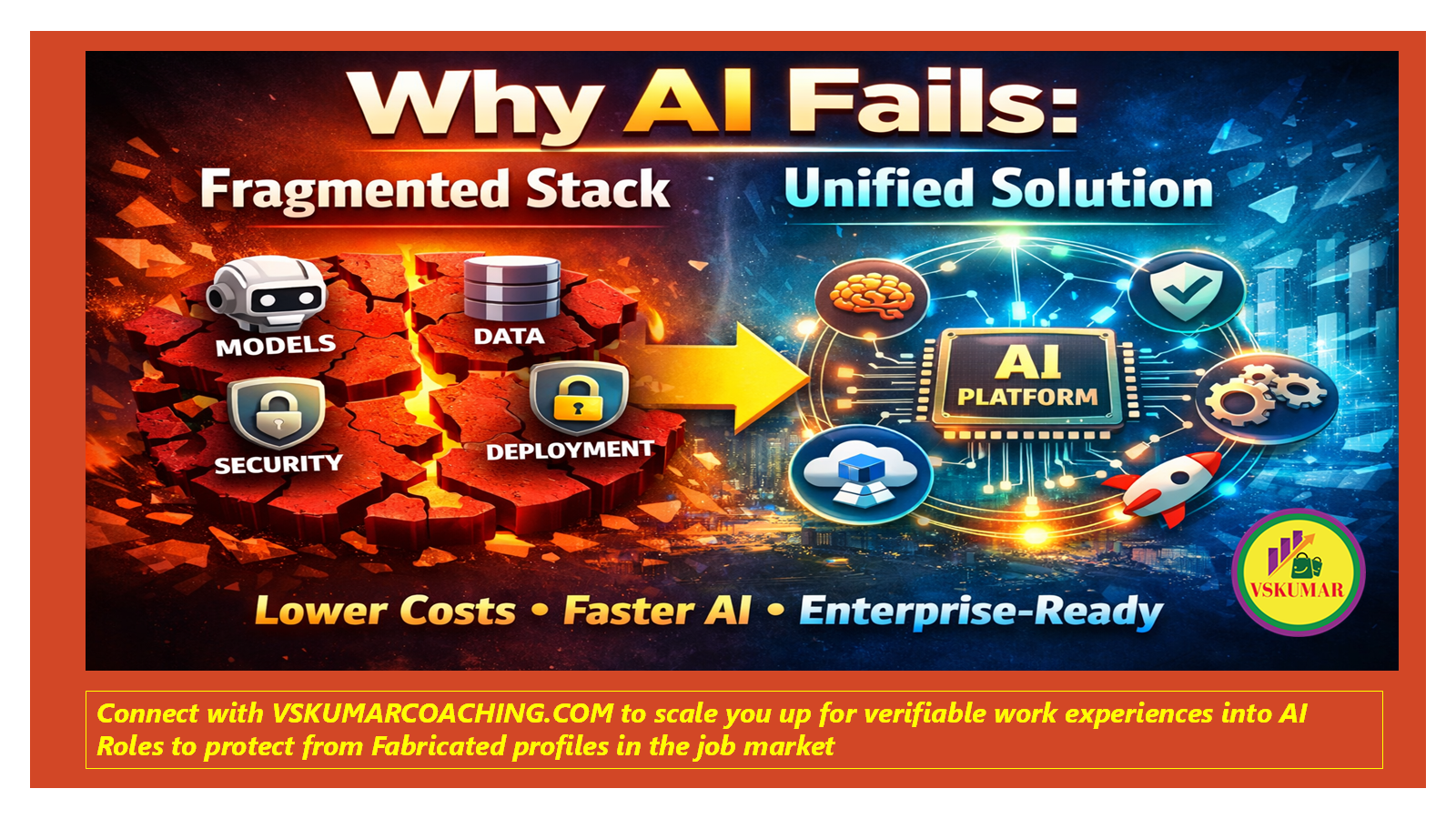
Most organizations do not fail at AI because their LLMs (Large Language Models) are weak. They fail because their AI platform architecture is fragmented, driving up TCO (Total Cost of Ownership) and blocking ROI (Return on Investment).
Different tools for models. Different tools for data. Different tools for security. Different tools for deployment.
Nothing integrates cleanly, forcing teams to rely on fragile glue code instead of IaC (Infrastructure as Code) and repeatable pipelines.
Rising OPEX (Operational Expenditure) for compute and data movement
Security gaps around IAM (Identity and Access Management) and PII (Personally Identifiable Information)
AI programs stuck in POC (Proof of Concept) mode, never reaching production
The Platform Shift: Treating AI as a First-Class System
Azure AI Foundry addresses this by treating AI as a PaaS (Platform as a Service), not a collection of tools.
Instead of stitching together 15–20 disconnected products, Azure provides an integrated environment where models, data, compute, security, and automation are designed to work together.
The key principle is simple but strategic:
LLMs are replaceable. Architecture is not.
This mindset enables enterprises to optimize for GRC (Governance, Risk & Compliance), MTTR (Mean Time to Resolution), and long-term scalability—without rewriting systems every time a better model appears.
1. Model Choice Without Lock-In (LLM, BYOM, MaaS)
Azure AI Foundry supports BYOM (Bring Your Own Model) and MaaS (Model as a Service) approaches simultaneously.
Enterprises can run:
Proprietary LLMs via managed APIs
OSS (Open Source Software) models such as Llama and Mistral
Specialized small language models like Phi
Enterprise Example
A regulated fintech starts with a commercial LLM for customer-facing workflows. To control cost and compliance, it later:
Uses OSS models for internal analytics
Deploys domain-tuned models for risk scoring
Keeps premium models only where accuracy directly impacts revenue
All models share the same API, monitoring, RBAC (Role-Based Access Control), and policy layer.
Impact: Model decisions become economic and regulatory choices—not technical constraints.
2. Data + Compute Built for AI Scale (DL, GPU, RTI, HPC)
AI workloads fail when data and compute are bolted together after the fact.
Azure AI Foundry integrates natively with DL (Data Lakes), Blob Storage, and Cosmos DB, while providing elastic GPU and HPC (High-Performance Computing) resources for both training and RTI (Real-Time Inference).
Enterprise Example
A global retailer trains demand-forecasting and personalization models using:
Historical data in a centralized DL
Real-time signals from operational databases
Scalable GPU clusters for peak training windows
Because compute scales independently, the organization avoids unnecessary CAPEX (Capital Expenditure) and reduces inference latency in production.
Impact: Faster experiments, lower data movement costs, and predictable performance at scale.
Azure AI Foundry embeds IAM, RBAC, policy enforcement, and monitoring into the platform, aligning AI workloads with enterprise SOC (Security Operations Center) and GRC standards.
Enterprise Example
A healthcare provider deploys AI for clinical summarization while:
Enforcing least-privilege access via RBAC
Logging all prompts and outputs for audit
Preventing exposure of PII through policy controls
AI systems pass compliance checks without slowing development.
Impact: AI moves from experimental to enterprise-approved.
4. Agent Building & Automation (AIOps, RAG, SRE)
Beyond copilots, Azure AI Foundry enables AIOps (AI for IT Operations) and multi-agent systems using RAG (Retrieval-Augmented Generation) and event-driven automation.
Enterprise Example
An SRE team deploys AI agents that:
Analyze alerts and logs
Retrieve knowledge from internal runbooks
Execute remediation via Functions and workflows
Escalate only unresolved incidents
MTTR drops, on-call fatigue reduces, and systems become more resilient.
5. Developer-First Ecosystem (SDK, IDE, DevEx)
Adoption fails when AI tools disrupt existing workflows.
Azure integrates directly with GitHub, VS Code (IDE), SDKs, CLI tools, and Copilot Studio, improving DevEx (Developer Experience) while maintaining enterprise controls.
Enterprise Example
Teams build, test, and deploy AI features using the same CI/CD pipelines they already trust—no new toolchains, no shadow IT.
Impact: AI becomes part of normal software delivery, not a side project.
Final Takeaway
Enterprises that scale AI successfully optimize for:
TCO, ROI, MTTR, and GRC
Platform consistency over model novelty
Architecture over experimentation
Azure AI Foundry reflects a clear industry shift:
AI is no longer a tool. It is enterprise infrastructure.

 Building Cloud/DevOps/AI/ML/Gen AI Architects