AI Era Upskilling: Practical Courses That Transform Legacy IT Skills into Career Experience
🌐 Why These Courses Matter in the AI Era for Legacy IT Professionals
Legacy IT professionals are not obsolete — but skills must evolve. These courses act as a bridge from traditional IT roles to AI-enabled, future-proof roles.
From POCs to Production: How IT Professionals Can Prove AI Skills in the Agentic Era
The AI industry has entered a decisive phase.
In the Agentic AI era, careers are no longer built on certifications, buzzwords, or slide decks. They are built on demonstrated capability.
Enterprises today are not asking:
“Do you know AI?”
They are asking:
“What have you built, customized, integrated, and proven?”
This is why Proofs of Concept (POCs) have become the foundation of modern AI careers — and why POC-driven job coaching is now essential for IT professionals.
This article explains:
Why POCs matter more than resumes
How POC customization builds real-world credibility
How professionals can move from learning AI → proving AI → delivering AI
Why weekly, hands-on POCs are the fastest way to upskill for AI jobs
Why the AI Job Market Has Changed Forever
In traditional IT:
Knowledge was enough
Experience could be implied
Roles were static
In the AI era:
AI systems behave dynamically
Agents make decisions
Human judgment and governance matter
Production failures are expensive
As a result, companies want professionals who can:
Design AI solutions
Customize them for business
Integrate them with systems
Govern them responsibly
Scale them confidently
This cannot be validated through theory alone.
👉 POCs have become the proof of skill.
Stage 1: POC (Proof of Concept) — Where AI Skills Begin
A POC is not just a demo.
A well-designed POC shows:
You understand a business problem
You can translate it into an AI use case
You can make AI work, not just talk about it
What a Strong AI POC Demonstrates
Business problem–driven thinking
AI feasibility assessment
Core agent or model capability
Practical experimentation mindset
What It Proves to Employers
✔ You can build ✔ You can experiment ✔ You understand AI fundamentals
But here’s the truth:
POCs alone are no longer enough.
The Missing Link: POC Customisation (Where Most Professionals Fall Short)
Most IT professionals stop at:
Generic demos
Sample datasets
Prebuilt prompts
Toy examples
Enterprises don’t hire for that.
They hire for contextual intelligence.
Why POC Customisation Is the Real Differentiator
POC customization proves that you can:
Adapt AI to their business
Work with their constraints
Think beyond code into operations
This is where job readiness is truly built.
The 5 Critical POC Customisation Steps Every AI Professional Must Master
1. Business Context Mapping
Understand real workflows
Identify decision points
Align with KPIs and outcomes
This proves domain understanding, not just AI knowledge.
2. Data & System Alignment
Work with real data structures
Handle messy, incomplete data
Align with enterprise systems
This proves enterprise realism.
3. Agent Behavior Design
Customize prompts and tools
Define guardrails
Control decision boundaries
This proves agentic thinking, not chatbot usage.
4. Human-in-the-Loop Controls
Decide where humans approve
Decide where humans override
Decide where humans intervene
This proves responsibility and governance maturity.
5. Governance & Compliance Checks
Security considerations
Auditability
Policy alignment
This proves production readiness.
👉 Customized POCs signal real-world AI competence.
Stage 2: Pilot — Where Confidence Is Built
Once POCs are customized, the next step is Pilot deployment.
What Happens in the Pilot Stage
POCs are embedded into real workflows
AI capabilities are exposed via APIs
Users interact with agents
Performance is monitored and refined
What This Proves
✔ Integration capability ✔ Operational thinking ✔ User-centric AI design
Pilots transform learning into confidence.
Stage 3: Production — Where Careers Are Made
Production AI systems are:
Scalable
Governed
Secure
Predictable
At this stage, professionals prove they can:
Deliver AI as a service
Maintain reliability
Support enterprise scale
Production-Ready Professionals Can:
Own AI systems end-to-end
Support real users
Handle real failures
Improve continuously
This is where AI careers accelerate.
The Enterprise Reality: How Companies Evaluate AI Talent Today
They want: ✅ Builders ✅ Customizers ✅ Integrators ✅ Responsible AI professionals
Why Weekly POC-Driven Coaching Beats Traditional AI Training
Most AI courses teach:
Concepts
Tools
Certifications
But jobs require:
Experience
Evidence
Confidence
Weekly POC Coaching Delivers:
Continuous hands-on practice
Exposure to multiple use cases
Real-world problem solving
Portfolio-ready artifacts
This is how skills become employable capability.
How VSKUMARCOACHING.COM Helps IT Professionals Become AI-Ready
At VSKUMARCOACHING.COM, the focus is simple:
Upskill by building. Prove by doing. Grow by delivering.
What Makes This Coaching Different
Weekly customized AI POCs
Business-aligned use cases
Agentic AI focus
Human-in-the-loop design
Enterprise-ready mindset
This is job coaching through real experience, not theory.
Final Thought: In the AI Era, Proof Beats Promise
AI careers are no longer built on:
Claims
Slides
Certifications alone
They are built on:
POCs
Customization
Integration
Production thinking
“Don’t just show a demo — show how this becomes a reliable service in business.”
That’s how professionals get hired. That’s how careers grow. That’s how AI skills become valuable.
Powered by VSKUMARCOACHING.COM
Build the competencies of IT professionals with weekly customized POC demos across multiple use cases to gain real experience and prove enterprise-ready AI skills.
Perfect — I’ll now convert this chart + concept into a long-form, SEO-optimized blog article designed to:
Rank on Google for AI POCs, Agentic AI, IT upskilling, AI job readiness
Position VSKUMARCOACHING.COM as a credible Job Coaching & Experience-building brand
Attract IT professionals, architects, managers, and services leaders
Clearly explain why hands-on POCs are the new currency of AI careers
From POCs to Production: How IT Professionals Can Prove AI Skills in the Agentic Era
The AI industry has entered a decisive phase.
In the Agentic AI era, careers are no longer built on certifications, buzzwords, or slide decks. They are built on demonstrated capability.
Enterprises today are not asking:
“Do you know AI?”
They are asking:
“What have you built, customized, integrated, and proven?”
This is why Proofs of Concept (POCs) have become the foundation of modern AI careers — and why POC-driven job coaching is now essential for IT professionals.
This article explains:
Why POCs matter more than resumes
How POC customization builds real-world credibility
How professionals can move from learning AI → proving AI → delivering AI
Why weekly, hands-on POCs are the fastest way to upskill for AI jobs
Why the AI Job Market Has Changed Forever
In traditional IT:
Knowledge was enough
Experience could be implied
Roles were static
In the AI era:
AI systems behave dynamically
Agents make decisions
Human judgment and governance matter
Production failures are expensive
As a result, companies want professionals who can:
Design AI solutions
Customize them for business
Integrate them with systems
Govern them responsibly
Scale them confidently
This cannot be validated through theory alone.
👉 POCs have become the proof of skill.
Stage 1: POC (Proof of Concept) — Where AI Skills Begin
A POC is not just a demo.
A well-designed POC shows:
You understand a business problem
You can translate it into an AI use case
You can make AI work, not just talk about it
What a Strong AI POC Demonstrates
Business problem–driven thinking
AI feasibility assessment
Core agent or model capability
Practical experimentation mindset
What It Proves to Employers
✔ You can build ✔ You can experiment ✔ You understand AI fundamentals
But here’s the truth:
POCs alone are no longer enough.
The Missing Link: POC Customisation (Where Most Professionals Fall Short)
Most IT professionals stop at:
Generic demos
Sample datasets
Prebuilt prompts
Toy examples
Enterprises don’t hire for that.
They hire for contextual intelligence.
Why POC Customisation Is the Real Differentiator
POC customization proves that you can:
Adapt AI to their business
Work with their constraints
Think beyond code into operations
This is where job readiness is truly built.
The 5 Critical POC Customisation Steps Every AI Professional Must Master
1. Business Context Mapping
Understand real workflows
Identify decision points
Align with KPIs and outcomes
This proves domain understanding, not just AI knowledge.
2. Data & System Alignment
Work with real data structures
Handle messy, incomplete data
Align with enterprise systems
This proves enterprise realism.
3. Agent Behavior Design
Customize prompts and tools
Define guardrails
Control decision boundaries
This proves agentic thinking, not chatbot usage.
4. Human-in-the-Loop Controls
Decide where humans approve
Decide where humans override
Decide where humans intervene
This proves responsibility and governance maturity.
5. Governance & Compliance Checks
Security considerations
Auditability
Policy alignment
This proves production readiness.
👉 Customized POCs signal real-world AI competence.
Stage 2: Pilot — Where Confidence Is Built
Once POCs are customized, the next step is Pilot deployment.
What Happens in the Pilot Stage
POCs are embedded into real workflows
AI capabilities are exposed via APIs
Users interact with agents
Performance is monitored and refined
What This Proves
✔ Integration capability ✔ Operational thinking ✔ User-centric AI design
Pilots transform learning into confidence.
Stage 3: Production — Where Careers Are Made
Production AI systems are:
Scalable
Governed
Secure
Predictable
At this stage, professionals prove they can:
Deliver AI as a service
Maintain reliability
Support enterprise scale
Production-Ready Professionals Can:
Own AI systems end-to-end
Support real users
Handle real failures
Improve continuously
This is where AI careers accelerate.
The Enterprise Reality: How Companies Evaluate AI Talent Today
They want: ✅ Builders ✅ Customizers ✅ Integrators ✅ Responsible AI professionals
Why Weekly POC-Driven Coaching Beats Traditional AI Training
Most AI courses teach:
Concepts
Tools
Certifications
But jobs require:
Experience
Evidence
Confidence
Weekly POC Coaching Delivers:
Continuous hands-on practice
Exposure to multiple use cases
Real-world problem solving
Portfolio-ready artifacts
This is how skills become employable capability.
How VSKUMARCOACHING.COM Helps IT Professionals Become AI-Ready
At VSKUMARCOACHING.COM, the focus is simple:
Upskill by building. Prove by doing. Grow by delivering.
What Makes This Coaching Different
Weekly customized AI POCs
Business-aligned use cases
Agentic AI focus
Human-in-the-loop design
Enterprise-ready mindset
This is job coaching through real experience, not theory.
Final Thought: In the AI Era, Proof Beats Promise
AI careers are no longer built on:
Claims
Slides
Certifications alone
They are built on:
POCs
Customization
Integration
Production thinking
“Don’t just show a demo — show how this becomes a reliable service in business.”
That’s how professionals get hired. That’s how careers grow. That’s how AI skills become valuable.
Powered by VSKUMARCOACHING.COM
We Build the competencies of IT professionals through weekly, customized POC demos across multiple real-world use cases to gain hands-on experience and prove enterprise-ready AI skills.
Entry Criteria & Coaching Approach: Every professional profile is unique. Our first step is a mandatory profile counseling session to assess your current skills, career goals, and AI readiness. Based on this assessment, we design a personalized AI upskilling roadmap tailored to help you transition and scale into the right AI roles.
This paid consultation is mandatory for everyone and helps us accurately define:
Coaching duration
Learning depth
Hands-on POC scope
Overall engagement cost
This structured approach ensures clarity, commitment, and measurable career outcomes.
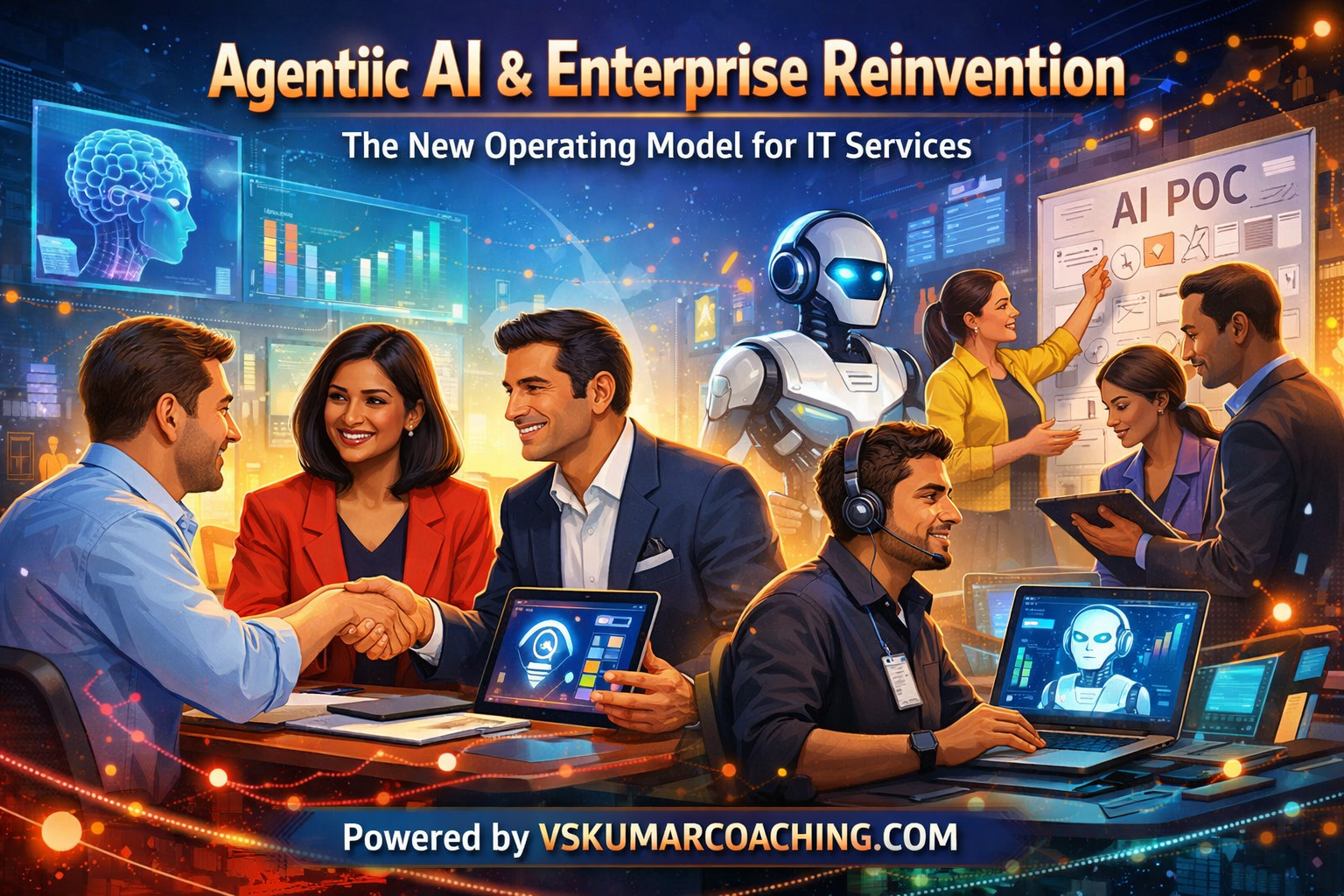
The recent advancement of powerful artificial intelligence (AI) has signaled a dramatic change in the corporate landscape, distinguishing itself greatly from the AI of the past. Previously, AI was often treated as a specialized discipline managed by teams of data scientists and machine learning engineers responsible for converting data into insights and actions. Today, organizations recognize that AI will fundamentally impact every corner of business, requiring a deep rethinking of organizational structure.
Many firms begin their journey by focusing on productivity—automating existing tasks using new tools. However, productivity has a limit, and businesses need to shift their focus to growth, which has no inherent limit. The goal should be to empower people to create the businesses of the future, moving beyond simply using technology to automate current practices. True enterprise transformation starts with the intent of the leadership, framing objectives around whether the company aims to simply use AI to do what it does today, or whether it intends to reinvent the entire way of working. This shift necessitates balancing investments across the tool set, the skill set, and the mindset.
The New Workforce and Agentic AI
This period of reinvention is radically restructuring the corporate career path. The traditional corporate ladder, where workers build experience and credibility before becoming a manager, is being kicked over. It is projected that people joining companies next year may be managers from day one, overseeing a workforce composed largely of agentic AI. These agents are designed to drive execution and perform the routine tasks or “toil” that people prefer not to do. Although these agents are extremely powerful, they are sometimes clumsy.
However, the agents are subject to the same “statistical sameness” if they are tasked with critical thinking, meaning the output will be predictable and similar to what other firms produce. To achieve market differentiation, the preferred sequence of work should involve human oversight, followed by the agent executing the work, and finally, a human concluding the process.
Raising the Ceiling with Human Skills
AI makes it easy to produce content that is “good,” thereby commoditizing the output and raising the floor of quality. However, to raise the ceiling and truly unlock AI’s potential, organizations need “AI and something”—specifically, human context.
The human skills critical for success are often summarized as the “big four”: creativity, critical thinking, systems thinking, and deep domain expertise. The role of the professional shifts from producing extensive content to becoming a creator who uses agents to handle the high volume of work. Furthermore, employees must develop strong delegation skills, which are necessary for providing agents with instructions and critically evaluating whether the resulting work was completed appropriately.
Strategic Transformation
For organizations beginning or accelerating their transformation, it is important to focus on a value-based story centered on growth. Instead of testing AI in underperforming areas or focusing experiments on back-office functions for cost reduction, strategic companies tackle challenging, existential business questions using AI. Leaders should articulate a clear, concise strategy for how AI will create value, setting the objectives for the necessary mindset, skill set, and tool set changes.
For large organizations with a long history, significant benefits can come from their scale, established customer reach, contracts, and internal data assets. This organizational nuance and internal data are particularly important for driving differentiation beyond what general-purpose AI models can achieve. Successfully navigating this transition involves creating a comprehensive “blueprint” for functions that operate natively with AI, including an intelligence layer and a control layer that governs the agents’ autonomy.
Leaders must champion this effort, prioritizing investments in upskilling the workforce. Providing employees with training in the context of their jobs and helping them integrate their deep domain expertise with AI ensures they feel they are in the driver’s seat of the change. In any technological revolution, an initial phase of fear is usually followed by a necessary phase of reinvention. Ultimately, just as past technological shifts created massive, new, trillion-dollar businesses, this technology will power a new economy, driven by people who learn how to scale their impact and creative thinking using AI.
The challenge of adapting a business model built on effort and billable hours to one focused on the value created by AI represents a fundamental change, requiring widespread change management among both the organization and its clients.
Here are 10 sharp, client-facing questions for IT Services Sales leaders, directly aligned to Agentic AI & Enterprise Reinvention: The New Operating Model for IT Services.
Each question is designed to surface verifiable proof of people skills, transformation readiness, and value maturity — not just AI tooling.
🔍 10 Strategic Questions IT Services Sales Should be asked by Clients
How has your leadership model changed with AI? Proof to look for: Named AI sponsors, decision rights, AI steering cadence, not just innovation labs.
Which roles now manage AI agents instead of doing manual execution? Proof to look for: Updated role charters, new KPIs, delegation playbooks, agent supervision metrics.
Can you show examples where human judgment overrides AI output? Proof to look for: Review checkpoints, human-in-the-loop workflows, escalation logs.
What people skills are you explicitly developing to work with AI? Proof to look for: Training programs on critical thinking, systems thinking, creativity, prompt delegation—not generic AI tool training.
Where has AI moved you from productivity to revenue or growth impact? Proof to look for: New offerings, faster GTM cycles, pricing model changes, client-facing use cases.
How do you differentiate your AI outcomes from competitors using the same models? Proof to look for: Use of proprietary data, domain playbooks, process nuance, contextual intelligence.
How do you measure value created by humans working with AI agents? Proof to look for: Value metrics beyond effort—decision speed, quality lift, innovation throughput.
What governance exists for agent autonomy and decision boundaries? Proof to look for: Control layers, approval thresholds, audit trails, agent risk classifications.
How are junior employees being prepared to lead AI-driven work early in their careers? Proof to look for: Early ownership models, shadow-agent programs, manager-from-day-one initiatives.
How has your client engagement model changed in an agentic world? Proof to look for: Outcome-based contracts, co-creation workshops, AI-enabled delivery transparency.
🎯 Why These Questions Matter for Sales
They separate AI theater from real transformation
They validate people + AI maturity, not tool adoption
They expose readiness for value-based pricing
They position sales as transformation advisors, not vendors
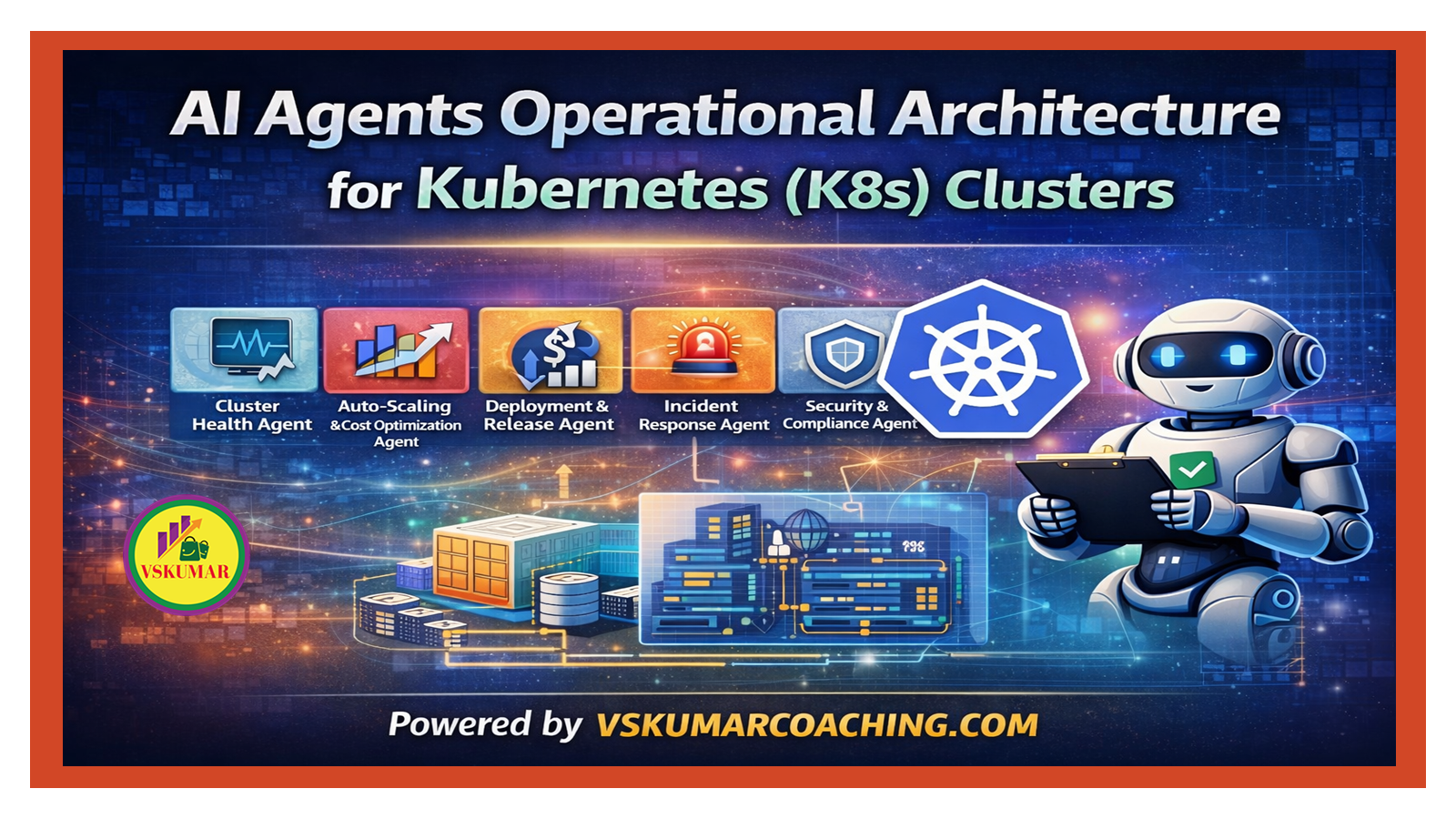
Below is a general, reusable advisory outline for the AI Agents Operational Architecture for Kubernetes (K8s) Clusters. This is written as guidance, not as a specific implementation — so it works for; frameworks and enterprise decks.
AI Agents Operational Architecture for Kubernetes (K8s) Clusters
General Guidance for Practical Adoption
1️⃣ Start With a Clear Purpose (Before Any Tooling)
Advice: Do not start by choosing an AI model or a Kubernetes tool.
Start by defining:
What operational problem needs automation?
What decisions are currently manual?
What risks must be controlled?
AI agents are operational assistants, not experiments.
2️⃣ Treat Agents as Controllers, Not Bots
Advice: Design every agent using the controller mindset:
Observe → Decide → Act → Learn
Observe real system signals
Decide within defined rules
Act through approved mechanisms
Learn from outcomes
Avoid agents that:
Act directly without governance
Bypass Kubernetes primitives
3️⃣ Use Single-Responsibility Agents
Advice: Each agent should do one job well.
Common operational agent categories:
Cluster health monitoring
Auto-scaling and cost optimization
Deployment and release management
Incident response and remediation
Security and compliance enforcement
This keeps behavior predictable and auditable.
4️⃣ Enforce Policy and Guardrails First
Advice: Never allow agents to operate without explicit boundaries.
Every architecture should include:
RBAC-based permissions
Policy engines (OPA / Kyverno)
Budget and risk limits
Human override options
Full audit logging
If guardrails are missing, do not enable automation.
5️⃣ Express Intent Using Kubernetes-Native Constructs
Advice: Use Custom Resource Definitions (CRDs) to define what agents should do.
Benefits:
Human-readable intent
Version-controlled changes
Native Kubernetes reconciliation
Clear separation of intent vs execution
This makes AI behavior infrastructure-native, not external.
6️⃣ Separate Decision-Making From Execution
Advice: Never let AI reasoning directly execute cluster actions.
Do not reinvent orchestration logic inside the agent.
8️⃣ Build Strong Observability and Feedback Loops
Advice: Agents are only as good as the signals they observe.
Ensure access to:
Metrics (CPU, memory, latency)
Logs and traces
Events and alerts
Action outcomes
Feedback loops allow agents to improve decisions over time.
9️⃣ Keep Humans in Control
Advice: AI agents should assist, not replace, human operators.
Best practices:
Start with recommendation mode
Move to auto-remediation gradually
Require approval for high-risk actions
Always provide explanations for decisions
Trust is built through transparency.
🔟 Adopt Incrementally, Not All at Once
Advice: Start small and expand.
Recommended approach:
Monitoring-only agents
Suggestive agents
Controlled auto-remediation
Predictive optimization
Self-optimizing operations
Each level must be stable before moving to the next.
Final Guidance
A well-designed AI agent architecture does not remove control — it improves it. Kubernetes provides the discipline. Agents provide intelligence. Governance provides safety.
Used together, this architecture enables scalable, responsible, and future-ready platform operations.
AI Agents Operational Architecture for Kubernetes (K8s) Clusters
1️⃣ Architecture Purpose (Top of Chart)
Objective: Design and operate AI Agents as governed controllers inside Kubernetes clusters to automate operational tasks safely, scalably, and audibly.
Core Principle: Agent-as-a-Controller
Every agent follows a closed loop:
Observe → Decide → Act → Learn
This ensures agents are:
Reactive to real-time signals
Bounded by policy
Continuously improving
2️⃣ Agent Capability Layer (Agent Types)
This layer shows what kinds of operational work agents perform.
Key Agent Types:
Cluster Health Agent Monitors node, pod, and cluster health.
Auto-Scaling & Cost Optimization Agent Balances performance and cost using workload signals.
Incident Response Agent Acts as the first responder during production incidents.
Security & Compliance Agent Enforces runtime security and policy compliance.
Each agent focuses on one responsibility and operates independently.
3️⃣ Policy & Guardrails Layer (Non-Negotiable)
This layer defines what agents are allowed to do.
Guardrails Include:
Kubernetes RBAC
OPA / Kyverno policies
Budget limits
Risk rules
Change windows
Governance Controls:
Every action is audited
Human override is always enabled
No unrestricted cluster access
This layer ensures controlled intelligence, not chaos.
4️⃣ Custom Resource Definitions (CRDs)
CRDs act as the intent contract between humans and agents.
Why CRDs Matter:
Humans declare what they want
Agents decide how to execute
Changes are versioned and auditable
CRDs convert AI behavior into Kubernetes-native workflows.
5️⃣ Agent Decision Engine
This is the brain of the system.
Characteristics:
Hybrid decision model
Rules for safety-critical logic
LLM reasoning for language and context
Uses historical context and feedback
Decisions are explainable
The agent never directly acts without passing through this engine.
6️⃣ Action Executor Layer
This layer handles execution, not intelligence.
What It Uses:
Kubernetes APIs
Helm charts
Argo workflows
Controlled CLI calls
Key Rule:
LLMs do not execute actions directly.
Execution is deterministic, auditable, and reversible.
7️⃣ Observability, Memory & Integrations
This layer feeds signals and feedback into the agent loop.
Inputs:
Metrics (Prometheus)
Logs (Loki)
Dashboards (Grafana)
Events & alerts
Message queues (Kafka / NATS)
Webhooks
Memory:
ConfigMaps
Vector databases (optional)
Historical actions and outcomes
This enables learning and optimization.
8️⃣ Kubernetes Cluster Context
This section shows where everything runs.
Supported Deployment Models:
Deployments (cluster-wide agents)
DaemonSets (node-level agents)
Jobs / Knative (event-driven agents)
Static pods (critical system agents)
Kubernetes ensures:
High availability
Auto-healing
Horizontal scaling
Isolation between agents
9️⃣ End-to-End Execution Flow
Signal detected (metric, log, event)
Agent observes the signal
Decision engine evaluates context and policy
Action executor performs safe operation
Outcome is monitored
Learning loop updates future behavior
🔟 Design Outcomes (Bottom of Chart)
This architecture delivers:
Clarity – clear responsibility per agent
Safety – strict guardrails and audit trails
Efficiency – faster operations with less manual effort
Control – human override always available
Governance – enterprise-ready by design
Final Message
This architecture transforms Kubernetes from a platform you operate manually into a system that assists, protects, and optimizes itself — under human control.
I wrote one article on its implementation for :
🛒 Designing AI Agents for E-Commerce Customer Review Automation Why Agents, Why Containers, Why Kubernetes (K8s) Clusters



 Building Cloud/DevOps/AI/ML/Gen AI Architects