
Below is a general, reusable advisory outline for the AI Agents Operational Architecture for Kubernetes (K8s) Clusters.
This is written as guidance, not as a specific implementation — so it works for; frameworks and enterprise decks.
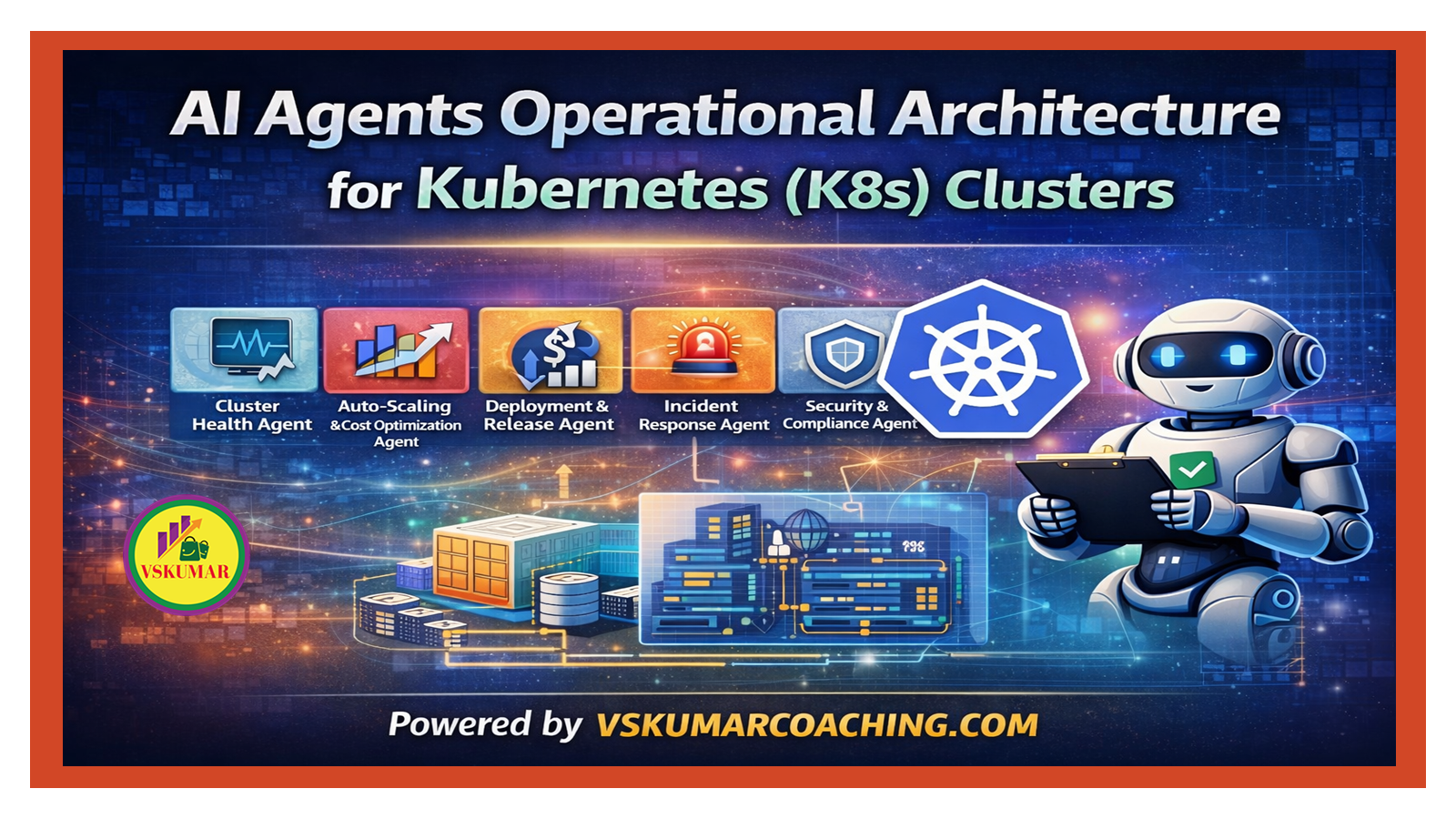
AI Agents Operational Architecture for Kubernetes (K8s) Clusters
General Guidance for Practical Adoption
1️⃣ Start With a Clear Purpose (Before Any Tooling)
Advice:
Do not start by choosing an AI model or a Kubernetes tool.
Start by defining:
- What operational problem needs automation?
- What decisions are currently manual?
- What risks must be controlled?
AI agents are operational assistants, not experiments.
2️⃣ Treat Agents as Controllers, Not Bots
Advice:
Design every agent using the controller mindset:
Observe → Decide → Act → Learn
- Observe real system signals
- Decide within defined rules
- Act through approved mechanisms
- Learn from outcomes
Avoid agents that:
- Act directly without governance
- Bypass Kubernetes primitives
3️⃣ Use Single-Responsibility Agents
Advice:
Each agent should do one job well.
Common operational agent categories:
- Cluster health monitoring
- Auto-scaling and cost optimization
- Deployment and release management
- Incident response and remediation
- Security and compliance enforcement
This keeps behavior predictable and auditable.
4️⃣ Enforce Policy and Guardrails First
Advice:
Never allow agents to operate without explicit boundaries.
Every architecture should include:
- RBAC-based permissions
- Policy engines (OPA / Kyverno)
- Budget and risk limits
- Human override options
- Full audit logging
If guardrails are missing, do not enable automation.
5️⃣ Express Intent Using Kubernetes-Native Constructs
Advice:
Use Custom Resource Definitions (CRDs) to define what agents should do.
Benefits:
- Human-readable intent
- Version-controlled changes
- Native Kubernetes reconciliation
- Clear separation of intent vs execution
This makes AI behavior infrastructure-native, not external.
6️⃣ Separate Decision-Making From Execution
Advice:
Never let AI reasoning directly execute cluster actions.
Recommended separation:
- Decision Engine: reasoning, context, policy checks
- Execution Layer: Kubernetes APIs, Helm, Argo
This ensures:
- Deterministic actions
- Rollback capability
- Security compliance
7️⃣ Use Kubernetes as the Runtime Control Plane
Advice:
Let Kubernetes handle what it does best:
- Scheduling
- Scaling
- Restarting
- Isolation
Deploy agents using:
- Deployments for cluster-wide logic
- DaemonSets for node-level tasks
- Jobs or event-driven services for episodic work
Do not reinvent orchestration logic inside the agent.
8️⃣ Build Strong Observability and Feedback Loops
Advice:
Agents are only as good as the signals they observe.
Ensure access to:
- Metrics (CPU, memory, latency)
- Logs and traces
- Events and alerts
- Action outcomes
Feedback loops allow agents to improve decisions over time.
9️⃣ Keep Humans in Control
Advice:
AI agents should assist, not replace, human operators.
Best practices:
- Start with recommendation mode
- Move to auto-remediation gradually
- Require approval for high-risk actions
- Always provide explanations for decisions
Trust is built through transparency.
🔟 Adopt Incrementally, Not All at Once
Advice:
Start small and expand.
Recommended approach:
- Monitoring-only agents
- Suggestive agents
- Controlled auto-remediation
- Predictive optimization
- Self-optimizing operations
Each level must be stable before moving to the next.
Final Guidance
A well-designed AI agent architecture does not remove control — it improves it.
Kubernetes provides the discipline.
Agents provide intelligence.
Governance provides safety.
Used together, this architecture enables scalable, responsible, and future-ready platform operations.
AI Agents Operational Architecture for Kubernetes (K8s) Clusters

1️⃣ Architecture Purpose (Top of Chart)
Objective:
Design and operate AI Agents as governed controllers inside Kubernetes clusters to automate operational tasks safely, scalably, and audibly.
Core Principle:
Agent-as-a-Controller
Every agent follows a closed loop:
Observe → Decide → Act → Learn
This ensures agents are:
- Reactive to real-time signals
- Bounded by policy
- Continuously improving
2️⃣ Agent Capability Layer (Agent Types)
This layer shows what kinds of operational work agents perform.
Key Agent Types:
- Cluster Health Agent
Monitors node, pod, and cluster health. - Auto-Scaling & Cost Optimization Agent
Balances performance and cost using workload signals. - Deployment & Release Agent
Manages safe rollouts, canary deployments, and rollbacks. - Incident Response Agent
Acts as the first responder during production incidents. - Security & Compliance Agent
Enforces runtime security and policy compliance.
Each agent focuses on one responsibility and operates independently.
3️⃣ Policy & Guardrails Layer (Non-Negotiable)
This layer defines what agents are allowed to do.
Guardrails Include:
- Kubernetes RBAC
- OPA / Kyverno policies
- Budget limits
- Risk rules
- Change windows
Governance Controls:
- Every action is audited
- Human override is always enabled
- No unrestricted cluster access
This layer ensures controlled intelligence, not chaos.
4️⃣ Custom Resource Definitions (CRDs)
CRDs act as the intent contract between humans and agents.
Why CRDs Matter:
- Humans declare what they want
- Agents decide how to execute
- Changes are versioned and auditable
CRDs convert AI behavior into Kubernetes-native workflows.
5️⃣ Agent Decision Engine
This is the brain of the system.
Characteristics:
- Hybrid decision model
- Rules for safety-critical logic
- LLM reasoning for language and context
- Uses historical context and feedback
- Decisions are explainable
The agent never directly acts without passing through this engine.
6️⃣ Action Executor Layer
This layer handles execution, not intelligence.
What It Uses:
- Kubernetes APIs
- Helm charts
- Argo workflows
- Controlled CLI calls
Key Rule:
LLMs do not execute actions directly.
Execution is deterministic, auditable, and reversible.
7️⃣ Observability, Memory & Integrations
This layer feeds signals and feedback into the agent loop.
Inputs:
- Metrics (Prometheus)
- Logs (Loki)
- Dashboards (Grafana)
- Events & alerts
- Message queues (Kafka / NATS)
- Webhooks
Memory:
- ConfigMaps
- Vector databases (optional)
- Historical actions and outcomes
This enables learning and optimization.
8️⃣ Kubernetes Cluster Context
This section shows where everything runs.
Supported Deployment Models:
- Deployments (cluster-wide agents)
- DaemonSets (node-level agents)
- Jobs / Knative (event-driven agents)
- Static pods (critical system agents)
Kubernetes ensures:
- High availability
- Auto-healing
- Horizontal scaling
- Isolation between agents
9️⃣ End-to-End Execution Flow
- Signal detected (metric, log, event)
- Agent observes the signal
- Decision engine evaluates context and policy
- Action executor performs safe operation
- Outcome is monitored
- Learning loop updates future behavior
🔟 Design Outcomes (Bottom of Chart)
This architecture delivers:
- Clarity – clear responsibility per agent
- Safety – strict guardrails and audit trails
- Efficiency – faster operations with less manual effort
- Control – human override always available
- Governance – enterprise-ready by design
Final Message
This architecture transforms Kubernetes from a platform you operate manually into a system that assists, protects, and optimizes itself — under human control.
I wrote one article on its implementation for :
🛒 Designing AI Agents for E-Commerce Customer Review Automation
Why Agents, Why Containers, Why Kubernetes (K8s) ClustersDesigning AI Agents for E-Commerce Customer Review Automation | LinkedIn
Powered by VSKUMARCOACHING.COM
 Building Cloud/DevOps/AI/ML/Gen AI Architects