
Agentic AI Components Explained (In Simple Terms)
A Plain-English Guide to How Autonomous AI Systems Really Work
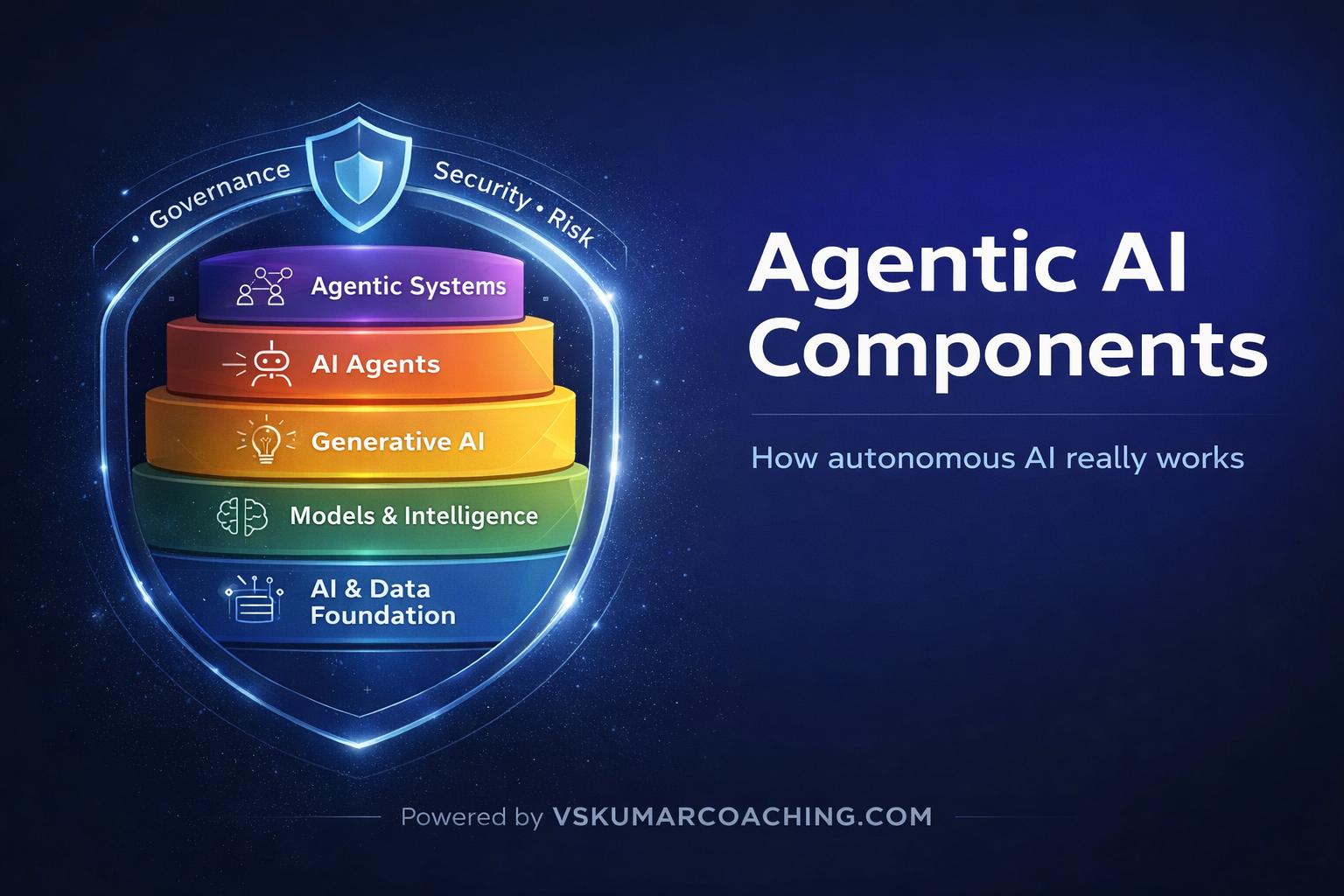
Most people hear words like Agentic AI, AI agents, or autonomous AI and imagine something mysterious or futuristic.
In reality, Agentic AI is not one magic technology.
It is a carefully assembled system of components, each playing a specific role—just like departments in an organization.
This blog breaks down Agentic AI Components in a way any layperson can understand.
1. Foundational AI & Data Systems
The learning foundation
What it is
This is the basic intelligence layer where AI learns from data. It includes traditional machine learning techniques that help systems recognize patterns, make predictions, and improve with experience.
Key items explained
- Machine Learning: Teaching computers using examples instead of hard rules.
- Natural Language Processing (NLP): Helping AI understand and respond to human language.
- Data Engineering: Preparing clean, usable data for AI to learn from.
- Training & Evaluation Pipelines: Processes to teach AI and test if it learned correctly.
How it’s used
- Fraud detection in banking
- Resume screening in HR
- Demand forecasting in retail
Business benefit
✅ Turns raw data into useful decisions
✅ Reduces manual analysis
✅ Forms the backbone of all advanced AI systems
2. Model & Intelligence Layer
The “brain” of the AI
What it is
This layer contains the actual AI models—the mathematical brains that think, reason, and generate outputs.
Key items explained
- Large Language Models (LLMs): Models like ChatGPT that understand and generate text.
- Deep Neural Networks: Systems inspired by the human brain, capable of complex reasoning.
- Multimodal Models: AI that understands text, images, audio, and video together.
- Transfer & Continual Learning: AI that improves over time without starting from scratch.
How it’s used
- Chatbots that understand context
- AI copilots for developers
- Smart document analysis
Business benefit
✅ Enables human-like understanding
✅ Handles complex tasks at scale
✅ Learns faster with less data
3. Generative & Knowledge Systems
Where AI creates and retrieves knowledge
What it is
This is the layer where AI creates content and grounds its answers in real information, instead of guessing.
Key items explained
- Prompt Engineering: Asking AI the right way to get better answers.
- Retrieval-Augmented Generation (RAG): Letting AI fetch facts from documents or databases before responding.
- Tool & Function Calling: Allowing AI to use software tools, APIs, or databases.
- Hallucination Mitigation: Preventing AI from making things up.
- Content Generation: Text, code, images, audio, and video.
How it’s used
- Customer support knowledge bots
- AI-powered research assistants
- Marketing content creation
Business benefit
✅ Accurate, reliable responses
✅ Faster content creation
✅ Reduced dependency on human experts
4. Agent Runtime, Memory & Orchestration
How AI actually “does work”
What it is
This layer turns AI from a talking system into a working system. It allows AI to plan tasks, remember context, and take actions.
Key items explained
- Task Planning: Breaking big goals into small steps.
- Goal Decomposition: “What needs to be done first, next, and last?”
- Tool Orchestration: Choosing and using the right tools automatically.
- Memory Systems: Remembering past interactions or decisions.
- Human-in-the-Loop: Humans approving or correcting AI when needed.
How it’s used
- AI scheduling meetings
- Automating IT support tickets
- Processing insurance claims
Business benefit
✅ Reduces manual workflows
✅ Improves consistency
✅ Enables safe autonomy
5. Multi-Agent & Autonomy Systems
AI working like a team
What it is
Instead of one AI doing everything, multiple AI agents collaborate, each with a role—just like employees in an organization.
Key items explained
- Multi-Agent Collaboration: Different AI agents working together.
- Communication Protocols: How agents talk to each other.
- Delegation & Handoffs: One agent assigns work to another.
- Long-Term Goals: AI working across days or weeks, not just seconds.
- Self-Improvement: Learning from mistakes automatically.
How it’s used
- End-to-end business process automation
- Supply chain optimization
- Complex research and analysis
Business benefit
✅ Scales operations without adding staff
✅ Handles complex workflows
✅ Operates continuously
6. IT Governance, Security & Risk Management
The control and trust layer
What it is
This is what makes Agentic AI safe, legal, and enterprise-ready. Without this layer, AI becomes risky and unreliable.
Key items explained
IT Governance
- Alignment with enterprise architecture
- Change and release management
Security
- Identity & Access Management (who can do what)
- Data encryption and privacy
- Secure APIs and secrets
AI Governance
- Ethical use of AI
- Regulatory compliance (GDPR, ISO, SOC2)
- Audit trails and explainability
Risk Management
- Monitoring and observability
- Cost and resource controls
- Rollback and kill switches
How it’s used
- Regulated industries (banking, healthcare)
- Large enterprises
- Mission-critical systems
Business benefit
✅ Prevents data leaks and misuse
✅ Ensures compliance
✅ Builds trust with customers and regulators
7. Platform, Infrastructure & Operations
The engine room
What it is
This layer provides the technical backbone that keeps Agentic AI running reliably at scale.
Key items explained
- Cloud and hybrid infrastructure
- Containers and sandboxes
- Performance and scalability tools
- Vendor and marketplace integration
How it’s used
- Running AI 24/7
- Scaling during peak demand
- Managing multiple AI vendors
Business benefit
✅ High availability
✅ Cost efficiency
✅ Enterprise-grade reliability
Final Takeaway (For Laymen)
Agentic AI is not a chatbot.
It is a secure, governed, autonomous digital workforce built from multiple components working together.
When organizations understand these components, they stop asking:
❌ “Which AI tool should we buy?”
And start asking:
✅ “Which Agentic AI capabilities do we need to build?”
 Building Cloud/DevOps/AI/ML/Gen AI Architects