Daily Archives: January 5, 2026

Thriving in the Age of AI: The Skills That Matter

Thriving in the Age of AI: The Skills That Matter

(Intro + human skills sections remain the same as before — I’ll keep them intact and focus on expanding the roadmap with “in‑house build” alternates.)
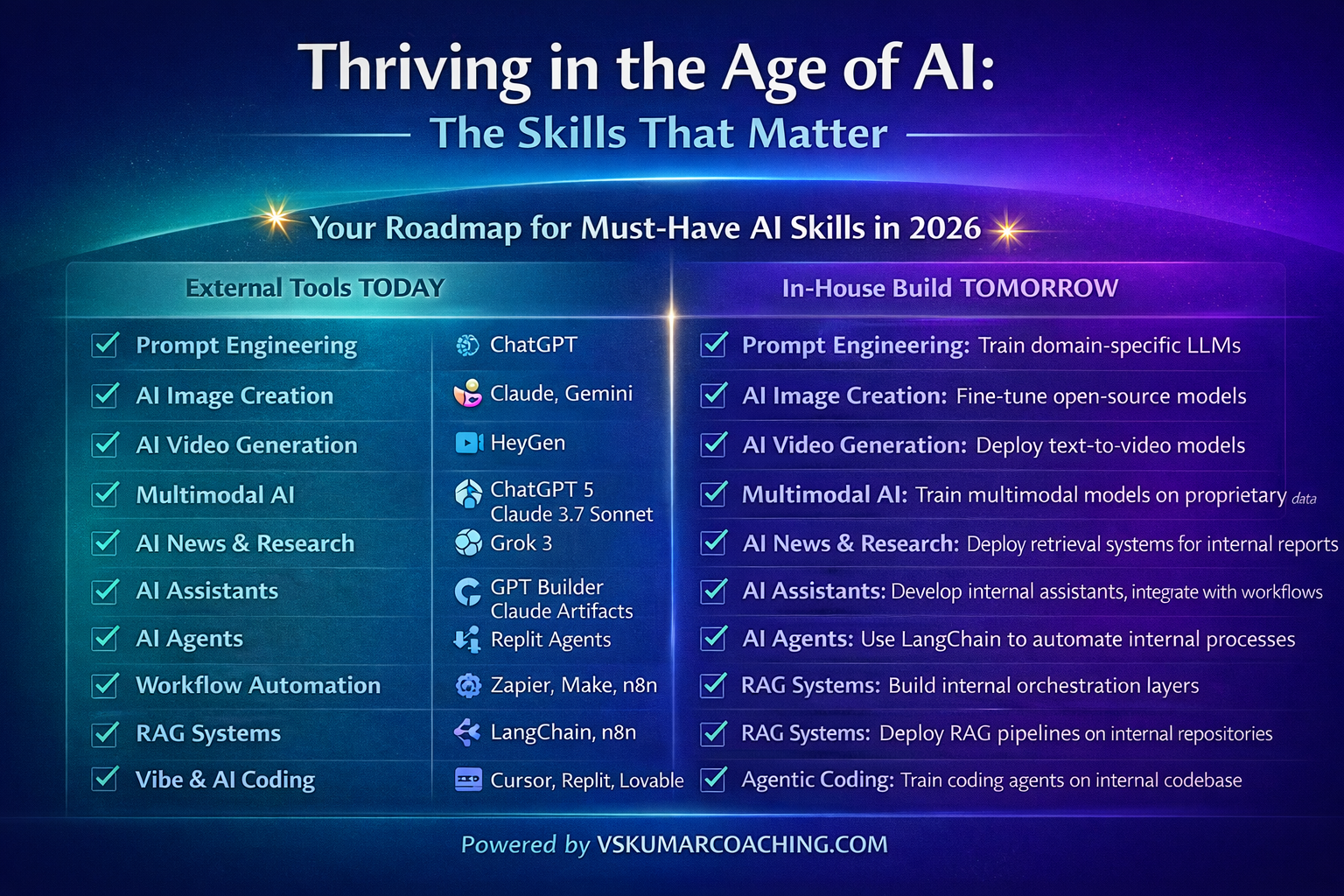

💥 Your Roadmap for Must-Have AI Skills in 2026

1. Prompt Engineering

Intro: At the heart of AI interaction lies the ability to communicate clearly. Prompt engineering is the skill of crafting precise instructions that guide AI toward useful, reliable outputs.

  • Write precise, context-clear instructions for reliable results
  • Break work into steps and guide AI with clean inputs
  • Tools: ChatGPT, Claude, Gemini

In‑House Build:

  • Train domain-specific LLMs with curated prompts and responses from your own workflows.
  • Build a prompt library inside a knowledge base for reusable, standardized instructions.
  • Develop internal “prompt QA” systems to test reliability before deployment.

2. AI Image Creation

Intro: Visual storytelling is now accessible to everyone. AI image creation allows professionals to turn abstract ideas into compelling visuals in seconds.

  • Transform ideas into visuals for content, design, and storytelling
  • Rapid prototyping and concept testing
  • Tools: Midjourney, Ideogram, Nana Banana

In‑House Build:

  • Fine-tune open-source diffusion models (e.g., Stable Diffusion) on brand assets.
  • Host internal image generation pipelines with compliance filters.
  • Create a style guide model that enforces brand colors, fonts, and recruiter-neutral visuals.

3. AI Video Generation

Intro: Video has become the dominant medium for communication, and AI makes it effortless. With no cameras or editing teams, you can produce professional content in minutes.

  • Produce videos without cameras or editing teams
  • Speed up training, updates, and content creation
  • Tools: HeyGen, Runway, Opus

In‑House Build:

  • Deploy text-to-video models on secure servers for training content.
  • Integrate avatars or synthetic presenters aligned with company branding.
  • Build modular templates for onboarding, compliance, or product demos.

4. Multimodal AI

Intro: The future of AI is multimodal—systems that can process text, images, audio, and video together. This unlocks richer insights and more integrated workflows.

  • AI that processes text, images, video, and audio together
  • Unified models for research, planning, and creation
  • Tools: ChatGPT 5, Claude 3.7 Sonnet, Grok 3

In‑House Build:

  • Train multimodal models on proprietary datasets (documents + visuals + audio).
  • Build pipelines that unify customer support transcripts, product images, and manuals.
  • Create dashboards where multimodal AI powers research and planning in one interface.

5. AI News and Research

Intro: Staying informed is critical, but information overload is real. AI research tools help professionals cut through the noise and surface what matters.

  • Quick answers, deep insights, and trend scanning
  • Summarize long documents and reports efficiently
  • Tools: Perplexity, Claude, ChatGPT Search

In‑House Build:

  • Deploy retrieval systems connected to internal reports, compliance docs, and market feeds.
  • Build summarization engines tuned to your industry language.
  • Create “trend dashboards” that auto-scan internal + external sources for executives.

6. AI Assistants

Intro: Personalized AI assistants are becoming everyday productivity partners. They organize work, repeat tasks, and adapt to your style.

  • Build personalized AI helpers that organize work and repeat tasks
  • Style-aligned assistants for productivity
  • Tools: GPT Builder, Claude Artifacts, Replit Agents

In‑House Build:

  • Develop internal assistants trained on company workflows (HR, finance, project management).
  • Integrate assistants with calendars, CRMs, and ticketing systems.
  • Build modular “assistant APIs” that employees can customize for their roles.

7. AI Agents

Intro: Beyond assistants, AI agents can autonomously handle multistep workflows. They execute tasks in the background, freeing you to focus on strategy.

  • Automate multistep workflows end-to-end
  • Run background tasks while focusing on decisions
  • Tools: LangChain, CrewAI, AutoGen

In‑House Build:

  • Use frameworks like LangChain to orchestrate internal processes (approvals, reporting).
  • Train agents to handle compliance-heavy workflows securely.
  • Build monitoring dashboards to track agent performance and decision logs.

8. Workflow Automation

Intro: Efficiency is about removing friction. Workflow automation connects tools so repetitive tasks happen seamlessly without human intervention.

  • Connect tools for seamless task handoffs
  • Automate repetitive updates and communications
  • Tools: Zapier, Make, n8n

In‑House Build:

  • Build internal orchestration layers that connect ERP, CRM, and HR systems.
  • Use event-driven architecture for auto-triggered workflows.
  • Create compliance-safe automation pipelines for sensitive data.

9. RAG Systems (Retrieval-Augmented Generation)

Intro: AI is most powerful when connected to your own data. RAG systems ensure answers are accurate, context-specific, and business-ready.

  • Link AI to your own data for accurate, context-specific answers
  • Convert PDFs and documents into instant responses
  • Tools: LangChain, LlamaIndex, Vectara

In‑House Build:

  • Deploy RAG pipelines on internal document repositories.
  • Build embeddings tuned to your company’s terminology.
  • Create secure query interfaces for employees to access knowledge instantly.

10. Vibe and AI Coding

Intro: Not every project needs heavy coding. AI coding tools let you prototype quickly, test ideas, and iterate without deep technical expertise.

  • Rapid prototyping with minimal coding
  • Build small tools quickly for testing and iteration
  • Tools: Cursor, Replit, Lovable

In‑House Build:

  • Set up internal sandboxes for rapid prototyping with AI coding copilots.
  • Build “innovation labs” where employees test ideas safely.
  • Integrate low-code AI platforms with company APIs for quick experiments.

11. Agentic Coding

Intro: For larger projects, agentic coding allows you to delegate entire coding tasks to AI agents that plan and execute autonomously.

  • Delegate full coding tasks to AI agents
  • Describe outcomes and let AI plan/execute steps
  • Tools: O1 Codex, Claude Code, Replit

In‑House Build:

  • Train coding agents on your internal codebase for context-aware development.
  • Build governance layers to review agent-generated code before deployment.
  • Use containerized environments for safe agent execution.

12. AI-Assisted Development

Intro: Software development is being transformed by AI copilots. They accelerate debugging, rewriting, and feature building—making development faster and more reliable.

  • Accelerate software building and debugging
  • Fix errors, rewrite code, and update features in minutes
  • Tools: Cursor, Gemini Code Assist, GitHub Copilot

In‑House Build:

  • Deploy AI copilots trained on your proprietary code repositories.
  • Integrate copilots into IDEs used across the company.
  • Build automated QA pipelines where AI suggests fixes and improvements.

Moving Forward

The professionals who will stand out are not those who try to outpace AI, but those who learn to work with it. Instead of drowning in the pressure to “learn it all,” they focus on building a toolkit of durable human skills—paired with practical AI capabilities that amplify their impact.

AI may be advancing daily. But with the right blend of judgment, creativity, adaptability, and these twelve must-have skills—whether through external tools or in-house builds—so can you.

The Complete AI Roles (2026+) with example Tasks and live Use cases


🌐 The Complete AI Roles (2026+) with example Tasks and live Use cases


Artificial Intelligence is no longer just a technical field — it’s an ecosystem of specialized roles that ensure AI systems are reliable, ethical, scalable, and human‑centric. Below is a comprehensive guide to 24 AI roles, grouped into Emerging, Core, Enterprise, and Holistic categories. Each role is explained with its importance, responsibilities, focus areas, and four live use cases to illustrate real‑world impact.

🧠 Emerging & Specialized AI Roles
1. Model Validator
Why it matters: Prevents unreliable or harmful models from reaching production.
What they do: Evaluate AI models for accuracy, bias, robustness, and compliance.
Key focus areas: Model evaluation, bias metrics, audit processes.
Use cases:
Auditing credit scoring models for fairness.
Validating healthcare diagnostic AI before deployment.
Stress‑testing autonomous driving models.
Certifying compliance of AI systems with regulations.
2. Knowledge Engineer
Why it matters: Enables AI to deliver context‑aware, expert‑level responses.
What they do: Structure domain knowledge for reasoning and retrieval.
Key focus areas: Knowledge graphs, ontologies, RAG pipelines.
Use cases:
Building legal knowledge graphs for contract review.
Structuring medical ontologies for clinical support.
Creating telecom troubleshooting knowledge bases.
Designing compliance query pipelines.
3. Decision Engineer
Why it matters: Ensures AI outputs translate into trusted, actionable decisions.
What they do: Merge predictions with business rules to design decision engines.
Key focus areas: Decision logic, constraints, explainability.
Use cases:
Designing AI‑driven loan approval workflows.
Creating explainable supply chain optimization systems.
Building insurance claim adjudication engines.
Developing smart grid energy distribution logic.
4. Agentic Workflow Designer
Why it matters: Enables autonomous multi‑agent systems to execute complex workflows.
What they do: Architect agent flows with tools, memory, and orchestration.
Key focus areas: Agent frameworks, tool chaining, async orchestration.
Use cases:
Designing AI agent swarms for customer support.
Orchestrating multi‑agent research assistants.
Automating procurement workflows in e‑commerce.
Coordinating newsroom content generation.
5. Synthetic Data Strategist
Why it matters: Solves data scarcity and privacy challenges in AI training.
What they do: Generate and validate synthetic datasets.
Key focus areas: Data simulation, privacy preservation, bias mitigation.
Use cases:
Creating synthetic patient records for healthcare AI.
Generating synthetic transaction data for fraud detection.
Simulating rare events for autonomous vehicles.
Producing synthetic transcripts for NLP training.

⚙️ Core & Essential AI Roles
6. ML Engineer
Why it matters: Turns experimental models into reliable, scalable AI solutions.
What they do: Build, deploy, and scale ML systems.
Key focus areas: Deployment, pipelines, MLOps, scalability.
Use cases:
Deploying recommendation engines for e‑commerce.
Scaling predictive maintenance models in manufacturing.
Automating fraud detection pipelines.
Deploying real‑time translation services.
7. Prompt Engineer
Why it matters: Improves AI accuracy, consistency, and output quality.
What they do: Design and optimize prompts for LLMs.
Key focus areas: Prompt patterns, reasoning chains, tool usage.
Use cases:
Crafting prompts for legal summarization.
Optimizing customer service chatbot prompts.
Designing prompts for AI coding assistants.
Creating reasoning chains for medical Q&A.
8. AI Ethicist
Why it matters: Reduces harm, bias, and compliance risks.
What they do: Define ethical standards and assess risks.
Key focus areas: Responsible AI, fairness, transparency.
Use cases:
Reviewing facial recognition systems.
Setting ethical hiring guidelines.
Auditing predictive policing algorithms.
Defining transparency standards for healthcare AI.
9. Head of AI
Why it matters: Aligns AI initiatives with business impact.
What they do: Set AI strategy and roadmap.
Key focus areas: Strategy, governance, value realization.
Use cases:
Defining AI adoption roadmap for telecom.
Aligning AI investments with healthcare compliance.
Leading AI transformation in retail supply chains.
Driving innovation strategy in BFSI.
10. Data & AI Translator
Why it matters: Prevents misalignment between business goals and technical execution.
What they do: Translate business problems into AI requirements.
Key focus areas: Problem framing, requirement mapping.
Use cases:
Translating retail needs into forecasting models.
Mapping insurance workflows into automation.
Bridging CXO goals with AI teams.
Aligning healthcare compliance with AI documentation.
11. Data Scientist
Why it matters: Drives data‑informed decision‑making.
What they do: Analyze data and build predictive models.
Key focus areas: Data modeling, experimentation, insights.
Use cases:
Building churn prediction models.
Analyzing patient data for disease risk.
Designing A/B tests for e‑commerce.
Modeling climate data for sustainability.
12. Data Engineer
Why it matters: High‑quality data is critical for AI reliability.
What they do: Build and maintain data pipelines.
Key focus areas: ETL/ELT, data quality, scalability.
Use cases:
Creating real‑time pipelines for stock trading.
Ensuring clean data feeds for hospital AI.
Building IoT sensor data pipelines.
Automating ETL for enterprise analytics.
13. AI Accessibility Advocate
Why it matters: Ensures AI is inclusive and usable for all.
What they do: Audit and redesign AI interfaces for accessibility.
Key focus areas: UX audits, localization, inclusive design.
Use cases:
Making chatbots accessible for visually impaired users.
Localizing AI interfaces for multilingual communities.
Designing voice‑enabled AI for elderly users.
Auditing accessibility compliance for enterprise apps.

🏢 Applied & Enterprise AI Roles
14. Model Manager
Why it matters: Keeps models accurate and compliant over time.
What they do: Monitor and retrain deployed models.
Key focus areas: Drift detection, lifecycle management.
Use cases:
Monitoring fraud detection models.
Retraining recommendation systems.
Managing telecom AI lifecycle.
Ensuring compliance of healthcare AI.
15. Analytics Engineer
Why it matters: Enables faster, trustworthy insights.
What they do: Transform raw data into analytics‑ready datasets.
Key focus areas: Data modeling, metrics, reliability.
Use cases:
Creating datasets for marketing ROI.
Building hospital resource dashboards.
Designing KPI pipelines for CXOs.
Automating analytics for e‑commerce.
16. AI Architect
Why it matters: Ensures AI solutions scale securely.
What they do: Design end‑to‑end architectures.
Key focus areas: System design, integration, scalability.
Use cases:
Designing AI infrastructure for banks.
Architecting smart city traffic control systems.
Building hybrid cloud AI for healthcare.
Designing scalable AI for telecom.
 
🏢 Applied & Enterprise AI Roles
17. AI Risk & Governance Lead
Why it matters: Keeps AI compliant with regulations and internal standards.
What they do: Define governance frameworks and manage AI‑related risks.
Key focus areas: Oversight, risk assessment, auditability, policies.
Use cases:
Ensuring GDPR compliance in AI data pipelines.
Auditing AI hiring tools for fairness.
Creating governance frameworks for financial AI systems.
Managing risk registers for enterprise AI deployments.
18. AI Product Manager
Why it matters: Ensures AI products solve real user and business problems.
What they do: Lead AI product vision from concept to launch.
Key focus areas: Roadmap, adoption, value delivery.
Use cases:
Launching an AI‑powered personal finance app.
Driving adoption of AI logistics optimization tools.
Managing roadmap for AI‑enabled healthcare apps.
Coordinating cross‑functional teams for AI product launches.
19. UX Designer (AI Systems)
Why it matters: Builds trust, usability, and clarity in AI interactions.
What they do: Design user experiences for AI‑powered products.
Key focus areas: Human‑AI interaction, explainability, usability, prototypes.
Use cases:
Designing interfaces for AI‑powered medical diagnostics.
Creating explainable dashboards for AI risk scoring.
Prototyping conversational flows for AI assistants.
Improving usability of AI‑driven enterprise apps.
20. AI Developer
Why it matters: Turns AI models and APIs into usable products.
What they do: Implement AI capabilities into applications and workflows.
Key focus areas: APIs, integrations, workflows, production code.
Use cases:
Integrating AI chatbots into enterprise CRM systems.
Embedding AI vision models into retail checkout apps.
Developing AI‑powered voice assistants for telecom.
Building workflow automation with AI APIs.
21. AI Onboarding Architect
Why it matters: Ensures smooth, compliant, recruiter‑neutral AI adoption.
What they do: Design onboarding flows, documentation overlays, and training assets.
Key focus areas: Compliance mapping, modular documentation, training kits.
Use cases:
Creating recruiter‑neutral onboarding kits for enterprise AI.
Designing compliance overlays for healthcare AI adoption.
Building modular training flows for BFSI AI systems.
Curating documentation for telecom AI onboarding.
22. AI Campaign Orchestrator
Why it matters: Drives adoption and trust through emotionally resonant, timed messaging.
What they do: Sequence AI‑powered outreach campaigns mapped to rhythm and psychology.
Key focus areas: Messaging cadence, timing, CTA design, visual storytelling.
Use cases:
Designing LinkedIn campaigns for AI product launches.
Sequencing outreach for healthcare AI adoption.
Timing BFSI campaigns with compliance cycles.
Coordinating AI‑driven marketing flows for e‑commerce.

🌱 Holistic & Integrative AI Roles
23. AI Nutrition & Wellness Integrator
Why it matters: Supports resilience and cognitive performance in AI‑intensive teams.
What they do: Curate wellness overlays, food protocols, and rhythm‑based routines.
Key focus areas: Nutrition mapping, stress reduction, holistic coaching.
Use cases:
Designing nutrition plans for AI development teams.
Curating stress‑reducing food overlays for CXOs.
Integrating wellness routines into enterprise AI adoption.
Mapping resilience strategies for high‑intensity AI projects.
24. AI Metaphysical Mapper
Why it matters: Bridges cultural and spiritual frameworks with AI adoption for deeper resonance.
What they do: Integrate sutras, chakras, and energy symbols into coaching and documentation flows.
Key focus areas: Symbolic overlays, recruiter‑neutral metaphors, rhythm mapping, trust scaffolding.
Use cases:
Embedding chakra‑based overlays into leadership coaching.
Using sutras as metaphors in AI onboarding documentation.
Mapping lunar cycles to campaign timing for resilience.
Designing recruiter‑neutral metaphysical overlays for enterprise trust building.

✨ Conclusion
This 24‑role landscape shows how AI is no longer just about algorithms — it’s about governance, ethics, accessibility, enterprise adoption, and even holistic integration. From Model Validators ensuring reliability to AI Metaphysical Mappers bridging cultural resonance, these roles together form a 360° ecosystem for the AI era.