
Why Modern Applications Need Both Vibe-Coding and No-Coding
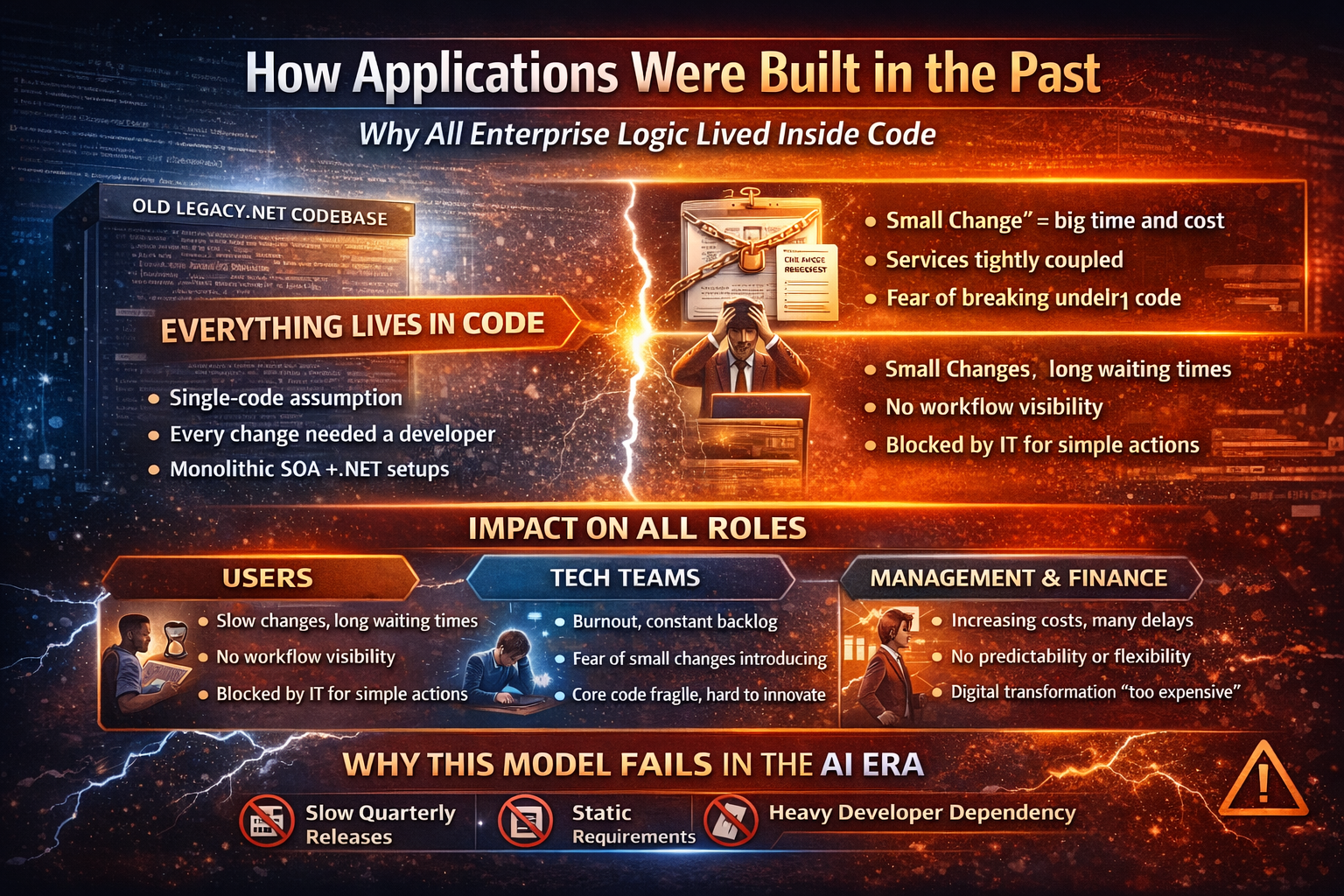
How Applications Were Built in the Past
Before we embrace AI, Vibe-Coding, and No-Coding workflows, it’s essential to understand how traditional applications were built, why the old model created bottlenecks, and why it fails in today’s fast-moving business world.
1.1 The Single-Code Assumption
Historically, every enterprise application was built with one principle:
“All logic belongs inside the codebase.”
This meant:
- Business rules, validations, approvals, notifications — everything lived in the same code.
- Any change, even a small one, required developer intervention.
Consequences of this assumption:
- IT teams became the bottleneck for all changes.
- Users waited days or weeks for even minor workflow adjustments.
- Flexibility and business agility were almost impossible.
1.2 Why Every Change Needed a Developer
Because all logic was embedded in code, a change was never trivial:
- Business Request: “Add an extra approval step for high-value transactions.”
- Developer Action:
- Locate the relevant code module
- Update business rules
- Refactor integration points
- Test the system for side effects
- Deployment: Deploy change to production with full QA cycles
Even small changes became weeks-long projects, consuming high-value developer time and delaying business outcomes.
1.3 Traditional SOA and .NET Realities
Many enterprises adopted SOA (Service-Oriented Architecture) with frameworks like .NET to try to modularize applications.
Reality of SOA + .NET in the past:
- Services were modular but still hard-coded for orchestration.
- Integration logic was brittle: any service update could break workflows.
- Scaling and error recovery required manual intervention.
The architecture promised flexibility but delivered dependency on tech teams for every change.
1.4 Past Repository Structure and Ownership
A typical legacy .NET repository looked like this:
/Application
├── Controllers
├── Services
│ ├── BusinessRules.cs
│ ├── IntegrationLogic.cs
│ ├── ApprovalLogic.cs
├── Jobs
├── Utilities
Observations:
- All logic lived together in monolithic files.
- No clear ownership — developers managed everything, business had no control.
- Deployment risk was high: one small change could affect unrelated workflows.
Over time, this structure became fragile, creating fear of touching “core code.”
1.5 Impact on Users, Tech Teams, Management, and Budgets
Users
- Long waiting times for requests
- No visibility of workflow status
- Dependency on IT for simple actions
Tech Teams
- Burnout from repetitive small changes
- Fear of introducing bugs
- Less time for innovation
Management
- Rising costs with limited visible progress
- Delivery delays blamed on “complexity”
- Difficulty planning for growth
Finance
- Each change = additional cost
- No predictability of timelines or budgets
- Digital transformation always seen as “too expensive”
1.6 Why This Model Collapses in the AI Era
Modern systems require:
- Hourly or daily changes, not quarterly releases
- Intent-driven orchestration
- Non-technical workflow adjustments
Legacy models assume:
- Static requirements
- Slow, predictable change
- Heavy developer dependency
AI, Vibe-Coding, and No-Coding workflows cannot operate on a code-only foundation.
Without change, enterprises risk stagnation, technical debt, and lost competitiveness.
✅ Key Takeaways
- All-logic-in-code is no longer sustainable.
- Every role (user, tech, management, finance) suffers from the legacy model.
- Modernization is not optional — the business demands speed, flexibility, and low-risk change.
This is the foundation for why Vibe-Coding and No-Coding layers are critical — a solution that keeps code stable, AI agile, and workflows flexible.
2. The Shift — From Code-Centric to Responsibility-Centric Systems
Modern enterprises cannot thrive by simply layering AI on top of legacy systems. To succeed, organizations must shift from a code-centric mindset to a responsibility-centric approach, where each layer of the application has a clear role, and the right people own the right part of the system.
This shift is the foundation for adopting Vibe-Coding and No-Coding workflows effectively.
2.1 What Actually Changes in Modern Applications
In legacy systems, every change was funneled through developers. Today, modern applications are split into layers, each responsible for a different aspect of the system:
- Core Code: Houses critical logic that cannot fail, like payment processing or security checks. Developers maintain and protect this layer.
- Vibe-Coding Layer: Handles system orchestration, AI-assisted integration, and repetitive tasks. Engineers describe the desired intent, and AI generates the implementation.
- No-Coding Layer: Powers visual workflows, notifications, approvals, and business operations. Non-technical teams can safely make changes here without touching code.
This shift allows faster change, reduced risk, and greater business agility. Small workflow changes no longer require developer intervention, freeing IT to focus on core innovation.
2.2 Moving from Tools to Layers of Responsibility
Many enterprises make the mistake of thinking that installing new tools alone will solve their modernization problems. Modernization isn’t about tools—it’s about clarity in responsibility.
In a responsibility-centric system:
- Developers focus on core code, ensuring system stability, performance, and compliance.
- Engineers using Vibe-Coding orchestrate integrations, refactor legacy code safely, and automate repetitive tasks.
- Business teams control operational workflows, approvals, and notifications visually.
By clearly defining who owns each layer, organizations reduce risk, accelerate change, and make modernization measurable and predictable.
2.3 Why Coding, Vibe-Coding, and No-Coding Must Coexist
Some organizations ask: “If we have AI, why do we need coding? If we have No-Code, why do we need AI?”
The answer is simple: each layer addresses a different problem. Coding provides stability and reliability, Vibe-Coding enables speed and automation, and No-Coding empowers business teams. Removing any layer either slows change, increases risk, or creates governance chaos.
A layered approach ensures that:
- Developers safeguard critical logic
- AI accelerates orchestration and integration
- Business users can act independently without breaking the system
Together, these layers create a system that is fast, safe, and adaptable.
2.4 Common Mistakes Enterprises Make During Modernization
- Tool-Only Mindset: Installing AI or No-Code platforms without defining responsibilities leads to confusion and risk.
- Ignoring Core Code: Moving everything to AI or No-Code can destabilize critical systems.
- No Clear Role Ownership: Without defined ownership, workflows fail and change management breaks down.
- Overcomplicating Orchestration: AI alone cannot automate everything. Success requires human-guided intent.
- Neglecting Training: Users, tech teams, and management must understand the new layers to adopt them successfully.
Key Takeaways
- Modernization is about responsibilities, not just tools.
- Coding ensures reliability, Vibe-Coding enables automation, and No-Coding empowers business users.
- Layering responsibilities correctly is essential for safe, scalable, and agile applications.
- Training and governance are critical to adoption and success.
This foundation sets the stage for splitting a live .NET application into Vibe-Coding and Workflow layers, which will be detailed in the next sections.
3. Understanding the Three Practices
Modern application development is no longer about choosing between Coding and No-Coding. Today, enterprises thrive by leveraging three complementary practices: Coding, Vibe-Coding, and No-Coding. Each layer has a distinct purpose, ownership, and value, and together they create a flexible, safe, and fast system.
Understanding these three practices is essential for anyone involved in AI modernization, digital transformation, or enterprise workflow innovation.
3.1 Coding — The System Integrity Layer
Role: Ensures stability, reliability, compliance, and performance.
What it does:
- Contains the core logic of the application.
- Manages security, regulatory compliance, and critical business rules.
- Handles high-risk processes that cannot tolerate failure.
- Maintains system architecture, database integrity, and critical integrations.
Who owns it: Developers and architects are responsible for coding, reviewing, testing, and deploying this layer.
Key characteristics:
- High control, low speed for routine changes
- Requires technical expertise
- Acts as the foundation for all other layers
Example:
In a banking application, payment authorization, risk scoring, and encryption routines reside in this layer. Any failure here could compromise system stability or compliance.
Why it matters:
Without this layer, AI or No-Code workflows would be building on a fragile base, increasing risk of downtime, compliance violations, or operational failure.
3.2 Vibe-Coding — The Architectural Velocity Layer
Role: Accelerates development, integration, and orchestration using AI-assisted coding.
What it does:
- Developers describe intent rather than writing all logic manually.
- AI interprets the intent and generates code, refactors existing code, or orchestrates workflows.
- Handles repetitive, boilerplate, or integration-heavy tasks.
- Ensures architectural consistency while reducing manual errors.
Who owns it: Senior engineers and architects use Vibe-Coding to bridge the gap between core systems and operational workflows.
Key characteristics:
- Medium control, high speed for integration tasks
- AI-assisted: humans guide intent, AI generates implementation
- Scales coding efforts without adding headcount
Example:
In an eCommerce system, Vibe-Coding can automatically orchestrate order flows between inventory, payment, shipping, and CRM systems, including retry logic for failed processes.
Why it matters:
Vibe-Coding dramatically increases velocity while maintaining architectural integrity. It ensures core logic is respected while enabling automation and rapid adaptation to changing business needs.
3.3 No-Coding — The Business Autonomy Layer
Role: Empowers non-technical teams to manage workflows, notifications, and operational processes visually.
What it does:
- Uses drag-and-drop tools to configure business processes.
- Allows product owners, operations, and business teams to create, modify, and track workflows without touching code.
- Provides dashboards, notifications, and approvals for end users.
- Reduces dependency on IT for operational changes.
Who owns it: Business users, product owners, and operations teams.
Key characteristics:
- Low control, very high speed for business operations
- Changes are visible and auditable
- Encourages experimentation and rapid adaptation
Example:
In HR onboarding, No-Code workflows can automatically trigger account creation, equipment provisioning, manager approvals, and welcome emails — all without a developer writing a single line of code.
Why it matters:
No-Coding allows organizations to respond instantly to business needs, increase employee productivity, and reduce the cost and time of operational changes.
✅ Key Takeaways
- Coding provides stability and compliance — it’s the foundation.
- Vibe-Coding adds speed and architectural intelligence — it’s the accelerator.
- No-Coding empowers business teams — it’s the autonomy layer.
- All three practices must coexist; ignoring any layer either slows change, increases risk, or creates governance issues.
- Layering these practices is the cornerstone of modern enterprise applications, enabling safe innovation, operational agility, and AI-driven modernization.
This understanding is critical before we move into splitting live applications into Vibe-Coding and Workflow layers, which will be covered in the next section.
We also mentor the CXOs on the AI Practices.
We build legacy profiles to handle the above mentioned activities.
Follow our linkedin newsletter on Regular AI Practices:
 Building Cloud/DevOps/AI/ML/Gen AI Architects