Daily Archives: May 1, 2025

Implementing Agentic AI Across 150 Supply Chain Areas and Their Benefits

In modern supply chain management, the integration of agentic AI can transform operations, drive resilience, and accelerate decision-making.

Below are 150 agentic AI practices across diverse supply chain areas, each with clear benefits. Always include citation links in this exact format.

  1. Autonomous demand sensing: Agents analyze real‐time sales and market data to predict demand surges, reducing stockouts by 20%.(Logility)
  2. Self‐healing inventory adjustment: AI agents reallocate stock dynamically after disruptions, improving service levels by 15%.(IBM)
  3. Intelligent order fulfillment: Agents select optimal warehouses per order, cutting delivery times by 10%.(SupplyChainBrain)
  4. Automated supplier risk scoring: AI evaluates financial and compliance data to flag high-risk suppliers, lowering supply failure by 12%.(Forbes)
  5. Dynamic route rerouting: Agents adjust delivery routes in response to congestion, reducing fuel consumption by 8%.(Logility)
  6. Real‐time customs compliance: AI agents auto‐generate customs declarations, cutting clearance times by 30%.(IBM)
  7. Proactive tariff monitoring: Agents scan trade databases for new tariffs, enabling preemptive sourcing changes and saving 5% on duties.(SupplyChainBrain)
  8. Automated contract negotiation: AI agents adjust payment terms based on performance, reducing disputes by 25%.(SupplyChainBrain)
  9. Self‐optimized replenishment thresholds: Agents recalc order points using live sales, cutting inventory carrying costs by 10%.(Logility)
  10. Autonomous price optimization: AI agents adjust pricing to balance sales velocity and margin, boosting revenue by 4%.(Medium)
  11. Automated quality inspection: Agents analyze sensor data for defects, reducing returns by 18%.(McKinsey)
  12. Predictive maintenance orchestration: AI schedules equipment upkeep to avoid downtime, increasing uptime by 12%.(Microsoft)
  13. Autonomous transportation booking: Agents allocate carriers based on rate and ETA, reducing freight spend by 7%.(Logility)
  14. Real‐time demand‐driven reshoring: AI predicts supply chain risks prompting localized production, improving resilience by 20%.(IBM)
  15. Agent‐mediated collaboration portals: AI consolidates supplier and purchaser queries in one interface, cutting response times by 50%.(SupplyChainBrain)
  16. Intelligent inventory transfer: Agents recommend stock moves between DCs, reducing overstocks by 15%.(Medium)
  17. Automated exception resolution: AI agents handle order anomalies, saving planners 20% of their time.(Logility)
  18. Dynamic network design: AI runs scenario simulations to optimize facility placement, decreasing logistics costs by 10%.(McKinsey)
  19. Autonomous supplier onboarding: Agents verify credentials and compliance, speeding onboarding by 40%.(SupplyChainBrain)
  20. AI‐driven sustainability scoring: Agents calculate carbon emissions per SKU, guiding greener sourcing decisions and reducing footprints by 8%.(Microsoft)
  21. Intelligent pallet configuration: AI determines optimal pallet patterns, increasing load density by 5%.(Logility)
  22. Self‐updating master data: Agents correct product attribute inconsistencies, improving data accuracy by 25%.(Medium)
  23. Autonomous returns routing: AI selects quickest return pathways, cutting reverse logistics costs by 12%.(SupplyChainBrain)
  24. Automated supplier scorecards: Agents compile performance metrics, enabling continuous improvement and boosting on‐time delivery by 7%.(SupplyChainBrain)
  25. AI‐mediated inventory forecasting: Agents integrate weather and event data, raising forecast accuracy by 10%.(Logility)
  26. Real‐time production scheduling: AI adjusts manufacturing queues to component delays, maintaining throughput.(IBM)
  27. Autonomous freight audit: Agents reconcile invoices vs. contracts, detecting overcharges and saving 5% in freight costs.(SupplyChainBrain)
  28. AI‐driven capacity planning: Agents model resource needs under various demand scenarios, reducing capacity shortages by 15%.(McKinsey)
  29. Intelligent customs classification: AI auto‐classifies goods under HS codes, lowering manual entry errors by 20%.(IBM)
  30. Autonomous order promising: Agents commit delivery dates based on live capacity, improving promise accuracy by 18%.(Logility)
  31. Real‐time trade compliance alerts: AI notifies teams of regulation changes, avoiding fines.(SupplyChainBrain)
  32. Auto‐generated regulatory filings: Agents prepare compliance reports instantly, reducing audit prep time by 50%.(SupplyChainBrain)
  33. AI‐powered supplier collaboration: Agents share forecasts and orders with suppliers, aligning production and reducing lead-time variability by 10%.(SupplyChainBrain)
  34. Autonomous SKU rationalization: AI identifies low‐performing SKUs for removal, cutting complexity by 12%.(McKinsey)
  35. Smart contract execution: Agents activate payment upon milestone completion, improving cash flow predictability.(SupplyChainBrain)
  36. Dynamic shipping lane optimization: AI rebalances container flows, reducing empty container miles by 8%.(IBM)
  37. Proactive cold‐chain monitoring: Agents adjust refrigeration setpoints during transit, preserving perishables and reducing spoilage by 15%.(Microsoft)
  38. Autonomous procurement sourcing: AI agents issue RFQs and evaluate bids, accelerating sourcing cycles by 30%.(SupplyChainBrain)
  39. AI‐determined order batching: Agents group orders for efficiency, cutting picking travel time by 10%.(Logility)
  40. Self‐service shipping recommendations: Agents suggest carriers at checkout, boosting customer satisfaction.(Medium)
  41. Automated vendor invoice approvals: AI validates invoice data and triggers payments, reducing processing time by 60%.(McKinsey)
  42. AI–driven sustainability reporting: Agents compile carbon and waste metrics, streamlining ESG disclosures.(Microsoft)
  43. Intelligent order cancellation management: Agents restock cancelled orders automatically, reducing lost sales.(Logility)
  44. Autonomous capacity sharing: AI matches surplus capacity across network, improving utilization by 7%.(IBM)
  45. AI‐controlled lane tendering: Agents select optimal freight lanes based on performance, reducing detention by 15%.(SupplyChainBrain)
  46. Dynamic buffer optimization: Agents adjust safety stock levels using volatility metrics, reducing inventory by 8%.(Logility)
  47. Autonomous sustainability alerts: AI notifies teams of supplier carbon breaches, enforcing green policies.(Microsoft)
  48. Smart customs bond management: Agents optimize bond allocations, lowering finance costs.(IBM)
  49. Automated allocation rules refinement: AI updates allocation logic based on delivery performance, enhancing fill rates by 5%.(Logility)
  50. Predictive supplier lead‐time updates: Agents adjust planning parameters with live lead‐time estimations, improving schedule adherence.(SupplyChainBrain)
  51. Proactive disruption mapping: Agents correlate global events to network impact, enabling timely mitigation.(IBM)
  52. Autonomous packaging optimization: AI designs minimal packaging, reducing materials use by 12%.(Medium)
  53. Self‐validating invoice matching: Agents reconcile PO, receipt, and invoice automatically, cutting exceptions by 25%.(McKinsey)
  54. Intelligent replenishment frequency: Agents schedule orders at optimal intervals, reducing stockouts by 8%.(Logility)
  55. Autonomous network event communication: AI notifies stakeholders of delays with next‐best‐actions included, improving collaboration.(SupplyChainBrain)
  56. Automated trade document validation: Agents cross‐check invoices, packing lists, and certificates, eliminating manual errors.(IBM)
  57. AI‐driven profit‐per‐order optimization: Agents adjust freight vs. margin trade‐offs, maximizing net profits.(McKinsey)
  58. Self‐service replenishment for stores: Agents auto‐reorder based on projected sales, freeing up planners.(Logility)
  59. Autonomous SLA enforcement: Agents monitor vendor performance and trigger penalties or support, improving compliance.(SupplyChainBrain)
  60. AI‐supported supplier capacity expansion: Agents analyze demand spikes and recommend supplier investments, preventing shortages.(IBM)
  61. Dynamic freight consolidation: Agents combine shipments in transit, reducing costs by 6%.(Microsoft)
  62. Autonomous supply chain control tower: AI orchestrates multi‐agent responses to disruptions, improving recovery time by 20%.(Logility)
  63. Automated import duty optimization: Agents apply preferential trade agreements, reducing duties by 5%.(SupplyChainBrain)
  64. AI‐driven supplier development tracking: Agents monitor training and performance improvements, ensuring ROI on programs.(SupplyChainBrain)
  65. Intelligent order back‐order management: Agents propose alternative shipments or substitutions, raising fulfillment by 7%.(Logility)
  66. Autonomous KPI dashboards: Agents aggregate metrics and generate insights proactively, empowering leaders.(IBM)
  67. Automated carbon offset procurement: Agents buy offsets aligned to emissions, supporting sustainability goals.(Microsoft)
  68. Smart invoice anomaly detection: AI flags unusual billing patterns, preventing fraud.(McKinsey)
  69. Self‐driving pallet movers coordination: Agents orchestrate AMRs in warehouses, optimizing pathways.(Microsoft)
  70. Autonomous supplier financial health monitoring: Agents analyze credit ratings and public filings, mitigating supplier defaults.(Forbes)
  71. Automated reverse‐logistics planning: AI schedules pickups for returns, improving cost recovery.(SupplyChainBrain)
  72. AI‐driven cross‐dock scheduling: Agents plan inbound and outbound dock assignments, reducing dwell time.(Logility)
  73. Autonomous payment term optimization: Agents negotiate early‐pay discounts, saving 3% on invoices.(SupplyChainBrain)
  74. Self‐updating Bill of Materials: Agents sync component changes, preventing production delays.(IBM)
  75. Automated sustainability scorecard distribution: Agents share green metrics with stakeholders, boosting transparency.(Microsoft)
  76. Predictive labor scheduling: AI aligns staffing with forecasted workloads, reducing overtime by 10%.(Logility)
  77. Autonomous NPI supply readiness: Agents coordinate sample orders and tooling, accelerating launch readiness.(IBM)
  78. AI‐controlled dynamic slotting: Agents adjust SKU locations based on velocity, improving pick rates by 12%.(Microsoft)
  79. Automated commodity hedging suggestions: Agents propose hedges for raw materials, stabilizing costs.(Forbes)
  80. Intelligent compliance audit readiness: Agents organize and retrieve audit data, cutting prep time by 40%.(SupplyChainBrain)
  81. Self‐service replenishment portals: Agents empower store managers to adjust orders within guardrails, boosting agility.(Logility)
  82. Automated global trade lane analysis: AI evaluates lane costs and risks, optimizing network strategies.(IBM)
  83. Agentic disaster recovery planning: AI models wide‐area disruptions and suggests reroutes, enhancing resilience.(McKinsey)
  84. Autonomous co‐packing orchestration: Agents allocate lines for co‐packing orders, maximizing utilization.(Logility)
  85. AI‐driven raw‐material traceability: Agents track components from source to product, improving recall efficiency.(IBM)
  86. Automated sustainability incentive identification: Agents find grants and credits for green initiatives, reducing project costs.(Microsoft)
  87. Predictive stockout alerts: Agents notify planners before SKUs go critical, reducing emergency orders.(Logility)
  88. Autonomous warehouse safety monitoring: AI agents analyze camera feeds for hazards, preventing incidents.(McKinsey)
  89. Automated lead‐time variance tracking: Agents measure and report supplier lead‐time drift, guiding corrective actions.(IBM)
  90. Smart customer delivery windows: AI proposes best‐fit delivery slots based on density, improving customer satisfaction.(SupplyChainBrain)
  91. Autonomous channel inventory allocation: Agents distribute stock across e-commerce and brick-and-mortar, optimizing omnichannel fulfillment.(Logility)
  92. AI‐powered green packaging design: Agents recommend recyclable materials, lowering waste disposal costs.(Microsoft)
  93. Automated freight consolidation yard management: Agents schedule trailers and optimize yard moves, cutting yard congestion.(Logility)
  94. Autonomous inventory value unlocking: AI identifies slow movers suitable for promotions, reducing markdown losses.(SupplyChainBrain)
  95. Real‐time contract compliance enforcement: Agents flag deviations from master agreements, ensuring terms adherence.(IBM)
  96. Smart labor productivity coaching: AI agents provide performance feedback to operators, boosting throughput.(McKinsey)
  97. Autonomous cross‐functional anomaly resolution: Agents collaborate across teams to solve process failures quickly.(Logility)
  98. Automated S&OP scenario planning: Agents generate alternative plans under supply shocks, improving consensus accuracy.(IBM)
  99. AI‐controlled loading dock scheduling: Agents assign appointments based on vessel ETAs, reducing detention fees.(SupplyChainBrain)
  100. Dynamic product lifecycle management: AI agents recommend phase-out timing, optimizing portfolio profitability.(McKinsey)
  101. Self‐learning root cause analysis: Agents identify process failure patterns, guiding continuous improvement.(Logility)
  102. Automated customs bond optimization: Agents rebalance bond allocations across trade lanes, lowering finance costs.(IBM)
  103. AI‐driven carbon impact forecasting: Agents model emissions trajectories under sourcing changes, aiding net-zero planning.(Microsoft)
  104. Smart supplier tax compliance: Agents monitor VAT/GST changes per region, ensuring accurate invoicing.(SupplyChainBrain)
  105. Autonomous regeneration of obsolete inventory: Agents propose liquidations or donations, reducing write-offs.(Logility)
  106. Proactive supplier financial aid suggestions: Agents identify suppliers needing financing support, securing supply continuity.(Forbes)
  107. Automated compliance framework updates: Agents ingest new import/export laws and update workflows, avoiding violations.(IBM)
  108. AI‐guided warehouse layout redesign: Agents simulate layout changes, improving throughput by 8%.(Microsoft)
  109. Autonomous contract renewal alerts: Agents notify teams before renewals, preventing lapses.(SupplyChainBrain)
  110. Real‐time product traceability verification: Agents validate blockchain entries, ensuring authenticity.(IBM)
  111. AI‐mediated collaboration chatbots: Agents facilitate cross-team knowledge sharing, reducing decision latency.(SupplyChainBrain)
  112. Automated sustainability target alignment: Agents adjust plans to meet ESG goals dynamically, ensuring target compliance.(Microsoft)
  113. Autonomous in‐transit damage claims: Agents detect anomalies and file claims, improving claim turnaround.(Logility)
  114. AI‐driven customer satisfaction insights: Agents analyze feedback and propose service improvements, boosting NPS.(McKinsey)
  115. Automated procurement risk hedging: Agents recommend contract clauses to mitigate currency and commodity risks.(Forbes)
  116. Self‐orchestrated multi‐modal freight: AI agents seamlessly switch carriers and modes, improving reliability.(IBM)
  117. Intelligent compliance document digitization: Agents OCR and categorize documents, enabling fast retrieval.(SupplyChainBrain)
  118. Automated production waste reduction: Agents tweak processes in real time to minimize scrap, improving yields by 5%.(Microsoft)
  119. Autonomous cross‐dock labor assignments: Agents optimize staffing based on shipment mixes, reducing labor costs.(Logility)
  120. AI‐powered supplier ESG profiling: Agents evaluate environmental and social governance metrics, supporting responsible sourcing.(Forbes)
  121. Automated KPI anomaly alerts: Agents flag metric deviations, enabling rapid corrective actions.(McKinsey)
  122. Self‐optimizing return center workflows: Agents sequence tasks by priority, speeding returns processing.(SupplyChainBrain)
  123. Autonomous vendor managed inventory: Agents control replenishment from supplier sites, improving fill rates.(Logility)
  124. AI‐driven regulatory sandbox testing: Agents simulate new compliance scenarios, validating readiness.(IBM)
  125. Automated customs preferential treatment: Agents apply free trade agreements, reducing duties automatically.(SupplyChainBrain)
  126. Real‐time supplier capacity forecasting: Agents blend internal and external data, improving planning accuracy by 12%.(Logility)
  127. Autonomous digital twin reconciliation: Agents align virtual models with live network data, enhancing decision confidence.(IBM)
  128. AI‐supported financial close for SC costs: Agents reconcile planning vs. actuals, speeding month‐end close by 30%.(McKinsey)
  129. Automated agentic AI pilot proofs of concept: Agents simulate full‐scale deployments, ensuring ROI before rollouts.(IBM)
  130. Autonomous regulatory change impact analysis: AI quantifies effect of new laws, guiding policy updates.(SupplyChainBrain)
  131. AI‐mediated cross‐enterprise visibility: Agents link data across partners, improving end‐to‐end transparency.(Microsoft)
  132. Intelligent packaging return management: Agents coordinate reusable packaging flows, reducing waste.(SupplyChainBrain)
  133. Autonomous trade compliance audit trails: Agents log actions and decisions for forensic reviews.(IBM)
  134. Smart load planning for intermodal: Agents assign container loads based on cost and speed, optimizing multimodal shipments.(Logility)
  135. Proactive stock rotation suggestions: Agents flag products nearing expiration, reducing spoilage.(SupplyChainBrain)
  136. Automated governance, risk, and compliance reporting: Agents generate GRC dashboards, ensuring oversight.(IBM)
  137. AI‐driven innovation idea generation: Agents analyze performance gaps and propose process enhancements.(McKinsey)
  138. Self‐serving analytics chatbot: Agents answer supply chain performance queries on demand, democratizing insights.(Logility)
  139. Autonomous e‐invoicing across global subsidiaries: Agents convert and route invoices per local tax rules, ensuring compliance.(SupplyChainBrain)
  140. Predictive dock door assignment: Agents forecast inbound volumes and assign doors, reducing congestion.(Microsoft)
  141. AI‐orchestrated contract lifecycle management: Agents monitor renewals, amendments, and compliance, increasing contract utilization.(IBM)
  142. Automated slotting simulation: Agents run day/night slot layouts to optimize space usage by 6%.(Logility)
  143. Autonomous exception budget allocation: AI routes financial overruns to mitigation strategies, controlling costs.(McKinsey)
  144. Proactive cross‐border payment optimization: Agents suggest payment currencies and terms, reducing FX costs.(Forbes)
  145. AI‐coordinated emergency logistics response: Agents mobilize backup routes and carriers during crises, ensuring continuity.(SupplyChainBrain)
  146. Self‐optimizing transloading operations: Agents sequence shipments for cross‐dock, reducing handling.(Logility)
  147. Automated procurement market intelligence: Agents gather supplier capability data, improving sourcing decisions.(IBM)
  148. AI‐driven transportation tender optimization: Agents benchmark carrier bids, securing best rates.(McKinsey)
  149. Autonomous invoice dispute resolution: Agents liaise with vendors on mismatches, closing disputes faster.(SupplyChainBrain)
  150. Predictive innovation pipeline prioritization: Agents rank improvement projects by ROI, focusing resources effectively.(Logility)

Each practice leverages agentic AI’s autonomous decision-making, planning, and execution capabilities to drive efficiency, resilience, and sustainability across the supply chain.
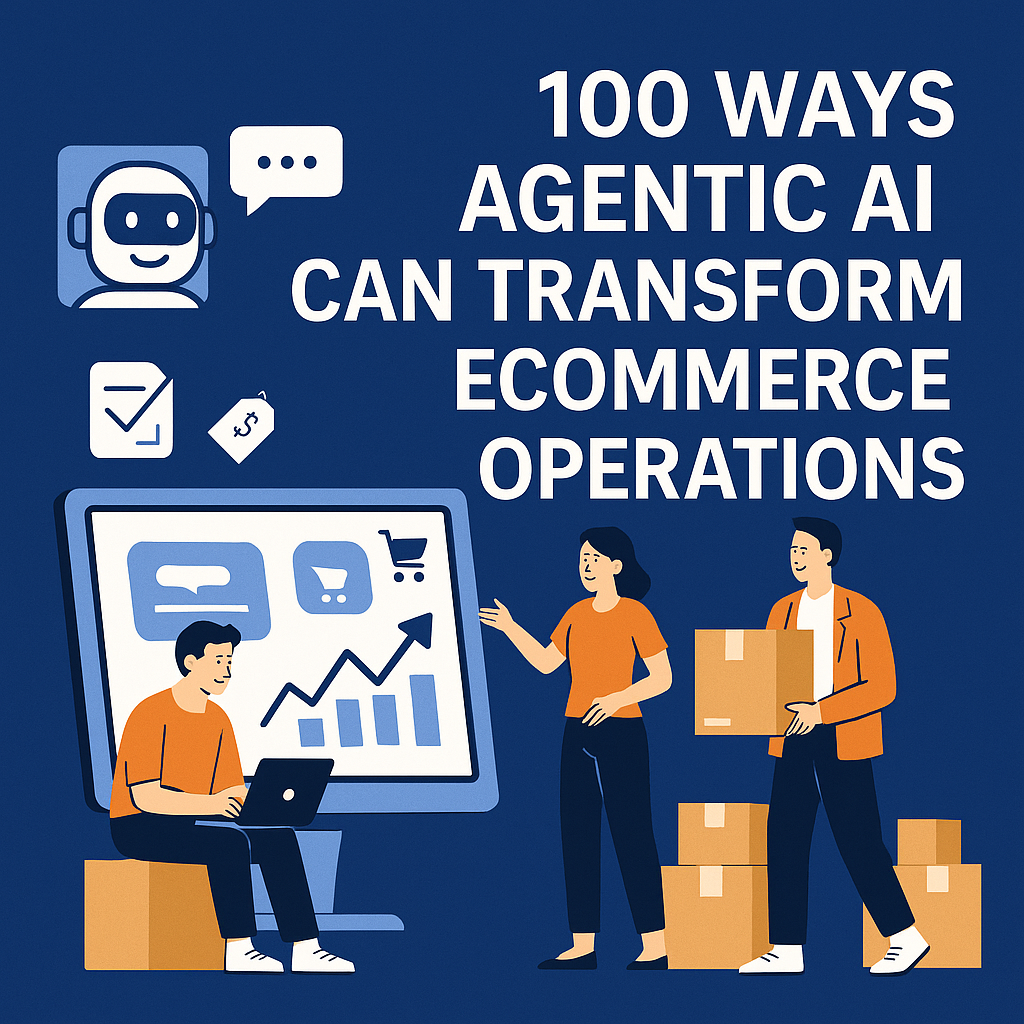
100 Ways Agentic AI Can Transform Ecommerce Operations

In modern ecommerce, agentic AI can autonomously handle complex tasks—from customer engagement to supply chain optimization—delivering efficiency, personalization, and cost savings across the board. Below are 100 areas where agentic AI can be implemented, with benefits for each.

  1. Dynamic Pricing Optimization
    Automatically adjust prices based on demand, competitor rates, and inventory to maximize revenue and margins. (Triple Whale)
  2. Personalized Product Recommendations
    Generate individualized product suggestions in real time to boost average order value and customer satisfaction. (Digital Commerce 360)
  3. Automated Customer Support Tickets
    Categorize and route customer inquiries to the right agents or answer them directly, reducing response times. (Canton Group)
  4. Churn Prediction and Retention
    Identify at-risk customers and trigger personalized retention campaigns before they cancel subscriptions. (Triple Whale)
  5. Inventory Demand Forecasting
    Predict future stock needs using sales history and market trends to prevent stockouts and overstock. (Forbes)
  6. Automated Email Campaign Creation
    Craft and schedule targeted email flows based on user behavior and lifecycle stage to increase open and click rates. (Forbes)
  7. Social Media Engagement Bots
    Post product teasers, answer comments, and nurture leads across social platforms 24/7. (Digital Commerce 360)
  8. Automated Content Generation
    Produce SEO-optimized blog posts, product descriptions, and landing page copy to drive organic traffic. (Triple Whale)
  9. Voice Commerce Assistants
    Enable customers to shop via voice commands, improving accessibility and convenience. (Fast Company)
  10. Real-Time Fraud Detection
    Monitor transactions and flag suspicious activity instantly to reduce chargebacks and losses. (Canton Group)
  11. Customer Sentiment Analysis
    Analyze reviews and social mentions to gauge satisfaction and inform product improvements. (Triple Whale)
  12. Automated Returns Processing
    Evaluate return reasons and issue refunds or exchanges without manual intervention to enhance customer experience. (Digital Commerce 360)
  13. Smart Upsell & Cross-Sell
    Offer complementary products at checkout based on cart content and browsing history to increase order values. (Forbes)
  14. Automated Supplier Sourcing
    Identify and engage optimal suppliers based on price, quality, and lead times to streamline procurement. (Forbes)
  15. Dynamic Ad Creative Testing
    Continuously test and optimize ad visuals and copy to maximize ROI on paid campaigns. (Digital Commerce 360)
  16. Automated A/B Testing
    Run multivariate tests on site elements and deploy winners automatically, reducing manual experiment management. (Triple Whale)
  17. Predictive Maintenance for Warehouses
    Schedule equipment maintenance proactively based on usage patterns to minimize downtime. (Forbes)
  18. Autonomous Warehouse Robotics
    Direct picking and packing robots to fulfill orders efficiently and accurately around the clock. (Triple Whale)
  19. Real-Time Order Tracking Notifications
    Inform customers of status changes proactively to reduce support inquiries and enhance trust. (Digital Commerce 360)
  20. Automated Customs & Duty Calculations
    Compute international shipping charges and taxes instantly for seamless global checkout. (Canton Group)
  21. Dynamic Landing Page Personalization
    Tailor homepage content to visitor demographics and intent to increase engagement and conversions. (Forbes)
  22. Smart Loyalty Program Management
    Automatically segment and reward customers based on behavior to foster repeat purchases. (Triple Whale)
  23. Automated Financial Reconciliation
    Match orders, payments, and refunds in real time, reducing errors and accounting overhead. (Digital Commerce 360)
  24. Inventory Redistribution Planning
    Optimize stock allocations across warehouses to meet regional demand and lower shipping costs. (Forbes)
  25. Real-Time Shipping Rate Comparison
    Evaluate carriers’ rates on the fly and choose the most cost-effective and reliable option. (Canton Group)
  26. Automated Marketing Budget Allocation
    Distribute ad spend across channels based on performance forecasts to maximize ROI. (Digital Commerce 360)
  27. Chatbot-Driven Checkout Assistance
    Guide users through complex purchases via conversational UI, reducing cart abandonment. (Fast Company)
  28. Automated SEO Audits and Fixes
    Scan for technical issues and update metadata to maintain high organic search rankings. (Triple Whale)
  29. Visual Search Implementation
    Allow customers to upload images for product matching, improving discovery and purchase rates. (Digital Commerce 360)
  30. Voice of Customer Insights
    Aggregate feedback from multiple channels to uncover trends and drive product development. (Canton Group)
  31. Real-Time Fraud Scoring
    Continuously update risk scores for customers and transactions to prevent unauthorized orders. (Triple Whale)
  32. Predictive Supply Chain Disruption Alerts
    Monitor geopolitical and environmental factors to reroute shipments proactively. (Forbes)
  33. Automated Compliance Monitoring
    Ensure product listings and marketing adhere to regional regulations, lowering legal risk. (Digital Commerce 360)
  34. Smart Gift Recommendation Engine
    Suggest gift options based on recipient profiles, holidays, and price range, boosting sales during peak seasons. (Fast Company)
  35. Automated Subscription Management
    Handle recurring orders, plan changes, and renewal reminders without manual intervention. (Triple Whale)
  36. Dynamic Returns Prevention
    Identify potential returners and intervene with incentives or alternative solutions to reduce return rates. (Forbes)
  37. Intelligent Bundle Creation
    Create product bundles based on complementary items and purchase patterns to increase revenue. (Digital Commerce 360)
  38. Automated Influencer Matching
    Pair products with influencers whose audiences match brand demographics for effective partnerships. (Canton Group)
  39. Real-Time Email Deliverability Optimization
    Adjust sending schedules and content to maximize inbox placement rates and engagement. (Triple Whale)
  40. Smart Geographic Expansion Analysis
    Evaluate market potential and logistical feasibility for launching in new regions. (Forbes)
  41. Personalized Onboarding Flows
    Guide new users through tailored tutorials and product tours to accelerate time-to-value. (Digital Commerce 360)
  42. Automated Vendor Performance Tracking
    Score suppliers on delivery times, quality, and cost to inform procurement decisions. (Fast Company)
  43. Real-Time Profitability Dashboards
    Generate up-to-the-minute financial insights to guide operational adjustments and strategy. (Triple Whale)
  44. Predictive Customer Lifetime Value (CLV)
    Estimate long-term revenue potential for individual customers and tailor marketing investments accordingly. (Forbes)
  45. Automated Packaging Optimization
    Determine ideal packaging sizes and materials to minimize waste and shipping costs. (Forbes)
  46. Real-Time Competitor Monitoring
    Track competitor pricing and promotions to inform dynamic adjustments. (Digital Commerce 360)
  47. Automated Affiliate Program Management
    Recruit, onboard, and monitor affiliates, optimizing commissions based on performance. (Canton Group)
  48. Smart Product Title Optimization
    A/B test and refine product titles for improved search visibility and click-throughs. (Triple Whale)
  49. Automated Regulatory Reporting
    Compile and submit required financial and sustainability reports to ensure compliance. (Forbes)
  50. Real-Time Traffic Source Optimization
    Allocate marketing budgets to the highest-performing traffic channels automatically. (Digital Commerce 360)
  51. AI-Driven Product Development Insights
    Analyze customer feedback and market trends to propose new product features. (Triple Whale)
  52. Automated Consumer Segmentation
    Continuously update customer clusters based on behavior for more precise targeting. (Fast Company)
  53. Smart Checkout Fraud Prevention
    Analyze risk patterns during checkout to flag or block fraudulent attempts in milliseconds. (Canton Group)
  54. Automated Packaging Label Generation
    Create shipping labels with real-time carrier integration, reducing manual errors. (Triple Whale)
  55. Real-Time Cross-Border Compliance
    Verify customs regulations and document requirements for international orders automatically. (Forbes)
  56. Automated Sustainability Reporting
    Track carbon footprint and water usage across operations to meet ESG goals. (Digital Commerce 360)
  57. AI-Driven Retargeting Campaigns
    Launch personalized ads to past visitors at optimal times and frequencies. (Fast Company)
  58. Voice of Brand Monitoring
    Detect brand mentions and sentiment across forums and social media to manage reputation. (Triple Whale)
  59. Automated Rewards Redemption Processing
    Validate and process loyalty redemptions instantly to enhance program engagement. (Digital Commerce 360)
  60. Smart Customer Acquisition Cost (CAC) Tracking
    Calculate real-time CAC per channel to inform budget reallocations. (Canton Group)
  61. Automated Product Launch Scheduling
    Select optimal launch dates and marketing sequences based on historical data. (Triple Whale)
  62. Real-Time Margin Analysis
    Monitor gross and net margins per SKU to highlight underperformers. (Forbes)
  63. AI-Driven Visual Merchandising
    Arrange product displays on site dynamically to highlight trending items. (Fast Company)
  64. Automated Tax Calculation and Filing
    Compute and remit sales taxes across jurisdictions without manual effort. (Digital Commerce 360)
  65. Predictive Lead Scoring
    Rank prospects by purchase likelihood to prioritize sales outreach. (Triple Whale)
  66. Automated Loyalty Tier Upgrades
    Promote customers to higher tiers based on real-time spending and engagement. (Forbes)
  67. Real-Time Channel Performance Summaries
    Generate instant overviews of each marketing channel’s ROI and KPIs. (Triple Whale)
  68. Smart Content Localization
    Translate and adapt product copy automatically for different markets. (Digital Commerce 360)
  69. Automated Influencer Content Approval
    Review and approve influencer-generated content based on brand guidelines. (Canton Group)
  70. Real-Time Customer Journey Orchestration
    Adjust touchpoints on the fly based on user actions to maximize conversions. (Triple Whale)
  71. AI-Driven Packaging Waste Reduction
    Optimize packaging materials to meet sustainability and cost targets. (Forbes)
  72. Predictive Warehouse Labor Planning
    Forecast staffing needs based on order volume and seasonal trends. (Digital Commerce 360)
  73. Automated Loyalty Churn Prevention
    Detect loyalty members at risk of inactivity and re-engage them with incentives. (Triple Whale)
  74. Smart Promotional Calendar Management
    Coordinate promotions across channels to avoid cannibalization and overexposure. (Fast Company)
  75. Automated Image Tagging and SEO
    Tag product images and generate alt text to improve search engine visibility. (Digital Commerce 360)
  76. Real-Time Bulk Order Quoting
    Provide instant quotes for B2B bulk inquiries based on tiered pricing models. (Canton Group)
  77. Automated Packaging Route Optimization
    Plan multi-order shipments in one package to save on materials and shipping. (Forbes)
  78. Smart Category Management
    Identify top-performing categories and recommend assortment adjustments. (Triple Whale)
  79. Automated Drop-Shipping Coordination
    Sync inventory and orders with drop-ship partners without manual updates. (Digital Commerce 360)
  80. AI-Driven Packaging Dimension Prediction
    Predict parcel size and weight for accurate shipping cost estimates. (Canton Group)
  81. Predictive Product Return Reasoning
    Forecast common return causes and suggest preventative product info or media. (Double Whale)
  82. Automated Wholesale Pricing Engine
    Generate dynamic B2B prices based on order volume, seasonality, and customer segment. (Digital Commerce 360)
  83. Real-Time Customer Success Alerts
    Notify success teams about high-value accounts needing attention to drive renewals. (Triple Whale)
  84. Smart Refund Fraud Detection
    Spot patterns of excessive returns to flag potential abuse of policies. (Canton Group)
  85. Automated Gift Card Fraud Monitoring
    Track suspicious gift card redemptions and transactions to prevent scams. (Forbes)
  86. Dynamic Affiliate Commission Adjustments
    Optimize payouts based on affiliate performance and lifetime value. (Digital Commerce 360)
  87. AI-Driven Video Product Demonstrations
    Generate personalized video content showcasing products in action for individual users. (Fast Company)
  88. Automated GDPR & CCPA Compliance Checks
    Scan forms and data flows to ensure customer data handling meets privacy laws. (Triple Whale)
  89. Predictive Email Unsubscribe Prevention
    Identify users likely to unsubscribe and adjust email frequency or content automatically. (Digital Commerce 360)
  90. Real-Time Cross-Sell Nudges in App
    Offer in-app suggestions based on user session behavior and purchase intent. (Canton Group)
  91. Automated Payment Gateway Optimization
    Switch payment providers dynamically to reduce transaction failures and fees. (Triple Whale)
  92. Smart Bulk Inventory Purchasing
    Recommend optimal reorder quantities and timing to leverage volume discounts. (Forbes)
  93. Automated Product Review Solicitation
    Trigger personalized review requests after optimal purchase intervals to improve ratings. (Digital Commerce 360)
  94. AI-Driven Packaging Cost Forecasting
    Project future packaging expenses based on order projections to inform budgeting. (Triple Whale)
  95. Real-Time Out-of-Stock Notifications
    Alert merchandisers and customers immediately when items deplete to manage expectations. (Fast Company)
  96. Automated Purchase Order Creation
    Generate and send POs to suppliers once inventory hits reorder thresholds. (Digital Commerce 360)
  97. Smart Customer Feedback Loop Closure
    Follow up on support tickets with surveys and escalate unresolved issues automatically. (Canton Group)
  98. Predictive Seasonal Campaign Planning
    Analyze past holiday performance to recommend themes, timing, and budget allocations. (Triple Whale)
  99. Automated Back-in-Stock Alerts
    Notify interested customers instantly when sold-out items return, driving immediate sales. (Digital Commerce 360)
  100. End-to-End Agentic AI Orchestration
    Coordinate all AI agents across functions—marketing, sales, logistics—for seamless, autonomous operations. (Triple Whale)

Implementing agentic AI across these 100 areas empowers ecommerce businesses to operate with unprecedented efficiency, agility, and personalization, ultimately driving revenue growth and customer loyalty.

50 Common Issues Faced During AI Conversion

Adopting artificial intelligence (AI) brings transformative potential but also introduces complex challenges across strategy, data, models, infrastructure, deployment, governance, ethics, legal, skills, change management, and security. This article outlines 50 specific issues teams often encounter during AI conversion projects, detailing their impact and suggesting considerations to address them.

1. Lack of Strategic Alignment

Many organizations embark on AI initiatives without a clear strategic vision, causing misaligned goals and wasted resources. Establishing an AI roadmap tied to business objectives is essential.(Naviant)

2. Fading Leadership Buy-In

Initial executive enthusiasm can wane, leaving AI projects underfunded or deprioritized. Continuous communication of ROI and successes helps maintain support.(Naviant)

3. Undefined Success Metrics

Without well-defined KPIs, teams struggle to measure progress or justify future investment. Clearly articulate performance indicators, such as accuracy gains or time saved.(IBM)

4. Siloed Decision-Making

Isolated teams working independently on AI lead to duplicate efforts and fragmented solutions. Cross-functional collaboration unifies expertise and data access.(Sand Technologies)

5. Inadequate Change Management

Implementing AI changes workflows, roles, and responsibilities. Without structured change management, user adoption falters and ROI is delayed.(Ragan Communications)

6. Poor Data Quality

Inaccurate, incomplete, or mislabeled data result in unreliable models. Robust cleansing, validation, and labeling processes are critical.(TechTarget)

7. Data Silos

Data trapped in disparate systems hinders holistic analysis. Implementing data lakes or integration platforms enables unified access.(TechTarget)

8. Insufficient Data Volume

Small datasets lead to overfitting and poor generalization. Data augmentation, synthetic data, and partnerships can enrich training sets.(IBM)

9. Biased Data

Historical prejudices in training data cause discriminatory outcomes. Proactive bias detection and representative sampling mitigate risks.(Simplilearn)

10. Unbalanced Class Distribution

Overrepresentation of one class skews model predictions. Techniques such as resampling or synthetic minority oversampling help balance datasets.(TechTarget)

11. Data Drift

Over time, input data distributions change, degrading model performance. Continuous monitoring and retraining strategies are needed to address drift.(McKinsey)

12. Lack of Data Governance

Undefined policies for access, lineage, and stewardship lead to compliance and quality issues. A data governance framework ensures accountability and consistency.(IBM)

13. Privacy and Security Concerns

AI systems process sensitive information, raising data breach risks. Encryption, anonymization, and regulatory compliance are non-negotiable.(Simplilearn)

14. Inadequate Infrastructure

Poorly provisioned compute resources (GPUs, TPUs) slow training and inference. Hybrid cloud and distributed computing models optimize performance and cost.(Simplilearn)

15. Integration with Legacy Systems

Legacy platforms often lack APIs or modern interfaces, complicating AI integration. Wrappers, microservices, or middleware can bridge gaps.(Naviant)

16. Model Explainability

Black-box models impede trust among stakeholders. Techniques like SHAP, LIME, or inherently interpretable algorithms provide transparency.(IBM)

17. Algorithmic Bias

Even fair training sets can yield biased outputs due to model design. Incorporating fairness metrics and regular auditing is key.(Simplilearn)

18. Performance vs. Interpretability Trade-Off

High-accuracy models like deep neural networks are less interpretable than linear models. Teams must balance predictive power with explainability requirements.(IBM)

19. Overfitting and Underfitting

Models too closely bound to training data or too simplistic fail in production. Cross-validation and regularization prevent these issues.(Oracle)

20. Lack of Scalable Deployment Pipelines

Manual deployment processes cause delays and inconsistencies. Implement CI/CD pipelines for continuous integration and automated model delivery.(Keymakr)

21. Insufficient Monitoring in Production

Without ongoing performance checks, anomalies go undetected. Monitoring dashboards and alerting on key metrics are essential.(McKinsey)

22. Model Versioning and Reproducibility

Inability to track model versions and reproduce experiments leads to confusion and errors. Use version control tools for data, code, and model artifacts.(IBM)

23. Lack of Robust Testing

Insufficient unit, integration, and stress testing of AI components results in failures. Test for edge cases, adversarial inputs, and failure modes.(Simplilearn)

24. Inadequate Model Documentation

Poor or missing documentation makes maintenance and knowledge transfer difficult. Document data sources, preprocessing, algorithms, hyperparameters, and performance.(Sand Technologies)

25. Regulatory Compliance Gaps

Evolving AI regulations (GDPR, CCPA, EU AI Act) impose strict requirements. Non-compliance can lead to fines and reputational damage.(Sand Technologies)

26. Intellectual Property Uncertainty

Ownership of AI-generated content and model IP is often unclear. Establish contracts and policies to define rights upfront.(Sand Technologies)

27. Ethical Dilemmas

AI decisions in sensitive areas (healthcare, law enforcement) raise moral questions. An ethical framework guides responsible AI use.(Simplilearn)

28. Accountability and Liability

Determining who is responsible when AI causes harm can be complex. Clear governance roles and audit trails are required.(Sand Technologies)

29. Third-Party Model Risks

Using external AI services (AIaaS) exposes organizations to hidden biases, data usage issues, or black-box algorithms. Rigorous due diligence and contractual safeguards mitigate risk.(Deloitte)

30. Vendor Lock-In

Proprietary AI platforms can make migration or multi-cloud strategies difficult. Favor open standards and portable solutions.(Deloitte)

31. Insufficient AI Skillsets

A shortage of data scientists, ML engineers, and AI-savvy product owners slows progress. Invest in upskilling and targeted hiring.(Naviant)

32. Poor AI Literacy Among Users

Non-technical stakeholders may distrust or misuse AI outputs. Training programs should cover AI basics, limitations, and ethical considerations.(Naviant)

33. High Cost of Talent

Competition for AI experts drives up salaries and recruitment expenses. Partnering with universities or outsourcing to managed services can alleviate costs.(IBM)

34. Fragmented Toolchains

Different teams using disparate tools hinder collaboration. Standardize on integrated platforms or open-source toolchains.(Sand Technologies)

35. Cultural Resistance

Employees fear job displacement or distrust AI decisions. Transparent communication of AI’s role and benefits fosters acceptance.(HealthTech Magazine)

36. Unrealistic Expectations

Hype leads stakeholders to expect immediate, magical results. Setting realistic timelines and outcomes averts disappointment.(Forbes)

37. Environmental Impact

Training large models consumes significant energy and water resources. Optimizing algorithms and using greener data centers reduce footprint.(MIT News)

38. Latency in Real-Time Systems

Edge deployment or low-latency applications require model optimization and hardware acceleration to meet performance needs.(Gcore)

39. Security Vulnerabilities

Adversarial attacks, data poisoning, or model inversion can compromise AI systems. Incorporate security testing and robust defense mechanisms.(McKinsey)

40. Insufficient Testing for Adversarial Inputs

AI models must be robust against maliciously crafted inputs. Perform adversarial testing and implement detection techniques.(IBM)

41. Lack of Model Maintenance Plans

Models degrade over time without scheduled retraining and updates. Define maintenance cycles and retraining triggers upfront.(Simplilearn)

42. Inadequate Collaboration Between IT and Business

Technical teams and business users often work in silos, leading to misaligned AI solutions. Joint teams and shared language bridge gaps.(McKinsey)

43. Over-Reliance on Third-Party Data

External datasets may be outdated, biased, or legally restricted for commercial use. Validate and verify licenses rigorously.(Sand Technologies)

44. Difficulty Managing Unstructured Data

Text, images, audio, and video require specialized preprocessing and storage strategies. Invest in tools for feature extraction and indexing.(Acceldata)

45. Limited Cross-Functional Expertise

AI projects need data engineers, domain experts, ML developers, and UX designers. Building multidisciplinary teams drives success.(Simplilearn)

46. Conflicting Regulatory Requirements Across Regions

Global operations face varying AI regulations and consumer expectations. A lowest-common-denominator policy may stifle innovation, while per-market policies increase complexity.(Deloitte)

47. Difficulty Measuring Long-Term Impact

Many benefits of AI, such as improved decision-making or customer loyalty, manifest over time. Establish baseline metrics and long-horizon tracking.(McKinsey)

48. Poorly Designed User Interfaces

Even powerful AI loses value if end-users can’t easily access or understand results. Invest in intuitive UIs and visualizations.(HealthTech Magazine)

49. Insufficient Feedback Loops

Without mechanisms to collect user feedback on AI outputs, models cannot improve over time. Implement review workflows and continual learning strategies.(McKinsey)

50. Overlooking Ethical AI Monitoring

Ethics is not a one-off checklist but requires ongoing oversight. Continuous audits for fairness, transparency, and societal impact are necessary.(Simplilearn)

Successfully converting to AI-driven operations demands anticipating and addressing these 50 issues across organizational, technical, legal, and ethical dimensions. A holistic, collaborative approach—grounded in strong governance, robust processes, and continuous learning—enables teams to harness AI’s full potential while mitigating risks.

50 Essential Questions Your Team Should Ask an AI Consultant

Assume you as an AI Consultant went to a competent client to serve for their AI Needs. What are the typical 50 questions can be asked by their teams ?

Artificial Intelligence (AI) consulting has become a cornerstone for organizations seeking to leverage data-driven insights, automate processes, and gain a competitive edge in a rapidly evolving marketplace(Growexx). When engaging an AI consultant, your internal team must ask the right questions to ensure alignment with business goals, data readiness, ethical governance, and measurable return on investment. Below are 50 critical questions—organized into five categories—that will help your organization maximize the value of AI consulting services.

Strategic Alignment and Vision

  1. What are the specific business problems you believe AI can solve for our organization?
    Understanding the consultant’s perspective on your core challenges ensures AI efforts address real needs rather than hypothetical use cases.
  2. How will AI initiatives align with our overall digital transformation strategy?
    AI should be an integral component of a broader digital strategy that reimagines workflows and drives strategic agility(Inductus Limited).
  3. What success metrics and key performance indicators (KPIs) will you establish to measure project impact?
    Clear KPIs—such as productivity improvements or cost reductions—are crucial for demonstrating AI’s business value.
  4. How do you prioritize AI projects when multiple use cases are identified?
    Consultants should use frameworks (e.g., RICE: Reach, Impact, Confidence, Effort) to rank initiatives by potential ROI(VentureBeat).
  5. What is your approach to identifying quick wins versus long-term AI investments?
    Balancing tactical deployments with strategic, foundational work ensures early value while building scalable capabilities.
  6. How will you ensure stakeholder buy-in across C-suite, operations, and IT?
    Cross-functional workshops and governance committees foster alignment and secure resources(Consultancy.uk).
  7. What industry benchmarks and best practices do you leverage when recommending AI solutions?
    Consultants should draw from comparable case studies and benchmarking studies to tailor recommendations.
  8. How do you plan to integrate AI into our existing technology roadmap?
    Seamless integration avoids siloed systems and maximizes synergy with CRM, ERP, or other platforms.
  9. What competitive advantages can AI deliver in our sector?
    Identifying differentiators—such as personalized customer experiences or predictive maintenance—clarifies value propositions.
  10. How will you adapt AI strategies as our business objectives evolve?
    A flexible, iterative roadmap accommodates changing market conditions and internal priorities.

Data Strategy and Infrastructure

  1. What data sources and types are essential for our AI use cases?
    Understanding data requirements—structured, unstructured, time-series—ensures comprehensive planning.
  2. How do you assess the quality, completeness, and reliability of our existing data?
    Data audits uncover gaps, biases, and inconsistencies that can undermine model performance.
  3. What data governance framework will you implement to ensure compliance and security?
    Ethical AI relies on clear protocols for data collection, storage, masking, and retention(Inductus Limited).
  4. How will you address data privacy regulations (e.g., GDPR, CCPA, India’s DPB)?
    Consultants must align data practices with local and global regulations to mitigate legal risks.
  5. What infrastructure upgrades (cloud, edge, hybrid) are required to support AI workloads?
    Scalable compute and storage capabilities are foundational for large-scale model training and inference.
  6. Which cloud platforms or on-premises solutions do you recommend for our needs?
    Consultants should weigh cost, performance, and data residency requirements when selecting infrastructure.
  7. How will you integrate third-party data providers or APIs into our ecosystem?
    Partnerships with data vendors can augment internal data but require compatibility evaluations.
  8. What processes will you establish for continuous data ingestion and pipeline management?
    Automated ETL (Extract, Transform, Load) pipelines ensure up-to-date data for real-time analytics.
  9. How do you plan to manage data versioning and lineage for reproducibility?
    Tracking data changes and provenance is critical for audits, model validation, and compliance.
  10. What upskilling programs will you recommend to improve our data literacy and infrastructure management?
    Empowering internal teams to maintain data pipelines reduces dependency on external consultants(Consultancy.uk).

Model Development and Integration

  1. What methodology will you follow for AI model development (e.g., CRISP-DM, CPMAI)?
    A structured framework like CPMAI™ integrates business understanding, data, governance, and ethics throughout the lifecycle(PMI).
  2. How will you select algorithms that balance accuracy, interpretability, and performance?
    Trade-offs between complex models (e.g., deep learning) and simpler algorithms (e.g., logistic regression) must align with business needs.
  3. What processes will you use for hyperparameter tuning and model optimization?
    Techniques such as grid search or Bayesian optimization improve model efficacy.
  4. How do you plan to validate models against unseen data to avoid overfitting?
    Cross-validation, hold-out sets, and stress testing ensure robust performance.
  5. How will you handle model explainability and interpretability for end-users?
    Tools like SHAP or LIME provide transparency into model decisions, fostering trust.
  6. What integration approach will you follow for embedding AI outputs into production systems?
    APIs, microservices, or containerized deployments should align with your application architecture.
  7. How will you monitor models in production for data drift and performance degradation?
    Continuous monitoring with alerting thresholds ensures timely retraining or rollback actions.
  8. What version control systems will you use for code, models, and datasets?
    Platforms like Git, MLflow, or DVC enable reproducibility and collaborative development.
  9. How do you plan to scale AI workloads during peak demand?
    Auto-scaling policies, GPU clusters, or serverless options provide elasticity under heavy loads.
  10. What is your approach to A/B testing and incremental rollout of AI features?
    Phased deployments and controlled experiments quantify real-world impact and reduce adoption risks.

Governance, Ethics, and Compliance

  1. What governance framework will you establish to oversee AI initiatives?
    A cross-functional AI ethics committee should define policies, roles, and escalation paths(AFPR).
  2. How do you ensure AI solutions comply with organizational and industry regulations?
    Regular compliance reviews and audits maintain alignment with evolving legal standards.
  3. What ethical guidelines will you adopt to address bias, fairness, and accountability?
    Embedding fairness metrics and bias mitigation techniques helps prevent discriminatory outcomes(ISPP).
  4. How will you conduct ethical impact assessments for high-risk use cases?
    Scenario analysis, stakeholder consultations, and red-teaming exercises identify potential harms.
  5. What data anonymization or de-identification techniques will you employ?
    Methods like tokenization or differential privacy protect sensitive personal information.
  6. How will you maintain audit trails for AI-driven decisions?
    Logging inputs, outputs, and model versions ensures transparency and supports forensic analysis.
  7. What processes will you implement for incident response and risk mitigation?
    Playbooks and escalation paths prepare teams to address AI failures or ethical breaches.
  8. How do you plan to update policies in response to new regulations (e.g., EU AI Act)?
    An agile policy review process adapts governance to global regulatory developments.
  9. What training and awareness programs will you provide to ensure ethical AI use?
    Workshops, e-learning modules, and certifications raise ethical and compliance literacy across teams.
  10. How will you engage external stakeholders (e.g., customers, regulators) in governance discussions?
    Transparent reporting and collaborative forums build trust and facilitate feedback loops.

ROI, Change Management, and Culture

  1. How will you calculate total cost of ownership (TCO) for proposed AI solutions?
    TCO includes development, infrastructure, licensing, and ongoing maintenance costs.
  2. What methodologies do you use to forecast ROI and payback periods?
    Financial models should consider direct cost savings, revenue uplifts, and productivity gains(InformationWeek).
  3. How will you track realized ROI and adjust strategies accordingly?
    Ongoing performance dashboards compare projected versus actual outcomes, enabling course corrections.
  4. What change management strategies will you deploy to ensure user adoption?
    Communication plans, training sessions, and pilot groups facilitate smooth transitions.
  5. How will you measure employee acceptance and satisfaction with AI tools?
    Surveys, usage analytics, and feedback channels gauge sentiment and identify pain points.
  6. What organizational structures or roles do you recommend to sustain AI initiatives?
    Dedicated AI centers of excellence, data science teams, or AI product owners foster long-term success.
  7. How do you plan to upskill and reskill our workforce for AI-enabled roles?
    Learning pathways in data literacy, model interpretation, and ethical AI equip employees for new responsibilities.
  8. What communication protocols will you establish to report progress to executives?
    Regular executive briefings and simplified dashboards keep leadership informed and aligned.
  9. How will you foster an AI-positive culture that encourages experimentation?
    Initiatives like “AI Exploration Days” or innovation contests stimulate creativity and lower fear of failure(Consultancy.uk).
  10. What criteria will determine when to scale successful pilots organization-wide?
    Defined thresholds—accuracy, adoption rates, business impact—guide decision-making for broader rollouts.

Engaging an AI consultant with these 50 questions will help your team gain clarity, mitigate risks, and set a strong foundation for AI initiatives that drive real business value. By covering strategy, data readiness, development processes, governance, and ROI measurement, you ensure a comprehensive approach to AI adoption—one that positions your organization for sustainable digital transformation and competitive advantage.

30 Essential Questions a Client Should Ask an AI Startup

What are the 30 questions A client can ask to you as an AI Startup ?

When an AI startup meets a prospective client, the client needs to vet the vendor thoroughly to ensure alignment with business goals, technical requirements, and risk management practices. Below are 30 key questions a client might ask an AI startup, grouped into thematic categories. Each question is accompanied by context and considerations.

For our Cloud/DevOps/AI/ML/ Ge AI digital job tasks Courses, visit URL:
https://kqegdo.courses.store/

1. AI Technology and Capabilities


1. What type of AI models and algorithms do you use, and why are they appropriate for our needs?
Understanding whether the startup uses supervised learning, unsupervised learning, reinforcement learning, large language models, or custom architectures helps assess technical fit and maturity(Learning Guild).


2. How do you handle model training, validation, and testing?
Clients should know the processes for splitting data, cross-validation,
hyperparameter tuning, and performance metrics to gauge model robustness and accuracy(Converge TP).


3. Can you provide examples of similar AI solutions you have implemented?
Case studies or proof-of-concept projects demonstrate real-world impact and the vendor’s domain expertise(Reddit r/startups).


4. How customizable is your AI solution?
Determine whether the models are off-the-shelf or can be fine-tuned to
specific business processes, data formats, and user workflows(Jasper).


5. What are the strengths and limitations of your AI technology?
No model is perfect; transparency about edge cases, failure modes, and
scenarios requiring human intervention builds realistic expectations(Learning Guild).


2. Data Requirements and Management


6. What data do you need to train and operate the AI, and how much historical data is required?
Clarify data volume, quality, structure, and labeling requirements to
prepare internal resources for data collection or cleansing(Converge TP).


7. How will you source, ingest, and integrate data from our existing systems?
Integration with CRM, ERP, databases, and legacy systems can be complex; understanding APIs, ETL pipelines, and middleware is crucial(Deloitte).


8. How do you ensure data quality, consistency, and governance?
Ask about processes for deduplication, validation, error correction, and
data stewardship roles to avoid “garbage in, garbage out” scenarios(Converge TP).


9. How do you handle data labeling and annotation?
For supervised learning models, label accuracy directly impacts
performance. Inquire whether labeling is done in-house, via third
parties, or through crowdsourcing, and how quality is monitored(ESOMAR).


10. What processes do you have to update and maintain data pipelines over time?
AI adoption is iterative. Data drift and evolving business contexts
require continuous monitoring, retraining, and pipeline adjustments(Deloitte).


3. Performance, Accuracy, and Metrics


11. What performance metrics do you use to evaluate the AI solution?
Common metrics include precision, recall, F1-score for classification;
mean squared error for regression; BLEU or ROUGE for language tasks.
Ensure metrics match business objectives(Converge TP).


12. Can you provide baseline and benchmark results?
Comparisons against existing processes or industry benchmarks help quantify potential ROI and improvement areas(Learning Guild).


13. How do you handle false positives, false negatives, and error cases?
Understanding the business impact of different error types guides tolerance levels and design of human-in-the-loop safeguards(IAPP).


14. Do you offer SLAs (Service Level Agreements) for model accuracy, uptime, and response time?
Explicit performance guarantees ensure accountability and allow tracking of vendor commitments(Converge TP).


15. How will we monitor and visualize AI performance in production?
Dashboards, alerts, and reporting mechanisms help stakeholders stay informed and enable rapid issue resolution(Deloitte).


4. Integration and Scalability


16. How does your solution integrate with our existing IT infrastructure and tools?
Compatibility with monitoring, alerting, ticketing, and CI/CD pipelines is essential to prevent silos(Deloitte).


17. What are the hardware and software requirements for deployment?
Clarify GPU/CPU needs, memory, storage, network bandwidth, and runtime environments (on-premises, cloud, hybrid) to plan capacity investments(Converge TP).


18. How do you scale the solution for increasing data volumes and user demand?
Expanding infrastructure, load balancing, containerization, and microservices architectures help maintain performance at scale(Deloitte).


19. Do you support batch processing, real-time inference, or both?
Different use cases require different processing modes. Ensure the vendor can meet latency and throughput requirements(Converge TP).


20. How do you manage versioning and updates of models in production?
Rolling updates, A/B testing, or canary deployments reduce risk when pushing new model versions(ESOMAR).


5. Security, Privacy, and Compliance


21. How do you secure sensitive data in transit and at rest?
Encryption standards (AES-256), key management, VPNs, TLS/SSL, and zero-trust architectures protect against breaches(IAPP).


22. What access controls and authentication mechanisms do you implement?
Role-based access control (RBAC), multi-factor authentication (MFA), and audit trails limit exposure and provide accountability(Securiti).


23. How do you address data privacy regulations such as GDPR, CCPA, and sector-specific rules?
Demonstrating compliance frameworks, consent management, data subject rights handling, and data localization practices is essential(Converge TP).


24. How do you mitigate AI-specific risks such as model poisoning, data leakage, and adversarial attacks?
Controls like differential privacy, adversarial training, anomaly detection, and secure enclaves help safeguard AI integrity(Securiti).


25. Do you perform regular security audits, penetration tests, and vulnerability assessments?
Independent third-party assessments and continuous monitoring build trust and reduce attack surfaces(IAPP).


6. Ethical Considerations and Governance


26. How do you ensure fairness and mitigate bias in your AI models?
Techniques include diverse training datasets, bias detection tools, fairness metrics, and periodic audits(Converge TP).


27. Can you explain decision-making processes (explainable AI) to non-technical stakeholders?
Transparent, interpretable models or post-hoc explanation techniques (LIME, SHAP) increase trust and regulatory compliance(Learning Guild).


28. What governance frameworks and policies guide your AI development and deployment?
Standards like ISO/IEC 42001, internal AI ethics boards, and alignment with OECD AI Principles demonstrate responsible practices(IAPP).


7. Commercial Terms, Support, and Future Roadmap


29. What is your pricing and licensing model (subscription, usage-based, outcome-based)?
Understanding cost drivers—compute hours, API calls, user seats, or transaction volumes—helps forecast total cost of ownership(Orb).


30. What support, training, and SLAs do you provide post-deployment?
Clarify onboarding programs, documentation, dedicated support teams,
training workshops, and escalation procedures to ensure long-term
success(Converge TP).


By asking these 30 questions, a prospective client can thoroughly
evaluate an AI startup’s technical capabilities, data practices,
performance guarantees, security measures, ethical stance, and
commercial terms. Well-informed discussions set the foundation for
successful AI adoption and long-lasting partnerships.