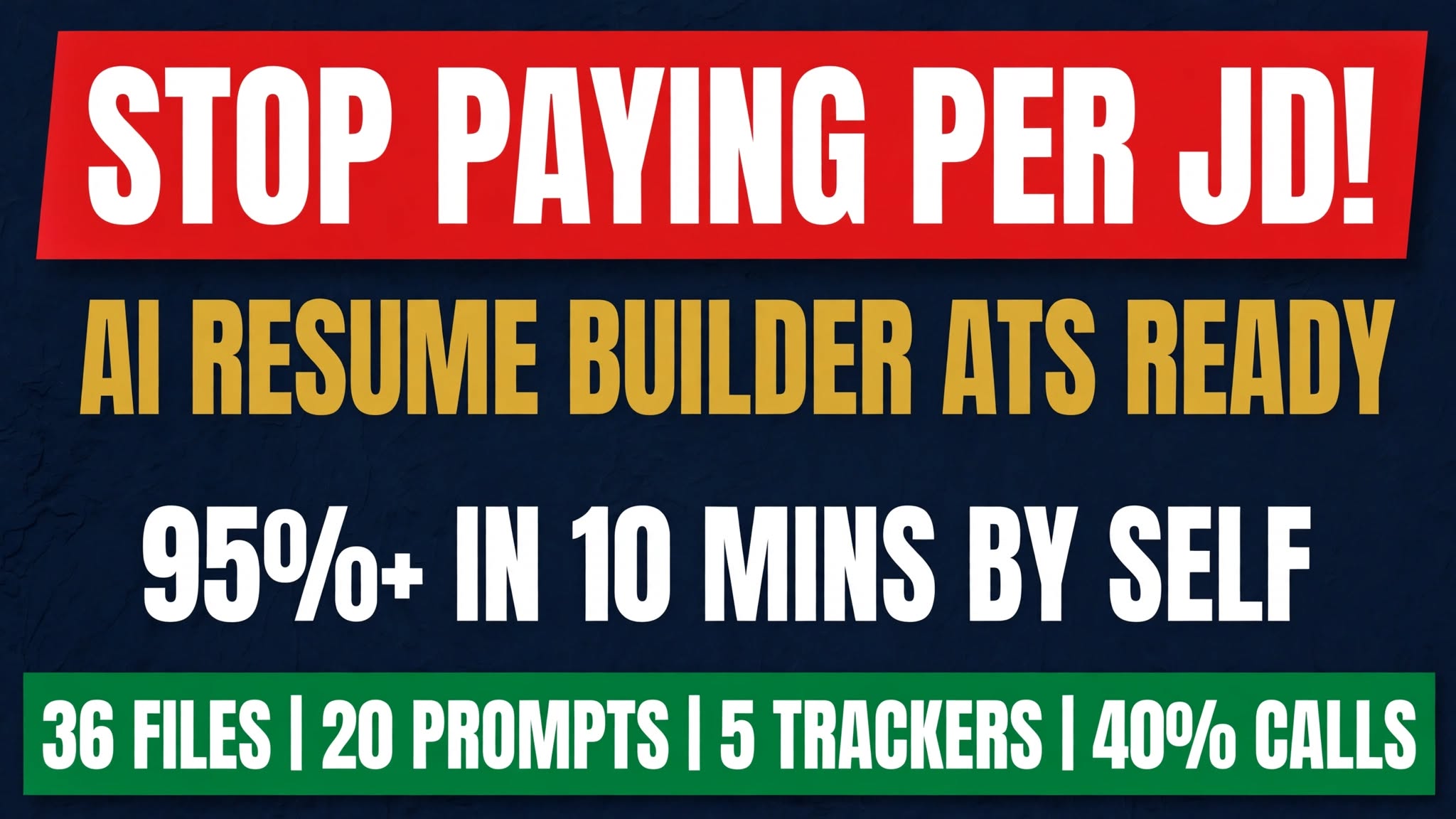
ATS Resume Building Tricks: Stop Paying Per Job Description and Create Tailored Resumes in Minutes
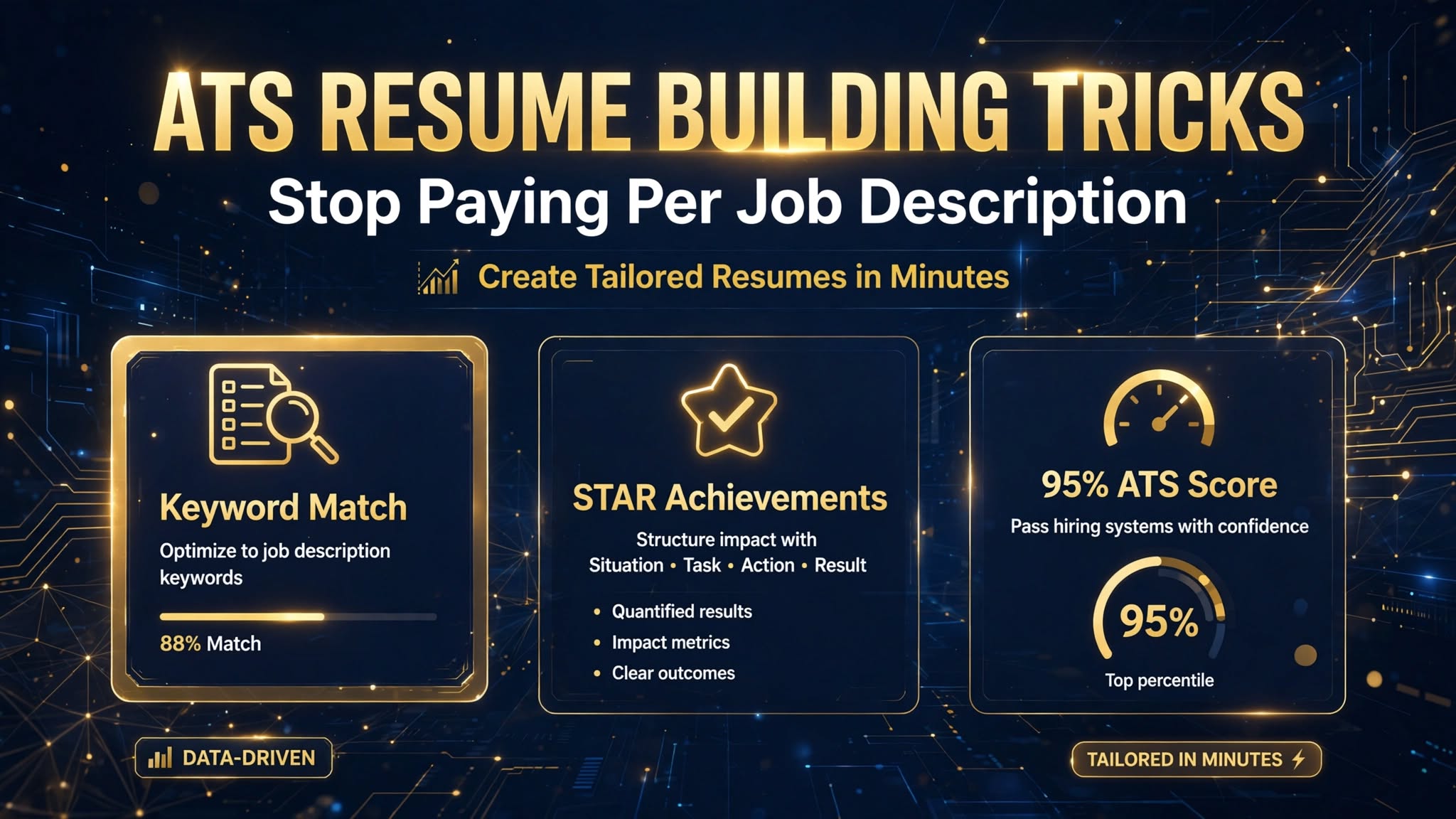
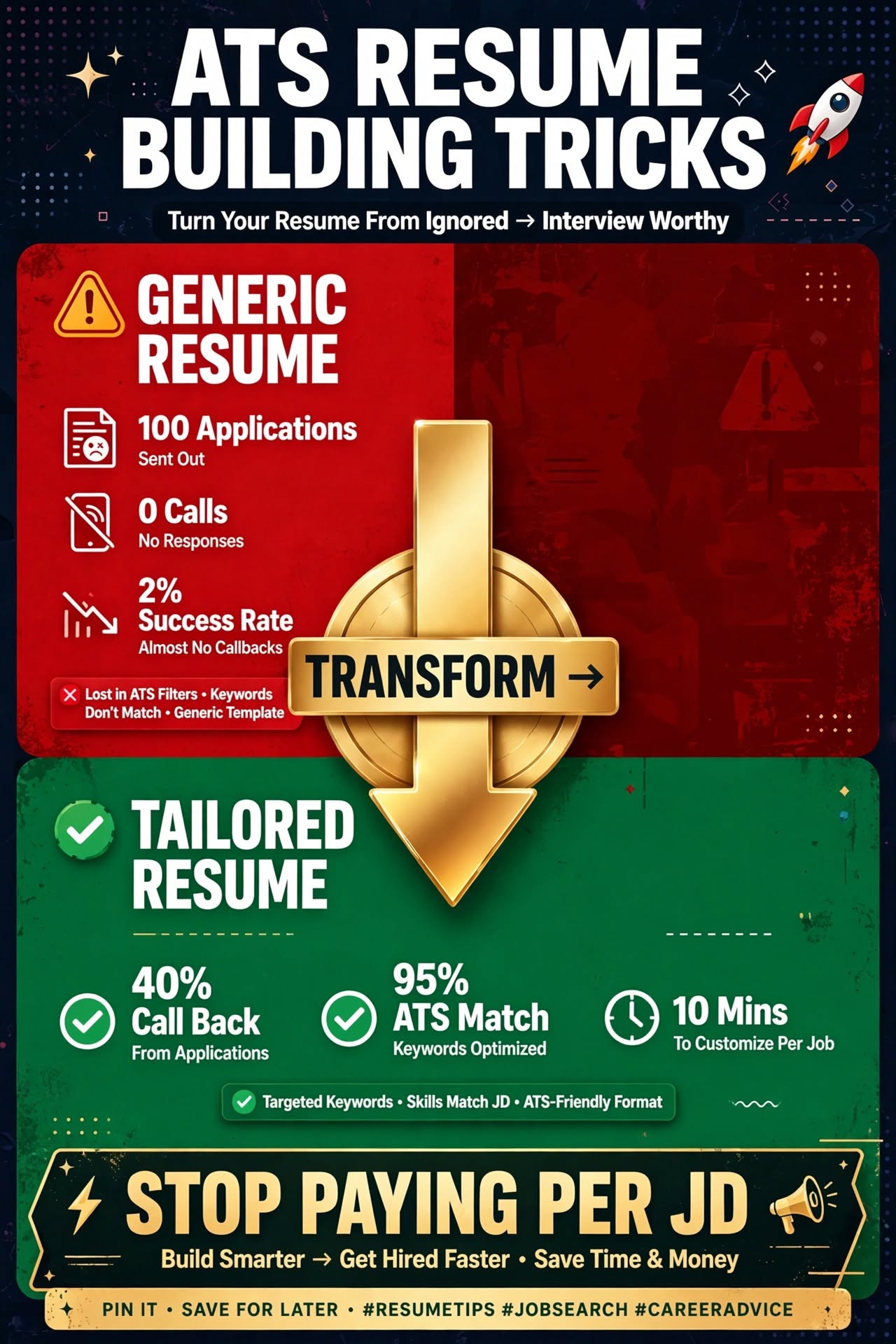
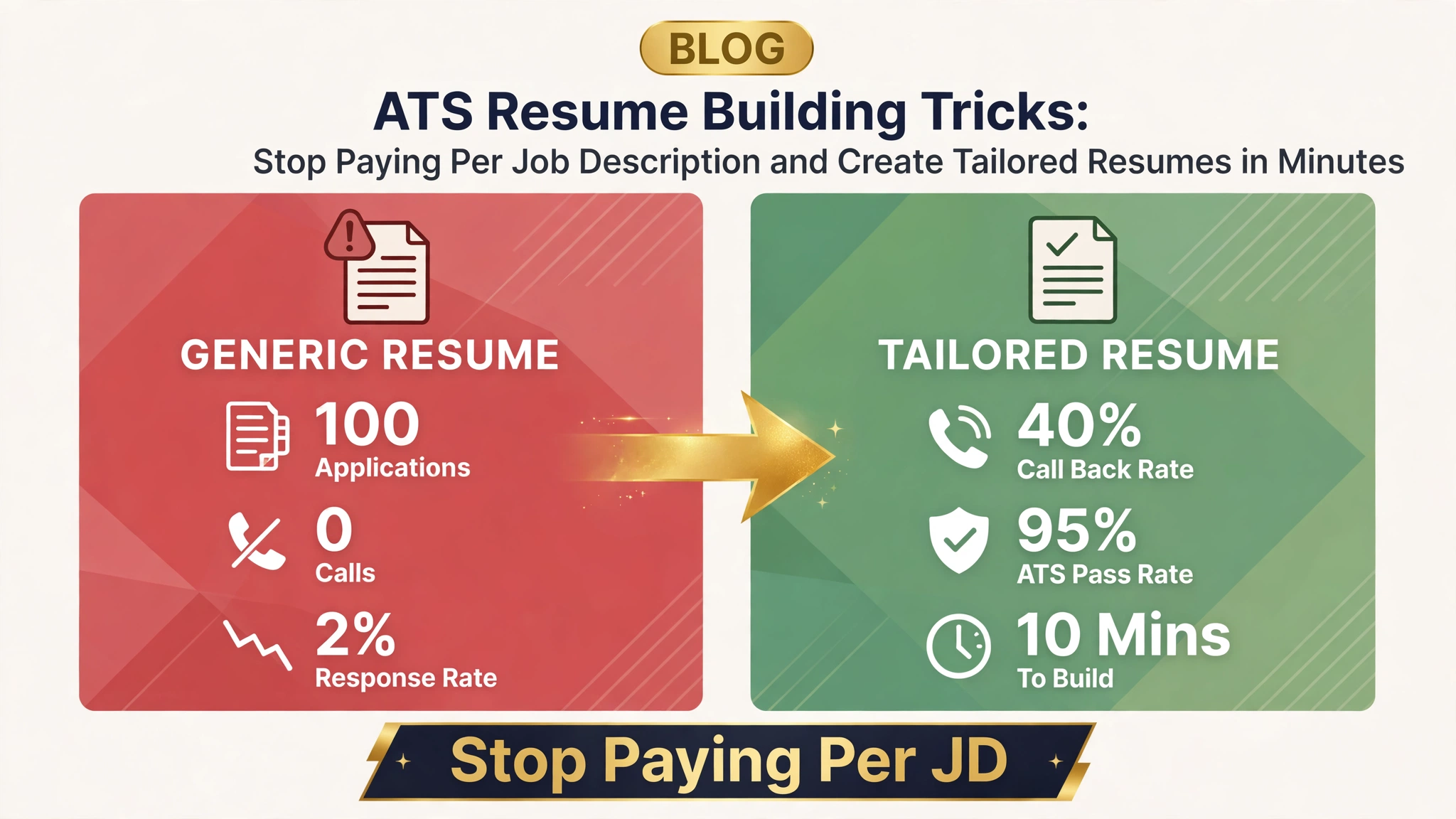
Why some job seekers submit 100 applications and hear nothing back, while others consistently land recruiter calls.
Introduction: The Hidden Reason Your Resume Isn’t Getting Seen
You spend evenings applying for jobs.
You carefully upload your resume, fill out application forms, and hit “Submit” with hope.
Days pass.
Then weeks.
No recruiter calls. No interview requests. No feedback.
If this sounds familiar, you’re not alone.
The harsh reality is that most resumes never reach a human recruiter. Before a hiring manager ever sees your application, it must survive an Applicant Tracking System (ATS), the software used by organizations to filter, score, and rank candidates.
Many talented professionals mistakenly believe they’re being rejected by recruiters when, in fact, their resumes are being filtered out automatically.
This creates an expensive and frustrating cycle:
- Apply to more jobs
- Receive fewer responses
- Purchase another resume revision
- Rewrite everything for a new opportunity
- Repeat endlessly
The good news is that ATS optimization isn’t a mystery.
It’s a learnable skill.
More importantly, it’s a repeatable process that can dramatically improve your visibility in the job market.
In this guide, you’ll learn the practical strategies high-performing candidates use to build ATS-friendly resumes, improve recruiter response rates, and reduce the time spent customizing applications.
Understanding How Modern ATS Systems Work
Applicant Tracking Systems are designed to help recruiters process large volumes of applications efficiently.
A typical corporate job posting may receive hundreds or even thousands of applications. ATS software acts as the first screening layer by evaluating resumes against job requirements.
The system typically analyzes:
- Keywords and terminology
- Technical skills
- Certifications
- Industry knowledge
- Work experience alignment
- Job titles
- Education credentials
- Formatting compatibility
If your resume doesn’t align sufficiently with the job description, it may never advance to human review.
This is why relevance has become more important than volume.
Sending 100 generic applications often produces worse results than submitting 20 highly targeted ones.
The 9 ATS Resume Strategies Used by Successful Candidates
1. Match Job Description Keywords Strategically
Keywords are the language recruiters and ATS platforms use to identify qualified candidates.
For example, a DevOps Engineer job description may repeatedly mention:
- AWS
- Kubernetes
- Docker
- Terraform
- CI/CD
- Infrastructure as Code
- Monitoring
If your resume talks about cloud infrastructure but never mentions these specific technologies, ATS systems may struggle to recognize your relevance.
Best Practice
For every application:
- Analyze the job description.
- Identify recurring skills.
- Extract critical keywords.
- Naturally incorporate them throughout your resume.
Keyword stuffing does not work.
Contextual relevance does.
Key Insight
Many ATS systems prioritize keyword alignment. Improving keyword relevance can significantly increase your chances of passing the initial screening stage.
2. Replace Responsibilities with Achievements
One of the biggest mistakes candidates make is listing responsibilities instead of accomplishments.
Weak Example
Responsible for reporting and team coordination.
Strong Example
Automated weekly reporting using Python and SQL, reducing manual workload from 5 hours to 15 minutes and improving team productivity by 40%.
Notice the difference.
The first statement explains activity.
The second demonstrates value.
Recruiters care about impact.
3. Use the STAR Framework Everywhere
The STAR methodology provides a structured way to showcase achievements.
STAR Formula
Situation → What was the challenge?
Task → What needed to be done?
Action → What did you do?
Result → What measurable outcome occurred?
Example
Situation: Weekly reporting consumed significant team time.
Task: Reduce reporting overhead.
Action: Built automated reporting pipelines using Python and SQL.
Result: Reduced manual reporting effort by 95% and improved productivity by 40%.
This framework works across every industry:
- Software Engineering
- Data Analytics
- Finance
- Sales
- Operations
- Human Resources
- Healthcare
- Education
4. Create a Skills Matrix
A skills matrix helps bridge the gap between your experience and employer expectations.
Instead of simply listing dozens of skills, categorize them according to:
Technical Skills
- Python
- SQL
- AWS
- Azure
- Power BI
- Machine Learning
Business Skills
- Stakeholder Management
- Business Analysis
- Project Management
Leadership Skills
- Team Management
- Mentoring
- Strategic Planning
Job Requirement Mapping
Match each requirement from the job description against your existing capabilities.
This approach is especially powerful for career switchers entering:
- AI
- Cloud Computing
- Cybersecurity
- DevOps
- Data Analytics
5. Customize Your Professional Summary
Many professionals make the mistake of using the same summary for every job application.
Recruiters immediately recognize generic positioning.
Experienced Professionals
Highlight:
- Years of experience
- Major achievements
- Technical expertise
- Industry specialization
Career Switchers
Highlight:
- Transferable skills
- Relevant projects
- Certifications
- New competencies
Fresh Graduates
Highlight:
- Academic projects
- Internships
- Certifications
- Technical skills
Your summary should tell recruiters exactly why you’re qualified for the specific role you’re applying for.
6. Measure Resume Readiness Before Applying
Most job seekers optimize blindly.
Instead, evaluate your resume systematically.
Resume Review Checklist
✅ Keyword relevance
✅ STAR-based achievements
✅ Skills alignment
✅ ATS-friendly formatting
✅ Professional summary quality
✅ Contact information accuracy
✅ Education information completeness
✅ Certification relevance
Think of your resume like a product.
Test it before releasing it.
7. Leverage Automation Instead of Rewriting Everything
Resume customization does not require creating a brand-new document every time.
Modern AI-assisted workflows can dramatically reduce effort.
Automation can help:
- Extract keywords
- Generate achievement variations
- Update summaries
- Suggest skills alignment
- Create tailored cover letters
- Score ATS readiness
The goal isn’t to automate authenticity.
The goal is to eliminate repetitive work.
8. Stop Ignoring Cover Letters
Many applicants skip cover letters entirely.
This is a missed opportunity.
A concise, role-specific cover letter can:
- Explain career transitions
- Address employment gaps
- Reinforce ATS keywords
- Demonstrate motivation
- Differentiate you from other candidates
A focused 150-word cover letter often performs better than generic multi-page templates.
9. Optimize LinkedIn Together with Your Resume
Recruiters frequently check LinkedIn profiles after reviewing resumes.
If your resume says one thing and LinkedIn shows another, trust decreases.
Optimize Three Critical Sections
Headline
Clearly define who you are and what role you’re targeting.
About Section
Communicate your professional value proposition.
Experience Section
Use measurable achievements and STAR-style accomplishments.
A strong LinkedIn profile can generate inbound recruiter messages even before you begin applying actively.
The Real Cost of Resume Customization
Many professionals underestimate both the time and financial cost associated with job-specific resume tailoring.
Let’s compare the three most common approaches.
Option 1: Manual Customization
Typical process:
- Read job description
- Extract keywords
- Rewrite summary
- Modify experience bullets
- Adjust skills section
- Draft cover letter
Average effort:
3-5 hours per application
Effective but difficult to scale.
Option 2: Resume Writing Services
Professional resume writers can provide expertise and polishing.
However, customization often needs to be repeated for every target role.
Challenges include:
- Additional costs
- Waiting periods
- Limited iteration speed
- Ongoing dependency
For active job seekers applying broadly, these expenses accumulate rapidly.
Option 3: AI-Assisted Resume Building
Modern AI-powered workflows combine:
- Resume templates
- Keyword extraction
- AI prompts
- ATS scoring
- Cover letter generation
- Application tracking
Benefits include:
- Faster customization
- Greater control
- Consistent quality
- Lower long-term cost
- Development of a valuable career skill
Instead of outsourcing resume optimization forever, candidates can learn a repeatable system.
Why Job-Specific Resumes Consistently Outperform Generic Ones
Every role has unique requirements.
A Data Engineer role differs from a DevOps Engineer role.
An AI Consultant role differs from a Product Manager role.
A Cybersecurity position differs from a Cloud Architect opportunity.
Yet many candidates continue sending identical resumes everywhere.
The strongest applicants adjust:
- Keywords
- Professional summary
- Skills emphasis
- Achievement positioning
- Cover letters
While their core story remains consistent, the presentation becomes role-specific.
That’s what recruiters expect.
How to Improve Recruiter Response Rates
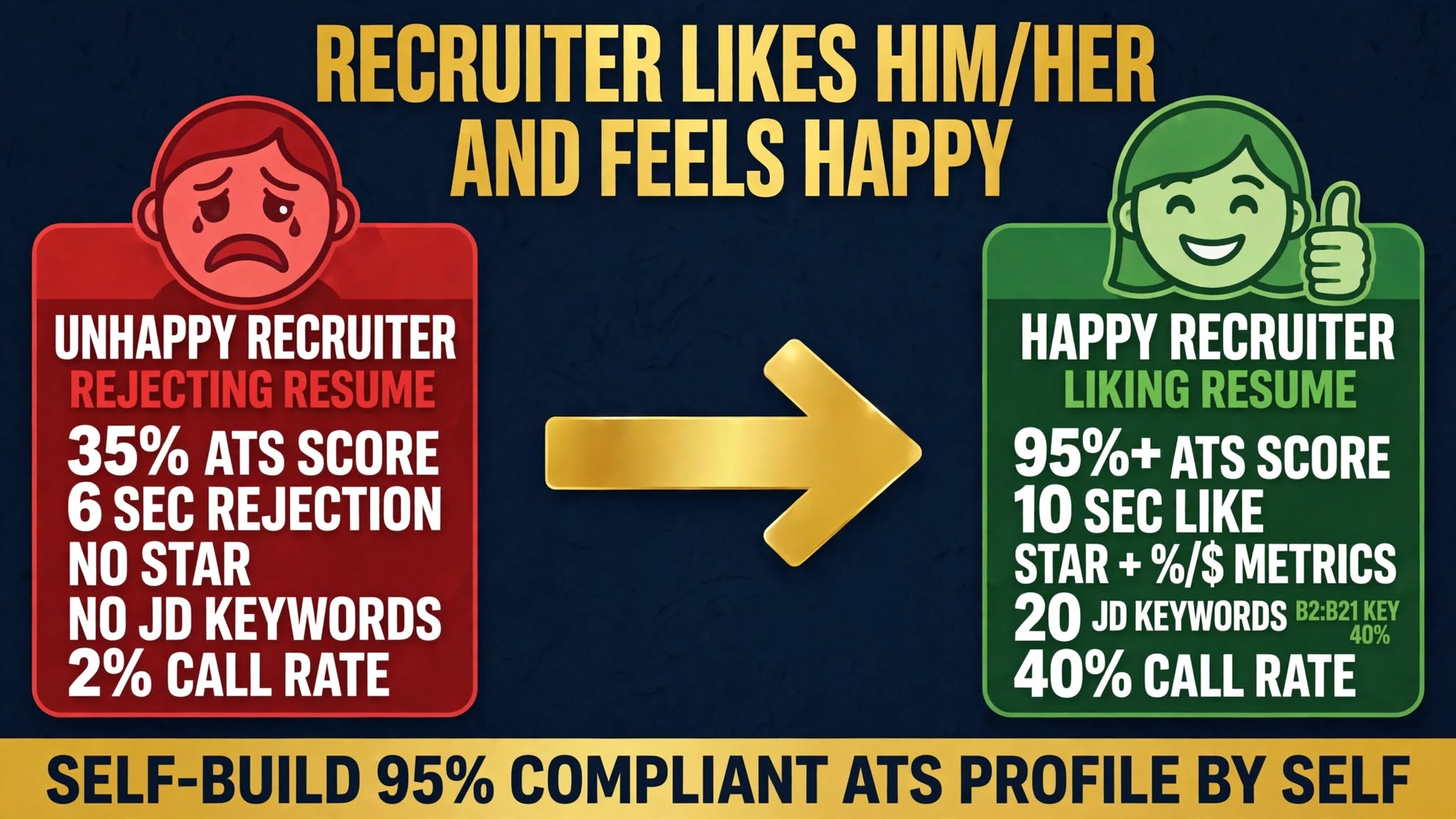
The most effective candidates focus less on application volume and more on application quality.
Use this seven-step framework.
Step 1: Analyze the Job Description
Identify:
- Skills
- Tools
- Responsibilities
- Certifications
- Success metrics
Step 2: Align Keywords
Integrate important terminology naturally throughout the document.
Keywords often drive ATS matching performance.
Step 3: Strengthen Achievements
Replace responsibility statements with measurable outcomes.
Include:
- Percentages
- Revenue impact
- Productivity gains
- Time savings
- Cost reductions
Step 4: Align Skills
Build a skills matrix linking your capabilities directly to employer requirements.
Step 5: Refine the Summary
Customize your value proposition for the target opportunity.
Step 6: Create Supporting Assets
Develop:
- Cover letter
- Optimized LinkedIn profile
- Interview preparation notes
- STAR story bank
Step 7: Review Before Submission
Verify:
- Consistency
- Formatting
- Keyword coverage
- Professional presentation
Every application should pass a final quality check before submission.
Building a Resume System Instead of a Resume
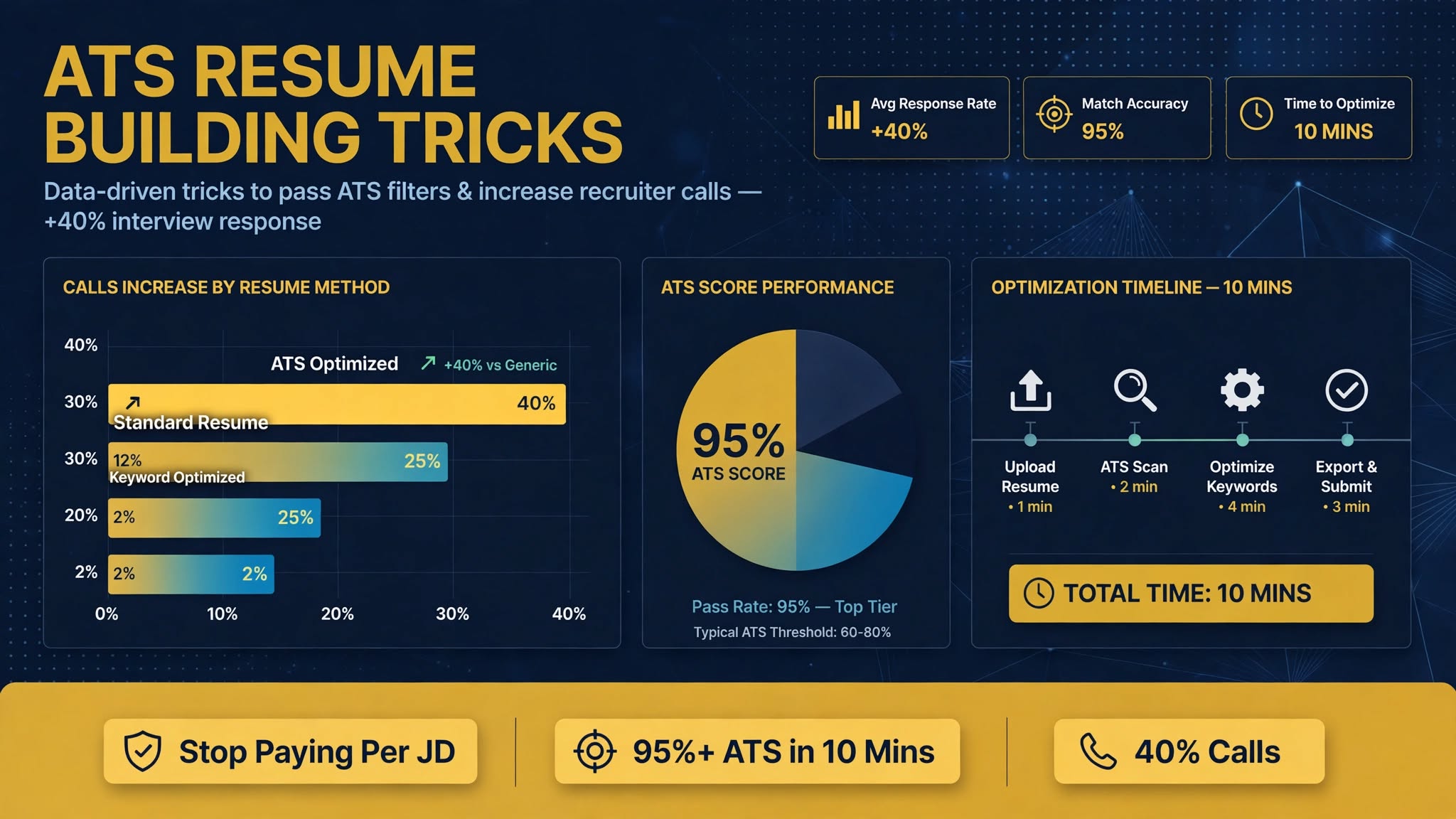
The biggest shift in today’s hiring market is this:
Successful candidates no longer build a single resume.
They build a resume system.
A resume system includes:
Resume Workspace
- Experience repository
- Achievement library
- Skills database
- Project portfolio
Prompt Library
- Achievement generation prompts
- Keyword extraction prompts
- Career-switch prompts
- Summary creation prompts
Application Assets
- Cover letters
- Outreach templates
- LinkedIn optimization resources
- Interview preparation guides
Tracking Tools
- Application tracker
- Interview tracker
- Follow-up tracker
- Version control tracker
This approach creates consistency while dramatically reducing effort.
Who Benefits Most from ATS Optimization?
Technology Professionals
Professionals pursuing:
- AI
- Cloud
- DevOps
- Cybersecurity
- Data Engineering
must continually adapt to changing market requirements.
Career Switchers
Those moving from:
- Teaching
- Sales
- Human Resources
- Finance
- Operations
- Healthcare
can reposition transferable skills more effectively.
Fresh Graduates
Students can transform academic projects into compelling experience narratives.
Laid-Off Professionals
Professionals seeking re-entry into competitive markets can modernize positioning and align with emerging demands.
Experienced Candidates
Professionals with 10-20 years of experience often need to update legacy resumes to reflect current hiring expectations.
The Future Belongs to Candidates Who Can Adapt
The modern hiring process rewards relevance, clarity, and measurable value.
Submitting more applications is not the answer.
Submitting better applications is.
Recruiters and ATS systems are ultimately asking one question:
“Can this candidate solve the problems described in this job description?”
Your resume should answer that question immediately.
Candidates who learn ATS optimization gain:
- Greater visibility
- More recruiter engagement
- Faster application cycles
- Better interview opportunities
- Long-term career resilience
Most importantly, they stop depending on expensive, repeated resume rewrites and develop a skill they can use throughout their careers.
Final Takeaway
ATS optimization is not about gaming the system.
It’s about communicating your value clearly.
The candidates who consistently secure interviews are not always the most qualified. They are often the candidates who present their qualifications in a way that both ATS platforms and recruiters can understand quickly.
Instead of creating a new resume for every opportunity, build a repeatable system.
The investment you make in learning resume optimization today can continue paying dividends across every future career move.