
Building a Bank Fraud Detection AI Solution: From Business Problem to Enterprise AI Product
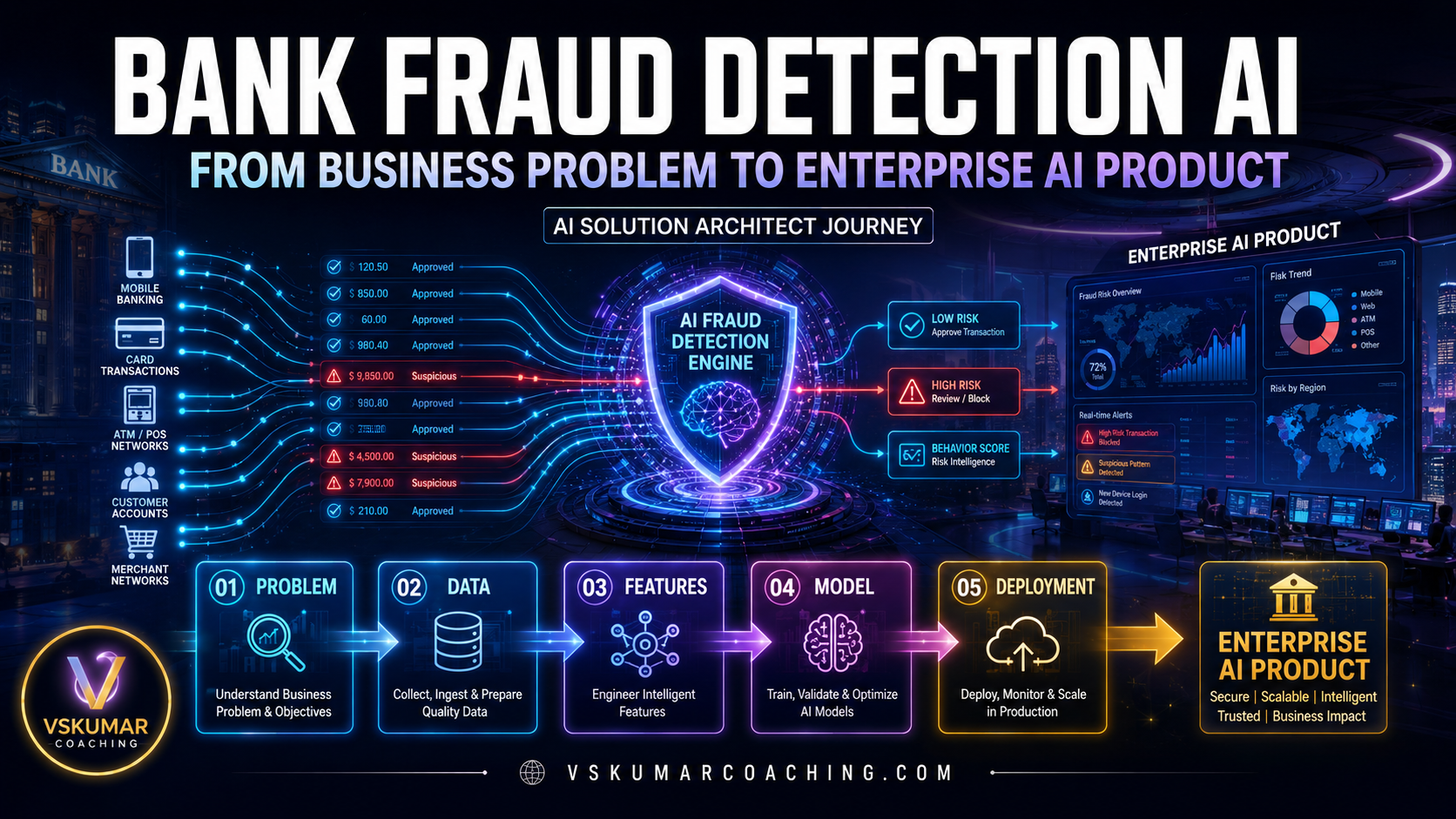
A Practical 5-Layer Journey for the AI Solution Architect
Bank fraud detection is often presented as a machine-learning problem.
Collect transaction data.
Train a classification model.
Predict fraudulent transactions.
But that description misses the bigger challenge.
A bank does not need an AI model simply because it can build one.
It needs an AI capability that can help make better decisions about transactions, operate reliably at scale, protect customers, integrate with existing banking systems, and continuously improve as fraud patterns change.
That changes the architecture completely.
The real journey is:
Business Problem → Decision → Data → Behavioral Intelligence → Model → Operational Integration → Monitoring → Governance → Product
This article presents a practical Bank Fraud Detection AI journey through five core layers:
Layer 1 — Use Case & Problem Definition
Layer 2 — Data Foundation
Layer 3 — Data Preparation & Feature Engineering
Layer 4 — Model Development
Layer 5 — Deployment
The objective is not merely to demonstrate how to build a fraud model.
It is to understand how an AI Solution Architect progressively converts a business problem into an enterprise AI capability.
1. The Starting Point Is Not Fraud — It Is a Business Decision
Imagine a customer initiates a transaction.
The bank needs to determine whether the transaction should proceed normally or receive additional scrutiny.
At first glance, the requirement appears simple:
Detect fraud.
But an architect should immediately ask a deeper question:
What decision should the AI help the bank make?
The answer could involve several possible actions:
Approve → Challenge → Hold → Investigate → Decline
Therefore, the AI system is not simply predicting “fraud.”
It is providing risk intelligence that supports a business decision.
This distinction is fundamental.
If the AI produces a prediction but there is no clear business action associated with that prediction, the organization may have built a technically interesting model without creating a useful business capability.
The first architectural activity is therefore to establish the relationship:
Transaction → Risk Assessment → Decision → Business Action
This is why the first layer focuses on use case and problem definition.
2. Layer 1 — Define the Use Case and Problem
The first challenge is to translate the broad business concern into a well-defined AI use case.
The bank needs to understand:
- What constitutes potentially fraudulent activity?
- Which transaction types are in scope?
- Who consumes the AI decision?
- What happens when risk is detected?
- What level of response is acceptable?
- What are the business consequences of incorrect decisions?
- How will success be measured?
This creates a boundary around the POC.
For example, the initial solution may focus on transaction-level fraud classification rather than attempting to solve every form of financial crime.
That boundary is important.
A well-defined POC creates a controlled environment in which the team can validate the architecture before expanding its scope.
The important architectural insight
Fraud detection is not simply a prediction problem. It is a decision-support problem.
That means business requirements must influence the technical architecture from the beginning.
The first demo in this journey, presented by Bharat on 09 August 2026, explores this foundation.
The goal is to establish what the solution is expected to accomplish before moving into data and model development.
3. Layer 2 — Build the Data Foundation
Once the decision has been defined, the next question becomes:
What evidence would allow the system to make that decision?
This takes us to data.
A fraud detection system may need information about:
Customer → Account → Transaction → Merchant → Device → Location → Channel → Historical Behavior
But simply creating tables with these columns does not create a useful fraud dataset.
The data needs to represent relationships and behavior.
For example, a transaction amount means something different depending on the customer’s historical behavior.
A location becomes more interesting when it is compared with the customer’s normal transaction geography.
A new device becomes a stronger signal when combined with unusual transaction timing and an unexpected merchant.
The value therefore comes from the relationships between data elements.
Synthetic data as an architecture tool
Because real banking data is sensitive and unavailable for this POC, synthetic data becomes an important engineering mechanism.
Python can be used to generate controlled banking datasets that allow us to experiment with the architecture without exposing production information.
But synthetic data should not simply look realistic.
It should also be:
Consistent → Relational → Variable → Reproducible → Testable
An important learning from the POC is that repeated execution should not simply produce the same dataset again.
Different execution cycles should be able to generate different transaction populations and behavioral patterns while preserving the same underlying data standards and business rules.
That makes the synthetic environment useful for testing.
The deeper insight
Synthetic data is not merely a substitute for missing production data. It can become an experimentation framework for validating an AI architecture.
The Layer 2 Python POC demonstrates how this data foundation can be created and evolved.
4. Layer 3 — Transform Transactions Into Behavioral Intelligence
Raw transaction data still does not tell the AI enough.
The next architectural challenge is to represent behavior.
Consider two transactions for the same customer:
Transaction A: ₹5,000 at a familiar merchant from a known device.
Transaction B: ₹5,000 from a new device, unusual location and unusual transaction time.
The transaction amount is identical.
The risk context is not.
This is the purpose of feature engineering.
The objective is to convert individual data points into signals that represent customer and transaction behavior.
Examples include:
- Transaction amount relative to historical behavior
- Transaction frequency
- Velocity of transactions
- Time-of-day patterns
- Geographic deviation
- Device familiarity
- Merchant behavior
- Channel changes
- Historical transaction patterns
The transformation is:
Raw Transaction Data → Context → Behavioral Signal → Feature
This is a critical shift.
The model should not simply see:
Amount = 5,000
It should ideally receive information that helps it understand:
“Is 5,000 normal for this customer under these circumstances?”
The deeper architectural insight
Feature engineering is really behavior engineering.
The architect and data team are deciding how real-world customer behavior will be represented inside the AI system.
That representation can have a major influence on what the model is capable of learning.
5. Layer 4 — Develop the Fraud Detection Model
Once behavioral signals have been created, the solution can move into model development.
This is where machine learning becomes useful.
The basic pipeline is:
Features → Model → Prediction → Evaluation
The model attempts to learn patterns associated with fraudulent and legitimate transactions.
However, fraud detection presents an important challenge.
The Accuracy Trap
Suppose a dataset contains:
99% legitimate transactions
1% fraudulent transactions
A model that predicts almost everything as legitimate could achieve very high accuracy while failing at the actual business objective.
This is why fraud detection requires careful evaluation.
The team must understand:
Precision
How many transactions identified as fraud are actually fraudulent?
Recall
How much of the actual fraud does the model detect?
False Positives
How many legitimate transactions are incorrectly flagged?
False Negatives
How many fraudulent transactions are missed?
These metrics are not merely technical measurements.
They have business consequences.
A false positive can create customer friction.
A false negative can create financial loss.
Therefore:
Model evaluation must be connected to business impact.
This is one of the most important lessons for an AI Solution Architect.
The architect does not need to become a data scientist for every use case, but must understand enough about model behavior to ensure that technical evaluation supports the business objective.
The Layer 4 Model Development demonstration by Bharat on 17 August 2026 provides the practical view of this transition from prepared data to a working fraud detection model.
6. Layer 5 — Deployment Is an Integration Problem
A model that works in a notebook is not yet a banking capability.
The next question is:
How does the model participate in the actual transaction journey?
This is where deployment begins.
A simplified architecture might look like:
Customer Transaction
↓
Banking Application
↓
Fraud Detection Service / API
↓
ML Model
↓
Risk Prediction
↓
Business Decision
But deployment is not simply placing a model on a server.
The model has to interact with the wider enterprise environment.
The architecture must consider:
APIs
How applications communicate with the AI service.
Infrastructure
Where the model runs and how resources are managed.
Scalability
What happens when transaction volumes increase?
Reliability
What happens if the AI service becomes unavailable?
Security
How is sensitive transaction information protected?
Observability
How do teams know whether the system is operating correctly?
Latency
How quickly must a fraud decision be produced?
Governance
How is the model’s behavior controlled and audited?
This creates a much broader architecture:
Model → API → Application → Infrastructure → Security → Monitoring → Governance → Business Operations
The deeper insight
AI deployment is not primarily a hosting problem. It is an integration problem.
The model must become part of the organization’s technology and business ecosystem.
The Layer 5 Deployment demonstration by Bharat explores this transition from a developed model toward an operational AI capability.
7. What Happens After Deployment?
Deployment is not the end of the AI lifecycle.
In fact, it creates a new responsibility:
Observe → Learn → Improve
Fraud patterns change.
Customer behavior changes.
Attack techniques change.
Transaction volumes change.
Therefore, a model that performs well today may behave differently tomorrow.
This introduces the need for continuous monitoring.
Monitoring should consider more than infrastructure availability.
We need to understand:
Is the service available?
Are predictions being generated within the required latency?
Has the input data changed?
Has model performance changed?
Is fraud prevalence changing?
Are false positives increasing?
Are certain customer segments being affected disproportionately?
Is the model drifting away from the environment in which it was trained?
This is where MLOps and model monitoring become important.
The operational loop becomes:
Deploy → Observe → Evaluate → Detect Change → Retrain / Adjust → Validate → Redeploy
This creates a feedback loop rather than a one-time deployment.
8. Governance Is Part of the Architecture
A banking AI system cannot be treated like an ordinary application.
The system may influence decisions that affect customers and financial transactions.
Therefore, governance needs to be considered throughout the lifecycle.
Important questions include:
- Where did the training data originate?
- Which version of the model made a decision?
- Can predictions be traced?
- How are model changes approved?
- How is performance monitored?
- What happens when the model is uncertain?
- Who is accountable for the AI-supported decision?
- How are security and privacy requirements enforced?
This creates another important architectural principle:
Governance should not be added after the AI system is built. Governance should be designed into the architecture.
The production solution therefore becomes:
Data + Model + Application + Infrastructure + Security + Governance + Monitoring
rather than simply:
Model + API
9. From Fraud Detection POC to Enterprise AI Product
At this point, the five layers have established the foundation:
Problem → Data → Features → Model → Deployment
But an enterprise product requires another level of maturity.
The solution may eventually need:
Real-Time Processing
for high-volume transaction decisions.
MLOps
for controlled model lifecycle management.
Model Monitoring
for continuous performance observation.
Drift Detection
for identifying changes in data or behavior.
Governance
for accountability, traceability and controlled change.
Explainability
for understanding important model decisions.
Human-in-the-Loop
for cases requiring investigation or additional judgment.
Security
for protecting financial and customer information.
Continuous Learning
for adapting to changing fraud patterns.
Business Integration
for connecting predictions to operational workflows.
This is where the architecture moves from:
Proof of Concept → Production Capability → Enterprise AI Product
The ultimate objective is not to prove that a machine-learning algorithm can detect fraud.
It is to build a capability that can operate, adapt, scale and create measurable business value.
10. The AI Solution Architect’s Real Responsibility
The five layers reveal something important about the AI Solution Architect role.
The architect is not simply responsible for selecting technology.
The architect must maintain the end-to-end connection between business intent and technical implementation.
That means understanding how:
Business Decision
becomes
AI Use Case
which requires
Data
which becomes
Behavioral Features
which support
Model Intelligence
which must operate through
Applications and Infrastructure
while being protected by
Security and Governance
and continuously improved through
Monitoring and Feedback
This is systems thinking applied to AI.
The AI Solution Architect is effectively designing the ecosystem around intelligence, not just the intelligence itself.
11. What This POC Teaches Beyond Fraud Detection
Although this journey uses bank fraud detection as the example, the architecture pattern is reusable.
Consider other enterprise AI problems:
Customer Churn
Credit Risk
Insurance Claims
Predictive Maintenance
Healthcare Risk Prediction
Supply Chain Anomaly Detection
Cybersecurity Detection
The domain changes.
The architectural thinking remains remarkably similar.
The architect still needs to answer:
What decision are we improving?
What evidence is required?
How do we represent the relevant behavior?
How will intelligence be developed?
How will it integrate with the enterprise?
How will it be monitored and governed?
How will it continuously improve?
That is why learning through a complete use case can be more valuable than learning isolated AI tools.
12. Keep Revisiting — The Product-Building Journey Continues
The five-layer Bank Fraud Detection POC establishes the foundation of the solution.
But the journey does not end here.
We will continue expanding this use case toward a complete enterprise AI product-building solution.
Future stages can progressively explore:
Production Architecture → Real-Time Processing → MLOps → Monitoring → Governance → Security → Explainability → Business Integration → Continuous Learning → Productization
The practical demonstrations associated with this journey are available at the bottom of this article.
Keep revisiting this article as new demonstrations, architecture components and product-building capabilities are added.
The goal is to show the complete journey:
DEFINE → BUILD → ENGINEER → DEVELOP → DEPLOY → MONITOR → GOVERN → PRODUCTIZE
13. Scale Up Into AI Roles
There is another important lesson in this journey.
You do not necessarily need to start your career again to move into AI.
Your existing experience can become your foundation.
An IT professional with Cloud experience can build toward AI Cloud Architecture.
A DevOps professional can move toward MLOps and AI Platform Engineering.
A Data professional can move toward Data & AI Architecture.
An Application Architect can move toward AI Solution Architecture.
A technology leader can move toward Enterprise AI Transformation.
The journey can be:
Current Role → Skills Gap Identification → AI Upskilling → Hands-on POCs → AI Architecture → Governance → Role Positioning → AI Role
This is the philosophy behind VSKUMARCOACHING.
The objective is not simply to teach AI tools.
It is to help professionals learn how to apply AI to business problems, build practical POCs, understand enterprise architecture and demonstrate the capabilities required for AI-era roles.
Potential career directions include:
AI Solution Architect | AI Architect | AI Engineer | AI/ML Engineering Lead | Data & AI Architect | AI Governance | Enterprise AI Transformation
Scale Up. Don’t Start Over.
Your existing IT, Cloud, DevOps, Data, Application, Architecture or Leadership experience can become the foundation for your AI transition.
VSKUMARCOACHING.COM
Helping professionals Scale Up into AI Roles through structured AI mentoring, hands-on enterprise POCs and AI Solution Architecture thinking.
Conclusion
A Bank Fraud Detection AI solution is much more than a machine-learning model.
It is a connected system of:
Business Decisions + Data + Behavioral Intelligence + Models + Applications + Infrastructure + Security + Governance + Monitoring
The five-layer journey provides a practical way to understand how those pieces come together.
The most important lesson is this:
Don’t build AI in isolation. Architect the complete journey from business problem to business value.
Start with the decision.
Build the right data foundation.
Represent behavior intelligently.
Develop the model with business-aware evaluation.
Integrate it into the enterprise.
Monitor what happens in production.
Govern the capability.
Learn from the feedback.
And continuously evolve the solution into a product.
That is the journey from:
Business Problem → AI Solution → Enterprise AI Capability → AI Product
And this Bank Fraud Detection use case is only the beginning.
Keep revisiting as we continue building the complete solution.
About the Author
Shanthi Kumar V
AI Solution Architect | AI Governance | Enterprise AI Transformation | AI Career Mentor
VSKUMARCOACHING.COM
Helping technology professionals Scale Up into AI Roles through structured AI mentoring, hands-on enterprise POCs and AI Solution Architecture thinking.
Follow the AI Solution Architect Playbook for more practical enterprise AI journeys.
Like | Share | Comment | Follow
#BankFraudDetection #FraudDetectionAI #AISolutionArchitect #AIArchitecture #BankingAI #MachineLearning #AIEngineering #MLOps #EnterpriseAI #AIProduct #FraudDetectionModel #VSKUMARCOACHING #ScaleUpIntoAI #AIRoles #AICareer
All the demos can be seen on my youtube channel:
https://www.youtube.com/@vskumarcoaching/videos

