
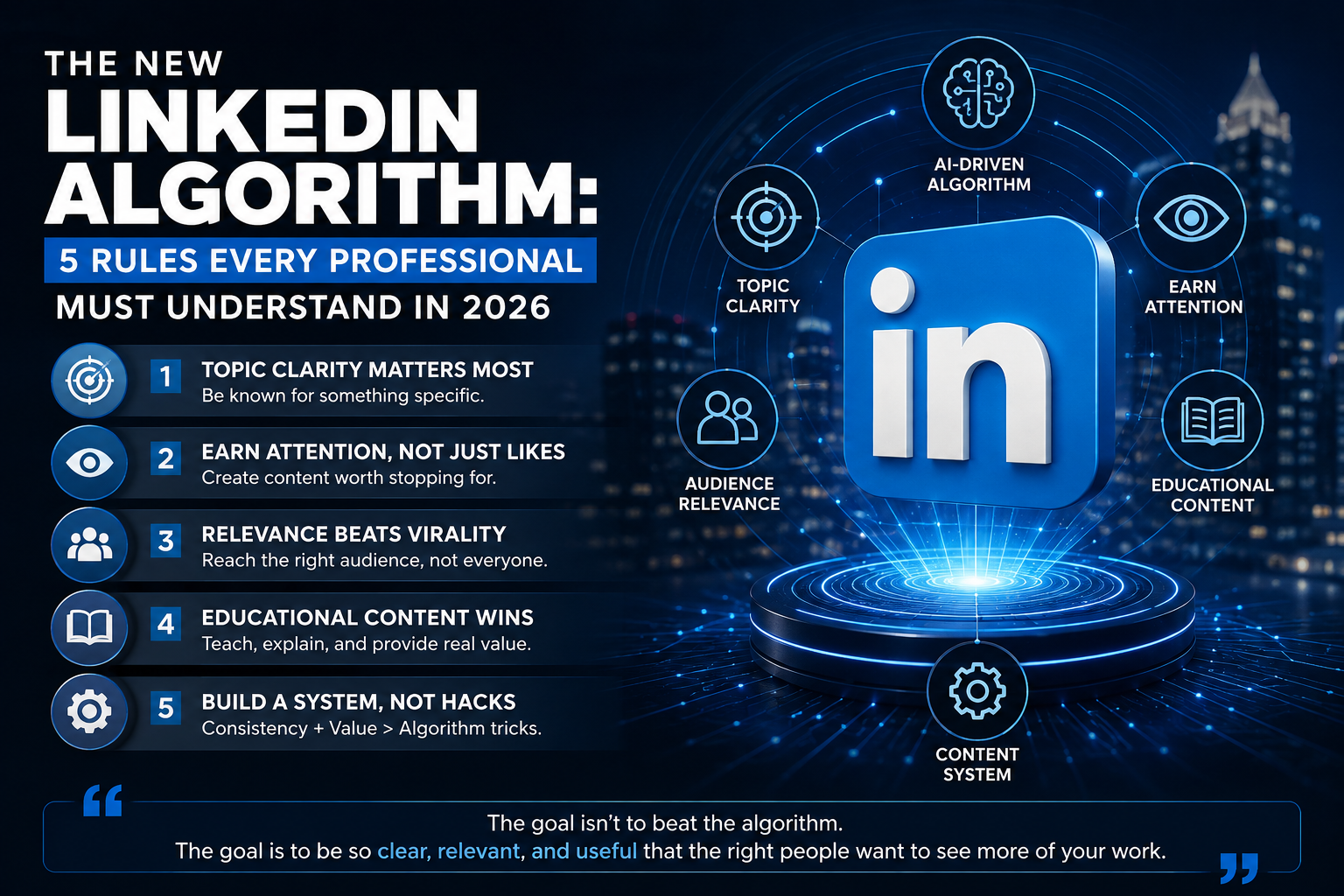
The New LinkedIn Algorithm: 5 Rules Every Professional Must Understand in 2026
For years, the LinkedIn growth playbook was simple:
Post more.
Use hashtags.
Grow your network.
Get likes and comments.
Repeat.
But LinkedIn has changed.
The platform is increasingly using AI-driven systems to understand content, determine relevance, personalize the Feed, and decide which content is worth surfacing to individual members.
That means the old question—
“How do I get more LinkedIn reach?”
—is becoming less useful.
A better question is:
“How do I create content that LinkedIn can understand, the right audience finds relevant, and professionals find valuable?”
That shift is especially important for consultants, executives, technology leaders, coaches, founders, and subject-matter experts.
Because your objective should not simply be visibility.
It should be professional authority.
Here are five rules every professional should understand about LinkedIn in 2026.
Rule 1: Topic Clarity Matters More Than Ever
The first mistake professionals make is trying to talk about everything.
One day:
AI.
The next day:
Leadership.
Then:
Motivation.
Then:
Politics.
Then:
Career advice.
Then:
A personal photograph.
Then:
A random industry news story.
There is nothing inherently wrong with any individual post.
The problem is what happens when someone looks at your content as a whole.
What exactly are you known for?
In 2026, this question matters more because LinkedIn’s Feed systems are increasingly designed to understand the meaning and relevance of content.
LinkedIn has described its next-generation Feed as using large language models and transformer-based systems to retrieve and rank content based on relevance, personalization, and timeliness.
That means content is increasingly being understood semantically.
In simple terms:
LinkedIn is getting better at understanding what your content actually means.
That creates an opportunity.
If you consistently talk about a clear professional subject, your content creates a stronger identity.
For example:
Enterprise AI Transformation
could include:
- AI strategy
- AI governance
- Agentic AI
- AI architecture
- AI economics
- AI workforce transformation
These topics are different, but they belong to a coherent professional territory.
Compare that with:
- AI
- Cricket
- Motivation
- Politics
- Travel
- Leadership
- Cryptocurrency
- Career advice
The second profile may have interesting content.
But the professional positioning is unclear.
The Topic Clarity Test
Ask yourself:
If someone read my last 10 posts, what would they say I am an expert in?
If the answer isn’t obvious, your content needs a clearer center.
You don’t need one topic.
You need one recognizable area of authority.
Rule 2: Stop Chasing Likes. Start Earning Attention.
Likes are visible.
That makes them psychologically powerful.
You publish something.
You refresh the page.
Twenty likes.
Fifty likes.
Two hundred likes.
It feels like progress.
But likes don’t necessarily tell you whether the content created professional value.
Imagine two posts.
Post A
AI is transforming every industry. The future belongs to those who embrace AI.
1,000 likes.
Post B
Before deploying an AI agent into a customer-facing workflow, answer these seven governance questions.
200 likes.
Which demonstrates more expertise?
Which would a CIO save?
Which might a transformation leader share with a colleague?
Which could generate a serious business conversation?
Probably the second.
That is why professionals need to move beyond reaction metrics.
LinkedIn has publicly discussed dwell time—how long members spend consuming Feed content—as part of its ranking work. Its engineering team has described using predictions of very short dwell time as a negative signal.
The practical lesson is not:
“Make your posts longer.”
It is:
Make your content worth stopping for.
A strong post earns attention through:
- A compelling opening
- A real problem
- A surprising observation
- A useful framework
- A practical example
- A strong point of view
- A visual explanation
Don’t manufacture attention.
Earn it.
Rule 3: Relevance Beats Random Virality
This may be one of the most important lessons for professionals building a personal brand.
A post can go viral and still be strategically useless.
Imagine you publish a humorous post about workplace culture.
It gets:
100,000 impressions.
5,000 reactions.
1,000 comments.
You celebrate.
But your actual business is enterprise AI consulting.
The people who engaged may have no interest in:
- AI transformation
- AI governance
- AI architecture
- Enterprise automation
- Technology strategy
Your next post about AI governance receives only 2,000 impressions.
You conclude:
“LinkedIn doesn’t like my content anymore.”
Maybe that’s not the problem.
Perhaps you trained your audience to expect something completely different.
This is why audience relevance matters.
You don’t necessarily need the largest possible audience.
You need the right audience.
For example, if you want to reach:
- CIOs
- CTOs
- CHROs
- AI leaders
- Enterprise architects
- Transformation executives
then your content should repeatedly address problems these people care about.
Instead of:
“AI agents are the future.”
Try:
“Your AI agent may be technically autonomous, but your organization may still have no idea who is accountable when it makes a bad decision.”
Now you’ve moved from technology hype to an executive problem.
That creates relevance.
Reach Is Not the Same as Authority
Think about these two metrics:
100,000 irrelevant impressions
versus
5,000 highly relevant impressions
For a professional building a consulting practice, career reputation, or executive brand, the second may be considerably more valuable.
The goal isn’t maximum visibility.
It is:
Maximum relevant visibility.
Rule 4: Educational Content Can Turn Expertise Into a Growth Asset
There is a major opportunity for professionals who know something deeply but struggle to communicate it simply.
Your expertise may take years to develop.
But the reader may give you only a few seconds of attention.
That is where educational content becomes powerful.
Instead of simply expressing an opinion, create something people can use.
For example:
A Framework
The 5 Levels of Enterprise AI Maturity
A Checklist
10 Questions Before Deploying an AI Agent
A Diagram
LLM → Context → Agent → Business Action
A Comparison
Traditional Automation vs Agentic Automation
A Maturity Model
AI Experimentation → Production → Governance → Scale
A Decision Framework
Should This Business Process Be Automated With AI?
These formats turn knowledge into reusable assets.
And reusable assets are more likely to be:
- Read
- Saved
- Shared
- Referenced
- Discussed
This is particularly important on LinkedIn because professional audiences are often looking for information they can take back to their organization.
Why Visuals Matter
A strong visual can communicate a complicated concept faster than several paragraphs of text.
Imagine an executive reading:
“Enterprise AI requires a context layer between the foundation model and the business process so that organizational data, policies, permissions, workflows, and business rules can influence the agent’s decisions.”
That’s useful.
But imagine a visual:
ENTERPRISE SYSTEMS
↓
CONTEXT LAYER
Data
Policies
Permissions
Business Rules
Workflows
↓
AI AGENT
↓
BUSINESS ACTION
The idea becomes immediately understandable.
That is the power of educational visualization.
The visual isn’t decoration.
It is knowledge compression.
Rule 5: Build a Content System Instead of Chasing Algorithm Hacks
The final rule may be the most important.
The algorithm will change.
Today there is a particular ranking model.
Tomorrow there will be another.
There will always be new advice about:
- Posting times
- Hashtags
- Formats
- Frequency
- Engagement
- Video
- Images
- Links
If your entire strategy depends on one algorithm trick, your strategy is fragile.
Instead, build a system around principles that are much more durable.
Start With Your Authority Territory
Choose three to five connected areas.
For example:
Primary Territory: Enterprise AI Transformation
Supporting themes:
- AI Strategy
- AI Governance
- Agentic AI
- AI Economics
- AI Workforce Transformation
Now you have a content ecosystem.
Turn One Idea Into Multiple Content Assets
Suppose your core insight is:
AI agents need governance before autonomy.
That single idea can become:
LinkedIn Post
Why AI autonomy without governance creates enterprise risk.
Visual
5 Controls Every AI Agent Needs
Carousel
How to Govern an Enterprise AI Agent
Article
The Agentic AI Governance Gap
Video
Why Your AI Agent Needs Governance Before Autonomy
Executive Checklist
Questions CIOs Should Ask Before Approving AI Agents
One idea.
Multiple formats.
That is a content system.
The New LinkedIn Content Equation
Forget:
More Posts + More Hashtags + More Likes = More Success
Think instead:
Topic Clarity
Audience Relevance
Attention
Useful Knowledge
Original Perspective
Consistent Positioning
=
Professional Authority
This is a much more sustainable approach.
What About Hashtags?
Hashtags are not the foundation of your strategy.
They cannot rescue unclear content.
If your post is about enterprise AI governance, the topic should already be clear from the:
- Headline
- Opening
- Language
- Examples
- Structure
- Visual
- Profile positioning
Use hashtags where they make sense.
But don’t confuse hashtags with strategy.
Your content should stand on its own.
What About Posting Every Day?
Posting every day isn’t automatically a winning strategy.
If you publish seven weak posts, you’ve created seven opportunities for people to ignore you.
If you publish three strong posts that demonstrate real expertise, you may create a much stronger professional impression.
The question isn’t:
“How much can I publish?”
It is:
“How consistently can I create something worth consuming?”
Quality and consistency should work together.
The AI Content Problem
There is another major development professionals need to recognize.
AI has dramatically reduced the cost of creating content.
Today, almost anyone can generate:
- LinkedIn posts
- Articles
- Headlines
- Carousels
- Images
- Scripts
- Comments
That means generic content is becoming abundant.
The scarce resource is no longer content.
It is:
Original thinking.
Consider these two statements.
Generic
AI will transform businesses and create new opportunities.
Experience-driven
Many enterprises are trying to automate individual tasks with AI before redesigning the operating model around those capabilities. The result is more AI tools—but not necessarily more business value.
The second has a point of view.
It sounds like someone who has thought about the problem.
That is the direction professionals should move toward.
Use AI to:
- Structure
- Research
- Edit
- Repurpose
- Visualize
- Improve clarity
But keep the most valuable part human:
Your judgment.
Your LinkedIn Profile and Content Must Tell the Same Story
Your content doesn’t operate independently from your profile.
Someone discovers your post.
They become curious.
They visit your profile.
What do they see?
Your:
- Headline
- About section
- Experience
- Featured section
- Articles
- Newsletter
- Recent posts
should reinforce the same professional story.
For example:
If your headline says:
Enterprise AI Transformation Advisor
but your content is primarily motivational quotes, there is a positioning gap.
But if your profile and content consistently demonstrate:
AI Strategy + AI Governance + Agentic AI + Enterprise Transformation
your authority becomes much easier to understand.
Don’t Chase Virality. Build Recognition.
There is nothing wrong with a viral post.
But virality should not become the objective.
Imagine someone sees one of your posts today.
Then another next week.
Then a visual the following week.
Then an article a month later.
Eventually they think:
“This person really understands enterprise AI transformation.”
That is recognition.
Recognition creates authority.
Authority creates trust.
Trust creates conversations.
Conversations create opportunities.
That is a much more valuable long-term outcome than a single viral post.
Your 2026 LinkedIn Strategy in Five Rules
If you remember nothing else from this article, remember these five rules:
1. Be clear about what you know.
Don’t make people guess what you are an expert in.
2. Earn attention.
Don’t optimize only for likes. Create content people want to consume.
3. Prioritize relevance.
The right audience matters more than an impressive but irrelevant reach number.
4. Teach something useful.
Turn your expertise into frameworks, examples, visuals, checklists, and practical insights.
5. Build a system.
Don’t depend on algorithm hacks. Build a repeatable content engine around expertise, relevance, and value.
Final Thought
The LinkedIn algorithm will continue to evolve.
That is inevitable.
But you don’t need to understand every technical detail of the algorithm to build a powerful professional presence.
You need to understand the fundamentals.
Be clear.
Be relevant.
Earn attention.
Teach something useful.
Demonstrate original thinking.
Stay consistent.
The opportunity in 2026 is bigger than simply getting more impressions.
It is the opportunity to make your expertise discoverable beyond the people who already know you.
LinkedIn’s next-generation Feed is designed to retrieve and rank content using AI-based systems that understand content and member relevance. That makes clarity and meaningful professional value increasingly important to anyone trying to build authority on the platform.
So don’t ask:
“How do I beat the LinkedIn algorithm?”
Ask:
“How do I become so clear, relevant, and useful that the right people want to see more of my work?”
That is the real LinkedIn strategy for 2026.
Build expertise.
Package it well.
Teach consistently.
Become recognizable.
And let your professional authority compound.
The LinkedIn Pre-Publish Checklist: 100+ Questions | LinkedIn

