Monthly Archives: August 2026

Building a Bank Fraud Detection AI Solution: From Business Problem to Enterprise AI Product

Building a Bank Fraud Detection AI Solution: From Business Problem to Enterprise AI Product
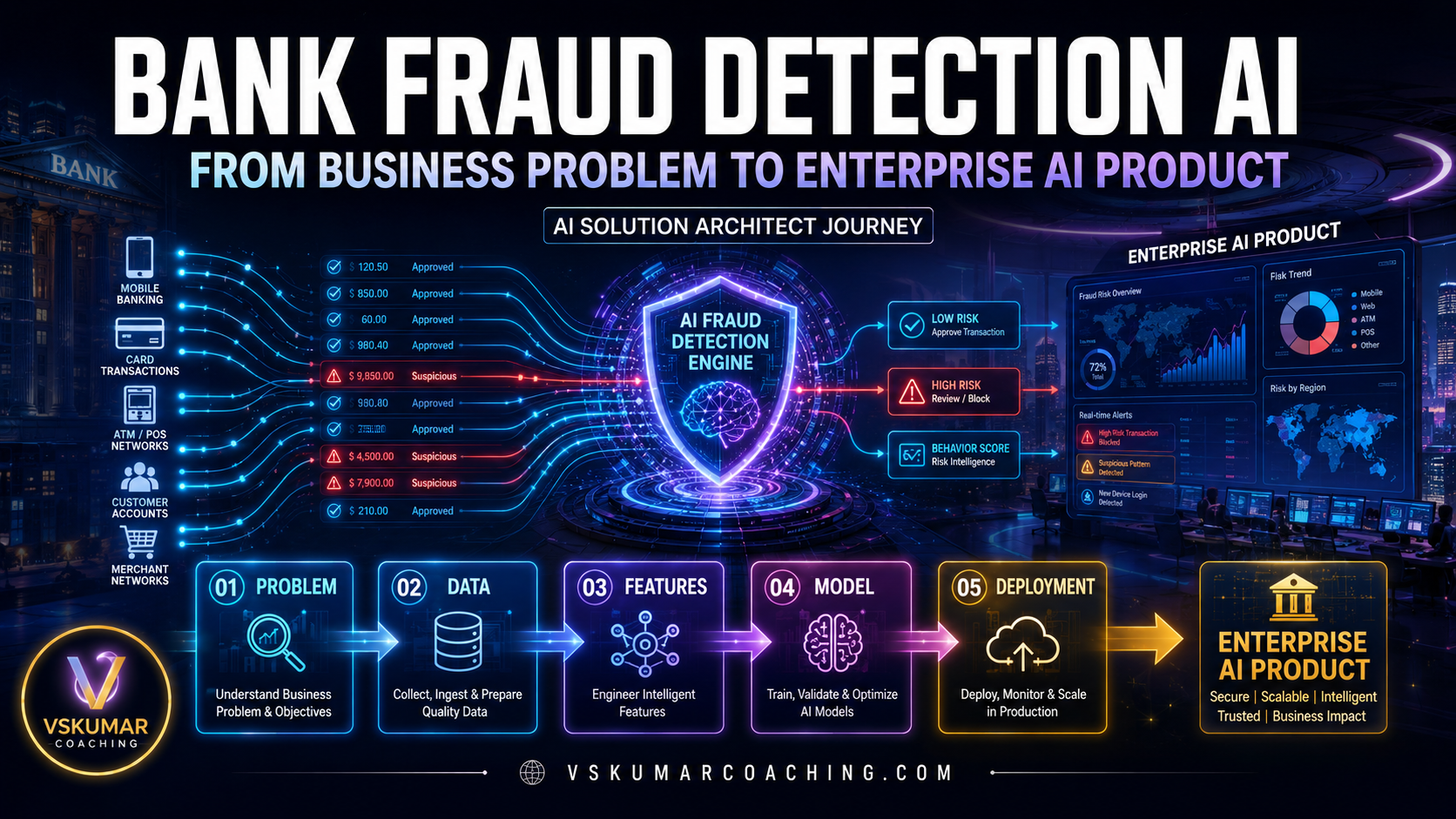
A Practical 5-Layer Journey for the AI Solution Architect

Bank fraud detection is often presented as a machine-learning problem.

Collect transaction data.
Train a classification model.
Predict fraudulent transactions.

But that description misses the bigger challenge.

A bank does not need an AI model simply because it can build one.

It needs an AI capability that can help make better decisions about transactions, operate reliably at scale, protect customers, integrate with existing banking systems, and continuously improve as fraud patterns change.

That changes the architecture completely.

The real journey is:

Business Problem β†’ Decision β†’ Data β†’ Behavioral Intelligence β†’ Model β†’ Operational Integration β†’ Monitoring β†’ Governance β†’ Product

This article presents a practical Bank Fraud Detection AI journey through five core layers:

Layer 1 β€” Use Case & Problem Definition
Layer 2 β€” Data Foundation
Layer 3 β€” Data Preparation & Feature Engineering
Layer 4 β€” Model Development
Layer 5 β€” Deployment

The objective is not merely to demonstrate how to build a fraud model.

It is to understand how an AI Solution Architect progressively converts a business problem into an enterprise AI capability.


1. The Starting Point Is Not Fraud β€” It Is a Business Decision

Imagine a customer initiates a transaction.

The bank needs to determine whether the transaction should proceed normally or receive additional scrutiny.

At first glance, the requirement appears simple:

Detect fraud.

But an architect should immediately ask a deeper question:

What decision should the AI help the bank make?

The answer could involve several possible actions:

Approve β†’ Challenge β†’ Hold β†’ Investigate β†’ Decline

Therefore, the AI system is not simply predicting β€œfraud.”

It is providing risk intelligence that supports a business decision.

This distinction is fundamental.

If the AI produces a prediction but there is no clear business action associated with that prediction, the organization may have built a technically interesting model without creating a useful business capability.

The first architectural activity is therefore to establish the relationship:

Transaction β†’ Risk Assessment β†’ Decision β†’ Business Action

This is why the first layer focuses on use case and problem definition.


2. Layer 1 β€” Define the Use Case and Problem

The first challenge is to translate the broad business concern into a well-defined AI use case.

The bank needs to understand:

  • What constitutes potentially fraudulent activity?
  • Which transaction types are in scope?
  • Who consumes the AI decision?
  • What happens when risk is detected?
  • What level of response is acceptable?
  • What are the business consequences of incorrect decisions?
  • How will success be measured?

This creates a boundary around the POC.

For example, the initial solution may focus on transaction-level fraud classification rather than attempting to solve every form of financial crime.

That boundary is important.

A well-defined POC creates a controlled environment in which the team can validate the architecture before expanding its scope.

The important architectural insight

Fraud detection is not simply a prediction problem. It is a decision-support problem.

That means business requirements must influence the technical architecture from the beginning.

The first demo in this journey, presented by Bharat on 09 August 2026, explores this foundation.

The goal is to establish what the solution is expected to accomplish before moving into data and model development.


3. Layer 2 β€” Build the Data Foundation

Once the decision has been defined, the next question becomes:

What evidence would allow the system to make that decision?

This takes us to data.

A fraud detection system may need information about:

Customer β†’ Account β†’ Transaction β†’ Merchant β†’ Device β†’ Location β†’ Channel β†’ Historical Behavior

But simply creating tables with these columns does not create a useful fraud dataset.

The data needs to represent relationships and behavior.

For example, a transaction amount means something different depending on the customer’s historical behavior.

A location becomes more interesting when it is compared with the customer’s normal transaction geography.

A new device becomes a stronger signal when combined with unusual transaction timing and an unexpected merchant.

The value therefore comes from the relationships between data elements.

Synthetic data as an architecture tool

Because real banking data is sensitive and unavailable for this POC, synthetic data becomes an important engineering mechanism.

Python can be used to generate controlled banking datasets that allow us to experiment with the architecture without exposing production information.

But synthetic data should not simply look realistic.

It should also be:

Consistent β†’ Relational β†’ Variable β†’ Reproducible β†’ Testable

An important learning from the POC is that repeated execution should not simply produce the same dataset again.

Different execution cycles should be able to generate different transaction populations and behavioral patterns while preserving the same underlying data standards and business rules.

That makes the synthetic environment useful for testing.

The deeper insight

Synthetic data is not merely a substitute for missing production data. It can become an experimentation framework for validating an AI architecture.

The Layer 2 Python POC demonstrates how this data foundation can be created and evolved.


4. Layer 3 β€” Transform Transactions Into Behavioral Intelligence

Raw transaction data still does not tell the AI enough.

The next architectural challenge is to represent behavior.

Consider two transactions for the same customer:

Transaction A: β‚Ή5,000 at a familiar merchant from a known device.

Transaction B: β‚Ή5,000 from a new device, unusual location and unusual transaction time.

The transaction amount is identical.

The risk context is not.

This is the purpose of feature engineering.

The objective is to convert individual data points into signals that represent customer and transaction behavior.

Examples include:

  • Transaction amount relative to historical behavior
  • Transaction frequency
  • Velocity of transactions
  • Time-of-day patterns
  • Geographic deviation
  • Device familiarity
  • Merchant behavior
  • Channel changes
  • Historical transaction patterns

The transformation is:

Raw Transaction Data β†’ Context β†’ Behavioral Signal β†’ Feature

This is a critical shift.

The model should not simply see:

Amount = 5,000

It should ideally receive information that helps it understand:

β€œIs 5,000 normal for this customer under these circumstances?”

The deeper architectural insight

Feature engineering is really behavior engineering.

The architect and data team are deciding how real-world customer behavior will be represented inside the AI system.

That representation can have a major influence on what the model is capable of learning.


5. Layer 4 β€” Develop the Fraud Detection Model

Once behavioral signals have been created, the solution can move into model development.

This is where machine learning becomes useful.

The basic pipeline is:

Features β†’ Model β†’ Prediction β†’ Evaluation

The model attempts to learn patterns associated with fraudulent and legitimate transactions.

However, fraud detection presents an important challenge.

The Accuracy Trap

Suppose a dataset contains:

99% legitimate transactions
1% fraudulent transactions

A model that predicts almost everything as legitimate could achieve very high accuracy while failing at the actual business objective.

This is why fraud detection requires careful evaluation.

The team must understand:

Precision

How many transactions identified as fraud are actually fraudulent?

Recall

How much of the actual fraud does the model detect?

False Positives

How many legitimate transactions are incorrectly flagged?

False Negatives

How many fraudulent transactions are missed?

These metrics are not merely technical measurements.

They have business consequences.

A false positive can create customer friction.

A false negative can create financial loss.

Therefore:

Model evaluation must be connected to business impact.

This is one of the most important lessons for an AI Solution Architect.

The architect does not need to become a data scientist for every use case, but must understand enough about model behavior to ensure that technical evaluation supports the business objective.

The Layer 4 Model Development demonstration by Bharat on 17 August 2026 provides the practical view of this transition from prepared data to a working fraud detection model.


6. Layer 5 β€” Deployment Is an Integration Problem

A model that works in a notebook is not yet a banking capability.

The next question is:

How does the model participate in the actual transaction journey?

This is where deployment begins.

A simplified architecture might look like:

Customer Transaction
↓
Banking Application
↓
Fraud Detection Service / API
↓
ML Model
↓
Risk Prediction
↓
Business Decision

But deployment is not simply placing a model on a server.

The model has to interact with the wider enterprise environment.

The architecture must consider:

APIs

How applications communicate with the AI service.

Infrastructure

Where the model runs and how resources are managed.

Scalability

What happens when transaction volumes increase?

Reliability

What happens if the AI service becomes unavailable?

Security

How is sensitive transaction information protected?

Observability

How do teams know whether the system is operating correctly?

Latency

How quickly must a fraud decision be produced?

Governance

How is the model’s behavior controlled and audited?

This creates a much broader architecture:

Model β†’ API β†’ Application β†’ Infrastructure β†’ Security β†’ Monitoring β†’ Governance β†’ Business Operations

The deeper insight

AI deployment is not primarily a hosting problem. It is an integration problem.

The model must become part of the organization’s technology and business ecosystem.

The Layer 5 Deployment demonstration by Bharat explores this transition from a developed model toward an operational AI capability.


7. What Happens After Deployment?

Deployment is not the end of the AI lifecycle.

In fact, it creates a new responsibility:

Observe β†’ Learn β†’ Improve

Fraud patterns change.

Customer behavior changes.

Attack techniques change.

Transaction volumes change.

Therefore, a model that performs well today may behave differently tomorrow.

This introduces the need for continuous monitoring.

Monitoring should consider more than infrastructure availability.

We need to understand:

Is the service available?

Are predictions being generated within the required latency?

Has the input data changed?

Has model performance changed?

Is fraud prevalence changing?

Are false positives increasing?

Are certain customer segments being affected disproportionately?

Is the model drifting away from the environment in which it was trained?

This is where MLOps and model monitoring become important.

The operational loop becomes:

Deploy β†’ Observe β†’ Evaluate β†’ Detect Change β†’ Retrain / Adjust β†’ Validate β†’ Redeploy

This creates a feedback loop rather than a one-time deployment.


8. Governance Is Part of the Architecture

A banking AI system cannot be treated like an ordinary application.

The system may influence decisions that affect customers and financial transactions.

Therefore, governance needs to be considered throughout the lifecycle.

Important questions include:

  • Where did the training data originate?
  • Which version of the model made a decision?
  • Can predictions be traced?
  • How are model changes approved?
  • How is performance monitored?
  • What happens when the model is uncertain?
  • Who is accountable for the AI-supported decision?
  • How are security and privacy requirements enforced?

This creates another important architectural principle:

Governance should not be added after the AI system is built. Governance should be designed into the architecture.

The production solution therefore becomes:

Data + Model + Application + Infrastructure + Security + Governance + Monitoring

rather than simply:

Model + API


9. From Fraud Detection POC to Enterprise AI Product

At this point, the five layers have established the foundation:

Problem β†’ Data β†’ Features β†’ Model β†’ Deployment

But an enterprise product requires another level of maturity.

The solution may eventually need:

Real-Time Processing

for high-volume transaction decisions.

MLOps

for controlled model lifecycle management.

Model Monitoring

for continuous performance observation.

Drift Detection

for identifying changes in data or behavior.

Governance

for accountability, traceability and controlled change.

Explainability

for understanding important model decisions.

Human-in-the-Loop

for cases requiring investigation or additional judgment.

Security

for protecting financial and customer information.

Continuous Learning

for adapting to changing fraud patterns.

Business Integration

for connecting predictions to operational workflows.

This is where the architecture moves from:

Proof of Concept β†’ Production Capability β†’ Enterprise AI Product

The ultimate objective is not to prove that a machine-learning algorithm can detect fraud.

It is to build a capability that can operate, adapt, scale and create measurable business value.


10. The AI Solution Architect’s Real Responsibility

The five layers reveal something important about the AI Solution Architect role.

The architect is not simply responsible for selecting technology.

The architect must maintain the end-to-end connection between business intent and technical implementation.

That means understanding how:

Business Decision

becomes

AI Use Case

which requires

Data

which becomes

Behavioral Features

which support

Model Intelligence

which must operate through

Applications and Infrastructure

while being protected by

Security and Governance

and continuously improved through

Monitoring and Feedback

This is systems thinking applied to AI.

The AI Solution Architect is effectively designing the ecosystem around intelligence, not just the intelligence itself.


11. What This POC Teaches Beyond Fraud Detection

Although this journey uses bank fraud detection as the example, the architecture pattern is reusable.

Consider other enterprise AI problems:

Customer Churn

Credit Risk

Insurance Claims

Predictive Maintenance

Healthcare Risk Prediction

Supply Chain Anomaly Detection

Cybersecurity Detection

The domain changes.

The architectural thinking remains remarkably similar.

The architect still needs to answer:

What decision are we improving?

What evidence is required?

How do we represent the relevant behavior?

How will intelligence be developed?

How will it integrate with the enterprise?

How will it be monitored and governed?

How will it continuously improve?

That is why learning through a complete use case can be more valuable than learning isolated AI tools.


12. Keep Revisiting β€” The Product-Building Journey Continues

The five-layer Bank Fraud Detection POC establishes the foundation of the solution.

But the journey does not end here.

We will continue expanding this use case toward a complete enterprise AI product-building solution.

Future stages can progressively explore:

Production Architecture β†’ Real-Time Processing β†’ MLOps β†’ Monitoring β†’ Governance β†’ Security β†’ Explainability β†’ Business Integration β†’ Continuous Learning β†’ Productization

The practical demonstrations associated with this journey are available at the bottom of this article.

Keep revisiting this article as new demonstrations, architecture components and product-building capabilities are added.

The goal is to show the complete journey:

DEFINE β†’ BUILD β†’ ENGINEER β†’ DEVELOP β†’ DEPLOY β†’ MONITOR β†’ GOVERN β†’ PRODUCTIZE


13. Scale Up Into AI Roles

There is another important lesson in this journey.

You do not necessarily need to start your career again to move into AI.

Your existing experience can become your foundation.

An IT professional with Cloud experience can build toward AI Cloud Architecture.

A DevOps professional can move toward MLOps and AI Platform Engineering.

A Data professional can move toward Data & AI Architecture.

An Application Architect can move toward AI Solution Architecture.

A technology leader can move toward Enterprise AI Transformation.

The journey can be:

Current Role β†’ Skills Gap Identification β†’ AI Upskilling β†’ Hands-on POCs β†’ AI Architecture β†’ Governance β†’ Role Positioning β†’ AI Role

This is the philosophy behind VSKUMARCOACHING.

The objective is not simply to teach AI tools.

It is to help professionals learn how to apply AI to business problems, build practical POCs, understand enterprise architecture and demonstrate the capabilities required for AI-era roles.

Potential career directions include:

AI Solution Architect | AI Architect | AI Engineer | AI/ML Engineering Lead | Data & AI Architect | AI Governance | Enterprise AI Transformation

Scale Up. Don’t Start Over.

Your existing IT, Cloud, DevOps, Data, Application, Architecture or Leadership experience can become the foundation for your AI transition.

VSKUMARCOACHING.COM

Helping professionals Scale Up into AI Roles through structured AI mentoring, hands-on enterprise POCs and AI Solution Architecture thinking.


Conclusion

A Bank Fraud Detection AI solution is much more than a machine-learning model.

It is a connected system of:

Business Decisions + Data + Behavioral Intelligence + Models + Applications + Infrastructure + Security + Governance + Monitoring

The five-layer journey provides a practical way to understand how those pieces come together.

The most important lesson is this:

Don’t build AI in isolation. Architect the complete journey from business problem to business value.

Start with the decision.

Build the right data foundation.

Represent behavior intelligently.

Develop the model with business-aware evaluation.

Integrate it into the enterprise.

Monitor what happens in production.

Govern the capability.

Learn from the feedback.

And continuously evolve the solution into a product.

That is the journey from:

Business Problem β†’ AI Solution β†’ Enterprise AI Capability β†’ AI Product

And this Bank Fraud Detection use case is only the beginning.

Keep revisiting as we continue building the complete solution.


About the Author

Shanthi Kumar V

AI Solution Architect | AI Governance | Enterprise AI Transformation | AI Career Mentor

VSKUMARCOACHING.COM

Helping technology professionals Scale Up into AI Roles through structured AI mentoring, hands-on enterprise POCs and AI Solution Architecture thinking.

Follow the AI Solution Architect Playbook for more practical enterprise AI journeys.

Like | Share | Comment | Follow

#BankFraudDetection #FraudDetectionAI #AISolutionArchitect #AIArchitecture #BankingAI #MachineLearning #AIEngineering #MLOps #EnterpriseAI #AIProduct #FraudDetectionModel #VSKUMARCOACHING #ScaleUpIntoAI #AIRoles #AICareer

All the demos can be seen on my youtube channel:

https://www.youtube.com/@vskumarcoaching/videos
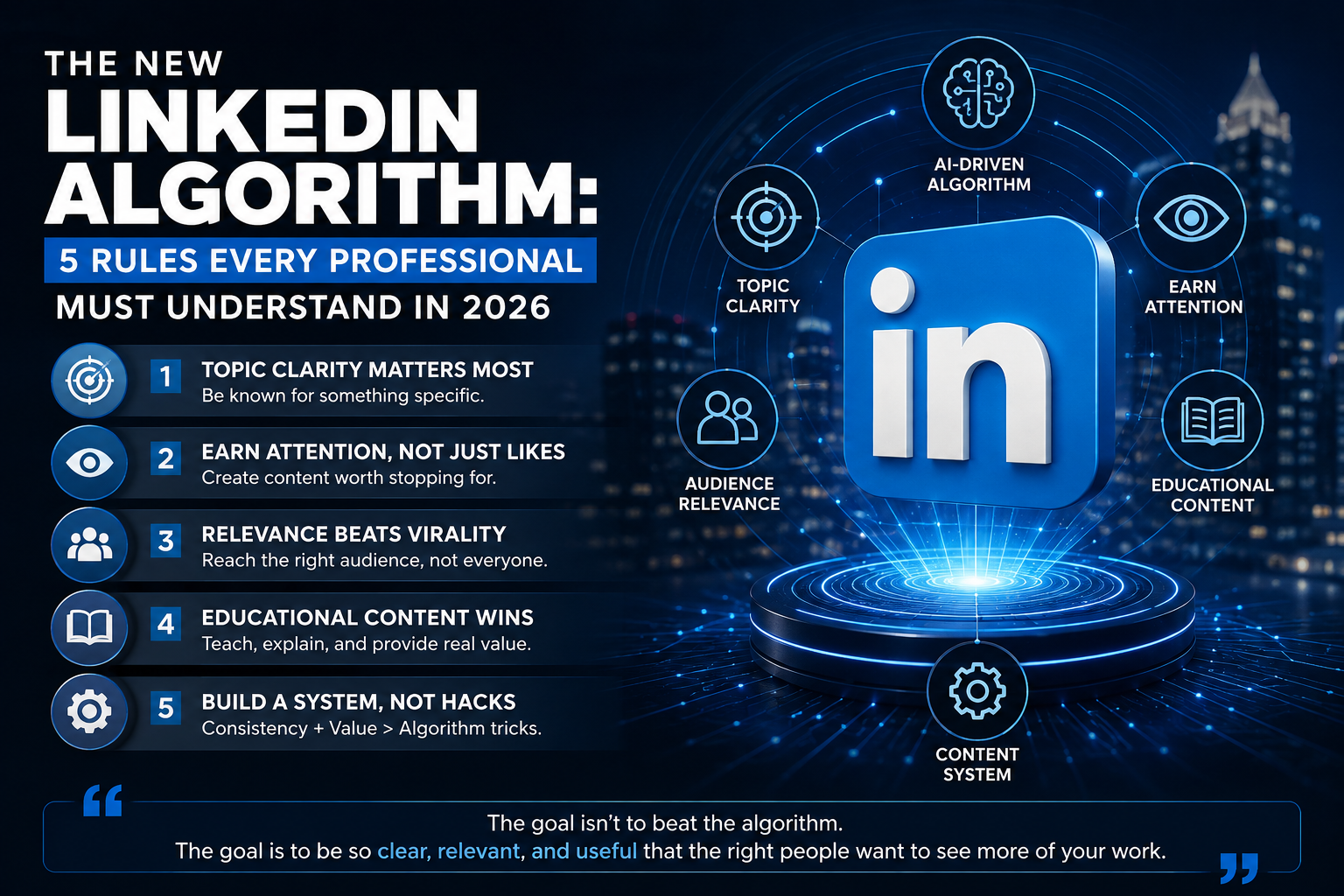
The New LinkedIn Algorithm: 5 Rules Every Professional Must Understand in 2026

The New LinkedIn Algorithm: 5 Rules Every Professional Must Understand in 2026

For years, the LinkedIn growth playbook was simple:

Post more.

Use hashtags.

Grow your network.

Get likes and comments.

Repeat.

But LinkedIn has changed.

The platform is increasingly using AI-driven systems to understand content, determine relevance, personalize the Feed, and decide which content is worth surfacing to individual members.

That means the old questionβ€”

“How do I get more LinkedIn reach?”

β€”is becoming less useful.

A better question is:

“How do I create content that LinkedIn can understand, the right audience finds relevant, and professionals find valuable?”

That shift is especially important for consultants, executives, technology leaders, coaches, founders, and subject-matter experts.

Because your objective should not simply be visibility.

It should be professional authority.

Here are five rules every professional should understand about LinkedIn in 2026.


Rule 1: Topic Clarity Matters More Than Ever

The first mistake professionals make is trying to talk about everything.

One day:

AI.

The next day:

Leadership.

Then:

Motivation.

Then:

Politics.

Then:

Career advice.

Then:

A personal photograph.

Then:

A random industry news story.

There is nothing inherently wrong with any individual post.

The problem is what happens when someone looks at your content as a whole.

What exactly are you known for?

In 2026, this question matters more because LinkedIn’s Feed systems are increasingly designed to understand the meaning and relevance of content.

LinkedIn has described its next-generation Feed as using large language models and transformer-based systems to retrieve and rank content based on relevance, personalization, and timeliness.

That means content is increasingly being understood semantically.

In simple terms:

LinkedIn is getting better at understanding what your content actually means.

That creates an opportunity.

If you consistently talk about a clear professional subject, your content creates a stronger identity.

For example:

Enterprise AI Transformation

could include:

  • AI strategy
  • AI governance
  • Agentic AI
  • AI architecture
  • AI economics
  • AI workforce transformation

These topics are different, but they belong to a coherent professional territory.

Compare that with:

  • AI
  • Cricket
  • Motivation
  • Politics
  • Travel
  • Leadership
  • Cryptocurrency
  • Career advice

The second profile may have interesting content.

But the professional positioning is unclear.

The Topic Clarity Test

Ask yourself:

If someone read my last 10 posts, what would they say I am an expert in?

If the answer isn’t obvious, your content needs a clearer center.

You don’t need one topic.

You need one recognizable area of authority.


Rule 2: Stop Chasing Likes. Start Earning Attention.

Likes are visible.

That makes them psychologically powerful.

You publish something.

You refresh the page.

Twenty likes.

Fifty likes.

Two hundred likes.

It feels like progress.

But likes don’t necessarily tell you whether the content created professional value.

Imagine two posts.

Post A

AI is transforming every industry. The future belongs to those who embrace AI.

1,000 likes.

Post B

Before deploying an AI agent into a customer-facing workflow, answer these seven governance questions.

200 likes.

Which demonstrates more expertise?

Which would a CIO save?

Which might a transformation leader share with a colleague?

Which could generate a serious business conversation?

Probably the second.

That is why professionals need to move beyond reaction metrics.

LinkedIn has publicly discussed dwell timeβ€”how long members spend consuming Feed contentβ€”as part of its ranking work. Its engineering team has described using predictions of very short dwell time as a negative signal.

The practical lesson is not:

“Make your posts longer.”

It is:

Make your content worth stopping for.

A strong post earns attention through:

  • A compelling opening
  • A real problem
  • A surprising observation
  • A useful framework
  • A practical example
  • A strong point of view
  • A visual explanation

Don’t manufacture attention.

Earn it.


Rule 3: Relevance Beats Random Virality

This may be one of the most important lessons for professionals building a personal brand.

A post can go viral and still be strategically useless.

Imagine you publish a humorous post about workplace culture.

It gets:

100,000 impressions.

5,000 reactions.

1,000 comments.

You celebrate.

But your actual business is enterprise AI consulting.

The people who engaged may have no interest in:

  • AI transformation
  • AI governance
  • AI architecture
  • Enterprise automation
  • Technology strategy

Your next post about AI governance receives only 2,000 impressions.

You conclude:

“LinkedIn doesn’t like my content anymore.”

Maybe that’s not the problem.

Perhaps you trained your audience to expect something completely different.

This is why audience relevance matters.

You don’t necessarily need the largest possible audience.

You need the right audience.

For example, if you want to reach:

  • CIOs
  • CTOs
  • CHROs
  • AI leaders
  • Enterprise architects
  • Transformation executives

then your content should repeatedly address problems these people care about.

Instead of:

“AI agents are the future.”

Try:

“Your AI agent may be technically autonomous, but your organization may still have no idea who is accountable when it makes a bad decision.”

Now you’ve moved from technology hype to an executive problem.

That creates relevance.

Reach Is Not the Same as Authority

Think about these two metrics:

100,000 irrelevant impressions

versus

5,000 highly relevant impressions

For a professional building a consulting practice, career reputation, or executive brand, the second may be considerably more valuable.

The goal isn’t maximum visibility.

It is:

Maximum relevant visibility.


Rule 4: Educational Content Can Turn Expertise Into a Growth Asset

There is a major opportunity for professionals who know something deeply but struggle to communicate it simply.

Your expertise may take years to develop.

But the reader may give you only a few seconds of attention.

That is where educational content becomes powerful.

Instead of simply expressing an opinion, create something people can use.

For example:

A Framework

The 5 Levels of Enterprise AI Maturity

A Checklist

10 Questions Before Deploying an AI Agent

A Diagram

LLM β†’ Context β†’ Agent β†’ Business Action

A Comparison

Traditional Automation vs Agentic Automation

A Maturity Model

AI Experimentation β†’ Production β†’ Governance β†’ Scale

A Decision Framework

Should This Business Process Be Automated With AI?

These formats turn knowledge into reusable assets.

And reusable assets are more likely to be:

  • Read
  • Saved
  • Shared
  • Referenced
  • Discussed

This is particularly important on LinkedIn because professional audiences are often looking for information they can take back to their organization.


Why Visuals Matter

A strong visual can communicate a complicated concept faster than several paragraphs of text.

Imagine an executive reading:

“Enterprise AI requires a context layer between the foundation model and the business process so that organizational data, policies, permissions, workflows, and business rules can influence the agent’s decisions.”

That’s useful.

But imagine a visual:

ENTERPRISE SYSTEMS

↓

CONTEXT LAYER

Data
Policies
Permissions
Business Rules
Workflows

↓

AI AGENT

↓

BUSINESS ACTION

The idea becomes immediately understandable.

That is the power of educational visualization.

The visual isn’t decoration.

It is knowledge compression.


Rule 5: Build a Content System Instead of Chasing Algorithm Hacks

The final rule may be the most important.

The algorithm will change.

Today there is a particular ranking model.

Tomorrow there will be another.

There will always be new advice about:

  • Posting times
  • Hashtags
  • Formats
  • Frequency
  • Engagement
  • Video
  • Images
  • Links

If your entire strategy depends on one algorithm trick, your strategy is fragile.

Instead, build a system around principles that are much more durable.

Start With Your Authority Territory

Choose three to five connected areas.

For example:

Primary Territory: Enterprise AI Transformation

Supporting themes:

  1. AI Strategy
  2. AI Governance
  3. Agentic AI
  4. AI Economics
  5. AI Workforce Transformation

Now you have a content ecosystem.


Turn One Idea Into Multiple Content Assets

Suppose your core insight is:

AI agents need governance before autonomy.

That single idea can become:

LinkedIn Post

Why AI autonomy without governance creates enterprise risk.

Visual

5 Controls Every AI Agent Needs

Carousel

How to Govern an Enterprise AI Agent

Article

The Agentic AI Governance Gap

Video

Why Your AI Agent Needs Governance Before Autonomy

Executive Checklist

Questions CIOs Should Ask Before Approving AI Agents

One idea.

Multiple formats.

That is a content system.


The New LinkedIn Content Equation

Forget:

More Posts + More Hashtags + More Likes = More Success

Think instead:

Topic Clarity

Audience Relevance

Attention

Useful Knowledge

Original Perspective

Consistent Positioning

=

Professional Authority

This is a much more sustainable approach.


What About Hashtags?

Hashtags are not the foundation of your strategy.

They cannot rescue unclear content.

If your post is about enterprise AI governance, the topic should already be clear from the:

  • Headline
  • Opening
  • Language
  • Examples
  • Structure
  • Visual
  • Profile positioning

Use hashtags where they make sense.

But don’t confuse hashtags with strategy.

Your content should stand on its own.


What About Posting Every Day?

Posting every day isn’t automatically a winning strategy.

If you publish seven weak posts, you’ve created seven opportunities for people to ignore you.

If you publish three strong posts that demonstrate real expertise, you may create a much stronger professional impression.

The question isn’t:

“How much can I publish?”

It is:

“How consistently can I create something worth consuming?”

Quality and consistency should work together.


The AI Content Problem

There is another major development professionals need to recognize.

AI has dramatically reduced the cost of creating content.

Today, almost anyone can generate:

  • LinkedIn posts
  • Articles
  • Headlines
  • Carousels
  • Images
  • Scripts
  • Comments

That means generic content is becoming abundant.

The scarce resource is no longer content.

It is:

Original thinking.

Consider these two statements.

Generic

AI will transform businesses and create new opportunities.

Experience-driven

Many enterprises are trying to automate individual tasks with AI before redesigning the operating model around those capabilities. The result is more AI toolsβ€”but not necessarily more business value.

The second has a point of view.

It sounds like someone who has thought about the problem.

That is the direction professionals should move toward.

Use AI to:

  • Structure
  • Research
  • Edit
  • Repurpose
  • Visualize
  • Improve clarity

But keep the most valuable part human:

Your judgment.


Your LinkedIn Profile and Content Must Tell the Same Story

Your content doesn’t operate independently from your profile.

Someone discovers your post.

They become curious.

They visit your profile.

What do they see?

Your:

  • Headline
  • About section
  • Experience
  • Featured section
  • Articles
  • Newsletter
  • Recent posts

should reinforce the same professional story.

For example:

If your headline says:

Enterprise AI Transformation Advisor

but your content is primarily motivational quotes, there is a positioning gap.

But if your profile and content consistently demonstrate:

AI Strategy + AI Governance + Agentic AI + Enterprise Transformation

your authority becomes much easier to understand.


Don’t Chase Virality. Build Recognition.

There is nothing wrong with a viral post.

But virality should not become the objective.

Imagine someone sees one of your posts today.

Then another next week.

Then a visual the following week.

Then an article a month later.

Eventually they think:

“This person really understands enterprise AI transformation.”

That is recognition.

Recognition creates authority.

Authority creates trust.

Trust creates conversations.

Conversations create opportunities.

That is a much more valuable long-term outcome than a single viral post.


Your 2026 LinkedIn Strategy in Five Rules

If you remember nothing else from this article, remember these five rules:

1. Be clear about what you know.

Don’t make people guess what you are an expert in.

2. Earn attention.

Don’t optimize only for likes. Create content people want to consume.

3. Prioritize relevance.

The right audience matters more than an impressive but irrelevant reach number.

4. Teach something useful.

Turn your expertise into frameworks, examples, visuals, checklists, and practical insights.

5. Build a system.

Don’t depend on algorithm hacks. Build a repeatable content engine around expertise, relevance, and value.


Final Thought

The LinkedIn algorithm will continue to evolve.

That is inevitable.

But you don’t need to understand every technical detail of the algorithm to build a powerful professional presence.

You need to understand the fundamentals.

Be clear.

Be relevant.

Earn attention.

Teach something useful.

Demonstrate original thinking.

Stay consistent.

The opportunity in 2026 is bigger than simply getting more impressions.

It is the opportunity to make your expertise discoverable beyond the people who already know you.

LinkedIn’s next-generation Feed is designed to retrieve and rank content using AI-based systems that understand content and member relevance. That makes clarity and meaningful professional value increasingly important to anyone trying to build authority on the platform.

So don’t ask:

“How do I beat the LinkedIn algorithm?”

Ask:

“How do I become so clear, relevant, and useful that the right people want to see more of my work?”

That is the real LinkedIn strategy for 2026.

Build expertise.

Package it well.

Teach consistently.

Become recognizable.

And let your professional authority compound.

The LinkedIn Pre-Publish Checklist: 100+ Questions | LinkedIn

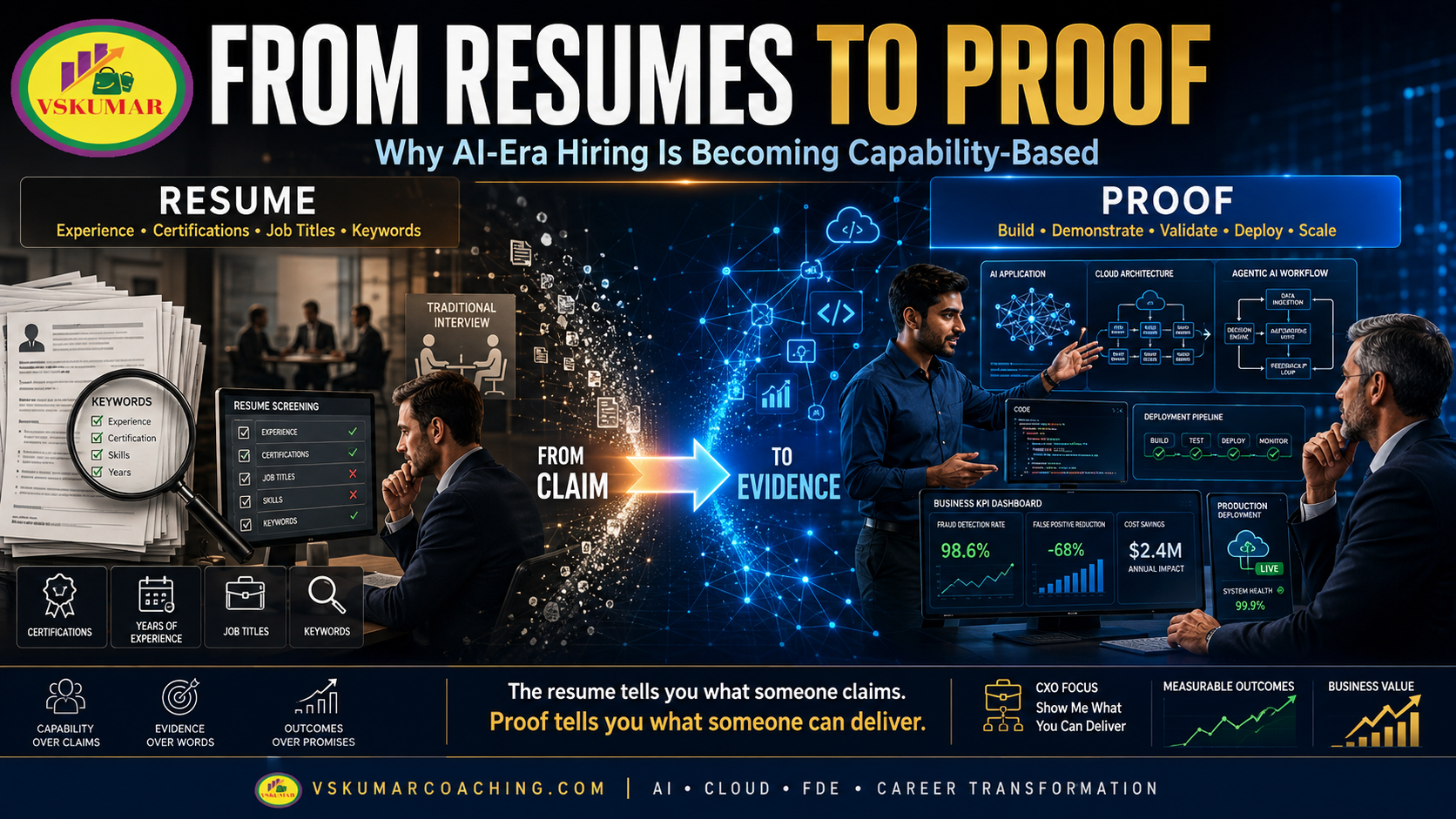
Why CXOs Must Move From Resume-Based Hiring to Proof-Based Capability

The AI-Era Talent Imperative: Why CXOs Must Move From Resume-Based Hiring to Proof-Based Capability

For decades, enterprise hiring has operated on a simple assumption: the resume is a reasonable proxy for capability.

A candidate lists years of experience, technologies, certifications, projects and job titles. Recruiters screen the resume. Hiring managers conduct interviews. The organization makes a decision.

That model is increasingly becoming inadequate.

The rise of AI is creating a fundamental change in how work gets doneβ€”and therefore how talent must be evaluated.

The question is no longer:

β€œWhat does this candidate say they can do?”

The more important question is:

β€œWhat can this candidate actually prove they can do?”

For CXOs, this is not merely an HR transformation.

It is a business competitiveness issue.


1. AI Has Changed the Economics of Capability

Generative AI, copilots, agents and automation are dramatically reducing the effort required to perform many traditional knowledge tasks.

A developer can generate code faster.

An analyst can produce reports faster.

A cloud engineer can automate infrastructure faster.

A business analyst can prototype solutions faster.

An AI engineer can connect models, tools, APIs and enterprise data faster.

But this creates an interesting paradox.

The value of knowing a technology is declining.

The value of knowing how to apply technology to a business problem is increasing.

This distinction is critical.

Knowing Python is not the same as building a production-ready AI application.

Knowing AWS is not the same as designing a secure, scalable cloud architecture.

Knowing prompt engineering is not the same as building an agentic workflow that improves an operational KPI.

Knowing Kubernetes is not the same as operating a resilient production platform.

The enterprise needs demonstrable capability, not technology vocabulary.


2. The Resume Was Designed for a Different Era

Traditional resumes were optimized for a world where experience accumulated slowly.

Five years of experience generally meant five years of exposure.

A certification indicated a certain level of structured learning.

A project description provided some indication of practical exposure.

But AI has disrupted this relationship.

Today, someone with three years of experience and exceptional AI-assisted engineering capability may outperform someone with ten years of traditional experience.

Conversely, someone with fifteen years of experience may struggle if they cannot demonstrate the ability to work effectively with modern AI-enabled engineering environments.

This creates a new CXO challenge:

Experience is no longer a reliable proxy for capability.

Organizations therefore need a new talent equation:

Capability = Knowledge + Application + Evidence + Business Impact

And evidence becomes increasingly important.


3. Welcome to the Era of Proof-Based Hiring

Imagine two candidates applying for an AI Engineering role.

Candidate A

Their resume says:

  • 8 years of IT experience
  • AWS certified
  • Python
  • Generative AI
  • Machine Learning
  • Docker
  • Kubernetes
  • Terraform
  • Multiple enterprise projects

Candidate B

Their resume says:

  • 4 years of experience

But Candidate B can demonstrate:

  • A working RAG application
  • An AI agent connected to enterprise tools
  • Infrastructure deployed using Terraform
  • CI/CD automation
  • Cloud architecture decisions
  • Observability dashboards
  • Security controls
  • Cost optimization
  • A documented business use case
  • A live demonstration of the complete workflow

Who should the enterprise trust?

The answer is obvious.

Candidate B has evidence.

The future of hiring will increasingly move toward this model.


4. The New Talent Funnel

CXOs should begin thinking about talent acquisition as an evidence pipeline.

Traditional model

Resume β†’ Screening β†’ Interview β†’ Hiring

AI-era model

Capability Definition β†’ Evidence β†’ Practical Assessment β†’ Business Simulation β†’ Interview β†’ Hiring

This is a profound change.

Recruiting should no longer begin with:

β€œHow many years of experience does this person have?”

It should begin with:

β€œWhat capabilities does this role require, and what evidence would prove those capabilities?”


5. HR Must Stop Hiring Job Descriptions

A job description typically says:

That describes a technology shopping list.

It does not describe the capability required by the business.

A stronger requirement would be:

β€œBuild and deploy an AI-enabled business workflow that integrates enterprise data, applies appropriate model orchestration, implements security and observability, and demonstrates measurable improvement in the target business process.”

Now the hiring process has something meaningful to evaluate.

The candidate must prove that they can:

Understand β†’ Design β†’ Build β†’ Integrate β†’ Deploy β†’ Operate β†’ Improve

That is far closer to real enterprise work.


6. CXOs Should Introduce the β€œProof of Capability” Layer

Every strategic AI role should have a defined Proof-of-Capability Framework.

For example:

CapabilityEvidence
AI EngineeringWorking AI application
Cloud ArchitectureDeployed architecture
AutomationInfrastructure/CI-CD automation
Agentic AIWorking agent workflow
Business UnderstandingClearly defined business problem
SecurityImplemented controls
OperationsMonitoring and observability
Cost ManagementCost-aware architecture
Problem SolvingDesign decisions and trade-offs
LeadershipAbility to explain and influence stakeholders

This changes recruitment from an opinion-driven process into an evidence-driven process.


7. The Interview Itself Must Change

Traditional interviews often ask:

β€œWhat is Kubernetes?”

AI-era interviews should increasingly ask:

β€œShow me how you would deploy this workload on Kubernetes.”

Traditional interviews ask:

β€œWhat is RAG?”

AI-era interviews should ask:

β€œHere is an enterprise knowledge problem. Design and demonstrate a RAG solution. What would you do about hallucination, access control, latency and cost?”

Traditional interviews ask:

β€œDo you know Terraform?”

AI-era interviews should ask:

β€œHere is an AWS environment. Show how you would provision it using Infrastructure as Code and explain your design decisions.”

The difference is enormous.

Knowledge can be memorized. Capability must be demonstrated.


8. AI Makes Evidence Even More Important

There is another reason CXOs need to rethink hiring.

AI makes it easier than ever to produce convincing-looking output.

A candidate can use AI to:

  • generate code,
  • write documentation,
  • create presentations,
  • prepare interview answers,
  • build prototypes,
  • explain technical concepts.

Therefore, organizations cannot simply evaluate the final artifact.

They must evaluate the candidate’s ability to reason about the artifact.

Ask:

  • Why did you choose this architecture?
  • What alternatives did you reject?
  • What happens when the model fails?
  • How did you validate the solution?
  • How did you secure it?
  • What does it cost?
  • How would you scale it?
  • What happens in production?
  • What business KPI does it improve?

This creates a much stronger signal.

The objective is not to prevent candidates from using AI.

Quite the opposite.

The objective is to identify people who can use AI effectively to produce business outcomes.


9. HR and Technology Leaders Must Work Together

This transformation cannot be owned by HR alone.

The future talent model requires a partnership between:

CHRO + CIO + CTO + CDAO + Business Leaders

HR understands workforce strategy.

Technology leaders understand technical capability.

Business leaders understand value creation.

Together they can define what good looks like.

For every strategic role, they should establish:

1. Capability Definition

What must the person be able to do?

2. Evidence Definition

What would prove that capability?

3. Assessment Design

How can we test it realistically?

4. Business Relevance

What business problem should the person be able to solve?

5. Production Readiness

Can the person move beyond a prototype?

This becomes the foundation of an AI-era talent operating model.


10. FDE Roles Make This Even More Critical

The shift becomes particularly important with the emergence of the Forward Deployed Engineer (FDE).

An FDE is not simply a developer.

They must operate across:

Business ↔ Domain ↔ AI ↔ Engineering ↔ Cloud ↔ Production

That means a resume listing twenty technologies tells a CXO very little.

What matters is whether the individual can enter an ambiguous business environment, understand the problem, design a solution, build it, deploy it and demonstrate measurable value.

That is why the FDE talent model naturally demands proof-based hiring.


11. CXOs Should Build a β€œTalent Evidence Portfolio”

Organizations should start thinking beyond resumes.

Imagine every strategic technology professional having a Talent Evidence Portfolio containing:

  • Demonstrable projects
  • Architecture diagrams
  • Working POCs
  • Git repositories
  • AI workflows
  • Cloud deployments
  • Automation examples
  • Business case studies
  • Design decisions
  • Performance metrics
  • Cost optimization examples
  • Security implementations
  • Production incidents resolved
  • Reusable components created

This becomes a far richer representation of capability than a two-page resume.

It also creates a powerful internal mobility mechanism.

Instead of asking:

β€œWho has the right title?”

the organization can ask:

β€œWho has demonstrated the capability?”


12. Performance Management Must Also Change

The transformation should not stop at recruitment.

If organizations hire based on evidence but evaluate employees based on traditional activity metrics, the system becomes contradictory.

AI-era performance management should increasingly measure:

Business Impact + Capability Growth + Automation + Reusability + Collaboration

For example:

Instead of:

β€œCompleted 25 tickets.”

Consider:

β€œAutomated a recurring operational process, reducing manual effort by 60%.”

Instead of:

β€œBuilt an AI chatbot.”

Consider:

β€œBuilt and deployed an AI assistant that reduced service resolution time by 35%.”

Instead of:

β€œCompleted AI training.”

Consider:

β€œApplied the training to build and deploy two production-ready AI capabilities.”

The organization must reward outcomes and capability creation.


13. The Biggest HR Risk: Hiring Yesterday’s Skills for Tomorrow’s Business

One of the most dangerous mistakes CXOs can make is optimizing recruitment for the current organization while the business is already moving toward an AI-native operating model.

Consider an organization preparing to scale AI across:

  • customer operations,
  • software engineering,
  • finance,
  • supply chain,
  • healthcare,
  • manufacturing,
  • cybersecurity,
  • enterprise knowledge management.

The required talent will not simply be people who know AI.

It will be people who can apply AI inside business systems.

This is where the distinction between an AI practitioner and an AI-capable business engineer becomes important.


14. Build Talent Factories, Not Talent Queues

The old model is:

Hire β†’ Train β†’ Deploy

The emerging model should be:

Identify Capability β†’ Build β†’ Demonstrate β†’ Validate β†’ Deploy β†’ Reuse β†’ Scale

This is essentially a Talent Factory.

Organizations can create internal academies where professionals work on realistic business problems and continuously build evidence.

The output is not merely a certificate.

The output is:

A professional who can demonstrate business-ready capability.

This is particularly powerful for large enterprises and IT services organizations.


15. What CXOs Should Do Now

CXOs do not need to redesign the entire HR organization overnight.

Start with five actions.

Action 1 β€” Identify 10 Critical AI-Era Roles

Select the roles that will have the greatest impact over the next 12–24 months.

Examples:

  • AI Engineer
  • AI Architect
  • FDE
  • AI Product Manager
  • Data/AI Platform Engineer
  • AI Security Engineer
  • AI Automation Engineer

Action 2 β€” Define Capability, Not Just Experience

For every role, document:

What must this person be able to demonstrate?

Action 3 β€” Create Evidence-Based Assessments

Replace a portion of theoretical interviews with:

  • POCs
  • architecture exercises
  • business simulations
  • live demonstrations
  • production scenarios

Action 4 β€” Build Internal Talent Evidence

Give existing employees opportunities to build and demonstrate AI capabilities.

Action 5 β€” Measure Business Outcomes

Track:

  • Time-to-capability
  • Time-to-deployment
  • Internal mobility
  • Productivity improvement
  • Automation created
  • Reusable assets
  • Revenue impact
  • Cost reduction

Now HR becomes directly connected to enterprise transformation.


16. The Strategic Advantage Will Belong to Organizations That Can Prove Talent Faster

There is a deeper strategic implication.

AI is compressing the distance between learning and execution.

A professional can learn a new capability today and potentially demonstrate it within weeks.

Therefore, organizations that can rapidly identify, develop and validate talent will have a significant advantage.

The competitive question will increasingly become:

How quickly can we turn human potential into demonstrated business capability?

That is a much more powerful question than:

β€œHow many people do we have?”


17. The Future of Hiring Is Not Resume-Free

The resume will not disappear.

It will simply lose its position as the primary evidence of capability.

The resume will become the introduction.

The portfolio will provide evidence.

The assessment will provide validation.

The business simulation will provide context.

The interview will test judgment.

And production performance will ultimately provide the strongest proof.

The future hiring architecture therefore looks like:

Resume β†’ Evidence Portfolio β†’ Capability Assessment β†’ Business Simulation β†’ Interview β†’ Production Outcome


18. The CXO Takeaway

The AI revolution is not simply changing technology.

It is changing the definition of talent itself.

In the previous era, organizations competed for people with experience.

In the AI era, organizations will increasingly compete for people who can convert knowledge into measurable outcomes.

That requires a new leadership mindset.

Do not ask only:

β€œWhere did this person work?”

Ask:

β€œWhat have they built?”

Do not ask only:

β€œWhat technologies do they know?”

Ask:

β€œWhat business problems can they solve with those technologies?”

Do not ask only:

β€œHow many years of experience do they have?”

Ask:

β€œWhat capability can they demonstrate today?”

And most importantly:

Stop hiring what people claim they can do. Start hiring what they can prove.

That is the foundation of an AI-ready workforce.

And for CXOs building the next generation of enterprise engineering organizations, this is not an HR initiative.

It is a competitive strategy.

also visit:

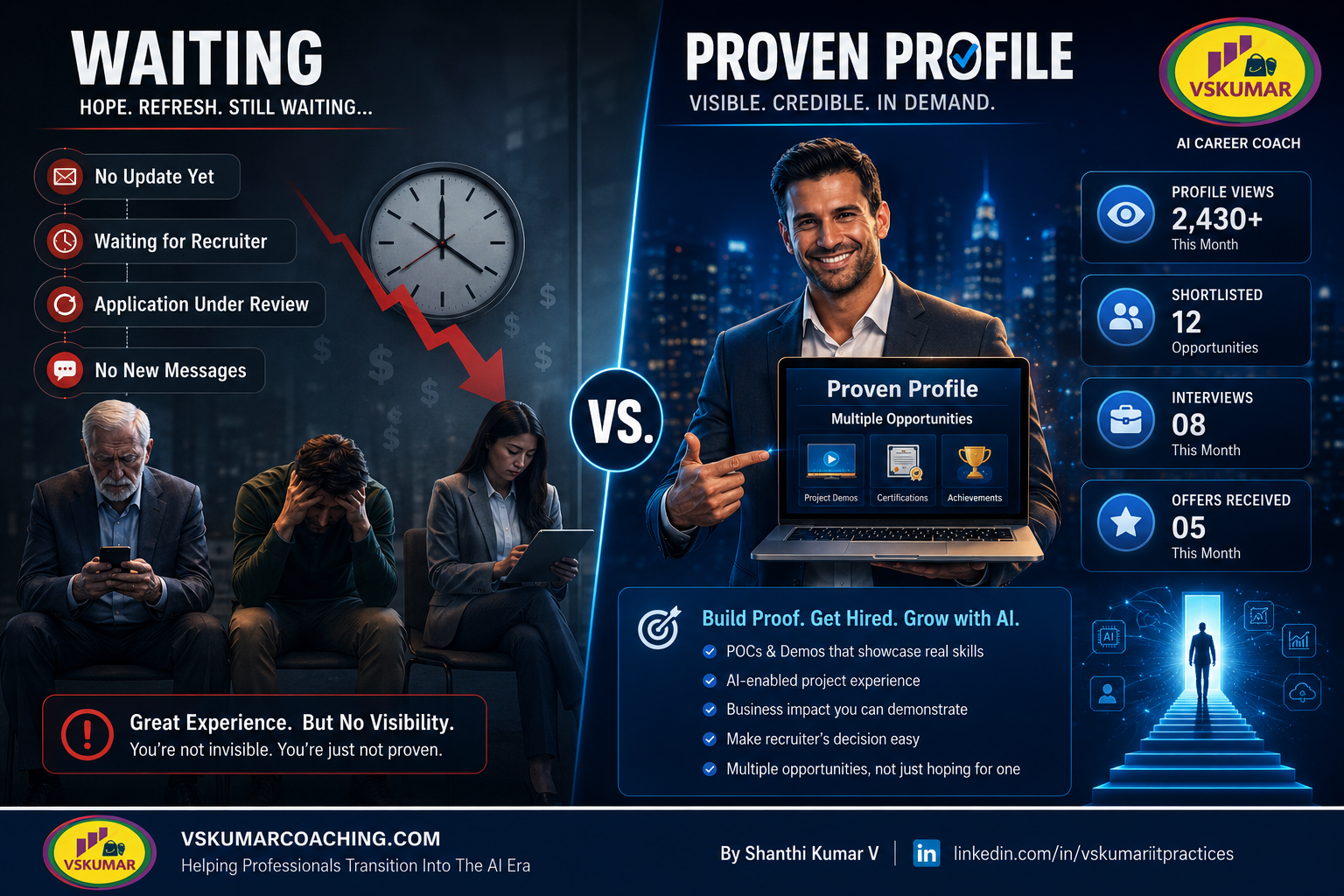
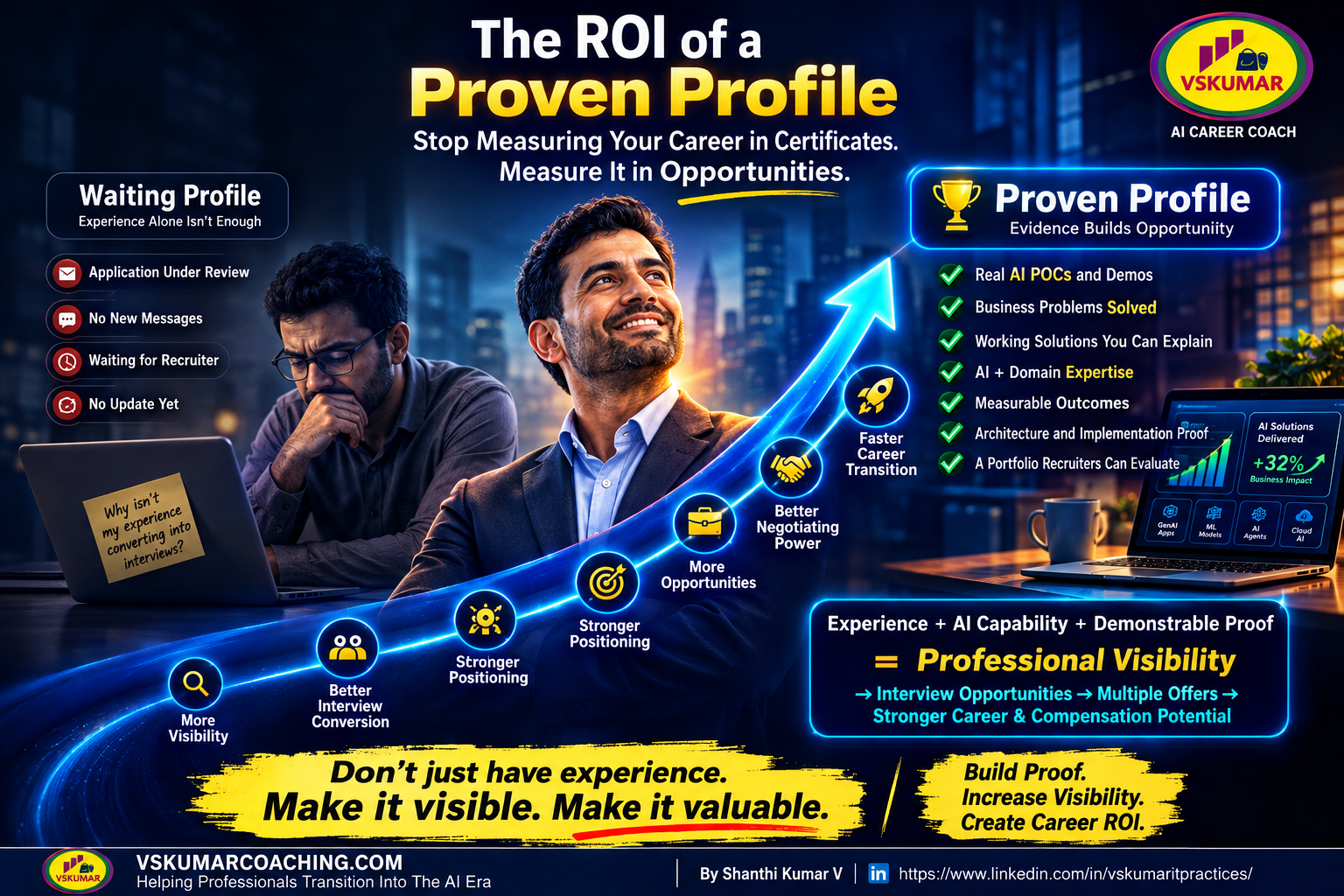
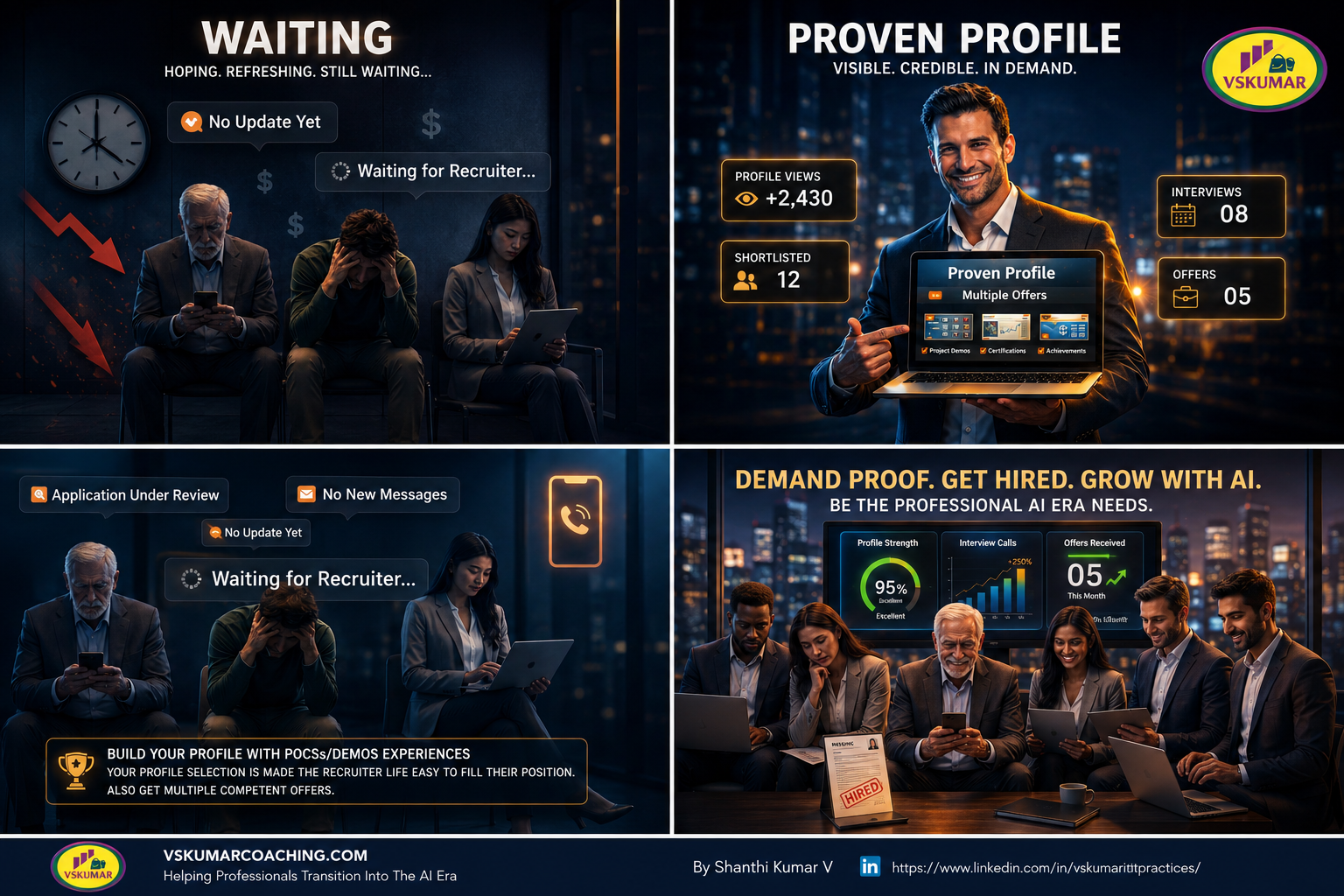
πŸš€ Don’t Wait for Recruiter Calls. Upgrade & Retry.

The AI job market is changing.

Many professionals remain β€œOpen to Work” and keep applying with their existing profilesβ€”but AI roles increasingly demand demonstrable skills, real project experience, and evidence of capability.

Simple training and certificates alone are no longer enough. The market has seen too many candidates without hands-on experience, and this makes it harder for recruiting managers to identify the right AI talent.

🎯 The answer is not more applications.

The answer is a proven career upgrade.

At VSKUMARCOACHING.COM, we help professionals transition into AI roles through a portfolio-based coaching approach:

βœ… Identify the right AI roles for your profile
βœ… Build a personalized 6–12 month roadmap
βœ… Develop real-world AI/ML/GenAI projects
βœ… Create POCs that demonstrate your capabilities
βœ… Build portfolio evidenceβ€”not just certificates
βœ… Prepare to return to the job market with a stronger profile

The objective is simple:

Learn β†’ Build β†’ Demonstrate β†’ Deploy β†’ Measure β†’ Upgrade β†’ Retry

If your current profile is not generating the right recruiter response, don’t waste your career time repeatedly applying with the same profile.

πŸ‘‰ Upgrade your capabilities. Build proof. Then retry.

πŸ“ž Book a FREE Counselling Call and start your AI career transformation.

From VSKUMARCOACHING.COM

#AICareer #AIJobs #CareerUpgrade #AIUpskilling #GenAI #MachineLearning #DataScience #MLOps #CareerTransformation #OpenToWork #VSKUMARCOACHING

How we build the AI Experiences of Legacy IT Professional

To learn How we build the AI Experiences of Legacy IT Professional, you need to watch our participants demos shared below:

For further more details visit the below Linkedin news letter:

https://www.linkedin.com/newsletters/ai-solution-architect-playbook-7481362647297253376