Unlock Your Future Career with VSKUMARCOACHING Digital Courses
In today’s rapidly evolving tech landscape, equipping yourself with the right skills is crucial for career advancement. By completing digital courses through the “VSKUMARCOACHING” app, you can effectively target several high-demand job roles in the cloud and machine learning domains. Here’s a look at some of the exciting career opportunities available to you:
1. Azure Solutions Architect Utilize your knowledge of Azure services and live integration issues to design and implement impactful cloud solutions.
2. AWS Solutions Engineer Leverage your experience with AWS live incidents, employing your problem-solving skills to support and enhance cloud infrastructure.
3. Cloud DevOps Engineer Apply your expertise in automation, containerization, and live tasks to efficiently manage deployments and optimize development processes across Azure and AWS environments.
4. MLOps Engineer Use your specialization in Azure ML and MLOps to develop and maintain robust machine learning workflows and frameworks.
5. Machine Learning Engineer Focus on designing and building machine learning applications, leveraging knowledge of Generative AI and practical use cases.
6. Data Scientist Analyze data and develop predictive models, guided by insights derived from Azure Machine Learning and MLOps principles.
7. DevOps Engineer Employ best practices in automation, Terraform, and Python to streamline operations and enhance CI/CD pipelines in cloud environments.
8. AI/ML Solutions Architect Design and implement innovative solutions that leverage machine learning and AI capabilities in the cloud, with a focus on Generative AI.
9. Cloud Consultant Advise organizations on optimizing cloud strategies by integrating AWS and Azure capabilities to meet their business objectives.
10. Technical Trainer/Educator Share your knowledge and skills by training others in Azure, AWS, and machine learning, helping to build the next generation of tech talent.
These roles not only demand a combination of technical skills but also practical experience and strategic thinking, all of which are cultivated through the courses offered by VSKUMARCOACHING. Embrace the opportunity to elevate your career and become a sought-after professional in the cloud and machine learning arenas. Your journey begins today!
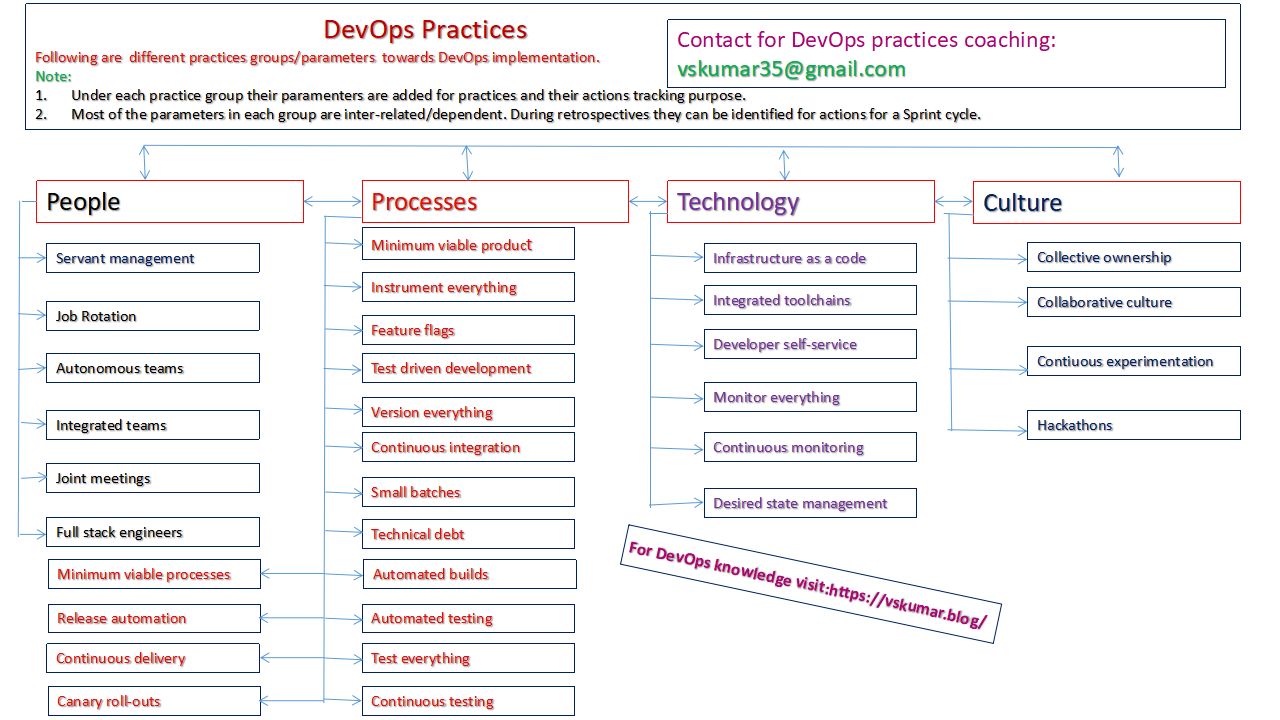
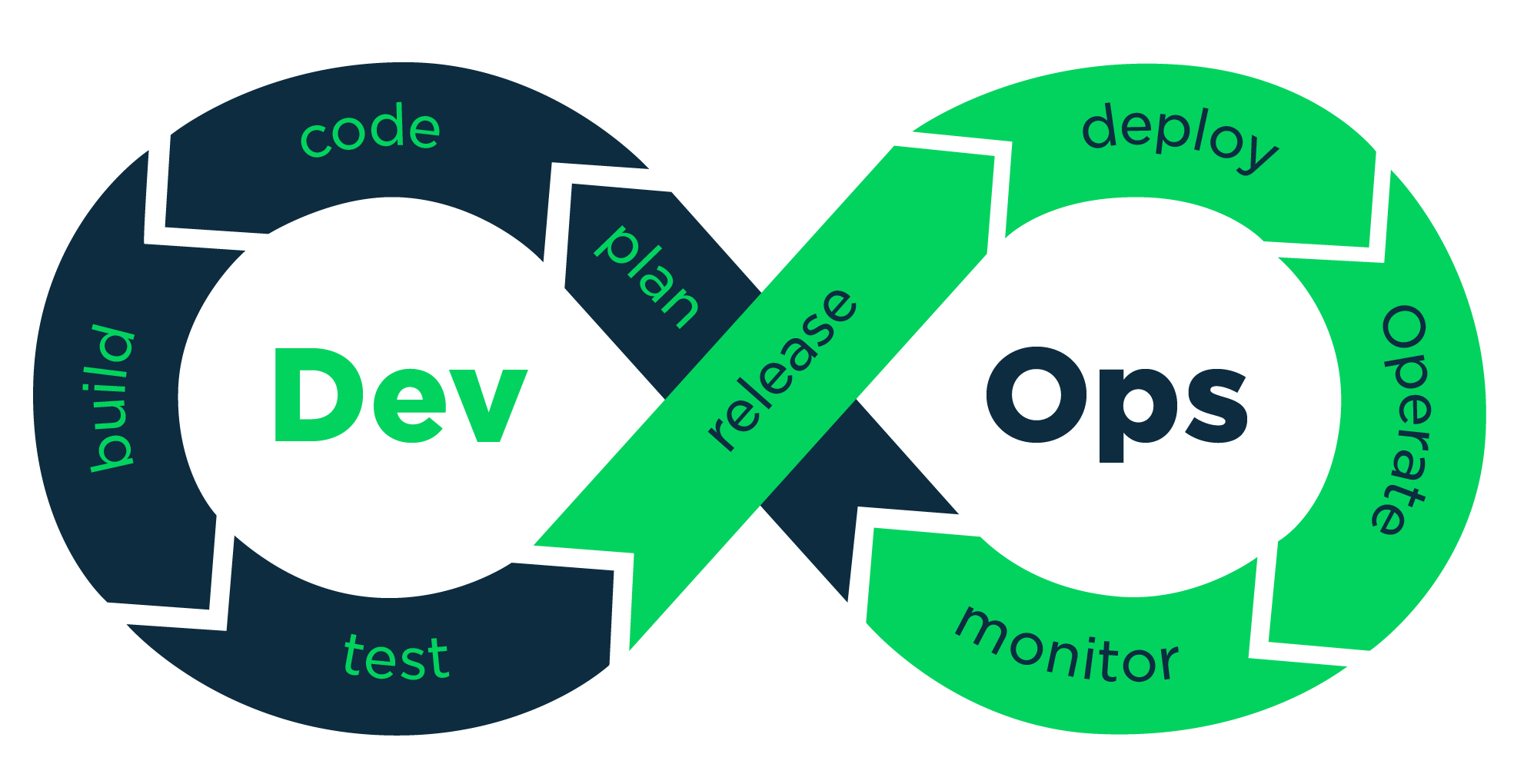
DevOps is a terminology used to refer to a set of principles and practices to emphasize the collaboration and communication of Information Technology [IT] professionals in a software project organization, while automating the process of software delivery and infrastructure using Continuous Delivery Integration[CDI] methods.
The DevOps is also connecting the teams of Development and Operations together to work collaboratively to deliver the Software to the customers in an iterative development model by adopting Continuous Delivery Integration [CDI] concepts. The software delivery happens in small pieces at different delivery intervals. Sometimes these intervals can be accelerated depends on the customer demand.
The DevOps is a new practice globally adopted by many companies and its importance and implementation is accelerating by maintaining constant speed. So every IT professional need to learn the concepts of DevOps and its Continuous Delivery Integration [CDI] methods. To know the typical DevOps activities by role just watch the video: https://youtu.be/vpgi5zZd6bs, it is pasted below in videos.
Even a college graduate or freshers also need to have this knowledge or practices to work closely with their new project teams in a company. If a fresher attends this course he/she can get into the project shoes faster to cope up with the experienced teams.
Another way; The DevOps is an extension practice of Agile and continuous delivery. To merge into this career; the IT professionals need to learn the Agile concepts, Software configuration management, Release management, deployment management and different DevOps principles and practices to implement the CDI patterns. The relevant tools for these practices integration. There are various tool vendors in the market. Also open source tools are very famous. Using these tools the DevOps practices can be integrated to maintain the speed for CDI.
There are tools related with version control and CDI automation. One need to learn the process steps related to these areas by attending a course. Then the tools can be understood easily. If one understands these CDI automation practices and later on learning the tools process is very easy by self also depends on their work environment.
As mentioned in the above; Every IT company or IT services company need to adopt the DevOps practices for their customers competent service delivery in global IT industry. When these companies adopt these practices, their resources also need to be with thorough knowledge of DevOps practices to serve to the customers. The companies can get more benefit by having these knowledged resources. At the same time the new joinees in any company either experienced or fresher professional if they have this knowledge, their CTC in view of perks will be offered more or with competent offer they may be invited to join in that company.
Let us know if you need DevOps training from the IT industry experienced people; which includes the above practice areas to boost you in the IT industry.
Training will be given by 3 decades of Global IT experienced professional(s):
There are many Learning units I am creating with basics. If you are not yet a member, please apply to utilize them. Read and follow the rules before you click your mouse.
Contact for AWS DevOps Engineer – Professional certification. Very few people globally covering the complete syllabus like I have explained from the AWS Exam guide. If interested please ping me in FB with your profile URL. Please note I coach only the global working IT Professionals.Hence Profile URL is mandated to know your background.
Watch the below 50 minutes video for the above analysis:
Following videos are made to elaborate on the need and advantages of thinking on conversion into DevOps Practices by IT Companies and the Professionals. Comparative reports have been incorporated.
In traditional projects [Non Agile practiced projects] ; Build Engineers, Sys Admins, Release Engineers can convert their career into DevOps Engineer role through an Agile practiced IT organization.
In Agile projects we might have seen Build or Deployment Engineers; they can convert into DevOps Engineer roles.
2. What a desired ‘DevOps Engineer role professional’ need to learn ?
If somebody would like to convert their role into DevOps Engineer; they need to understand the following :
Agile and Scrum or Lean practices
DevOps Principles, practices and patterns
Deployment, SCM and Release management process
Version control System tools [Ex: Git, SVN, etc..]
Cloud setup and deployment [Ex: AWS, Azure,Google Cloud, Alibaba, etc..]
Packaging process and tools [Ex: Maven, Gradle, etc.]
Some of the scripting languages [Ex: Shell, Bash, python, Ruby, Nodejs, etc.]
Windows, Linux OS commands and operations.
They can learn incrementally also depends on the project need. Note all projects will not use the unique tools. Depends on the IT organization plans, practices and the environments they decide on choosing the vendor based or open source tools.
Note: Some of the famous tools only it has been mentioned. Hence one need to identify the customer project environment and their DevOps architecture also. If one understands the Basic process in their 1st learning phase, later on they can pickup faster.
If you want to learn DevOps Practices, join the below group:
Following videos are made to elaborate on the need and advantages of thinking on conversion into DevOps Practices by IT Companies and the Professionals. Comparative reports have been incorporated.
Visit my current running facebook groups for IT Professionals with my valuable discussions/videos/blogs posted:
DevOps is a terminology used to refer to a set of principles and practices to emphasize the collaboration and communication of Information Technology [IT] professionals in a software project organization, while automating the process of software delivery and infrastructure using Continuous Delivery Integration[CDI] methods.
The DevOps is also connecting the teams of Development and Operations together to work collaboratively to deliver the Software to the customers in an iterative development model by adopting Continuous Delivery Integration [CDI] concepts. The software delivery happens in small pieces at different delivery intervals. Sometimes these intervals can be accelerated depends on the customer demand.
The DevOps is a new practice globally adopted by many companies and its importance and implementation is accelerating by maintaining constant speed. So every IT professional need to learn the concepts of DevOps and its Continuous Delivery Integration [CDI] methods. To know the typical DevOps activities by role just watch the video: https://youtu.be/vpgi5zZd6bs, it is pasted below in videos.
Even a college graduate or freshers also need to have this knowledge or practices to work closely with their new project teams in a company. If a fresher attends this course he/she can get into the project shoes faster to cope up with the experienced teams.
Another way; The DevOps is an extension practice of Agile and continuous delivery. To merge into this career; the IT professionals need to learn the Agile concepts, Software configuration management, Release management, deployment management and different DevOps principles and practices to implement the CDI patterns. The relevant tools for these practices integration. There are various tool vendors in the market. Also open source tools are very famous. Using these tools the DevOps practices can be integrated to maintain the speed for CDI.
There are tools related with version control and CDI automation. One need to learn the process steps related to these areas by attending a course. Then the tools can be understood easily. If one understands these CDI automation practices and later on learning the tools process is very easy by self also depends on their work environment.
As mentioned in the above; Every IT company or IT services company need to adopt the DevOps practices for their customers competent service delivery in global IT industry. When these companies adopt these practices, their resources also need to be with thorough knowledge of DevOps practices to serve to the customers. The companies can get more benefit by having these knowledged resources. At the same time the new joinees in any company either experienced or fresher professional if they have this knowledge, their CTC in view of perks will be offered more or with competent offer they may be invited to join in that company.
Let us know if you need DevOps training from the IT industry experienced people; which includes the above practice areas to boost you in the IT industry.
Training will be given by 3 decades of Global IT experienced professional(s):
Watch the below videos on why the IT company need to shift to DevOps work culture and practices and what advantages the company can get and the employees can get :
There are many Learning units I am creating with basics. If you are not yet a member, please apply to utilize them. Read and follow the rules before you click your mouse.
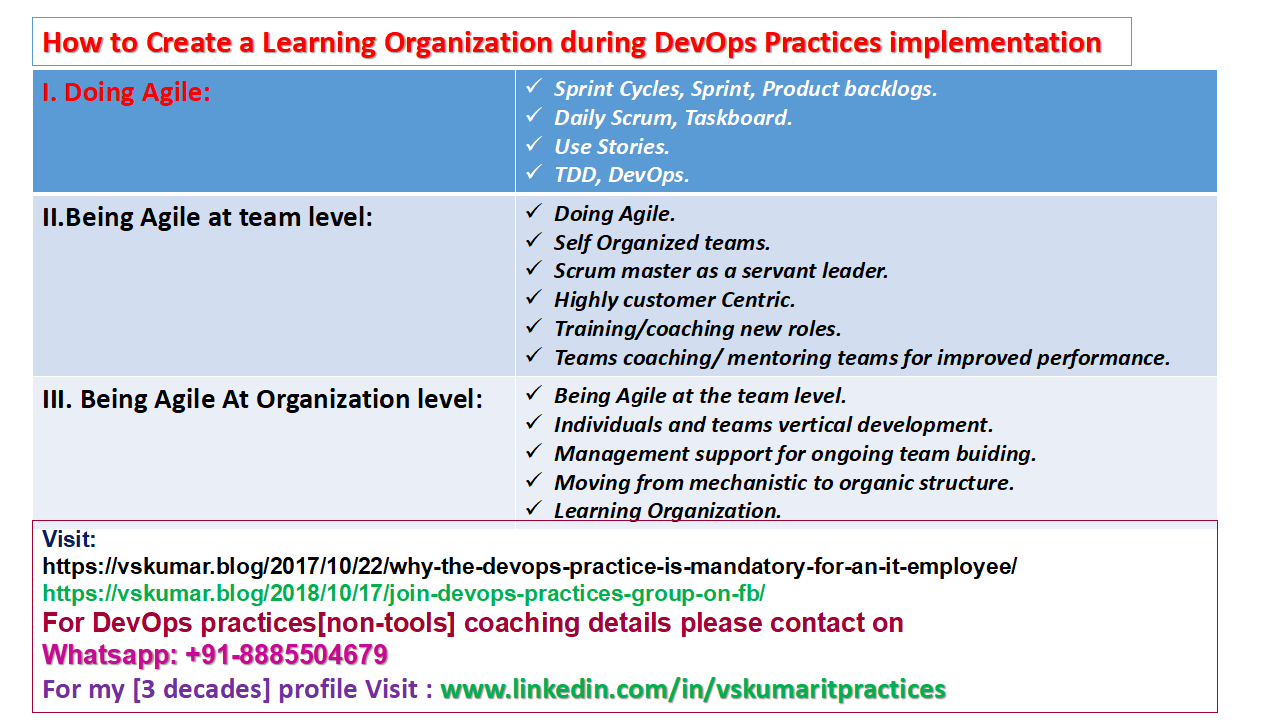
In continuation of my previous blogs on SDLC/Agile/Scrum, this blog can give some tips to Scrum Masters.
As per the Agile manifesto and Scrum principles, the Scrum Master need to work as a servant leader. The typical servant leader how he/she should have characteristics to bring the team alignment for right delivery with CDI speed, I have drafted in the below content. This can be useful as TIPS to new Scrum master on Agile projects.
What characteristics a Servant Leader should have in the organization ?
Creating the right leadership roles is very important and challenging to any organization with the current trend of the rapid technology or business transformation.
They need to look into the person’s characteristics very deeply. At the end of the day these leaders only drive the key aspects of the organization to achieve the results.
There are different leadership roles taken by coaches. One of them and very famous and with value added is; Servant leadership.
The servant leadership denotes as ‘a philosophy and practice’ of leadership. This concept has been appearing from the prehistoric. I would like to give a brief introduction of this role in this article, which can help the professionals who would be pursuing into the leadership roles.
When we move forward on analyzing this role, our mindset might have the following questions:
1.What is servant leadership means?
2.How they can thrive the teams in organizations?
3.How they can improve the corporate culture?
4.What is the significance they can create?
5.How this leader can drive high loyalty of the customers?
6.How this leader can build empowered teams to the organization?
7.How the teams can feel being with this leader?
8.Does the organization get the opportunity to drive long term goals with this role?
9.How the organization work culture can be changed timely with this role?
10.How this leadership role can help the organization with accelerated ROI?
In any organization servant leaders accomplish the results while reaching to the targets. These leaders give preferences to the needs of their contemporaries. By thumb rule, these leaders are being seen as humble stewards in their organizational resources like; human, financial and physical.
Focus on teams: A servant leader focuses on his/her team members needs towards scaling them into higher levels in their organization by helping them to resolve their issues and promotes their personality development also. These leaders feel it’s a management philosophy which can be applied to in the view of quality of people, work and community spirit.
We can see in many organizations there are several leaders’ supports their employees in the above mentioned areas to ascend them further. Every growing organization needs this kind of leaders to achieve their targets. Without these leaders and their characteristics it would have not been possible many companies rapid growth in the relevant industries.
Servant leader’s characteristics: When we think of their characteristics, certainly the following can come into our mind with leadership analysis thought process.
Listening
Empathy
Healing
Awareness
Persuasion
Conceptualization
Foresight
Stewardship
Commitment to the growth of people
Building community
Understanding people closely: A servant leader attempts to understand and empathize with the team. This leader would not consider them as employees. Their individual respect and appreciation on their personal development would be awarded by the leader. As a manager or leader you can consider any team members tasks, look into its complexity, and support the team member to achieve its result. And you can apply your servant leadership compassion. The team members would not have realized you earlier, when you applied these leadership techniques to achieve their targets.
Effective management of people and their skills: The servant leaders don’t use their power in getting the things done by the people. Instead they manage the tasks and people through effective discussions. This way the team member also can understand on how their manager is giving the importance and respect to their individual concerns. Their hidden or unused skills or power can be utilized to complete any complex tasks with easy ways. For the future tasks, the minimal discussion time can be taken place to convince the team members, while having built the relationship empathetically.
Focus on operating targets and objectives: The servant leadership also plays to focus on long term operating goals also, rather than short term benefits. In view of this kind of thought process they derive specific goals towards implementing strategies for the benefits of the organization as well as tuning the teams towards working on the strategic plans and their execution.
Serving with Openness and persuasion: These leaders would have dedication to help and serve others. With their openness and persuasion their leadership qualities can be demonstrates in the organization to achieve any complex activities also with simple.
How the servant leadership can build the teams for competencies ?
You can see this video :
To know some of the basics of Agile/Scum practices, visit the below video:
1. Agile: What are Agile manifesto Principles & How they can be used ?
The below videos explains on how to invent and design a reusable code during Agile Sprint planning to save the cycle time. Given with an example of E-commerce site design by identifying its repeatable steps from the user operations.https://youtu.be/zCR6GP1ji60
Continuous test automation planning during Agile iterations
Please refer to my blog and videos on Agile practices and the importance of Re-usable code libraries for cycle time reduction.
During the reusable code usage and the iterations or sprint planning, the test automation also can be planned, designed and implemented.
This blog eloborates on the easy processes can be used to implement it and demonstrate the cycle time reduction. Please note atleast after passing the two cycles of tests on the selected manual scripts need to be planned for test automation.
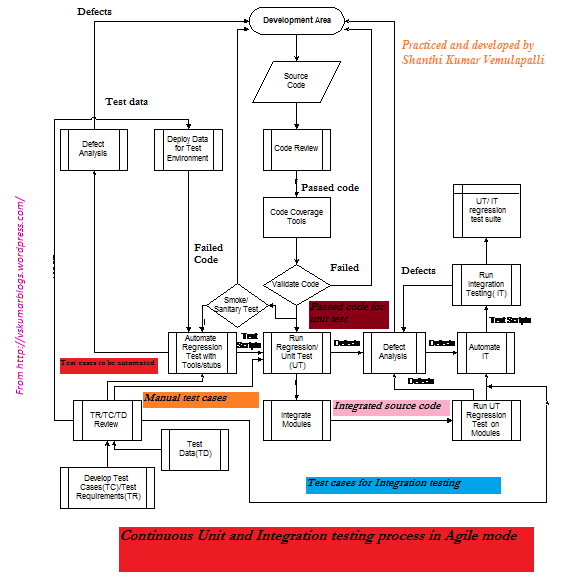
I am trying to elaborate on the process of the Automation of unit testing and component or module integration test automation. Please note the test automation is also a development project. Hence some of the phases are similar to SDLC.The pictorial chart elaborates the detailed steps involved in these test phases automation.Module (Unit) or Component Development in Agile: The below contents and the chart narrates the relationship of automation Development process and the Testing process under each development phase. Development and Testing process Relationship table:
Phase
Development Process
Test Process
Module (Unit) or component Development
Design module from requirements
Perform test planning and test environment set up.
Code module
Create test design and develop test data.
Debug module
Write test scripts or record test scenario using module.
Unit test module
Debug automated test script by running against module. Also, tools that support unit testing [Purify, etc] can be used.
Correct defects
Rerun automated test script to regression test as defects are corrected.
Conduct Performance Testing
Verify system is scaleable and will meet the performance requirements. This is the entry criteria for Integration test automation.
Integration
Build system by connecting modules.Conduct Integration test with connected modules.Review trouble reports.
Combine unit test scripts and add new scripts that demonstrate module inter-connectivity. Use test tool to support automated integration testing.
Correct defects and update defect status.
Rerun automated test script as part of regression test, as defects are corrected.
Continued Performance Testing Activities
At this point, Verifying system is scaleable and will meet performance requirements with the integrated modules. If this passes then the system test or VVT entry can be considered.
Below chart demsontrates the process steps to be used for test automation of unit test and integration testing:
The acronyms used in the chart: TC–>Test case, TD–>Test data, TR–> Test requirement, UT–>Unit test, IT–> Integration test.
All the automated test scripts and test data need to be preserved under configuration management tools.
Choosing the right tools for test automation comes under tools evaluation process. Once the tools are identified, the above processes can be planned and adopted for regular practice on the Agile projects.
In many Agile transformation sessions the Agile practitioners or savvy’s discuss more on the process related activities rather than elaborating on the technical or software engineering process steps to reduce the cycle time.
At the same time prior to the Agile meetings, activity efforts need to be defined by the designers and the developers. Unless they identify the size of the reusable code components in the applications it is not worth for conducting the Release or Sprint planning meetings for planning of the iterations.
Hence it is the moral responsibility of the technical teams to apply this kind of practices ahead of Agile process or Scrum meetings.
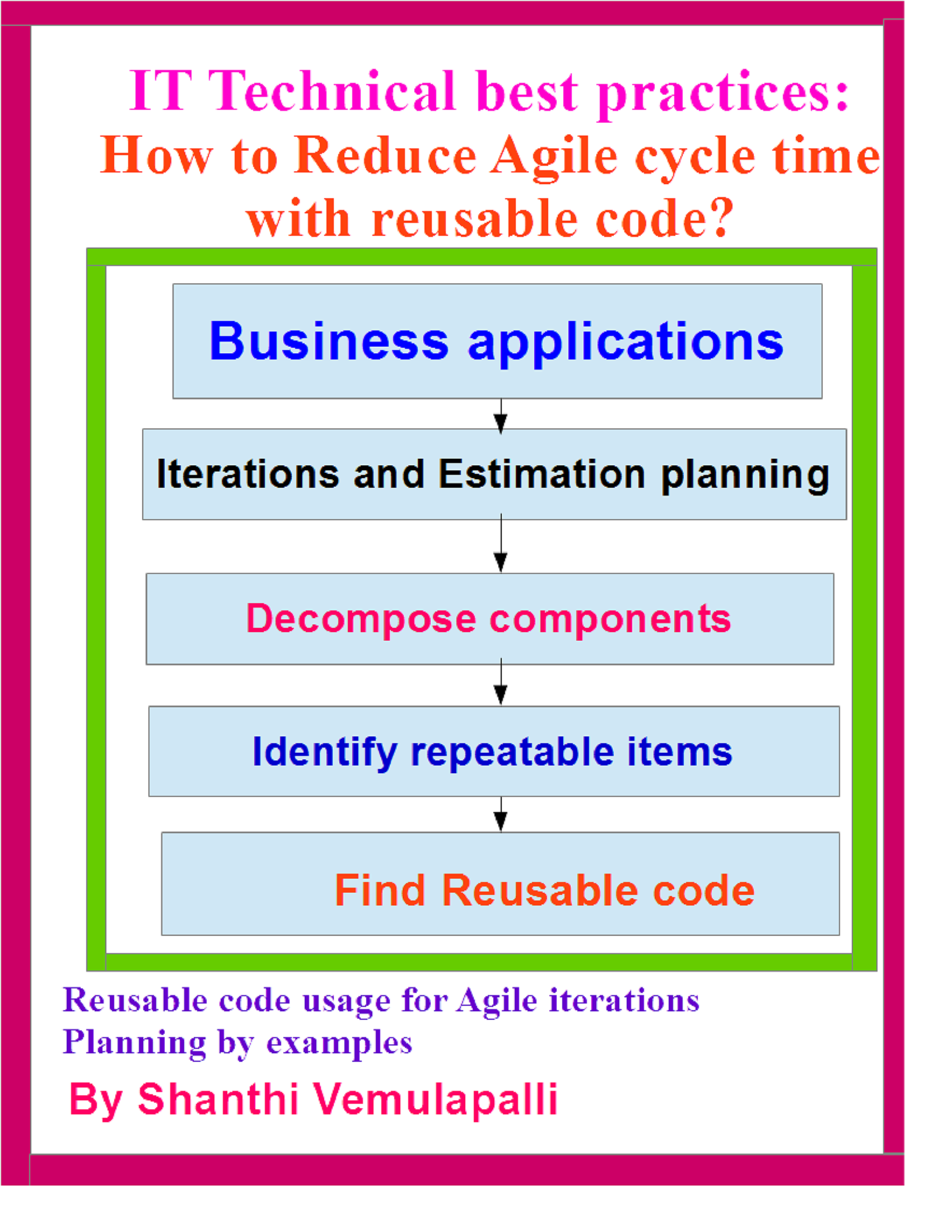
If you are interested to know what reusable code with examples is, this E-Book can be useful. Using this technique, you can plan for code refractor and its cleaning also to get ROI on future Agile iterations. During Scrum meetings, these are the important topics where technical people need to discuss for customer’s ROI acceleration planning and also the cycle time reduction acceleration. The team’s technical capabilities also can be accelerated by following these practices regularly.
I have considered an application example of E-commerce site building for defining the Sprint planning and their iterations. Each iteration has been divided into different reusable code components design parts.
The relevant graphics have been designed and added into this E-book. The software configuration processes with Code Items process have been discussed also.
One can answer the following after understanding this E-Book content: How to define the reusable code? How the Iterations can be planned? Is it possible to demonstrate the iterations cycle time reduction? What are the entry criteria for Sprint planning? What are the jumpstart activities required for designers before Agile release meeting? How to manage the code components with configuration management process? How to plan the efforts reduction for Sprint cycles?
The proposed or mandatory readers are: Agile developers Agile Designers Agile PMS Agile Product Owners Agile teams Who all intended to learn Agile Practices?






 Building Cloud/DevOps/AI/ML/Gen AI Architects