Category Archives: Uncategorized

SDLC & Agile – Interview questions for Freshers -5

In continuation of my previous blog  on this subject following questions and answers are continued:

1. What is retrospective in agile and where it can be useful?

Ans: During agile development model in each iteration different requirements are considered to design, develop and construct the code. While performing these tasks there can be different issues identified and resolved by the teams at each stage. The teams need to maintain knowledge information against to each issue as lessons learnt. These issues resolution mechanism processes are going to be considered for any process improvements  for next iteration. During the retrospective [after completing iteration] the team is going to discuss the lessons learnt  from the completed  iteration and the best practices  identified for next iteration. The retrospective is a mandatory activity for every iteration of Agile projects. And this need to be conducted before starting the next iteration.


2.   What is continuous stream of development in agile model?

Ans: As per the agile concept continuous software delivery need to  happen by following iterative development. Let us assume the development team consider the four days for development and fifth day it need to go for release and deployment, fifth day onwards developer considered as other iteration/SPRINT as their continuous development activity. The developers are picking up one  by one SPRINT items for their construction activity this is called as continuous stream of development. When the testing activity is ongoing the developer can pickup other workable items from the SPRINT to do construction activity.


3. What is Continuous Delivery[CD] in Agile ?

Ans: As per the agile concepts and principles, the developer need to get small chunk of workable item only which can be delivered in hours or few days.  When this kind of continuous development is happening through the agile developers there will be builds for continuous testing and deployments. Obviously then the agile project leads to have continuous  delivery [CD] of software into production with small chunks of functionality or fixes.

Example: Many technology companies consider each SPRINT item to complete in hours only to speed up their ongoing software deployments for their daily business needs. This kind of concept is called as Continuous Delivery [CD] in Agile.


4.  What is transition activity and their tasks involved in  agile project?

Ans:  Transition activity is start with deploying software release into production. Once the software construction phase is signed off the transition activity need to be started, typically transition activity contains following tasks.

i) Active stakeholder participation

ii) Final system testing

iii) Final acceptance testing

iv) Finalize documentation

v) Final testing of the release

vi) Train end users

vii) Train production staff

viii) Deploy into production.

All the above tasks are performed in the sequential order.


5.  What is final system testing during transition stage?

Ans: Once software can be deployed  internally, the planned system testing need to be conducted by testing team for a specific iteration. Once system testing is passed or certified the  acceptance testing need to be started.


 6.  When can you conduct final acceptance testing in agile model?

Ans:  In any agile project developers need to conduct a skeleton software demo to the users. Depends on the design requirement once users approved it, the Construction phase need to be  started. Once the software is constructed and  it can be deployed internally for various levels of testing during the transition stage of agile project. At this stage the software release is deployed in test environment. Then the  system testing is conducted and signed off.  The final acceptance testing is conducted on the software to be delivered to the users in production. Once the final acceptance is signed off the remaining tasks are being performed during transition phase, as mentioned in the list of tasks.


7. When can the pilot testing  happen and who all will perform it?

Ans: During the transition stage once the acceptance test is signed off , and final document is done, the software build is executed under a pilot test in a preproduction test or in a production environment depends on the organization policy. The pilot test is attended by the business users and testers or nominated coordinator along with the development team and operations[ops] team.


8.  During the transition stage who all need to be trained?

Ans:  Once the pilot test is done software end users and the production staff (ops team) needs to be trained to operate the product in live [production] for business operations.


9.  When can you deploy the system into production?

Ans: During transition stage once the pilot test is signed off, end users and production staff will be trained on software system and then it is deployed into production.


10. How a  prototype can be designed ?

Ans: When the business user give some requirements which consists of user interface and some data processing to provide output, there are two ways we can design prototype software; a) Prototype model  b) Design and developing the complete software.

a) Prototype model: During prototype model developer design and develop the critical requirements of the users and demonstrate those things as the skeleton software. The skeleton software will not have the complete software operations. It will have an user interface to get an idea by the user on the software to be delivered by the development in future. Once user approved skeleton model, developer can design complete model through Agile SDLC. Note; the prototype model or process can be applied  for one or more SPRINT cycles or iterations.

b) Design and developing the complete software: This kind of software happens in a regular Agile project process from collection of user story onwards. All the agile phases and their tasks will be applied for execution. If the team agreed to a demo [for prototype], the user demos can also happen as and when required for each SPRINT during construction phase.

Keep watching this site for further updates.

Contact for any guidance/coaching.

 Vcard-Shanthi Kumar V


SDLC & Agile – Interview questions for Freshers -3

Agile Cirlce1

In continuation of my previous blog [https://wordpress.com/post/vskumar.blog/1944] on this subject following questions and answers are continued:

1.  During selection of Agile  Projects what are the main activities need to be performed?

Ans: a) Identify potential projects

         b) Prioritize potential projects

         c) Develop initial vision

         d) Consider project feasibility

 2.  How to identify potential projects in an organization?

Ans: In any organization initially, the critical business processes are identified. These critical business process are analyzed for automation through IT  technology. Then they are going to be converted into IT projects. And will be planned as per the Agile methodology for planning, execution and delivery.

3. How the  projects can be prioritized/identified during Agile ?

Ans: Once the critical business processes are identified and planned for IT projects, and these will be the potential projects for prioritization and planning. 

4. What is the initial vision to a project and what should be done at that stage?

Ans: Each prioritized  project should be associated with initial vision of organization. During this stage the ROI [Return On Investment] is calculated for a project. 

5.  What is a project feasibility?

Ans: Once ROI is measured for  a project. The feasibility of doing that project is going to be researched. If it is feasible only the project team is going to consider it as an IT project.

 6.  To initiate the Agile project what are the main activities need to be performed?

Ans: a) Identification of active stakeholders and their participation.

         b) Identification of budgeting and funding to the project. The Required support           need  to be given.         

        c) Building the initial teams.

         d) Envisioning the initial requirement with agile concept by following iterative development plans.

         e) Identifying initial architecture and design.

         f) Identifying required development, testing environments and setting up these environments.

      7. What is the process involved in initial requirement envisioning

             Ans:  In a prioritized project the customer requirements are gathered and these requirements are prioritized by user group. The project team is going to segregate them into different iterations of a software delivery. Each iteration is going to be considered in  one software delivery.

8. What are the steps involved during  initial architecture?

Ans: During initiation of project,  the project team need to identify the required technical teams for  different iterations of delivery. The skeleton architecture need to be enhanced to baseline it with reference to the identified iterations of entire software project delivery. Then the technical teams need to understand their delivery responsibility in view of different software components.

9.  During the initiation of the project what are the steps involved in setting up  the environments ?

Ans:  i) During the environmental  setup activity as per the agile development process we need to have the following environments by minimum.

a) Development environment

b) Testing environment

c) Production environment.

          ii) The above environments needs to be satisfied as per the initial architectural requirement.

iii) If modification is required it needs to be documented for specific iteration.

10. During construction phase what is the meaning or importance for active stakeholder participation?

Ans:  In agile development by following different process steps it facilitates for a sustainable development environment. During this stage the stakeholders are called [for example ] as; sponsors, developers, users, etc. These stakeholders can vary from one project to another project, when it is going to be defined for a project selection. The stakeholders involvement is mandatory during construction phase to review and decide on  further movement  of construction phase tasks. At this stage they might ask for some more changes also. The developers should be in a position to accept them as per the Agile manifesto rules. The Product Owner [PO] can decide on the size of the SPRINT [iteration] delivery. Hence during construction stage the stakeholder participation is mandatory to finalize the final SPRINT delivery. If it is a maintenance or bug fixes project sometimes the stakeholders may not be required, the PO only can decide the final SPRINT.

Keep watching this site for further updates.

Contact for any guidance/coaching.
View my UrbanPro-profile

URL is : https://www.urbanpro.com/vskumar

Vcard-Shanthi Kumar V

For next blog, visit: https://vskumar.blog/2017/10/05/sdlc-agile-interview-questions-for-freshers-4/


Typical DevOps activities by role


I have made a video with a detailed explanation on these roles/activities/tasks.


For my DevOps basic course watch this:


Vcard-Shanthi Kumar V


SDLC & Agile – Interview questions for Freshers -2

Agile Cirlce1

In continuation of my previous questions blog [https://vskumar.blog/2017/09/04/sdlc-agile-interview-questions-for-freshers-1] on this topic these were made.

SDLC and Agile Model:

Questions on SDLC Phases:

1. How the agile methodology has been architected?

Ans: The agile methodology has been architected with 12 principles to govern the agile development approach.

2. What is highest priority during agile development model?

Ans: The highest priority is customer satisfaction and the early and continuous delivery of software which will work for the customer requirement.

3. Why the agile development models need to accept the request on irrespective of the development stage?

Ans: As per the  fundamental approach of agile development  it provides facility to the users towards inception of new or enhanced requirements before the delivery.

4. During agile development approach who all need to work together?

Ans: The business people and software developers need to work collaboratively and consistently throughout the project life cycle.

5. To get the right delivery what do we need to do during agile development model?

Ans: In agile project we need to have self motivated individuals at the same time we also need to supply the required human and nonhuman resources to get the job done.

6. When the life cycle of agile model ends?

Ans: The agile model continues till the retirement of the product or project. When the customer decides the retirement of the product then the project operation is terminated. 

7. Why do we need to have face to face conversation during agile development approach?

Ans: The agile principle guides to have face to face conversation among the project resources to have most efficient and effective method of communication.

8. How can you measure the progress and success of agile project?

Ans: The basic concept of agile is to deliver the working software of component.

9. How  the agile development process need to be promoted and to whom  all ?

Ans: Agile development process need to be promoted in a  sustainable development for continuous delivery to the sponsors, developers and users.

10. Why do we need technical excellence and good design project delivery?

Ans: The concept of the agile is for continuous delivery to the users as per the requirements in an iterative development approach. The team capacity needs to be accelerated towards the functions and processes to work on good software design.

Keep watching this site for further updates.

Contact for any guidance/coaching.

View my UrbanPro-profile

URL is : https://www.urbanpro.com/vskumar 


Vcard-Shanthi Kumar V

Your customer issues and services


Customer issues closure

Contact for services/solutions:

Vcard-Shanthi Kumar V

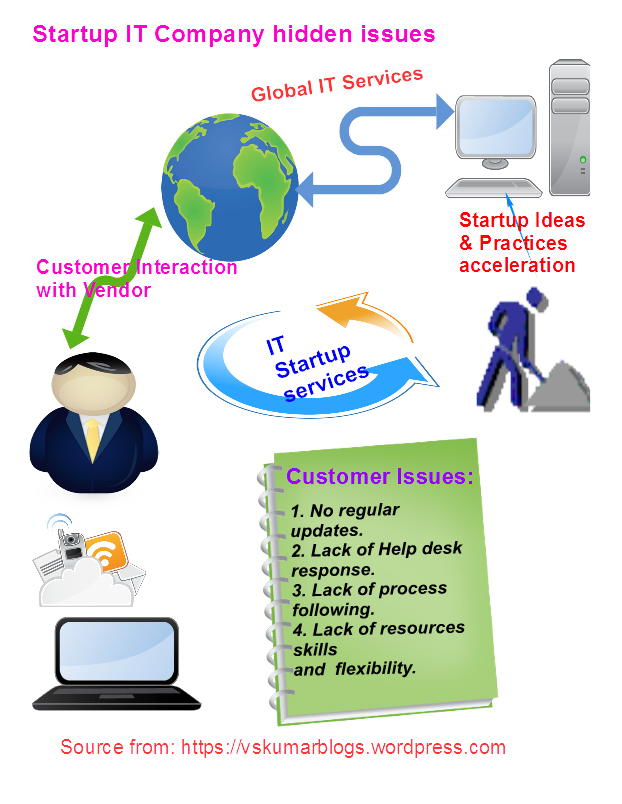
Are you a new customer or vendor for IT services or on outsourcing ? – then predict these issues

IT Startup & lack of ITSM service design practicesGlobal Startup IT services-issues1


The feasibility of services from this scenario are as below for both customer and IT services vendor :

  1. You might be a customer given IT work outsourcing to a vendor. For mediating the satisfaction under CSAT we can serve you.
  2. You might be an IT Services vendor not able to satisfy the customer. You need an independent seasoned IT consultant to work for mediating, we can serve for you.

Please Contact for [global] IT services:

Vcard-Shanthi Kumar V


How the ambiguities can be resolved for defect clarity in a mini project ?

Sometimes many teams in a project get confusion on the test cycles process and the importance of the testing teams, and support to them. This situation might create ambiguities within them.

In this blog I would like to elaborate different operational roles during the test cycles planning/performance [Since the offline requests were received].

In any project, apart from the development [SDLC] teams there are testing teams and the user groups. Sometimes the user groups can have Business Analysts [BAs] also. Now, let us go through the typical process required for test planning and the execution.

Assuming the environment is a mini project, having an independent tester and the BA along with the developer and all are reporting to the one single Project Manager.

The following points can be useful for the healthy testing environment:

  1. The BA collects the user requirements and transfers the requirements to the technical teams. The BA also needs to make sure the relevant tester is in the review meeting to be aware of the latest release requirements.
  2. Once the developers complete the GAP analysis on the new requirements with the existing applications, they can come up with the feasible or allowed requirements for the iteration or the current project.
  3. Then the BA needs to seek user approval to go-ahead with the new release.
  4. Once the approval is given, the Development team needs to share the GAP analysis information along with the approved new requirements to the tester for their clear understanding.
  5. The testers need to understand the requirements and also conduct the presentation on the test scenarios to the BA. If development team attends this session it can benefit them to understand the future defects faster and fixes them ontime.
  6. Once the test scenarios are agreed by the BA, the tester need to keep working on the test planning, test strategy and the approach of the testing. This information need to be shared to the BA and the development team. Once the development team and the testing team agrees on the reviewed contents, the tester need to plan for writing the test cases, data, test cycles and the environment planning.
  7. The test cases and the data need to be reviewed by the BA and the development team needs to be aware on the test coverage.
  8. Once the test execution schedule is arrived, the tester needs to execute the test cases as per their sequence and the schedule. If they find the defect, it needs to be simulated number of times to the developers [as needed]. This way it can give clarity to the developers on the raised defect to understand and fix faster to save the project cycle time or to meet the schedule. The BA need to monitor the defects and their status.
  9. By following the above series of steps the ambiguities can be nullified among the teams for smooth functioning of the project delivery on time.

slide1

cover-ta-qstns

Visit: https://www.amazon.com/dp/B01MD1OMXU


Sample Book video- ISTQB ATA exam practice questions #Kindle

ISTQB ATA SAMPLE EXAM QUESTIONS FOR PRACTICE Kindle Edition

cover-ta-qstns

Visit: https://www.amazon.com/dp/B01MD1OMXU

Verify the knowledge videos from the YouTube channel.

You can watch a demo class for Test Analyst test process from URL: :
https://www.youtube.com/watch?feature=player_detailpage&v=dhn2a8f-yoE

For Foundation:

For A test automation Video please visit:

There is a Part2 also, please watch it in URL: http://youtu.be/An4_EMA9gbE

slide1

You can also join to learn the concepts freely: https://www.facebook.com/groups/410279332851728/?

Practice ISTQB Test analyst sample questions #8

Slide10.PNG
slide1

How to initiate a Project using PMI methodology ?

I am trying to attempt to elaborate the PMI steps during project chartering, with a scenario  and a chart from the following.

The PMI defines the project charter under Project initiation process group [PIPG].

Chartering the project is a major step under this PIPG. The project charter authorizes the PM to plan and use the allocated budget, time and resources. By using these entities the PM need to complete the objectives of the project with better planning, execution and control towards reaching the organization’s targets.

They are mentioned in the below chart.

PMI-Project charter processes'


For a successful project manager assessing and defining all of them are very essential upfront during the project initiation phase with Chartering process step.

By identifying them, the PM or a Program manager also can identify the risk mitigation areas before starting any activity. The required risk and contingency planning can be done for the activity’s smooth functioning. At the same time these two managers also can well plan for cost control by keeping percentage of the buffer budget from the allocated or planned budget.  Hence it helps in controlling the project overruns also.

Normally, in any IT organizations taking care of these measures happens upfront due to the resources costing for the activity. Hence most of the clients are greedy in controlling the resources cost as per their role or responsibility. Once the cost is hiked and the allocated budget is eaten up by the program, there is a possibility of unavailability of the funds. Due to these financial constraints, obviously the client needs to close the project or program. Ultimately it is a failure of a Program or Project Manager also due to risks mitigation or planning  are not done. It not only denotes the failure of these managers and customer,  and also on the resources.

When the resources come out of the project, they will be under confusion on answering on their past project performance.  In reality any 1st attempt recruiter or a recruiting manager might feel this resource did not work well on the project, it happens due to the recruitment team’s  unawareness on these issues. But the resource might have worked or contributed well on the project. Unfortunaltely, for the failed projects many people don’t like to give the feedback.

To avoid this kind of havocs to all the team of the project, if the managers follow the processes correctly and completely, a healthy environment can be created for the resources also. A PM should not think Project charter is a document only; it has lot of controls planning also,  to be successful and also to achieve the planned targets timely within the budget.

A good leader in PM role also educates the resources on these process steps and plans to be aware of by the resources. So that they can feel the responsibility to identify the timely risks and intimate to the PM immediately.  Otherwise,  the reserved or uneducated [on Project] resource might feel, “Okay, It is not working for now! I have done my work for today let me logout  my day”. Then the next day nobody knows the dependent issues. The client also can get astonished for the suddenly appearing issues through the PM or resource and those were not mitigated.

Hope this might help any new PM or existing leads to understand the project initiation stage using the PMI methods with some meaningful scenarios.


How to initiate a cloud transformation? Watch video

I have made a video on this blog and posted on youtube URL: http://youtu.be/98zboBaXgoU

Coach for Cloud and DevOps Job skills's avatarvskumar Cloud Blogs

Initiate-Page1

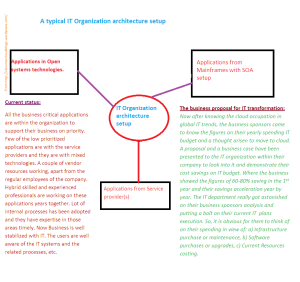
Current IT setup before cloud

Initiate-Page2

 Cloud evaluation-chart

Initiate-Page3Initiate-Page4   On the above content explanation I have made a video and posted  on youtube URL: http://youtu.be/98zboBaXgoU

View original post

Visit for Kindle books

How Lean Six Sigma [LSS] is useful to the organizations ?

LSS Lean Six Sigma helps companies to make the transformation; from a more traditional business and operational management model to a process management company. What is the principle behind LSS?

  • Lean Six Sigma [LSS] is based on the principle; in order to deliver service and product excellence, firms must not only have an in-depth knowledge of their internal processes, but also have a profound understanding of customers current expectations and future needs.
 How Lean Six Sigma [LSS] can help a company to achieve quantifiable improvements ?
  • By creating a sustainable quality culture: Many processes can be introduced for very good strategic ROI.
  • By bringing clarity to Invisible processes and enhancing control: Stringent Quality control  can be applied to achieve the desired market quality of the product. 
  • By providing a corporate strategy for differentiation: Integrated corporate strategy with different processes in place can demonstrate the differentiation from the past to the current status of the organization.
  • By becoming a world-class service or product provider at the lowest cost: For any product manufacturing or service provide company, reduced cost can bring very good and strategic ROI. 
  • By providing customers with what they value:The customers attraction can be accelerated by using LSS methods in execution.
  • By reducing the hidden costs associated with poor-quality products or services: Basically the waste can be identified and when their control can be accelerated, the removal of poor-quality can be accelerated with better services along with the customer satisfaction acceleration.
  • When an organization follows LSS methods: They can demonstrate all the above changes for different business domains.
  • These activities can be applied in multiple domain areas. Then the perception of LSS can be applied only in Manufacturing domain can be vanished with the accelerated proven cases for an organization.

Conclusion: When the organization senses these symptoms by having all the above accelerated improvements, it can lead to the service excellence acceleration also. It can be part of the world class service organizations. Note: For any LSS support to your organization please contact me. I offer a free half day workshop [on web or F2F] for a corporate with prior schedule, to motivate and mentor your teams towards LSS practices activation. You can visit for my next LSS article: http://wp.me/p4umAl-7l  

Data migration testing practice – A Kindle edition


Data Migration-image

Background on writing this book:

Most of the data migration projects can happen through the incremental data loading or if they have redesigned any of their business applications data migration need to be verified to give confidence level to the business users. Sometimes it is a critical activity and risk involved towards certification of the migrated data for business.

Many of these project timelines are getting extended or some failures are happening due to lack of; knowledge, best practices and the experiences or following right approach.

To overcome on the above situations and to be proved as best IT professionals in front of the business user community, we need a methodology and the right approach to conduct successful data migration testing and certify the data for business.

This book has been written with 10 plus years of testing experience on this kind of projects by suggesting the feasible approaches, practices and easy teams handling with right and ontime delivery by involving business users also. It also can reduce the risks while doing continuous planning improvements.

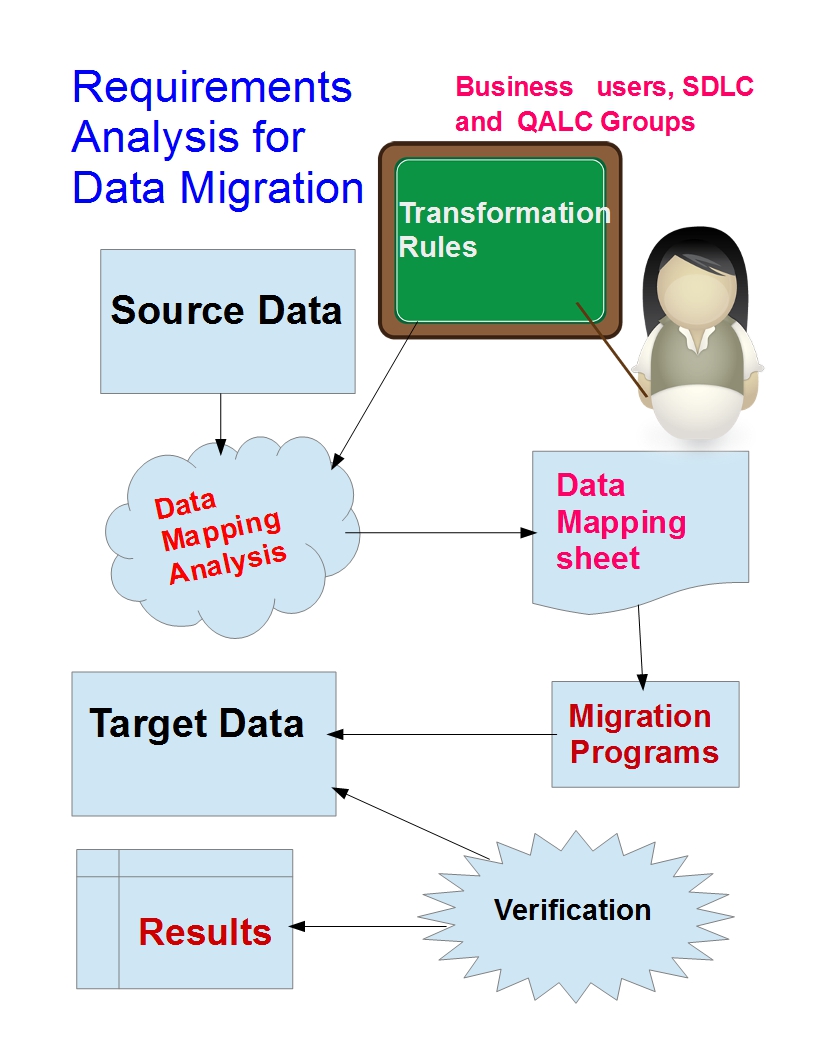
Different charts or diagrams can help the reader to understand the process faster also. One of the charts presented below:

Some of the Contents are:

Chapter 1: Introduction

Chapter 2: The scenarios of data migration

Chapter 3: Requirements Analysis

Chapter 4: Testing practices for data migration

Chapter 5: During data discovery phase

Chapter 6: Identifying the Business scenario based data

Chapter 7: Identifying the relevant data schemas

Chapter 8: Identifying the tables/queries/SPs, etc. on each of the Data schemas

Chapter 9: Planning for each Data schemas Extraction, Transformation and Loading to target Applications.

Chapter 10: Verifying the source and target data flows for business operation continuity.

Chapter 11: Conducting data verification and validation by QA/Testing team

Chapter 12: Planning

Chapter 13: The project approach

Now it is in cheaper price  look into it if you are on the same practice.

URL:http://www.amazon.com/Data-migration-testing-practice-incremental-ebook/dp/B018EP9MO2/ref=sr_1_2?ie=UTF8&qid=1452042282&sr=8-2&keywords=Shanthi+vemulapalli

If you feel these practices can be used by somebody please leave your comments after reading the book.


Coolpad Note 3 (White, 16GB)

Apple iPhone 4S (Black, 8GB)

Lenovo S850 (Dark Blue)

Kindle Voyage Wifi – 6″ High-Resolution Display (300 ppi) with Adaptive Built-in Light and PagePress Sensors


The advantage of leadership skills of a project manager

During this high competitive global work environments, the PM’s role is very critical for the individual and to the business.

We can recap the role of the PM and the advantages of applying the leadership skills while playing this role.

There are few scenarios or cases we need to consider, while assessing the leadership skills of a PM:

Let us assess first what are the critical tasks for a manager in a traditional projects management environment required:
1. Any manager is; just to plan and manage the tasks and make sure he/she is getting the required output from the team members on time, while executing the plans.
2. As a manager he/she need to make sure the mile stones are passed and the critical activities are being attended successfully by the resources.
3. The manager also needs to plan for several contingency plans and the risk mitigation plans to adhere to on time output of an activity.
4. He/she needs to apply the required policies and procedures from the company or client while operating the project. And it should be communicated to the team on time while applying them.
5. Some improvements need to be shown by the manager at different stages of the project execution.
6. The manager also needs to manage the resources administration with reference to the client or company policies.
7. Please note a manager without leadership skills is also a controller for resources. Hence the openness cannot be applied by the resources to express their views or ideas. Their work environment will not be well communicative.
These are the typical activities one might need to take care as a manager without having much leadership skills. Most of the managers lack the leadership skills. If we collect the legacy practices times, obviously no organization was looking for leadership skills in a PMs Role. Now the need is raised very much a manager also need to apply his/her leadership skills to manage resources with reference to the changes in the organizations and changing environments or work styles.

Now, let us see briefly the leadership skills, a manager need to have:

Any project or programme will have lot of dynamic changes with reference to the ad-hoc requirements or while facing the market challenges. During these times the following need to be considered to apply the PMs Leadership skills also as mandatory to demonstrate the reduction in costing:
1. A change in adopting project plans/execution methods need to be demonstrated.
2. Changes in resources skills up-gradation are required or new staff augmentation needs to be applied.
3. He/she needs to be adopted in the changing environments along with the resources. The manager also needs to redefine the roles of the team members along with the changes happening in the project(s) and the activities. The role changes need to be educated to the team members in advance with supportive confidence and also to get an agreement before performing the new tasks. This way the relationship with the resources made easier while executing new or changed tasks.
4. A manager need to be not only as an activity/task executor, should be adopted as a mentor, coach and team builder on the changing environment. This can help the team to be acquainted to the dynamic changes of the project activities. This can help the manager to produce the team’s outputs well.
5. A manager with the leadership skills should be an innovator to the team. It can make them as creators to adopt a new technology, processes and other new changes. Also they can take more efforts to complete the critical or complex tasks or new tasks.
6. The leadership should be adept for new ideas or best practices, adopting and implementing them. This way it can demonstrate to implement as an on-going improvements for the project and to the resources skills augmentation. When it is demonstrated the value of them also need to be assessed for the team benefits and their recognition. Then it can denote the importance of this manager’s role on the project as a skilled leader.
7. The PM with leadership skills, also need to demonstrate the Return on Investment [ROI] on any new changes to the organization. This practice can make the awareness on the manager and the team’s importance to the organization to sell them for their future business.
8. The manager as a leader should have openness to receive the feedback or suggestions or criticism. These need to be converted as process improvements or changes for better outputs towards ROI.
8. A leader cum Manager also can have the attitude of getting the things done on time to meet the deadlines, by having all new changes. It should be done without demonstrating the aggressiveness. Few additional efforts need to be applied by the manager and also by the relevant teams to achieve these results.
Conclusion:
The PM cum leader should be able to practice the above key responsibilities as an on-going activity in his/her role for team’s productivity acceleration. There can be humpty number of internal and external road blocks while achieving these targets. He/she need to overcome them to show the on time results, which can demonstrate the manager and the leadership skills together.
Once the Activity completion is done, a retrospective discussion can be conducted by the manager and the team to bring up all the ad-hoc challenges faced along with the process improvements made to achieve the results. They need to include a senior management team also as part of this discussion.

The senior management team need to make sure they can take up this team’s practices to upper level in the organization to get some rewards or awards for the team. This is also the role of Project manager with leadership skills to make sure the team gets the required benefits. At the same time the team and manger are scaled up in the organization for their career progress.

Vcard-Shanthi Kumar V


You can see Youtube Videos on my content Posted

You can see Youtube Videos on my content Posted [by Shanthi Kumar V] I have made some videos and continuing to make on the published contents.

Following are available videos currently, you can download and watch them please :

1. If you are planning to move or adopt cloud setup for your company, this is the 1st video you should watch. It helps you towards your cloud initiation. You tube URL:http://youtu.be/98zboBaXgoU

If you are working for DevOps implementation you can watch the below video for their roles/activities knowing:

All the videos I posted can be seen from the below channel [Shanthi Kumar V] URL:

http://www.youtube.com/channel/UCR1qBu2xUiypGDa2UaNQr8A/videos