Category Archives: Uncategorized

Leveraging Large Language Models (LLMs) to Protect Against Cyber Attacks in Operations

Leveraging Large Language Models (LLMs) to Protect Against Cyber Attacks in Operations

In the ever-evolving landscape of cybersecurity, organizations face increasing threats that challenge their operational integrity. As cyber attacks become more sophisticated, the need for advanced solutions has never been greater. One promising technology in this realm is Large Language Models (LLMs). These powerful AI tools can significantly enhance cybersecurity measures, particularly in Operations (Ops). Let’s explore how LLMs can be applied to protect against cyber attacks, complete with real-world examples and solutions.

1. Threat Detection and Analysis

Example: A financial institution notices unusual login attempts during off-hours, indicating potential unauthorized access.

Solution: By implementing an LLM trained on historical login data, organizations can analyze patterns that may indicate a threat. In this case, the model flags anomalies in real-time, alerting the security team to investigate further. This proactive approach allows for quicker responses to potential breaches.

2. Incident Response Automation

Example: A company experiences a ransomware attack, overwhelming its security team with tasks.

Solution: An LLM can automate incident response by generating incident reports and remediation steps based on predefined templates. It can also draft communication for stakeholders, ensuring timely updates while the security team focuses on containment and recovery. This not only speeds up the response but also streamlines the workflow.

3. Phishing Detection

Example: Employees receive multiple emails claiming to be from the IT department, asking for password resets.

Solution: Integrating an LLM that analyzes incoming emails for phishing indicators—such as unusual language patterns and sender discrepancies—can significantly reduce the risk of successful phishing attacks. The model flags suspicious emails for further review and alerts users to exercise caution.

4. User Behavior Analytics

Example: An employee suddenly accesses sensitive data they have never interacted with before, raising red flags.

Solution: Deploying an LLM to establish a baseline of normal user behavior allows organizations to detect deviations. When unusual access patterns occur, the model triggers an alert for the security team to investigate, potentially thwarting insider threats or compromised accounts.

5. Security Awareness Training

Example: A company wants to improve its employees’ ability to recognize phishing attempts.

Solution: Utilizing an LLM to create interactive training modules simulating phishing scenarios can enhance security awareness. The model generates personalized quizzes based on employees’ performance, reinforcing learning and better preparing staff to identify threats.

6. Vulnerability Management

Example: A tech company discovers several vulnerabilities in its software but struggles to prioritize them.

Solution: An LLM can analyze vulnerability reports and correlate them with existing systems. By prioritizing vulnerabilities based on potential impact, organizations can allocate resources more effectively, ensuring that critical vulnerabilities are addressed promptly.

7. Natural Language Processing for Threat Intelligence

Example: A cybersecurity team needs to stay updated on emerging threats but is overwhelmed by the volume of information.

Solution: An LLM can aggregate and summarize threat intelligence reports from various sources. By extracting key insights and providing concise summaries, the model keeps the team informed without requiring extensive manual review, allowing them to focus on strategic planning.

8. Log Analysis and Correlation

Example: A network administrator needs to analyze logs from multiple sources to identify potential security incidents.

Solution: Deploying an LLM for automated log analysis enables the correlation of data from firewalls, servers, and applications. The model identifies patterns that may indicate an ongoing attack, facilitating quicker response times and reducing the risk of data breaches.

9. Policy Development and Compliance

Example: A healthcare organization must ensure its security policies comply with HIPAA regulations.

Solution: An LLM can assist in drafting and reviewing security policies, ensuring they align with compliance requirements. The model can also suggest updates based on regulatory changes, helping organizations maintain compliance and avoid penalties.

10. Continuous Learning and Adaptation

Example: A cybersecurity team wants to ensure their defenses evolve alongside emerging threats.

Solution: Implementing an LLM that continually learns from new data—such as recent attack vectors and threat intelligence reports—helps organizations stay ahead of potential threats. This adaptive model updates detection protocols and response strategies, ensuring robust defenses against evolving cyber attacks.

Conclusion

Incorporating Large Language Models into cybersecurity practices provides organizations with a powerful tool to enhance their defenses against cyber attacks. By automating processes, improving detection capabilities, and continuously learning from new data, LLMs can significantly bolster an organization’s cybersecurity posture. As cyber threats continue to evolve, leveraging advanced technologies like LLMs will be crucial for proactive defense measures and ensuring operational integrity.

Embracing these innovations not only protects sensitive data but also fosters a culture of security awareness within the organization, paving the way for a more resilient future.

#Cybersecurity
#ArtificialIntelligence
#LargeLanguageModels
#ThreatDetection
#IncidentResponse
#PhishingProtection
#UserBehaviorAnalytics
#VulnerabilityManagement
#SecurityAwareness
#DataProtection
#AIinSecurity
#ContinuousLearning
#DigitalSecurity
#Compliance
#OperationalExcellence
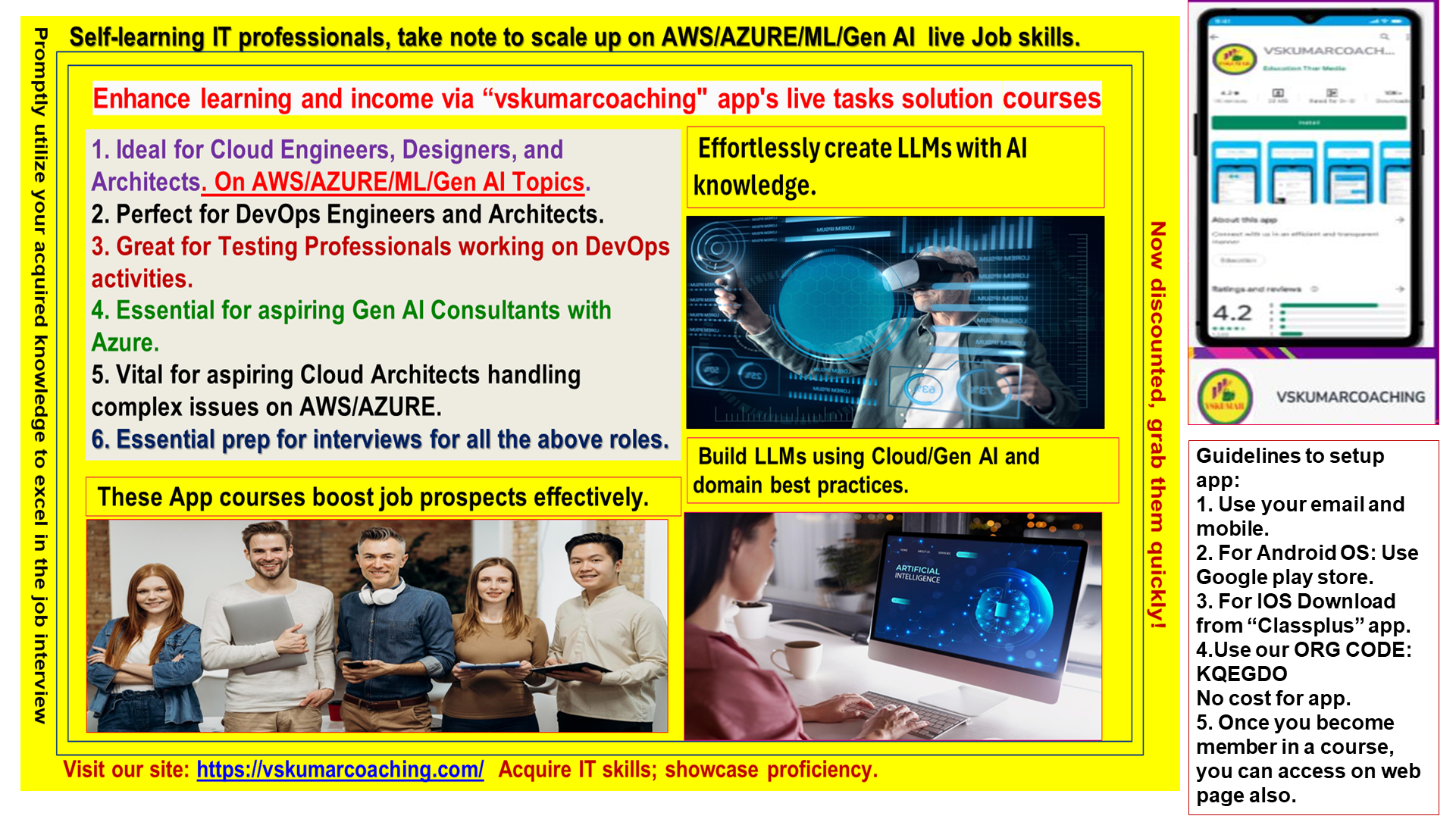
The Ultimate Guide to Self-Learning Cloud, DevOps, ML, Generative AI, and MLOps Skills with Digital Courses

IDiscover the Future of IT Management:

Integrating AIOps and MLOps for Enhanced Performance.

L1 and L2 professionals are essential in adapting to these evolving demands in IT through AIOps.

https://www.linkedin.com/pulse/future-management-integrating-ai-ops-mlops-optimal-shanthi-kumar-v–yemqc/?trackingId=ffLuccG%2FSGyWcMXnIxPA2w%3D%3D

Addressing Pain Points of L1/L2 Support Engineers with AI Solutions

The Ultimate Guide to Self-Learning Cloud, DevOps, ML, Generative AI, and MLOps Skills with Digital Courses

In today’s rapidly evolving technological landscape, staying ahead of the curve is more important than ever. Whether you’re looking to break into a new field or advance in your current career, acquiring skills in Cloud Computing, DevOps, Machine Learning (ML), Generative AI, and MLOps can open up a world of opportunities. One of the most effective ways to gain these skills is through self-learning with digital courses crafted by experienced coaches. In this blog, we’ll explore the numerous benefits of this approach and how you can make the most out of it.

Why Choose Self-Learning with Digital Courses?

  1. Personalized Learning Experience

Tailored Content: Digital courses designed by coaches can be customized to meet your specific learning goals, interests, and career aspirations. Unlike traditional classroom settings, where the curriculum is often rigid, these courses offer flexibility in content delivery.

Pacing: One of the most significant advantages of self-learning is that you can learn at your own pace. This allows you to spend more time on complex topics that require deeper understanding, ensuring better retention and mastery of the subject matter.

  1. Access to Expert Knowledge

Industry Insights: Coaches often bring real-world experience and insights to their courses. This contextual understanding helps bridge the gap between theoretical knowledge and practical application, making the learning process more relevant and engaging.

Up-to-Date Information: The tech industry is constantly evolving. Digital courses can be regularly updated to reflect the latest trends, technologies, and best practices, ensuring that you are always learning the most current information.

  1. Structured Learning Path

Clear Roadmap: A well-organized curriculum provides a clear roadmap for your learning journey. This structured approach helps you navigate through essential skills and knowledge areas systematically, reducing the overwhelm that often comes with self-learning.

Milestones and Goals: Coaches can set specific milestones and goals to track your progress. These checkpoints keep you motivated and accountable, making it easier to stay committed to your learning objectives.

  1. Flexibility and Convenience

Learn Anytime, Anywhere: Digital courses offer the ultimate flexibility, allowing you to access materials from any location. Whether you’re a full-time professional or a busy parent, you can fit learning into your schedule without compromising your responsibilities.

Diverse Learning Formats: These courses often include a variety of learning formats such as videos, quizzes, hands-on projects, and community forums. This diversity caters to different learning styles, making the process more engaging and effective.

  1. Practical Skills Development

Hands-On Experience: Many digital courses include practical exercises and projects that simulate real-world scenarios. These hands-on experiences help you apply what you’ve learned, reinforcing your skills and boosting your confidence.

Portfolio Building: Completing projects as part of your coursework allows you to build a portfolio that showcases your skills. This portfolio can be a valuable asset when applying for jobs or seeking promotions, providing tangible evidence of your capabilities.

  1. Networking Opportunities

Community Access: Engaging with a community of learners can provide valuable networking opportunities. Collaboration and support from peers can enhance your learning experience and open doors to new career opportunities.

Mentorship: Coaches often offer mentorship and guidance, helping you navigate your career path more effectively. This personalized support can be invaluable in overcoming challenges and achieving your goals.

  1. Cost-Effectiveness

Affordable Learning: Digital courses are often more affordable than traditional education options. This makes high-quality training accessible to a broader audience, democratizing education and skill development.

Value for Money: The ability to learn specific, in-demand skills that directly relate to job opportunities can lead to a higher return on investment. By focusing on practical, career-oriented skills, you can quickly see the benefits of your learning efforts.

  1. Career Advancement

In-Demand Skills: Acquiring skills in Cloud, DevOps, ML, Generative AI, and MLOps can significantly enhance your employability. These fields are in high demand, and having expertise in them can set you apart in a competitive job market.

Promotion Opportunities: Continuous learning and skill development can position you for promotions and new job roles within your organization. By staying current with industry trends, you demonstrate your commitment to professional growth and advancement.

  1. Self-Motivation and Discipline

Self-Directed Learning: Taking responsibility for your learning fosters self-discipline and motivation. These are essential skills in any professional setting, contributing to your overall effectiveness and success.

Confidence Building: Mastering new skills through self-learning can boost your confidence and sense of accomplishment. This newfound confidence can positively impact other areas of your life, both personally and professionally.

  1. Future-Proofing Your Career

Adaptability: Learning these skills prepares you for the future.

What is our Four months Scaling up Coaching program for AZ-ML-MLOPS Job roles

My Latest Ebooks on Kindle

Azure Generative AI Guide: 500 Questions for Students, Pros, and Job Seekers: Mastering Generative AI with Azure: Your Comprehensive Q&A Resource for Certification, … issues, Root causes and solutions Book 

Mastering Azure Basic Services for Live Jobs: Navigating 50 Real-World Challenges in each Core Service Addressing 300 live issues with Solutions (Azure … issues, Root causes and solutions Book 1)

Cybersecurity Unlocked: Practical Implementation practices for IT Professionals and Students 

IT Training vs. Job Coaching in Machine Learning and AI: Bridging the Gap: IT Training vs. Job Coaching in Machine Learning and AI

Mastering Machine Learning: A Professional’s Guide to Generative AI Implementation.

Mastering AWS Landing Zone: 150 Interview Questions and Answers: An AWS implementation practitioner’s book focused on solutions.

Testing BI and ETL Applications with manual and automation approach: A comprehensive guide for Business Intelligence project evaluation.

Unlock Your Future Career with VSKUMARCOACHING Digital Courses

Unlock Your Future Career with VSKUMARCOACHING Digital Courses

In today’s rapidly evolving tech landscape, equipping yourself with the right skills is crucial for career advancement. By completing digital courses through the “VSKUMARCOACHING” app, you can effectively target several high-demand job roles in the cloud and machine learning domains. Here’s a look at some of the exciting career opportunities available to you:

1. Azure Solutions Architect
Utilize your knowledge of Azure services and live integration issues to design and implement impactful cloud solutions.

2. AWS Solutions Engineer
Leverage your experience with AWS live incidents, employing your problem-solving skills to support and enhance cloud infrastructure.

3. Cloud DevOps Engineer
Apply your expertise in automation, containerization, and live tasks to efficiently manage deployments and optimize development processes across Azure and AWS environments.

4. MLOps Engineer
Use your specialization in Azure ML and MLOps to develop and maintain robust machine learning workflows and frameworks.

5. Machine Learning Engineer
Focus on designing and building machine learning applications, leveraging knowledge of Generative AI and practical use cases.

6. Data Scientist
Analyze data and develop predictive models, guided by insights derived from Azure Machine Learning and MLOps principles.

7. DevOps Engineer
Employ best practices in automation, Terraform, and Python to streamline operations and enhance CI/CD pipelines in cloud environments.

8. AI/ML Solutions Architect
Design and implement innovative solutions that leverage machine learning and AI capabilities in the cloud, with a focus on Generative AI.

9. Cloud Consultant
Advise organizations on optimizing cloud strategies by integrating AWS and Azure capabilities to meet their business objectives.

10. Technical Trainer/Educator
Share your knowledge and skills by training others in Azure, AWS, and machine learning, helping to build the next generation of tech talent.

These roles not only demand a combination of technical skills but also practical experience and strategic thinking, all of which are cultivated through the courses offered by VSKUMARCOACHING. Embrace the opportunity to elevate your career and become a sought-after professional in the cloud and machine learning arenas. Your journey begins today!

#VSKUMARCOACHING
#Azure
#AWS
#CloudComputing
#DevOps
#MachineLearning
#MLOps
#DataScience
#GenerativeAI
#CareerDevelopment
#TechSkills
#CloudSolutions
#Automation
#AI
#TechEducation
#DigitalCourses
#ProfessionalGrowth
#LearningPath
#JobRoles
#ITCareers

Machine Learning: 10 Live Examples and Detailed Solutions You Need to Know

Machine Learning: 10 Live Examples and Detailed Solutions You Need to Know

Introduction: Understanding Machine Learning and Its Real-World Applications

machine learning, introduction to machine learning, machine learning applications, artificial intelligence examples

Example 1: Predictive Analytics in Retail – Enhancing Customer Experience

predictive analytics, customer insights, retail machine learning solutions, sales forecasting

Example 2: Image Recognition in Healthcare – Revolutionizing Diagnostics

image recognition, healthcare technology, diagnostic tools, medical image analysis

Example 3: Natural Language Processing in Chatbots – Improving Customer Support

natural language processing, chatbots technology, customer service automation, conversational AI

Example 4: Fraud Detection in Finance – Securing Transactions with AI

fraud detection algorithms, financial security systems, transaction monitoring with ML, credit card fraud prevention

Example 5: Autonomous Vehicles – How ML Powers Self-Driving Cars

autonomous vehicles technology, self-driving cars algorithms, vehicle safety systems powered by AI

Example 6: Recommendation Engines for E-Commerce – Personalizing User Experience

recommendation systems example, e-commerce personalization strategies, product suggestions using ML

Example 7: Sentiment Analysis on Social Media Platforms – Understanding Public Opinion

manual sentiment analysis vs. automated tools; social media insights; public relations and marketing strategies using ML

Example 8: Energy Consumption Forecasting – Optimizing Resource Management

sustainable energy management; energy usage forecasting models; smart grid technology solutions

Example 9: Sports Analytics – Enhancing Team Performance and Strategy

s sports data analysis; performance metrics optimization; player statistics predictions using machine learning

Example 10: Smart Home Devices – Automating Daily Life with AI Technology

IOT devices powered by ML; smart home automation features; user behavior prediction technologies.

Unlock Your Potential: How Generative AI Coaching Can Accelerate Your Job Prospects

Boost Your Career with Generative AI Coaching: Gain Valuable Job Experience and Stand Out to Employers

  • In today’s competitive job market, having relevant job experience is crucial for securing your dream job. However, gaining job experience can be challenging, especially for recent graduates or individuals looking to switch careers. This is where Generative AI coaching comes in.

  • Generative AI coaching is a revolutionary technology that uses artificial intelligence to simulate real-world job experiences and provide personalized coaching to help individuals develop the skills they need to succeed in their chosen field. By using Generative AI coaching, individuals can gain valuable job experience without actually being in a job, allowing them to accelerate their job prospects and stand out to potential employers.

  • One of the key benefits of Generative AI coaching is that it allows individuals to practice and refine their skills in a safe and controlled environment. This means that they can make mistakes, learn from them, and improve without the fear of negative consequences. This not only boosts their confidence but also helps them develop the skills and knowledge needed to excel in their chosen field.

  • Additionally, Generative AI coaching can help individuals gain exposure to different job roles and industries, allowing them to explore their interests and discover new career opportunities. This can be especially beneficial for individuals who are unsure of what they want to do or are looking to switch careers, as it allows them to try out different roles and see what they enjoy and excel at.

  • Furthermore, the personalized coaching provided by Generative AI coaching can help individuals identify their strengths and weaknesses and develop a personalized development plan to help them reach their career goals. This targeted coaching can help individuals improve their skills, build their confidence, and ultimately increase their job prospects.

  • Overall, Generative AI coaching offers a unique and effective way for individuals to gain job experience, develop their skills, and accelerate their job prospects. By using this innovative technology, individuals can stand out to potential employers, increase their chances of securing their dream job, and ultimately achieve career success.

#GenerativeAIcoaching

#ITJobexperience

#Careerdevelopment

#Artificialintelligence

#ITJobprospects

#ITSkilldevelopment

#ITPersonalizedcoaching

#ITAcceleratecareer

#ITJobmarket

#ITFuturejobtraining

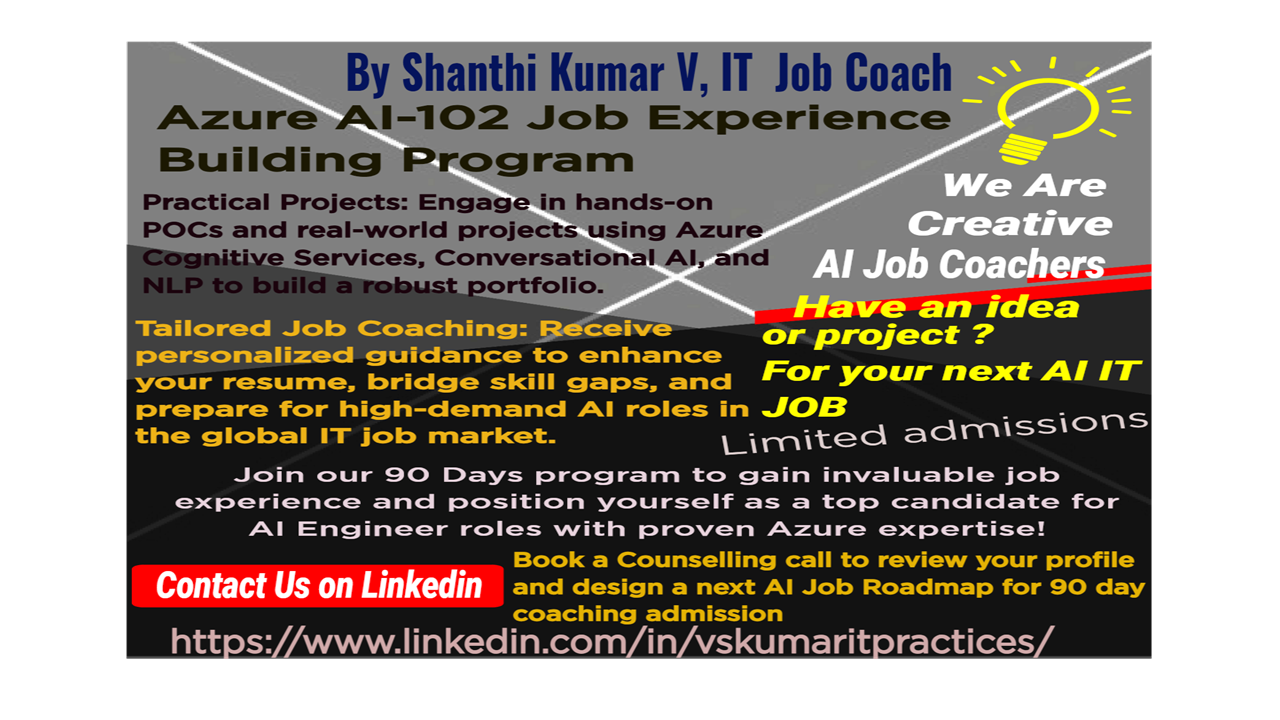
Do you want to Self learn Azure Gen Ai [AZ-102] Job live tasks ?

Do you want to Self-learn Azure Gen Ai [ AZ-102 Job live tasks?
You might have the below questions also:
1. How does the Gen AI course integrate Azure Cognitive Services and Knowledge Mining for live task experience?
2. Can you elaborate on the types of scenarios typically covered under the Azure Cognitive Services discussed in this course?
3. What are some practical examples of how Conversational AI solutions are taught and applied within this course?
4. In what ways does the program focus on developing domain-specific knowledge for leveraging Natural Language Processing in real-world AI applications?
5. How does the course address practical applications of Computer Vision within the context of the AI-102 exam and live project experience?
6. What scenario-based questions related to Azure Cognitive Services can students expect to encounter in this comprehensive training?
7. How does this course prepare students to understand and create practical applications using Azure Cognitive Search in an AI-based environment?
8. Can you explain the approach to presenting and learning from the 50 scenario-based questions integrated into the AI-102 exam curriculum?
9. In what specific ways does the program work towards providing practical, domain-specific knowledge and real-world solutions for Azure Cognitive Services applied in a professional setting?
10. How does the integrated job coaching discussion videos add supplementary value to this comprehensive Gen AI course?

This course addresses all these aspects comprehensively to facilitate faster upskilling.
See the content from this link:
https://lnkd.in/gTAn_ZGF
Avail the hectic discount for these live experiences gaining.

#SelfLearning #AZ102 #JobTasks #AzureCertification #MicrosoftCertification #CloudLearning #ProfessionalDevelopment #UpSkill #CareerGrowth

The Roles of GEN AI+ML Consultant/Lead and Solution Architect – GenAI & Cloud

Exploring the Roles of GEN AI+ML Consultant/Lead and Solution Architect – GenAI & Cloud

In the rapidly evolving world of artificial intelligence (AI) and machine learning (ML), the demand for skilled professionals is greater than ever. Two key roles that stand out in this landscape are the GEN AI+ML Consultant/Lead and the Solution Architect – GenAI & Cloud. Let’s dive into what these roles entail, the responsibilities they carry, and the skills required to excel in them.

GEN AI+ML Consultant/Lead

Key Responsibilities:

  1. Leadership and Management: Lead and manage AI teams, fostering a collaborative and innovative work environment.
  2. Model Development and Deployment: Develop and deploy AI models, particularly those based on Generative AI frameworks.
  3. Architectural Design: Define and oversee the implementation of AI architecture that aligns with business goals.
  4. Innovation: Drive innovation in AI capabilities, generating new ideas and strategies to enhance performance.
  5. Troubleshooting: Identify issues and improve current AI systems through effective troubleshooting.
  6. Business to Technical Translation: Convert business use-cases into technical requirements and implement suitable algorithms.
  7. Collaboration: Work alongside cross-functional teams to design and integrate AI systems.
  8. Staying Updated: Keep abreast of the latest technology trends to ensure strategies remain relevant and effective.

Required Skills:

  • Leadership: Strong leadership abilities to guide and mentor your team.
  • Technical Proficiency: Expertise in programming languages such as Python, Node.Js, C#, HTML, and JavaScript.
  • AI Libraries and Frameworks: Familiarity with tools like TensorFlow, Pytorch, and NLTK.
  • Cloud Platforms: Understanding deployment frameworks and cloud services (AWS, Azure, Google Cloud).
  • AI Concepts: Knowledge in supervised and unsupervised learning, neural networks, and time-series forecasting.

Solution Architect – GenAI & Cloud

Key Responsibilities:

  1. Project Leadership: Lead the development and implementation of Generative AI and Large Language Model (LLM) projects, ensuring they align with business objectives.
  2. Proof of Concepts (POCs): Design and deploy POCs and Points of View (POVs) across various industry verticals to demonstrate the potential of Generative AI applications.
  3. Customer Engagement: Engage effectively with customer CXOs and Business Unit heads to showcase and demonstrate the relevance of Generative AI applications.
  4. Cross-Functional Collaboration: Collaborate with different teams to integrate AI/ML solutions into cloud environments effectively.

Required Skills:

  • Experience: At least 12 years of experience in AI/ML with a focus on Generative AI and LLMs.
  • Cloud Expertise: Proven track record working with major cloud platforms (Azure, GCP, AWS).
  • Model Deployment: Understanding of how to deploy models on cloud and on-premise environments.
  • API Utilization: Ability to leverage APIs to build industry solutions.

Common Tasks and Skills

Both roles share several common tasks and skills, including:

  • Leading and managing AI teams.
  • Developing and deploying AI models.
  • Designing AI architectures.
  • Collaborating with cross-functional teams.
  • Driving innovation and engaging with customers.
  • Troubleshooting and improving AI systems.
  • Converting business use-cases into technical requirements.
  • Integrating AI solutions into cloud environments.
  • Keeping up to date with technology trends.

Additional Skills:

  • Research Interpretation: Ability to interpret research literature and implement algorithms based on business needs.
  • Communication: Excellent verbal and written communication skills.
  • Mentorship: Proven ability to mentor and develop team members.

In summary, the roles of GEN AI+ML Consultant/Lead and Solution Architect – GenAI & Cloud are critical in advancing AI initiatives within organizations. These positions require a blend of technical expertise, leadership, and innovative thinking to drive successful AI projects. If you’re passionate about AI and ready to take on these challenges, these roles offer exciting opportunities to shape the future of technology.

See this discussion video:

#ArtificialIntelligence #MachineLearning #GenerativeAI #AIConsultant #SolutionArchitect #CloudComputing #AIArchitecture #DataScience #AIInnovation #TechLeadership #AIProjects #AIModels #CrossFunctionalTeams #AIIntegration #AITrends #CareerInTech #TechRoles #AICommunity #CloudSolutions #AIEngineering #FutureOfAI

Unlocking the Power of Retrieval-Augmented Generation (RAG): A Cost-Effective Approach to Enhance LLMs

Unlocking the Power of Retrieval-Augmented Generation (RAG): A Cost-Effective Approach to Enhance LLMs

Table of Contents:

  1. Introduction
  2. What is Retrieval-Augmented Generation (RAG)?
  3. Key Benefits of RAG
  4. Cost Benefits of Using RAG over Retraining Models
  5. Limitations of RAG in Adapting to Domain-Specific Knowledge
  6. Conclusion

About This Blog Post:

In today’s digital landscape, language models have become increasingly popular for their ability to generate human-like text. However, these models are not perfect and often struggle with accuracy and relevance. One approach to improve their performance is Retrieval-Augmented Generation (RAG), a cost-effective framework that enhances the quality and accuracy of large language model (LLM) responses by retrieving relevant information from an external knowledge base.

What is Retrieval-Augmented Generation (RAG)?

RAG is an AI framework that improves the quality and accuracy of LLM responses by retrieving relevant information from an external knowledge base to supplement the LLM’s internal knowledge. It has two main components: Retrieval and Generation. The Retrieval component searches for and retrieves snippets of information relevant to the user’s prompt or question from an external knowledge base. The Generation component appends the retrieved information to the user’s original prompt and passes it to the LLM, which then draws from this augmented prompt and its own training data to generate a tailored, engaging answer for the user.

Key Benefits of RAG

RAG offers several key benefits, including:

  • Providing LLMs access to the most current, reliable facts beyond their static training data
  • Allowing users to verify the accuracy of the LLM’s responses by checking the cited sources
  • Reducing the risk of LLMs hallucinating incorrect information or leaking sensitive data
  • Lowering the computational and financial costs of continuously retraining LLMs on new data

Cost Benefits of Using RAG over Retraining Models

Using RAG offers several cost benefits compared to traditional model retraining or fine-tuning. These benefits include:

  • Reduced Training Costs: RAG does not require the extensive computational resources and time associated with retraining models from scratch.
  • Dynamic Updates: RAG allows for real-time access to up-to-date information without needing to retrain the model every time new data becomes available.
  • Flexibility and Adaptability: RAG systems can easily adapt to new information and contexts by simply updating the external knowledge sources.
  • Minimized Hallucinations: RAG reduces the risk of hallucinations by grounding responses in retrieved evidence.
  • Lower Resource Requirements: RAG can work effectively with smaller models by augmenting their capabilities through retrieval, leading to savings in cloud computing expenses and hardware procurement.

Limitations of RAG in Adapting to Domain-Specific Knowledge

While RAG provides a flexible approach to integrating external knowledge, it has several limitations when it comes to adapting to domain-specific knowledge. These limitations include:

  • Fixed Passage Encoding: RAG does not fine-tune the encoding of passages or the external knowledge base during training, which can lead to less relevant or accurate responses in specialized contexts.
  • Computational Costs: Adapting RAG to domain-specific knowledge bases can be computationally expensive.
  • Limited Understanding of Domain-Specific Contexts: RAG’s performance in specialized domains is not well understood, and the model may struggle to accurately interpret or generate responses based on domain-specific nuances.
  • Hallucination Risks: RAG can still generate plausible-sounding but incorrect information if the retrieved context is not sufficiently relevant or accurate.
  • Context Window Limitations: RAG must operate within the constraints of the context window of the language model, which limits the amount of retrieved information that can be effectively utilized.

Conclusion

In conclusion, RAG is a cost-effective framework that can enhance the quality and accuracy of LLM responses by retrieving relevant information from an external knowledge base. While it has several limitations, RAG offers several key benefits, including reduced training costs, dynamic updates, flexibility, and minimized hallucinations. By understanding the limitations of RAG, developers and organizations can better implement and adapt this framework to meet their specific needs and improve the overall performance of their language models.

Here are the #tags for the blog post:

#RetrievalAugmentedGeneration, #RAG, #LLMs, #LanguageModels, #AI, #MachineLearning, #NaturalLanguageProcessing, #NLP, #CostEffective, #DomainSpecificKnowledge, #ExternalKnowledgeBase, #KnowledgeRetrieval, #GenerativeAI, #Chatbots, #ConversationalAI, #ArtificialIntelligence, #AIApplications, #AIinBusiness, #AIinIndustry

Revolutionizing IT Interviews with AI Chatbots: A Comprehensive Guide

Title: “Revolutionizing IT Interviews with AI Chatbots: A Comprehensive Guide”

In today’s competitive IT landscape, AI chatbots offer a transformative approach to streamlining interview processes, utilizing Azure Cognitive Services to create intuitive and insightful interactions. Here’s how these chatbots can be leveraged for IT interviews:

  1. Initial Screening: AI chatbots conduct preliminary interviews to filter out unqualified candidates and determine their background, skills, and interest in the role. Employing Azure QnA Maker, a knowledge base is established to address common interview questions and responses.
  2. Interview Scheduling Automation: Chatbots seamlessly handle interview scheduling by engaging with candidates to find suitable times, integrating Azure Bot Service with calendar APIs for efficient meeting arrangements.
  3. Technical Assessments: Chatbots facilitate technical evaluations by administering coding challenges and analyzing candidates’ technical knowledge. Leveraging Azure Cognitive Search, these chatbots compare responses against a model answer database.
  4. Interview Feedback: Following interviews, chatbots provide candidates with personalized feedback, highlighting their strengths and areas for improvement. Utilizing Azure Text Analytics, these chatbots assess candidates’ responses for insightful feedback generation.

While AI chatbots offer significant benefits, it’s important to acknowledge limitations, such as the potential challenge in evaluating soft skills and the need for careful integration with HR systems. By optimizing the design using Azure Cognitive Services, AI chatbots can effectively enhance the interview process.

For further insights, explore the following resources:

This holistic guide emphasizes the potential of AI chatbots in revolutionizing IT interviews and provides valuable insights to maximize their efficacy.

#AIChatbots #InterviewAutomation #AzureCognitiveServices #HRInnovation #ITRecruitment #ChatbotTechnology #InterviewEfficiency

Learning Guidelines for Generative AI Security Consultants

For our Solution discussions, visit:

https://vskumarcoaching.com/cloud-security

Learning Guidelines for Generative AI Security Consultants

Understanding of Generative AI Technologies

  1. Familiarize with Generative AI Frameworks: Gain proficiency in popular generative AI frameworks such as GPT-3, DALL-E, and Stable Diffusion. Understand their underlying architectures, capabilities, and limitations.
  2. Master Natural Language Processing (NLP): Develop a strong understanding of NLP techniques, including text generation, language modeling, and sentiment analysis. Learn how these techniques are applied in generative AI systems.
  3. Explore Deep Learning Fundamentals: Study the core concepts of deep learning, including neural networks, convolutional neural networks (CNNs), and recurrent neural networks (RNNs). Understand how these techniques power generative AI models.
  4. Gain Hands-on Experience: Practice implementing and fine-tuning generative AI models using programming languages like Python and relevant libraries (e.g., TensorFlow, PyTorch).

Cybersecurity Fundamentals

  1. Understand Cybersecurity Principles: Establish a solid foundation in cybersecurity concepts, including risk management, threat modeling, and incident response.
  2. Tailor Cybersecurity to AI Applications: Learn how to apply traditional cybersecurity practices to the unique challenges and vulnerabilities of AI systems, such as model poisoning and adversarial attacks.
  3. Study Secure Software Development Lifecycle: Familiarize yourself with secure software development practices, including secure coding, testing, and deployment, specifically for AI-powered applications.
  4. Explore Incident Response for AI Systems: Develop skills in detecting, investigating, and responding to security incidents involving generative AI models and their associated data.

Data Privacy and Compliance

  1. Understand Data Protection Regulations: Gain in-depth knowledge of data privacy regulations, such as GDPR and CCPA, and their implications for the use of generative AI technologies.
  2. Learn Best Practices for Securing Sensitive Data: Study techniques for protecting sensitive data used in the training and deployment of generative AI models, including data anonymization, encryption, and access controls.
  3. Develop Compliance Frameworks: Create and implement compliance frameworks to ensure that generative AI applications adhere to relevant data protection standards and industry-specific regulations.
  4. Stay Updated on Regulatory Changes: Continuously monitor updates and changes in data privacy laws and regulations to maintain compliance for your organization’s generative AI initiatives.

Vulnerability Assessment

  1. Identify AI-specific Vulnerabilities: Develop the skills to identify and assess vulnerabilities unique to generative AI systems, such as model biases, data poisoning, and adversarial attacks.
  2. Conduct Penetration Testing: Learn how to perform comprehensive penetration testing on generative AI applications, simulating real-world attacks to uncover security weaknesses.
  3. Implement Mitigation Strategies: Devise and implement effective mitigation strategies to address the identified vulnerabilities, ensuring the overall security and resilience of generative AI systems.
  4. Stay Informed on Emerging Threats: Continuously research and stay updated on the latest security threats and attack vectors targeting generative AI technologies to proactively address them.

By mastering these technical skills, Generative AI Security Consultants can effectively secure AI applications, protect sensitive data, and ensure compliance with relevant regulations, while leveraging the capabilities of generative AI technologies to enhance their organization’s security posture.

https://vskumarcoaching.com/salesforce-marketing/f/essential-skills-for-generative-ai-security-consultants

#GenerativeAIFrameworks

#NaturalLanguageProcessing

#DeepLearningFundamentals

#HandsOnExperience

Azure Security Consultant: Roles and Responsibilities

Azure Security Consultant: Roles and Responsibilities

As an Azure Security Consultant, your primary responsibilities are to protect networks and systems from external or internal attacks, identify and prevent cyber threats, and ensure the security of clients’ Azure environments[1].

Role

  • Understand how attackers think, work, and act in order to effectively defend against threats[1]
  • Identify vulnerabilities in Azure systems and networks that attackers can exploit[1]
  • Use this vulnerability information to build robust security solutions to strengthen Azure environments[1]
  • Verify that clients’ Azure resources are secure and compliant with security best practices[1]

Responsibilities

Security Assessment and Recommendations

  • Conduct thorough security assessments of clients’ Azure deployments to identify risks and vulnerabilities[1]
  • Analyze security logs and monitoring data to detect potential threats and anomalies[3]
  • Provide actionable recommendations to improve the security posture of Azure resources[1]
  • Help clients prioritize and remediate security issues in a timely manner[1]

Security Implementation and Management

  • Design and implement security controls and solutions in Azure to protect against cyber threats[1]
  • Configure Azure security services like Azure Security Center, Azure Sentinel, and Azure Firewall[3]
  • Manage and maintain Azure security solutions to ensure continuous protection[1]
  • Automate security tasks and integrate Azure security with DevOps pipelines[3]

Compliance and Governance

  • Ensure clients’ Azure environments adhere to industry standards, regulations, and best practices[1]
  • Help clients define and implement Azure security policies and baselines[1]
  • Conduct regular security audits and generate compliance reports[1]
  • Assist with Azure resource management using Azure Resource Manager templates[2]

Incident Response and Disaster Recovery

  • Develop and test incident response and disaster recovery plans for Azure environments[1]
  • Provide guidance and support during security incidents and data breaches[1]
  • Coordinate with incident response teams to contain, eradicate, and recover from attacks[1]
  • Conduct post-incident reviews and implement lessons learned to improve security[1]

Client Engagement and Knowledge Sharing

  • Collaborate with clients to understand their security requirements and objectives[4]
  • Communicate security risks, recommendations, and solutions effectively to stakeholders[4]
  • Share Azure security best practices and knowledge with clients and team members[4]
  • Stay updated with the latest Azure security features, services, and industry trends[4]

As an Azure Security Consultant, you play a crucial role in protecting clients’ Azure environments and helping them achieve their security goals. By leveraging your expertise in Azure security, you can help organizations mitigate risks, ensure compliance, and build resilient cloud infrastructures.

Citations:
[1] Roles and Responsibilities of a Cyber Security Consultant
[2] Microsoft Azure Security Fundamentals
[3] Cloud Security Consultant Job Description
[4] Security Consultant Career Overview

#AzureSecurityExpertise

#VulnerabilityManagement

#SecuritySolutions

#SecurityAssessment

#ThreatAnalysis

#SecurityRecommendations

#RemediationPrioritization

#SecurityControls

#AzureSecurityServices

#SecurityAutomation

#DevSecOps

Transformation of Data Analyst Activities to Azure Machine Learning (Azure ML)

### Transformation of Data Analyst Activities to Azure Machine Learning (Azure ML)

To adapt and enhance traditional data analyst activities using cutting-edge technologies like Azure Machine Learning (Azure ML), the following transformations and integrations can be implemented:

  1. Data Collection and Preparation with Azure ML:
  • Utilize Azure ML capabilities for streamlined data collection from diverse sources with enhanced data quality checks and preprocessing steps, ensuring data integrity for reliable analyses[2][5].
  1. Data Exploration and Analysis Using Azure ML:
  • Employ Azure ML tools for advanced exploratory data analysis, including machine learning algorithms for pattern recognition, clustering, and predictive modeling to derive deeper insights[2][5].
  1. Data Visualization Enhancements with Azure ML:
  • Leverage Azure ML’s integrated visualization features to create interactive dashboards and reports that dynamically represent complex data findings and facilitate stakeholder understanding[2][5].
  1. Reporting and Communication Efficiency via Azure ML:
  • Utilize Azure ML for automated report generation, real-time data updates, and seamless communication channels to share insights with non-technical audiences, enhancing decision-making processes[2][4].
  1. Enhanced Collaborative Data Analysis in Azure ML Environment:
  • Collaborate seamlessly within Azure ML’s workspace, facilitating cross-functional team engagements, sharing data insights, and aligning analyses with organizational objectives for data-driven strategies[2][3].

Transformation towards Azure Machine Learning (Azure ML) – Key Activities Recap:

  • Azure ML Data Collection and Preparation: Simplified data gathering with enhanced accuracy and relevance checks.
  • Azure ML Data Exploration and Analysis: Advanced analytics tools for pattern identification and predictive modeling.
  • Azure ML Data Visualization Enhancement: Dynamic visual representations for simplified data communication.
  • Azure ML Reporting and Communication: Automated reporting and efficient insights sharing for non-technical audiences.
  • Azure ML Collaborative Analysis: Seamless teamwork within Azure ML workspace for aligned data analysis.

Transformation of Data Analyst Activities to Azure Gen AI

Adapting traditional data analyst tasks into Azure Gen AI involves leveraging artificial intelligence capabilities offered by Azure to elevate data analysis practices. Here’s how the key activities can be transformed:

  1. Data Analyst Statistical Analysis with Azure Gen AI:
  • Incorporate Azure Gen AI’s advanced statistical models for data examination, generating deeper insights through AI-driven analytics techniques.
  1. Azure Gen AI Data Visualization Enhancements:
  • Utilize Azure Gen AI’s AI-powered visualization tools to create interactive dashboards and intuitive data representations, enhancing stakeholder understanding.
  1. Data Cleaning and Preparation with Azure Gen AI:
  • Employ Azure Gen AI for automated data cleaning processes, anomaly detection, and data augmentation, ensuring data quality and usability.
  1. Predictive Modeling and Forecasting Using Azure Gen AI:
  • Integrate Azure Gen AI’s predictive analytics capabilities to develop robust forecasting models, leveraging AI algorithms for accurate predictions and trend analysis.
  1. Natural Language Processing (NLP) for Reporting with Azure Gen AI:
  • Harness Azure Gen AI’s NLP functionalities for automated report generation, storytelling, and natural language communication of data insights to diverse audiences.

Transformation towards Azure Gen AI – Key Activities Recap:

  • Azure Gen AI Statistical Analysis: Advanced AI-driven statistical modeling for comprehensive data examination.
  • Azure Gen AI Data Visualization: Interactive visualizations using AI-powered tools for enhanced data representation.
  • Azure Gen AI Data Cleaning and Preparation: Automated data cleaning and augmentation processes for improved data quality.
  • Azure Gen AI Predictive Modeling: AI-driven forecasting capabilities for accurate predictions and trend analysis.
  • Azure Gen AI NLP Reporting: Natural Language Processing for automated report generation and effective data storytelling.

By integrating Azure Machine Learning (Azure ML) and Azure Gen AI into traditional data analyst activities, organizations can unlock new possibilities for advanced data analysis, predictive modeling, and improved decision-making processes.


For additional insights and references, please refer to:
[2] https://www.simplilearn.com/data-analyst-job-description-article
[3] https://emeritus.org/in

#DataAnalysis #AzureMachineLearning #AzureGenAI #DataInsights #DataVisualization #StatisticalAnalysis #PredictiveModeling #DataPreparation #CollaborativeAnalysis #ArtificialIntelligence #AzureIntegration #DataCollection #Reporting #Communication #DecisionMaking #AdvancedAnalytics #DataQuality #NaturalLanguageProcessing #InteractiveVisualization

Unveiling the Diverse Applications of Clustering Algorithms in Data Analysis

## Unveiling the Diverse Applications of Clustering Algorithms in Data Analysis

Clustering algorithms are indispensable tools in data analysis across numerous industries, showcasing their versatility and significance in generating insights. Here are key utilization scenarios where clustering algorithms excel:

Customer Segmentation

Marketing strategies leverage clustering to categorize customers based on their purchasing habits, demographics, or preferences. This segmentation enables businesses to craft targeted campaigns and personalized recommendations for each customer segment[1][4].

Market Basket Analysis

Retail establishments employ clustering to scrutinize sales data and identify correlated product purchases. This information informs product placement strategies, promotional activities, and cross-selling initiatives[5].

Social Network Analysis

Clustering techniques empower social media platforms to comprehend user behavior, facilitate content recommendations, and pinpoint influential users within the network[5].

Anomaly Detection

Clustering algorithms like DBSCAN play a pivotal role in identifying anomalies or outliers in real-time data streams. This capability is integral for fraud detection, network security, and fault diagnosis in manufacturing scenarios[2][5].

Image Segmentation

Medical imaging utilizes clustering for the identification of diseased regions or areas of interest in diagnostic images such as X-rays and MRIs. This aids in the early detection and monitoring of diseases[5].

Simplification of Complex Datasets

Clustering aids in representing intricate datasets through cluster IDs, simplifying data management, particularly when dealing with voluminous datasets. These cluster IDs serve as a condensed representation of the original feature set, enhancing data accessibility[5].

Exploratory Data Analysis

Data analysts rely on clustering during the preliminary phases of data exploration to unearth patterns, trends, and relationships within the dataset. This process facilitates hypothesis generation and identifies areas warranting further investigation[4].

These diverse applications underscore the pivotal role of clustering algorithms in extracting valuable insights from data, thereby bolstering decision-making processes across a spectrum of industries encompassing marketing, retail, healthcare, and social media.

Citations:

  1. Neptune.ai – Clustering Algorithms
  2. Explorium.ai Article
  3. JavaTpoint – Clustering in Machine Learning
  4. DataCamp Blog
  5. GeeksForGeeks – Clustering in Machine Learning

#Customer Segmentation

#Market Basket Analysis

#Social Network Analysis

#Anomaly Detection

#Image Segmentation

Simplification of Complex Datasets

#Exploratory Data Analysis

Exploring the World of Data Science and Machine Learning: An Insightful Journey with 5 use cases

Title: Exploring the World of Data Science and Machine Learning: An Insightful Journey

Data science and machine learning have become pivotal realms in today’s technological landscape, offering powerful tools and insights that drive informed decision-making and strategic planning. Whether you’re a curious beginner or a seasoned professional, embarking on a journey to explore these dynamic fields can open up a world of opportunities. In this article, we’ll dive into the offerings of free sessions on data science and machine learning while exploring compelling use cases that exemplify the practical applications of data science across diverse domains. Join us as we unravel the transformative potential of data-driven insights.

Unveiling the Essence of Data Science and Machine Learning

To embark on this journey, it’s essential to understand the core principles of data science and machine learning. Data science, as a multidisciplinary domain, leverages scientific techniques, algorithms, and systems to extract valuable insights from both structured and unstructured data. By combining expertise from statistics, computer science, and domain knowledge, data science enables organizations to analyze complex data and derive actionable insights that drive impactful decision-making.

Machine learning, a branch of artificial intelligence, empowers computers to learn from data autonomously, uncover patterns, and make informed predictions without explicit programming. This capability revolutionizes industries by enabling intelligent decision-making and predictive modeling, thus unlocking a wealth of opportunities for innovation and growth.

Exploring Real-World Use Cases

  1. Detecting Financial Fraud:
    Data science techniques can be employed to analyze financial data, identifying irregular patterns and anomalies that signal potential fraudulent activities. This approach serves as a proactive measure to safeguard against financial losses and ensure the integrity of financial transactions, thereby bolstering trust and transparency in the financial realm.
  2. Enhancing Healthcare through Predictive Analytics:
    By leveraging data science techniques, healthcare professionals can analyze patient data to predict disease outbreaks, enhance diagnosis accuracy, and optimize treatment outcomes. This proactive approach empowers healthcare management to make informed decisions, improve patient care, and foster a healthier society.
  3. Anticipating Customer Churn in Telecom:
    Through the analysis of customer behavior and usage data, data science enables telecom companies to predict the likelihood of customer churn. Armed with these insights, proactive measures can be implemented to retain customers, fostering long-term relationships and enhancing customer satisfaction.
  4. Optimizing Retail Operations through Demand Forecasting:
    Retail businesses harness data science to analyze sales data, customer demographics, and external factors to forecast product demand accurately. This not only improves inventory management and operational efficiency but also enables businesses to craft effective pricing strategies to meet consumer demands.
  5. Personalizing Marketing and Recommendations:
    Data science facilitates the analysis of customer preferences and behaviors, enabling businesses to personalize marketing campaigns and develop sophisticated recommendation systems. By tailoring offerings to individual preferences, businesses can enhance customer engagement and drive brand loyalty.

Discovering the Free Sessions: A Glimpse into Practical Insights and Applications

The free sessions on data science and machine learning provide a comprehensive introduction to these domains, offering participants a deep dive into diverse use cases across different industries. Throughout these sessions, attendees can expect to gain insights into business and technical solution designs, understand the practical implementation of these solutions, and explore coding guidelines for executing these use cases effectively.

In essence, these sessions bridge the gap between theoretical knowledge and practical application, empowering participants to envision how data-driven insights can be transformed into real-world solutions. Whether you’re an aspiring data scientist or a business professional seeking to harness the potential of data-driven strategies, these sessions serve as a valuable gateway to embark on a transformative journey.

In conclusion, the world of data science and machine learning presents a tapestry of opportunities for innovation, growth, and informed decision-making. By immersing yourself in these dynamic disciplines, you can uncover the transformative potential of data-driven insights and pave the way for impactful solutions in your professional endeavors. Join us on this enlightening journey, and unlock the power of data science and machine learning to drive success and innovation in your ventures.

#DataScience #MachineLearning #FreeSessions #PredictiveAnalytics #FraudDetection #Healthcare #Telecom #Retail #Marketing #BusinessSolutions #TechnicalSolutions #CodingGuidelines #DataDrivenInsights #ArtificialIntelligence #Innovation

I am hosting Daily Data Science and ML Free sessions from 8 PM to 9 PM IST. They will be available from this URL:
The Daily sessions upload link: https://vskumarcoaching.com/data-science%26ml-sessions

Empowering ML Professionals: A Path to Mastery in Generative AI Services

Empowering ML Professionals: A Path to Mastery in Generative AI Services

As a Machine Learning professional, the evolving landscape of AI presents an enticing opportunity for growth and specialization. Transitioning into the domain of Generative AI services offers a promising avenue for expanding your expertise and advancing your career. By harnessing proven job skills, you can undergo a transformation that propels you into the realm of cutting-edge AI innovation.

The key to this transition lies in cultivating a deep understanding of Generative AI services and leveraging existing skills to effectively navigate this transformative journey. To gain valuable insights into this process, we invite you to explore a detailed video walkthrough, which delves into the intricate nuances and essential strategies required for this transition.

In this enlightening video tutorial (https://youtu.be/lSEwtlA7N_c), you will discover a comprehensive breakdown of the core skills and competencies needed to flourish in Generative AI services. The presentation unveils a roadmap tailored to propel Machine Learning professionals towards a proficiency in Generative AI, equipping them with the prerequisite knowledge to thrive in this specialized domain.

By following this detailed guidance, you can harness your existing skill set to seamlessly transition into the realm of Generative AI services. This newfound expertise promises to not only broaden your professional horizons but also ensures that you remain at the forefront of the ever-evolving AI landscape.

Embark on this transformative journey and unleash your full potential in the world of Generative AI services. Discover how your established skills coalesce with the demands and intricacies of this specialized field, forging a path towards mastery in AI’s next frontier.

#MachineLearning #AIProfessionals #GenerativeAI #Specialization #CareerGrowth #SkillsTransformation #AIInnovation #Proficiency #ProfessionalDevelopment #VideoTutorial

Solution Demo on E-commerce Development and Azure Migration Essentials

Solution Demo on E-commerce Development and Azure Migration Essentials

Developing an e-commerce platform and migrating it to Microsoft Azure requires a well-structured plan and a clear understanding of the necessary steps. Here’s a concise overview of the key components involved in this process:

  1. Functional Requirements for an E-commerce Platform
  • Defining essential functionalities for a comprehensive e-commerce platform, including user management, product management, order management, customer service, and marketing features.
  1. Creating the Legacy (Non-Cloud) Infrastructure Plan
  • Outlining the required server infrastructure to support the e-commerce platform, focusing on web servers, application servers, database servers, load balancers, and file servers.
  1. Azure Migration Plan for Legacy E-commerce Platform
  • Providing a detailed plan for migrating the e-commerce platform’s infrastructure to Azure, covering assessment and planning, migration execution (infrastructure, application, database, and data migration), and post-migration validation and cutover.
  1. E-Commerce Platform Migration to Azure Cloud: Resource Plan
  • Detailing the resources needed for the migration, including Azure infrastructure resources (compute, storage, database, and networking), tools (Azure Migrate, Azure Data Factory), and human resources (IT teams, developers, and database administrators).

Read for More Details

For a more detailed guide and a practical demonstration of the migration process, please read the full article and watch the demo video here. This demo, done by our coaching participant, provides a step-by-step guide on the key activities and strategies involved in migrating an e-commerce platform to Azure.

#EcommerceDevelopment #AzureMigration #CloudComputing #EcommercePlatform #AzureCloud #LegacyInfrastructure #AzureMigrationPlan #CloudMigration #EcommerceRequirements #ITInfrastructure #AzureResources #DigitalTransformation #AzureAssessment #DataMigration #ApplicationMigration #DatabaseMigration #AzureMigrate #AzureDataFactory #ITCoaching #CloudCoaching #EcommerceSolution #MicrosoftAzure #TechDemo #CloudServices #ITStrategy

Accelerate Your Career with AI Career Counseling at VSKUMARCOACHING

Title: Accelerate Your Career with AI Career Counseling at VSKUMARCOACHING

Are you ready to step into the exciting world of Generative AI and propel your career to new heights? Look no further! VSKUMARCOACHING brings you specialized IT career counseling tailored specifically for Generative AI roles. Here’s why you should dive into this opportunity:

  • Specialized Guidance: Navigate the unique requirements of Generative AI roles with expert guidance tailored to this dynamic field.
  • Stay Ahead in a Rapidly Evolving Industry: The field of Generative AI is constantly evolving. Our career counseling keeps you abreast of the latest technologies and trends.
  • Unlock Career Clarity: Unsure about which path to take in Generative AI? Our personalized assessments provide clarity on potential career options within the field.
  • Build Valuable Connections: Access mentors and industry experts to expand your network and unlock opportunities for internships, job placements, and collaborations.
  • Gain a Competitive Edge: With the high demand for AI professionals, our tailored career counseling equips you with the skills, experience, and interview preparation needed to excel in Generative AI roles.

At VSKUMARCOACHING, we believe in accelerating your career trajectory. Your time is a valuable asset – invest it wisely in upskilling and embracing the future of AI. Don’t miss out on this opportunity to supercharge your career in Generative AI. Book your slot now at VSKUMARCOACHING and take the first step towards a brighter tomorrow! 🚀✨

Let’s shape your future together!

Mastering Data Analysis with Real-Time Power BI Training

The “Real-Time Based Power BI Training Program” offers a comprehensive learning experience tailored to equip individuals with the practical skills and knowledge required to excel in the realm of data analysis and visualization. This article delves into the numerous benefits of enrolling in this program, highlighting how it can shape your abilities, boost your career prospects, and enhance your decision-making skills.

Hands-On Learning and Practical Skills Development

One of the key advantages of the Real-Time Power BI Training Program is the emphasis on hands-on experience. Participants engage in real-world projects and scenarios, allowing them to apply theoretical concepts into practical situations. This approach not only solidifies understanding but also hones skills that are directly applicable in professional settings. By working on authentic projects, individuals can gain valuable experience that prepares them for real-life data analysis challenges.

Job-Readiness and Career Advancement

Upon completion of the training program, participants emerge job-ready with a set of skills highly sought after in the data analysis and visualization field. The practical nature of the training equips individuals with the proficiency needed to thrive in data-centric roles. As organizations increasingly rely on data-driven insights, possessing expertise in tools like Power BI can significantly enhance career opportunities and open doors to diverse roles in data analysis, business intelligence, and decision support.

Data Analysis Proficiency and Visual Storytelling

An essential aspect of the program is its focus on enhancing data analysis proficiency. Participants learn how to leverage Power BI to extract meaningful insights from complex datasets. The ability to analyze data effectively and derive actionable insights is a vital skill in today’s data-driven economy. Moreover, the program equips individuals with the art of visual storytelling through insightful visualizations. Communicating data effectively through compelling visuals is a key skill that enhances the impact of data analysis outcomes.

Data-Driven Decision Making and Practical Application

Another significant benefit of the training program is the development of data-driven decision-making skills. By utilizing Power BI to analyze data and derive insights, participants become adept at making informed decisions based on data trends and patterns. The practical application of Power BI in real-world projects ensures that participants are well-versed in applying data analysis techniques to solve business problems and drive strategic decision-making processes.

Career Enhancement and Skill Advancement

Participants can expect a significant enhancement in their career prospects upon completing the Real-Time Power BI Training Program. The demand for professionals with data analysis and visualization skills is on the rise, making this training an invaluable asset for career advancement. Whether aspiring to enter the data analysis field or seeking to elevate existing skills, the program offers a pathway to success in data-intensive roles.

Conclusion

In conclusion, the “Real-Time Based Power BI Training Program” stands out as a comprehensive and practical training opportunity for individuals looking to excel in data analysis and visualization. Through hands-on experience, job-ready skills, data analysis proficiency, visual storytelling abilities, and a focus on data-driven decision-making, this program equips participants with the tools needed to succeed in today’s data-centric world. By enrolling in this training, individuals can embark on a rewarding journey towards professional growth and career success in the dynamic field of data analysis.

Get he course view from:
https://kqegdo.courses.store/480855?utm_source%3Dother%26utm_medium%3Dtutor-course-referral%26utm_campaign%3Dcourse-overview-webapp

Elevate Your Career in Marketing Technology: Job Opportunities with Salesforce Marketing Cloud Personalization and Interaction Studio

Mastering Salesforce Marketing Cloud Personalization with Interaction Studio: Transforming Customer Experiences

In the rapidly evolving realm of digital marketing, personalized interactions and tailored experiences have emerged as essential components for successful customer engagement. Salesforce Marketing Cloud Personalization, coupled with Interaction Studio, presents a robust platform for businesses to deliver individualized and targeted engagements to their customers. By delving into these tools and mastering their functionalities, individuals can unveil an array of benefits and tap into diverse job opportunities within the burgeoning field of marketing technology.

Unlocking the Power of Salesforce Marketing Cloud Personalization with Interaction Studio

  1. Real-Time Personalization: Interaction Studio empowers marketers to customize customer interactions instantly based on behavior, preferences, and intent. This feature enables businesses to provide timely and relevant content, recommendations, and offers to customers, thereby boosting engagement and conversions.
  2. Elevated Customer Experiences: Through Interaction Studio, marketers gain valuable insights into customer behaviors across various channels and touchpoints. This data serves as a catalyst for creating seamless and tailored customer journeys, resulting in enriched user experiences and heightened customer satisfaction.
  3. Omnichannel Engagement: Salesforce Marketing Cloud Personalization in conjunction with Interaction Studio equips marketers to orchestrate personalized interactions seamlessly across multiple channels, including email, mobile, web, and social media. This omnichannel approach ensures a cohesive brand experience and consistent messaging for customers.
  4. Data-Driven Decision-Making: Interaction Studio offers robust analytics and reporting features, enabling marketers to track, analyze, and optimize customer interactions effectively. By harnessing data-driven insights, businesses can make informed decisions, refine their strategies, and drive organizational growth.
  5. Enhanced Operational Efficiency: By automating personalized interactions and engagement strategies, marketers can streamline their marketing initiatives and enhance operational efficiency. This automation not only saves time and resources but also allows marketers to focus on strategic endeavors to drive tangible results.

Potential Job Roles for Proficient Learners

  1. Marketing Cloud Specialist: Individuals well-versed in Salesforce Marketing Cloud Personalization and Interaction Studio can pursue roles as Marketing Cloud Specialists. These professionals are tasked with designing and executing personalized marketing campaigns, managing customer interactions, and optimizing engagement strategies.
  2. CRM Manager: Proficiency in Interaction Studio opens pathways to positions as CRM Managers. These roles involve overseeing customer relationship management initiatives, implementing personalized communication strategies, and fostering customer retention and loyalty.
  3. Digital Marketing Analyst: Skilled practitioners in Salesforce Marketing Cloud Personalization can explore opportunities as Digital Marketing Analysts. These professionals analyze customer data, monitor campaign performance, and offer insights to enhance marketing efforts and drive superior return on investment.
  4. Marketing Automation Specialist: Mastery of Interaction Studio can lead to roles as Marketing Automation Specialists. These positions involve setting up automated marketing workflows, personalizing customer interactions, and refining overall campaign efficacy.
  5. Customer Experience Manager: Proficient learners in Salesforce Marketing Cloud Personalization with Interaction Studio can aim for positions as Customer Experience Managers. These professionals focus on enhancing customer journeys, optimizing touchpoints, and delivering personalized experiences to bolster customer satisfaction and loyalty.

In summary, mastering Salesforce Marketing Cloud Personalization with Interaction Studio bestows a plethora of benefits for marketers aiming to deliver personalized, engaging, and data-driven customer experiences. By acquiring and honing these skills, individuals can position themselves for exciting job opportunities in the dynamic and competitive realm of marketing technology.

Course Overview: Salesforce Marketing Cloud Personalization with Interaction Studio

Description: Delve into the world of personalized customer experiences with our Salesforce Marketing Cloud Interaction Studio course. Learn to harness real-time data and AI to craft tailored interactions across channels, driving customer engagement and conversions. Master the art of customer segmentation, journey mapping, and content personalization to deliver impactful messaging at the right moment.

Table of Contents:

  1. Website Introduction and Beacon Installation: Elevate user experiences with seamless integration of Marketing Cloud Personalization.
  2. Sitemap: Craft personalized user journeys with the Marketing Cloud Personalization Series.
  3. Sign-Up Pop-up (Use Case): Drive conversions with targeted messaging using Marketing Cloud Personalization.
  4. Info Bar (Use Case): Deliver real-time information to users with marketing Cloud Personalization.
  5. Einstein Recipe – Product Recommendations: Boost sales with smart product recommendations powered by Marketing Cloud Personalization.
  6. Banners (Use Case): Create impactful personalized banners to drive engagement.
  7. Abandoned Cart: Recapture lost sales by retargeting users with personalized reminders.
  8. Abandoned Browse: Re-engage users with tailored content based on browsing behavior.
  9. Exit Intent Pop-up: Prevent user churn with targeted messages using Marketing Cloud Personalization.
  10. Open Time Email Campaigns: Enhance email relevance with personalized campaigns at optimal times.

Enrolling in the Salesforce Marketing Cloud Personalization with Interaction Studio course is your gateway to mastering these essential tools and elevating your marketing campaigns to new heights. Start your journey towards becoming a proficient marketing technologist today!

Use below link to view the course:

Salesforce Marketing Cloud Personalization with Interaction Studio (courses.store)

DigitalMarketing #SalesforceMarketingCloud #InteractionStudio #PersonalizedMarketing #MarketingAutomation #CustomerExperience #RealTimePersonalization #AIinMarketing #MarketingStrategy #CustomerEngagement #MarketingEfficiency #CareerAdvancement #SalesforceCertification #NonITtoTech #MarketingTechnologist #OnlineCourse #LearnSalesforce #DigitalMarketingCourse #MarketingCloudPersonalization #CustomerInsights

Transform traditional ML practices with Azure Gen AI Cloud Solutions through 10 business scenarios.

Learn how you can Transform Traditional Machine Learning Practices with Azure Gen Ai Cloud Solutions: 10 Business Scenarios.

For more details visit my linkedin article:

https://www.linkedin.com/pulse/transforming-ml-practices-azure-gen-ai-cloud-10-cases-7dfqc/?trackingId=IwFm7KXTQFivwTzf9B1ttw%3D%3D

Elevate Your IT Career in the AI Era with VSKUMARCOACHING!

Enhance Your IT Career with Professional Coaching in Artificial Intelligence, Machine Learning, Cloud Computing, and DevOps.

Are you prepared to elevate your IT career in the era of Artificial Intelligence? The IT industry continues to evolve rapidly, making it essential to stay up-to-date with the latest trends. Whether your aspirations lie in roles like Cloud Engineer, DevOps Engineer, MLOps Engineer, or AI Architect, our coaching services are designed to equip you with the necessary expertise in AI, Machine Learning, Cloud computing, and DevOps methodologies. Proficiency in AWS, Azure, and GCP is vital for success in these positions.

Our personalized coaching ensures that your skillset aligns perfectly with the current demands of the IT market. Remarkably, our top achievers have experienced salary increases of up to 7X, a testament to the effectiveness of our coaching. You can explore more details and testimonials on our website: vskumarcoaching.com.

For independent learners, we provide digital courses through the “vskumarcoaching” app[https://clplearnol.page.link/6Yc1], granting you the freedom to enhance your abilities at your own pace. Alternatively, if you prefer individualized guidance, a counseling session with Shanthi Kumar V can help outline a personalized career advancement strategy. You can connect with Shanthi Kumar V on LinkedIn or contact via WhatsApp at +91-8885504679 to kickstart your upskilling and professional growth journey.

In the current IT landscape, investing in upskilling is not just about career progression; it also serves as a preventive measure against downsizing. Strategic career planning and continuous learning have enabled many of our former students to secure promotions even in challenging economic climates. This opportunity is your chance to invest wisely in your career for a guaranteed return on investment.

If you are ready to embark on this transformative experience, schedule a counseling call along with your resume via LinkedIn to take the initial step towards advancing your IT career.

Exciting opportunities await you in the AI-powered domain of IT. Wishing you the best as you forge your path to success in your IT career.

** Our Digital Courses:**
Download the “vskumarcoaching” app for live task demos and comprehensive learning.
https://vskumarcoaching.com/digital-%26-online-courses-1

Connect With Us:
Shanthi Kumar V: LinkedIn | WhatsApp: +91-8885504679

Note: Investing in career upskilling can save you many future pennies. Check testimonials and counseling session studies in my [Shanthi Kumar V] LinkedIn profile featured sections: https://www.linkedin.com/in/vskumaritpractices/

Reviews & Feedback: Read Here
https://www.urbanpro.com/bangalore/shanthi-kumar-vemulapalli/reviews/7202105

AI Coaching Programs (AWS/AZURE/GCP): Discover More

Instagram:
https://www.instagram.com/vskumarcoaching/

Facebook page:
https://www.facebook.com/profile.php?id=100030635392763

X Page:
https://x.com/KumarV61

Telegram:
https://t.me/kumarclouddevopslive

Youtube channel:Shanthi Kumar V
@shanthikumarv6302
https://www.youtube.com/channel/UCR1qBu2xUiypGDa2UaNQr8A

Self learn the Job skills from our digital courses from “VSKUMARCOACHING” App

Live Project Tasks: AWS Mastery with POC Demos for Job Interviews – download option:

https://kqegdo.courses.store/418972?utm_source%3Dother%26utm_medium%3Dtutor-course-referral%26utm_campaign%3Dcourse-overview-webapp

Advanced AWS Cloud and DevOps Mastery: Real-World Applications of 50 Key Issues per Service:

https://kqegdo.courses.store/433684?utm_source%3Dother%26utm_medium%3Dtutor-course-referral%26utm_campaign%3Dcourse-overview-webapp

AWS Mock interviews and JDs discussions – Get ready for interviews:

https://kqegdo.courses.store/419569?utm_source%3Dother%26utm_medium%3Dtutor-course-referral%26utm_campaign%3Dcourse-overview-webapp

Unlocking Azure: Comprehensive POCs Journey Through Deployment and Management:

https://kqegdo.courses.store/448460?utm_source%3Dother%26utm_medium%3Dtutor-course-referral%26utm_campaign%3Dcourse-overview-webapp

Mastering Azure Services: Resolving 50 Real-World Challenges in Each Core Service:

https://kqegdo.courses.store/448842?utm_source%3Dother%26utm_medium%3Dtutor-course-referral%26utm_campaign%3Dcourse-overview-webapp

Master Azure AI-102 Exam with 100 Use Cases & 50 Real-World Scenarios by topic:

https://kqegdo.courses.store/500821?utm_source%3Dother%26utm_medium%3Dtutor-course-referral%26utm_campaign%3Dcourse-overview-webapp

I am A Certified Reki master healer [online]

Folks,

I am glad to say now, I am

A Certified Reki master healer.

Doing online healing.

For more details read the below brochure:

Are you a dedicated IT professional striving to master the intricacies of AWS DevOps?

Unlock Your Full DevOps Potential: Elevate Your AWS Skills and Boost Productivity

Folks,

Are you a dedicated IT professional striving to master the intricacies of AWS DevOps? Are you encountering challenges in resolving live issues, staying up-to-date with AWS updates, or optimizing resource allocation? The world of DevOps is dynamic, and staying ahead requires continuous learning and practical skills.

Introducing our exclusive DevOps Coaching Program: “Navigating Live AWS DevOps Issues to Boost Your Performance.” Our program is designed to empower IT professionals like you to conquer the challenges that hinder productivity and transform them into stepping stones for success.

🎯 Hook: Uncover the Power of Live Issue Awareness

In a fast-paced AWS environment, real-time awareness of live issues is a game-changer. Imagine confidently resolving incidents faster, allocating resources efficiently, and crafting resilient systems that endure challenges.

📖 Story: Real-Life Experiences that Resonate

Our program is built on the bedrock of real stories from DevOps professionals who overcame hurdles similar to what you face. From accelerating problem resolution during service disruptions to harnessing the benefits of timely updates and patches, our participants have harnessed the power of live issue awareness to drive their careers forward.

Consider Mark, a seasoned DevOps engineer who struggled with optimizing resource allocation during traffic spikes. Through our coaching, he learned to adapt his strategies in real-time, leading to smoother user experiences and optimized costs.

🎁 Offer: Your Path to DevOps Excellence

By enrolling in our coaching program, you’ll embark on a journey of transformation:

  • Personalized Guidance: Our expert coaches will provide tailored guidance, addressing your unique challenges and helping you overcome knowledge gaps.
  • Hands-On Practice: Learn by doing! We’ll guide you through real-world scenarios, enhancing your skills in resource allocation, incident resolution, and more.
  • Networking Opportunities: Connect with a community of like-minded professionals who share their experiences, insights, and strategies for success.
  • Exclusive Resources: Access curated resources, case studies, and practical tools that will accelerate your journey to becoming an AWS DevOps expert.

📞 Act Now: Secure Your Spot

Unlock the full potential of your DevOps career. Our coaching program has limited availability to ensure personalized attention. Don’t miss out on this opportunity to elevate your skills and boost your productivity in the AWS DevOps landscape.

Click here to learn more and secure your spot: [Insert Registration Link]

Join us in transforming challenges into triumphs. The world of AWS DevOps is waiting for your expertise!

Looking forward to connect Shanthi Kumar V on :https://www.linkedin.com/in/vskumaritpractices/

To streamlining your career ROI.

AWS SAA Questions & Answers interview discussion

From the below videos; you can learn AWS Solution Architect Associate Questions & Answers interview discussion:

A series of discussions were done for SAA interview feasible questions. Some of them are furnished here.

AWS SAA Interview Q & As-Part1:

How AI AWS Coaching with chat bot design can scale you up ?

We have designed a 3 months coaching programme to scale up the Cloud and DevOps professionals towards AWS Prompt engineering side.

For more details, see this video:

In the AI era, cloud and DevOps professionals have the opportunity to enhance their profiles by expanding their skill sets and knowledge in AI technologies. Here are some ways they can scale up their profiles:

1. Learn Machine Learning (ML) Concepts: Understanding the fundamentals of machine learning is essential for building AI-powered solutions. Cloud and DevOps professionals can start by familiarizing themselves with ML algorithms, data preprocessing techniques, and model evaluation methods.

2. Gain Knowledge in Natural Language Processing (NLP): NLP is a subfield of AI that focuses on enabling machines to understand and process human language. Professionals can explore NLP techniques, such as sentiment analysis, named entity recognition, and text classification, to enhance their AI capabilities.

3. Acquire Skills in AWS AI Services: Amazon Web Services (AWS) provides a range of AI services that integrate seamlessly with its cloud infrastructure. Professionals can explore services like Amazon SageMaker for building ML models, Amazon Comprehend for NLP analysis, and Amazon Rekognition for image and video analysis.

4. Experiment with AI Development: Cloud and DevOps professionals can leverage cloud platforms to experiment with AI development. They can set up AI development environments, build and train models, and deploy AI applications using services like AWS Elastic Beanstalk or AWS Lambda.

5. Stay Updated on Latest AI Trends: The field of AI is constantly evolving, with new algorithms, frameworks, and tools emerging regularly. Professionals should make it a point to stay updated on the latest trends and advancements in the AI industry through reading articles, attending conferences, and participating in online AI communities.

6. Obtain AI Certifications: Cloud providers like AWS offer certifications in AI and machine learning. By obtaining relevant certifications, professionals can validate their expertise and demonstrate their commitment to continuous learning and professional growth.

7. Collaborate with AI Professionals: Networking and collaborating with AI professionals can provide valuable insights and learning opportunities. Engaging in AI-focused meetups, forums, and online communities can help professionals expand their knowledge and connect with experts in the field.

8. Showcase AI Projects: Building and showcasing AI projects on platforms like GitHub or personal websites can help professionals demonstrate their practical experience and skills in AI development. Employers and clients often value real-world project experience when evaluating AI professionals.
By following these steps and continuously investing in learning and experimentation, cloud and DevOps professionals can position themselves as valuable contributors in the AI era. The ability to combine AI with cloud infrastructure and DevOps practices can lead to innovative and highly scalable solutions that drive business success.

AI Mastery with AWS: Become an AWS Prompt Engineer and Pave the Way for Intelligent Chatbots

Are you passionate about cutting-edge technologies and creating intelligent chatbots?

We are looking for talented individuals to join our team as AWS Prompt Engineers!

Note:This is not a JOB, Its a 3 months coaching to mold you as AWS chabot designer/Prompt engineer expert.

We coach the Cloud and DevOps working IT professionals to transform into AI activities within 3 months of our coaching.

As an AWS Prompt Engineer, you will play a crucial role in designing and implementing advanced chatbots powered by AWS technologies. You’ll be at the forefront of innovation, incorporating the Chain of Thought (CoT) Prompting Method and creating personalized recommendations based on user interactions and historical data.

Roles/Tasks:

  • Design and implement the CoT Prompting Method within the chatbot application.
  • Set up AWS Lex for building conversational interfaces, creating intents, and collecting user data.
  • Integrate the Language Model (LLM) with AWS SageMaker, training it using historical data for smarter recommendations.
  • Implement a CoT prompting mechanism to capture intermediate steps and decision points.
  • Utilize AWS Comprehend to extract meaningful explanations from the chatbot’s decision-making process.
  • Generate detailed explanation reports for each recommendation and store them in Amazon S3.
  • Create a user-friendly explanation feature within the chatbot interface for enhanced user experience.

If you are driven by a passion for AI, machine learning, and cloud technologies, this is the opportunity for you to make a significant impact on cutting-edge chatbot solutions.

Key Qualifications:

  • Solid experience in AWS services, particularly AWS Lex, SageMaker, DynamoDB, and Comprehend.
  • Proficiency in programming languages like Python or Java for chatbot development.
  • Strong problem-solving skills and ability to troubleshoot complex issues effectively.
  • Knowledge of AI and machine learning concepts, with a focus on Language Models (LLM).
  • Excellent communication and collaboration skills to work with cross-functional teams.

Join our dynamic team of innovators and take your career to new heights with groundbreaking AI-powered chatbot solutions. Be a part of a company that values creativity, continuous learning, and empowers you to make a real impact.

Apply now and revolutionize the world of chatbots with us!


VSKUMAR ENTERPRISES
Whatsapp # +91-8885504679

VSKUMARCOACHING.COM

AI-Powered Cloud Engineer Interview

 AI-Powered Cloud Engineer: Bridging Cloud Infrastructure and Artificial Intelligence

In the current AI-powered AWS roles, a Cloud Engineer may be interviewed based on a combination of technical skills and AI-related expertise. The specific skills assessed during the interview may include:

1. Cloud Computing: Proficiency in working with AWS services, understanding different cloud deployment models (e.g., public, private, hybrid), and hands-on experience with cloud infrastructure management.

2. AI and Machine Learning: Knowledge of AI and machine learning concepts, algorithms, and frameworks. Understanding how to leverage AI services offered by AWS, such as Amazon SageMaker and Amazon Rekognition, for building intelligent applications.

3. Programming and Scripting: Strong programming skills in languages like Python, Java, or Ruby, as well as proficiency in scripting languages such as Bash or PowerShell. This includes experience with automating infrastructure provisioning, deployment, and management using tools like AWS CloudFormation or Terraform.

4. DevOps: Understanding of DevOps principles and practices, including continuous integration and continuous deployment (CI/CD), version control systems (e.g., Git), and configuration management tools like AWS CodePipeline or Jenkins.

5. Networking and Security: Knowledge of networking concepts, such as VPC, subnets, and routing. Understanding of AWS security best practices, identity and access management (IAM), and experience with implementing security controls and monitoring.

6. Infrastructure as Code (IaC): Familiarity with IaC concepts and tools like AWS CloudFormation or Terraform for defining and provisioning infrastructure resources in a declarative manner.

7. Troubleshooting and Problem Solving: Ability to diagnose and resolve technical issues related to cloud infrastructure, networking, and application deployments. Strong analytical and problem-solving skills are essential.

8. Communication and Collaboration: Effective communication skills to work collaboratively with cross-functional teams, understanding customer requirements, and translating them into scalable and reliable cloud solutions.

During the interview process, candidates may be evaluated through technical assessments, coding exercises, scenario-based questions, and discussions around their experience working with AWS services, cloud architectures, AI integration, and problem-solving in cloud environments.

The list of AWS upgraded roles with AI prompt engineering ?

The following roles are considered upgraded versions or variations of existing roles in the AWS ecosystem with he introduction of AI prompt engineering :

  1. AWS Prompt Architect: This role focuses on designing and architecting AWS Prompt solutions for customers. They work closely with customers to understand their requirements, design efficient data analysis workflows, and optimize the use of AWS Prompt services to meet specific business needs.
  2. AWS Prompt Consultant: An AWS Prompt Consultant provides expert guidance and advice to customers on leveraging AWS Prompt effectively. They assess customer environments, identify opportunities for improvement, and offer recommendations on best practices, query optimization, and performance tuning.
  3. AWS Prompt Developer: An AWS Prompt Developer specializes in developing custom applications, scripts, and integrations using AWS Prompt. They utilize AWS Prompt APIs and SDKs to create automated workflows, custom data analysis tools, and seamless integrations with other AWS services.
  4. AWS Prompt Data Engineer: This role focuses on managing and optimizing data pipelines and workflows within AWS Prompt. They are responsible for data ingestion, transformation, and integration, ensuring efficient data processing and storage to support accurate and timely data analysis.
  5. AWS Prompt Support Engineer: An AWS Prompt Support Engineer provides technical support and assistance to customers using AWS Prompt. They troubleshoot issues, resolve customer inquiries, and act as a point of contact for prompt-related technical problems, collaborating with customers and internal teams to deliver solutions.
  6. AWS Prompt Operations Manager: This role oversees the operational aspects of AWS Prompt, ensuring smooth service delivery, high availability, and optimal performance. They monitor system health, manage capacity planning, and implement incident management and escalation processes to maintain a reliable AWS Prompt environment.
  7. AWS Prompt Solutions Architect: An AWS Prompt Solutions Architect is responsible for designing end-to-end solutions that incorporate AWS Prompt within a broader AWS architecture. They collaborate with customers to understand their overall infrastructure requirements and design comprehensive solutions that leverage AWS Prompt for efficient data analysis.
  8. AWS Prompt Trainer: An AWS Prompt Trainer specializes in providing training and education on AWS Prompt to customers, internal teams, and partners. They develop training materials, deliver workshops and webinars, and ensure that users have the knowledge and skills to effectively utilize AWS Prompt for their data analysis needs.

These roles reflect the specialization and expertise required in working with AWS Prompt specifically, enabling organizations to leverage the full potential of the service and deliver high-quality data analysis solutions to their customers.

Do you know the Real Reason Why Something Doesn’t Work the Way it is Supposed to be in Cloud and DevOps coaching ?


The Real Reason Why Cloud and DevOps Coaching Falls Short – Unlock Your Mastery with Our Proven Program!
Discover the Hidden Flaws in Cloud and DevOps Coaching – Unleash Your Full Potential Today!
Cracking the Code: Unveiling the Truth Behind Cloud and DevOps Coaching – Revolutionize Your Skills Now!
Unmasking the Secrets: Why Cloud and DevOps Coaching Misses the Mark – Elevate Your IT Career!
Unraveling the Mystery: The Untold Reasons Cloud and DevOps Coaching Fails – Join Our Mastery Program for Unparalleled Success!

Introducing Our Cloud Mastery-DevOps Agility Coaching Program for IT Professionals!

🔥 The Real Reason Why Cloud and DevOps Coaching Falls Short – Unlock Your Mastery with Our Proven Program! 🔥

Are you an IT professional striving to excel in the dynamic world of Cloud and DevOps? Have you ever wondered why some coaching programs fail to deliver the expected results? 

Look no further! Our groundbreaking Cloud Mastery-DevOps Agility Coaching Program is here to revolutionize your skills and propel your career to new heights! It is proven programme for IT Professionals upto 2.5 decades experienced to be scaled with these upskilled job skills. 

Through this programme:

🚀 Discover the Hidden Flaws in Cloud and DevOps Coaching – Unleash Your Full Potential Today! 🚀

Many IT professionals invest their time and resources in coaching programs, only to find themselves falling short of their desired outcomes. What’s the missing piece of the puzzle? Our expert team has cracked the code and identified the real reason behind these shortcomings. With our carefully designed program, you’ll uncover the hidden flaws in traditional coaching approaches and unlock your true potential.

🔓 Cracking the Code: Unveiling the Truth Behind Cloud and DevOps Coaching – Revolutionize Your Skills Now! 🔓

It’s time to demystify the secrets behind Cloud and DevOps coaching! Our program goes beyond the surface-level knowledge and dives deep into the intricacies that often go unnoticed. We’ll equip you with the tools, strategies, and insider insights to overcome the challenges that hold you back from achieving greatness. Revolutionize your skills and position yourself as a sought-after expert in the industry.

🌟 Unmasking the Secrets: Why Cloud and DevOps Coaching Misses the Mark – Elevate Your IT Career! 🌟

Don’t let subpar coaching hold you back from reaching your true potential! Our program unveils the untold reasons behind the shortcomings of Cloud and DevOps coaching. By addressing these gaps head-on, we empower you to elevate your IT career to unprecedented heights[see the past cases]. Gain the confidence and expertise to tackle complex challenges and become a valued asset in any organization.

Some of the past   exceptional performers achievement see the review page [Included the NONIT People also]:
https://www.urbanpro.com/bangalore/shanthi-kumar-vemulapalli/reviews/7202105

💡 Unraveling the Mystery: The Untold Reasons Cloud and DevOps Coaching Fails – Join Our Mastery Program for Unparalleled Success! 💡

Double your salary in 90 days with Cloud Mastery and DevOps Agility coaching!

Are you ready to take your career to the next level and double your salary in just 90 days?

Look no further! Introducing our groundbreaking one on one coaching, “Cloud Mastery and DevOps Agility: Proven Coaching for Salary Boost.”

In today’s fast-paced and highly competitive tech industry, having expertise in cloud computing and DevOps is essential. This comprehensive coaching series is designed to equip you with the skills and knowledge needed to excel in these areas and accelerate your professional growth.

Led by industry experts with years of hands-on experience, this coaching program combines theory, practical exercises, and real-world examples to ensure maximum learning and application. You’ll dive deep into the world of cloud technologies, exploring platforms like Amazon Web Services (AWS), Microsoft Azure, and Google Cloud Platform (GCP). Learn how to architect, deploy, and manage scalable cloud infrastructures while optimizing costs and ensuring security.

But that’s not all! We also focus on DevOps principles and practices, teaching you how to streamline software development, automate workflows, and foster collaboration between development and operations teams. Gain proficiency in popular tools such as Docker, Kubernetes, Jenkins, and Git, and discover the secrets to building and maintaining efficient DevOps pipelines.

With our proven coaching methodology, you’ll not only acquire technical skills but also develop the mindset and soft skills necessary to thrive in the modern tech workplace. We’ll guide you through effective communication strategies, problem-solving techniques, and project management best practices, empowering you to lead teams and drive successful outcomes.

Imagine the possibilities that await you with a doubled salary in just 90 days. Whether you’re an experienced professional looking to upskill or a newcomer eager to break into the industry, this course is designed to transform your career trajectory.

Don’t miss out on this incredible opportunity to supercharge your earning potential. Enroll now and embark on a transformative journey with “Cloud Mastery and DevOps Agility: Proven Coaching for Salary Boost.” Double your salary, double your success!

Good and bad stories of Cloud Architects into their job role transformation

Certainly! Here are examples of bad and good experiences for individual architects in the context of lack of Cloud and DevOps coaching and gaining its benefits.

Bad Experience:

Title: “The Overwhelmed Architect”

An architect embarked on a cloud and DevOps transformation journey without proper coaching and guidance. They were overwhelmed by the complexity of the tasks involved, such as selecting the right cloud services, designing scalable architectures, and implementing automation. Without a clear roadmap or mentorship, the architect struggled to keep up with the rapidly evolving technology landscape. As a result, they faced numerous setbacks, including inefficient infrastructure designs, security vulnerabilities, and delayed project timelines. The lack of expertise and support hindered their ability to drive successful outcomes and led to frustration and stress.

Key Takeaway: Without adequate coaching and guidance, individual architects may feel overwhelmed and encounter significant challenges during cloud and DevOps transformations.

Good Experience:

Title: “Empowered Architect, Driving Transformation”

Description: This story highlights an architect who actively sought Cloud and DevOps coaching to enhance their skills and drive successful transformations. Through coaching, they gained a deep understanding of cloud architectures, infrastructure as code (IaC), and continuous integration and deployment (CI/CD) practices. Equipped with this knowledge, they effectively designed scalable and resilient cloud architectures, automated infrastructure provisioning, and implemented CI/CD pipelines. The architect’s ability to leverage coaching and mentorship empowered them to drive successful transformations, enabling their organization to achieve faster time-to-market, improved scalability, and increased efficiency.

Key Takeaway: With the right coaching and guidance, individual architects can become empowered drivers of cloud and DevOps transformations, leading to significant positive impacts for their organizations.

These stories provide examples of the challenges and successes individual architects may face during cloud and DevOps transformations. They underscore the importance of coaching and guidance in empowering architects to navigate complex tasks and drive successful outcomes.

Visit this link for the details of this programme:

https://cloudmastery.vskumarcoaching.com/Coaching-session

Looking forward to hearing from you soon to scale you up ASAP for greater ROI.

Unlock Your Potential with Cloud Mastery-DevOps Agility Coaching

I hope this message finds you well. I wanted to reach out and introduce you to an exciting opportunity that can accelerate your career and empower you to thrive in the world of cloud computing and DevOps. I am thrilled to present to you “Cloud Mastery-DevOps Agility,” my one-on-one coaching program designed to help individuals like you unlock their full potential and achieve professional success.

Engage: I have been following your career journey closely and have recognized your passion for leveraging cutting-edge technologies. With Cloud Mastery-DevOps Agility, you can take your skills and expertise to the next level by mastering the powerful combination of cloud computing and DevOps principles.

Motivate: I understand that in today’s fast-paced digital landscape, staying ahead of the curve is crucial. By embracing cloud technologies and DevOps practices, you can gain a competitive edge, drive innovation, and deliver efficient, scalable solutions to meet the demands of modern businesses.

Promote: Cloud Mastery-DevOps Agility is a comprehensive coaching program tailored to your specific needs and goals. Through personalized guidance and mentorship, I will equip you with the knowledge, tools, and strategies required to navigate complex cloud environments, optimize operations, and foster a culture of agility and collaboration.

Acknowledge: As part of the coaching program, I am committed to providing continuous support and guidance. I will be there to address your questions, provide feedback, and share insights based on my extensive industry experience. Your progress and success are of utmost importance to me.

Tailor: One of the key strengths of Cloud Mastery-DevOps Agility is its customization. I will work closely with you to understand your current skillset, aspirations, and specific areas you want to focus on. Together, we will create a personalized roadmap to accelerate your learning and growth in cloud computing and DevOps.

Highlight: The power of Cloud Mastery-DevOps Agility lies in the success stories of individuals who have transformed their careers through this program. I have witnessed countless professionals like you gain confidence, achieve promotions, and make a significant impact in their organizations. By enrolling in this coaching program, you will be joining a community of driven individuals committed to continuous improvement and success.

If you’re ready to embark on this transformative journey and become a Cloud Mastery-DevOps Agility expert, I would be delighted to discuss the program in more detail and answer any questions you may have. Please let me know a convenient time for us to connect or if you would like to schedule an introductory call.

Together, we can unlock your true potential and propel your career to new heights. Don’t miss out on this opportunity to excel in the world of cloud computing and DevOps.

Visit this link details of this programme:

https://cloudmastery.vskumarcoaching.com/Coaching-session

Looking forward to hearing from you soon to scale you up ASAP for greater ROI.

Cost Savings and Career Growth: Why Cloud Mastery-DevOps Agility Coaching is the Key to Success

Introducing Cloud Mastery-DevOps Agility Coaching: Unlock Your Potential in the Cloud and DevOps World!

Accelerate your progress and financial success with our enhanced AWS Solution Expert coaching program. Gain a competitive edge by leveraging cutting-edge AI services incorporated into our coaching sessions, allowing you to become a live expert and maximize your return on investment.

Are you an IT professional venturing into the realm of Cloud and DevOps technology?

Do you find yourself struggling to navigate the complexities of infrastructure setup and understanding?

If so, you’re not alone. Many professionals like you are joining this exciting field without the necessary domain knowledge, leading to skyrocketing project costs and surprising top management.

But fear not! We have the perfect solution to empower you on your Cloud and DevOps journey. Introducing Cloud Mastery-DevOps Agility Coaching, a comprehensive program designed to bridge the knowledge gap and unleash your true potential.

Our coaching program is tailored to equip you with the skills and expertise needed to excel in the world of Cloud and DevOps. We understand that theoretical training alone may not be sufficient, so we focus on hands-on, practical learning experiences. Through a series of Proof of Concept activities, you will work on real-world scenarios, integrating various cloud services and gaining invaluable experience along the way.

As part of the coaching, we emphasize the importance of profile building and proof of your accomplishments. You will have the opportunity to showcase your work through impressive demos, establishing a strong professional identity that sets you apart in the competitive job market.

Recognizing that different job roles require specific skills, our coaching program covers a wide range of roles within Cloud and DevOps. Whether you aspire to be a Cloud Architect, DevOps Engineer, or Solutions Architect, we provide targeted training and guidance to help you succeed in your desired role.

But our support doesn’t stop there! We understand that landing your dream job involves more than just technical prowess. That’s why we offer resume preparation assistance and conduct mock interviews, preparing you to shine in front of potential employers. Our experienced coaches will mentor you every step of the way, sharing their industry insights and guiding you towards career success.

Why choose Cloud Mastery-DevOps Agility Coaching?

  1. Hands-on, practical learning: Gain real-world experience through Proof of Concept activities and build your expertise in cloud integration.
  2. Profile proof: Showcase your work through impactful demos, enhancing your professional profile.
  3. Targeted role training: Get trained for specific job roles within the Cloud and DevOps domain, boosting your employability.
  4. Resume preparation: Craft a compelling resume that highlights your skills and achievements.
  5. Mock interviews: Hone your interview skills and gain the confidence to excel in job interviews.
  6. Experienced coaches: Benefit from the guidance and mentorship of seasoned professionals who understand the industry inside out.

Don’t let the lack of domain knowledge hold you back. Take the leap into Cloud and DevOps technology with confidence, knowing that Cloud Mastery-DevOps Agility Coaching has your back.

Are you ready to unlock your true potential and skyrocket your career? Enroll in Cloud Mastery-DevOps Agility Coaching today and embark on a transformative journey towards success!

Contact us now to learn more and secure your spot in the next coaching cohort. Together, let’s conquer the Cloud and DevOps world!

How to Develop professionally as a Cloud and DevOps professional

Developing professionally as a Cloud and DevOps professional involves continuous learning, skill development, and staying updated with the latest industry trends. Here are some key strategies to enhance professional growth in this field:

  1. Continuous Learning:
  • Stay updated: Keep up with the latest advancements, updates, and best practices in Cloud and DevOps through industry blogs, forums, conferences, and online resources.
  • Join professional communities: Engage with like-minded professionals through online forums, user groups, and social media platforms. Participate in discussions, share knowledge, and learn from others’ experiences.
  • Follow thought leaders: Follow influential experts and thought leaders in the Cloud and DevOps space through blogs, podcasts, and social media channels. Their insights can provide valuable guidance and keep you informed about industry trends.
  1. Technical Skill Development:
  • Hands-on practice: Actively engage in hands-on projects and experiments to reinforce your technical skills. Set up personal cloud environments, build automation pipelines, and explore new tools and technologies.
  • Pursue certifications: Consider earning certifications offered by leading cloud service providers like AWS, Microsoft, or Google. Certifications validate your expertise and demonstrate your commitment to professional development.
  • Attend training programs: Attend workshops, seminars, and training sessions conducted by reputable organizations or cloud service providers to enhance your technical skills and gain deeper insights into specific topics.
  1. Professional Networking:
  • Attend industry events: Participate in conferences, meetups, and workshops related to Cloud and DevOps. These events provide opportunities to network with experts, share knowledge, and build professional connections.
  • Join professional associations: Become a member of professional associations or communities focused on Cloud and DevOps. These platforms offer networking opportunities, access to industry resources, and potential mentorship or collaboration opportunities.
  1. Soft Skill Development:
  • Communication skills: Develop effective communication skills to convey complex technical concepts to non-technical stakeholders. Strong communication abilities are crucial for collaboration, project management, and presenting ideas effectively.
  • Leadership and teamwork: Seek opportunities to lead projects or work in cross-functional teams. This helps develop leadership skills, the ability to navigate diverse perspectives, and effective teamwork.
  • Problem-solving and critical thinking: Sharpen your problem-solving and critical thinking abilities, as they are essential for troubleshooting issues, optimizing workflows, and making informed decisions.
  1. Continuous Improvement:
  • Reflect and learn from experience: Regularly assess your work and reflect on lessons learned. Identify areas for improvement and seek feedback from colleagues or mentors to refine your skills and approaches.
  • Embrace new technologies: Stay open to exploring emerging technologies and tools within the Cloud and DevOps landscape. This adaptability and willingness to learn new technologies can enhance your professional growth and keep you relevant in a rapidly evolving field.
  1. Mentorship and Coaching:
  • Seek guidance: Find mentors or seek coaching from experienced professionals in the Cloud and DevOps domain. Their insights and guidance can provide valuable career advice, help navigate challenges, and offer industry-specific knowledge.
  • Internal training programs: Explore if your organization offers internal training programs or mentorship initiatives. Take advantage of such opportunities to learn from senior professionals and gain exposure to real-world projects.

Remember that professional development is a lifelong journey, and staying curious, proactive, and adaptable is key to thriving in the Cloud and DevOps industry. Continuously invest in yourself, seek new challenges, and embrace opportunities for growth.

https://vskumar.blog/2023/06/08/business-domain-knowledge-and-technical-knowledge-in-cloud-and-devops-connecting-and-harnessing-both-for-effective-collaboration/

https://vskumar.blog/2023/06/04/what-are-the-3-levels-of-coaching-designed-to-scale-you-up/

https://vskumar.blog/2023/06/01/what-are-the-benefits-you-get-from-cloud-mastery-and-devops-agility-coaching/

https://vskumar.blog/2023/05/17/what-is-cloud-mastery-devops-agility-live-tasks-learning/

Visit this link for the details of this programme:

https://cloudmastery.vskumarcoaching.com/Coaching-session

Looking forward to hearing from you soon to scale you up ASAP for greater ROI.

Business Domain Knowledge and Technical Knowledge in Cloud and DevOps: Connecting and Harnessing Both for Effective Collaboration

In today’s topic let us understand;

Business Domain Knowledge and Technical Knowledge in Cloud and DevOps: Connecting and Harnessing Both for Effective Collaboration

Introduction: In today’s digital era, Cloud and DevOps technologies have become critical components of modern business operations. To ensure successful implementation and utilization of these technologies, it is essential to understand the distinction between business domain knowledge and technical knowledge. This article aims to clarify the differences between the two and highlight their connection in working on activities related to Cloud and DevOps. Additionally, we will explore how to acquire and combine these knowledge areas effectively, including the role of training and coaching.

  1. Business Domain Knowledge: Business domain knowledge refers to expertise in understanding the specific industry, market, or functional area in which a business operates. It involves comprehending the nuances, processes, challenges, and goals of the industry or domain. Here are some key aspects of business domain knowledge:

a. Industry-specific understanding: It encompasses knowledge of the sector’s unique characteristics, regulations, trends, and best practices. For example, understanding the healthcare industry’s compliance requirements or the e-commerce industry’s customer experience priorities.

b. Business processes and workflows: Familiarity with the organization’s internal processes, workflows, and operational challenges is crucial. This includes knowledge of sales cycles, supply chain management, customer relationship management, and other domain-specific procedures.

c. Stakeholder analysis: Recognizing the key stakeholders, their roles, and their needs within the business domain helps identify the objectives and requirements for Cloud and DevOps initiatives.

  1. Technical Knowledge in Cloud and DevOps: Technical knowledge in Cloud and DevOps refers to proficiency in the technologies, tools, and methodologies associated with managing cloud infrastructure and implementing DevOps practices. It includes the following elements:

a. Cloud technologies: Familiarity with cloud platforms like Amazon Web Services (AWS), Microsoft Azure, or Google Cloud Platform (GCP), and their various services such as compute, storage, networking, and security. Knowledge of cloud deployment models (public, private, hybrid) is also essential.

b. DevOps practices: Understanding the principles and practices of DevOps, including continuous integration, continuous delivery/deployment, infrastructure as code, automated testing, and monitoring. Proficiency in tools like Jenkins, Docker, Kubernetes, Ansible, or Terraform is valuable.

c. Automation and scripting: Competence in scripting languages (e.g., Python, PowerShell) and automation frameworks facilitates the automation of infrastructure provisioning, deployment, and configuration management.

  1. Connecting Business Domain Knowledge and Technical Knowledge: To work effectively on activities related to Cloud and DevOps, connecting business domain knowledge with technical knowledge is crucial. Here’s how these two areas can be connected:

a. Collaboration: Foster collaboration between business domain experts and technical experts, encouraging open communication and knowledge sharing. This ensures that technical solutions align with business objectives and domain-specific requirements.

b. Requirements gathering: Engage business domain experts during the requirements gathering process to capture the nuances and specific needs of the industry or domain. This information guides the technical implementation and decision-making.

c. Solution design: Collaboratively design solutions by combining business domain knowledge and technical expertise. This ensures that the proposed solutions meet both the business goals and the technical requirements.

d. Continuous feedback loop: Maintain an ongoing feedback loop between business and technical teams throughout the implementation process. This helps refine and adjust the solutions based on evolving business needs and technological advancements.

  1. Acquiring Business Domain Knowledge and Technical Knowledge:

a. Training Programs: Invest in domain-specific training programs that cover the essential concepts, trends, and practices within the business domain. Look for reputable training providers or online courses that offer industry-specific content.

b. Technical Certifications: Pursue relevant certifications in Cloud and DevOps technologies to acquire technical knowledge. Certifications from cloud service providers (e.g., AWS Certified Solutions Architect

What are the 3 levels of Coaching designed to scale you up

🚀 Level up your AWS skills with our comprehensive coaching program! 🌟

Discover the power of our 3-level coaching sessions designed to supercharge your expertise in AWS. In the first two levels, you’ll dive deep into the world of AWS, mastering domain-related activities ranging from basic services to DevOps. We’ll guide you through hands-on exercises where you’ll learn to set up and configure AWS resources manually, with a specific focus on ECS and EKS.

But that’s not all! We’ll take your learning to the next level in Level 3, where you’ll receive three months of personalized one-on-one coaching. During this phase, you’ll work on real-world tasks, tackling live projects that will sharpen your skills. With our expert guidance, you’ll gain the confidence to independently provide competent and innovative solutions.

Not only will you boost your technical capabilities, but you’ll also unlock exciting career opportunities. As you showcase your demoed projects in your profile, you’ll attract the attention of recruiters, resulting in faster closures. And as your performance shines, you’ll have the leverage to negotiate higher rates for your valuable skills.

Don’t miss this chance to transform your AWS journey! Join our coaching program now and become a sought-after professional with the ability to deliver exceptional results and open doors to unlimited possibilities. Click to secure your spot and accelerate your AWS career today. 💪💼

Use the below link for your jump start with Level1:

https://cloudmastery.vskumarcoaching.com/Coaching-session

What are the benefits you get from Cloud Mastery and DevOps Agility coaching ?

As DevOps professional, what are the benefits you get from Cloud Mastery and DevOps Agility coaching ?

Use the below link to get registration before expiry: https://cloudmastery.vskumarcoaching.com/Coaching-session

What is Cloud Mastery-DevOps Agility Live Tasks Learning?

Introducing Cloud Mastery-DevOps Agility Live Tasks Learning: Unlocking the Power of Modern Cloud Computing and DevOps

Are you feeling stuck with outdated tools and techniques in the world of cloud computing and DevOps? Do you yearn to acquire new skills that can propel your career forward? Fortunately, there’s a skill that can help you achieve just that – Cloud Mastery-DevOps Agility Live Tasks Learning.

So, what exactly is Cloud Mastery-DevOps Agility Live Tasks Learning?

Cloud Mastery-DevOps Agility Live Tasks Learning refers to the ability to master the latest tools and technologies in cloud computing and DevOps and effectively apply them to real-world challenges and scenarios. It goes beyond mere theoretical knowledge and emphasizes practical expertise.

Why is Cloud Mastery-DevOps Agility Live Tasks Learning considered a skill and not just a strategy?

Unlike a strategy that follows rigid rules and guidelines to reach a specific goal, Cloud Mastery-DevOps Agility Live Tasks Learning is a skill that can be developed and honed over time through practice and experience. It requires continuous learning, adaptability, and improvement.

How can coaching facilitate the development of this skill?

Engaging with a knowledgeable coach who understands cloud computing and DevOps can provide invaluable guidance and support as you navigate the complexities of these technologies. A coach helps you deepen your understanding of underlying concepts and encourages their practical application in real-world scenarios. They offer constructive feedback to help you refine your skills and keep you up-to-date with the latest advancements in cloud computing and DevOps.

In conclusion:

Cloud Mastery-DevOps Agility Live Tasks Learning is a critical skill that can keep you ahead in the ever-evolving field of cloud computing and DevOps. By working with a coach and applying your knowledge to real-world situations, you can master this skill, enhance your capabilities, and remain up-to-date with new technologies. Embrace Cloud Mastery-DevOps Agility Live Tasks Learning today and revolutionize your career!

Take your DevOps Domain Knowledge to the next level with our proven coaching program.

If you find yourself struggling to grasp the intricacies of your DevOps domain, we have the perfect solution for you. Join our Cloud Mastery-DevOps Agility three-day coaching program and witness a 20X growth in your domain knowledge through hands-on experiences. Stay updated with the latest information by following the link below:

https://cloudmastery.vskumarcoaching.com/Coaching-session

#experience #career #learning #future #coaching #strategy #strategy #cloud #cloudcomputing #devops #aws


P.S. Don’t miss out on this opportunity to advance your career in live Cloud and DevOps adoption! Our Level 1 Coaching program provides practical, hands-on training and coaching to help you to identify and overcome common pain points and challenges in just 3 days, with 2 hours per day. Register now and take the first step towards your career success before the slots are over.

P.P.S. Remember, you’ll also receive a bundle of valuable bonuses, including an ebook, video training, cloud computing worksheets, and access to live coaching and Q&A sessions. These bonuses are valued at Rs. 8,000. Take advantage of this offer and enhance your skills in AWS cloud computing and DevOps agility. Register now!

Learn 100 AI Use cases

As artificial intelligence (AI) continues to take over different industries, it has become clear that there are numerous use cases for AI across different sectors. These use cases can aid organizations in improving efficiency, reducing operational costs, and enhancing customer experiences. Here are 100 AI use cases across different industries.

  1. Chatbots for customer service
  2. Predictive maintenance in manufacturing
  3. Fraud detection in finance
  4. Sentiment analysis for social media marketing
  5. Customer churn prediction in telecommunications
  6. Personalized recommendations in e-commerce
  7. Automated stock trading in finance
  8. Healthcare triage using symptom chatbots
  9. Credit scoring using AI algorithms
  10. Virtual assistants for personal productivity
  11. Weighted scoring for recruitment
  12. Automated report generation in business intelligence
  13. Financial forecasting using AI algorithms
  14. Image recognition in security
  15. Inventory management using predictive demand planning
  16. Speech recognition for transcribing and captioning
  17. Fraud detection in insurances
  18. Personalized healthcare using AI algorithms
  19. User profiling for content personalization
  20. Enhanced supply chain management using AI algorithms
  21. Predictive modeling for real-time pricing, risk management, and capacity planning in energy and utilities
  22. Intelligent routing in logistics
  23. Recruiting systems using natural language processing algorithms
  24. Virtual lab assistants in R&D
  25. Sales forecasting using predictive modeling
  26. Recommendation engines for streaming platforms like Netflix
  27. Smart home automation using AI algorithms
  28. Text mining algorithms for insights and analytics
  29. Intelligent content detection for obscene and harmful content
  30. Diagnostics and monitoring using AI algorithms
  31. Health insurance fraud detection using AI algorithms
  32. Speech-to-text translation in customer service
  33. Advanced facial recognition for security and access control
  34. Real-time demand planning in retail
  35. Network outage prediction and management in telecommunications
  36. Social media analysis for marketing
  37. Energy consumption prediction in road transportation
  38. Location-based advertising and user segmentation
  39. Product categorization for search optimization in e-commerce
  40. Automated captioning and transcription in video content production
  41. Credit card fraud detection using deep learning
  42. AI-powered visual search in e-commerce and fashion
  43. Personalized news feeds using recommendation systems
  44. Fraud prevention in payments using machine learning
  45. Time-series forecasting in finance and insurance
  46. Intelligent pricing in e-commerce using consumer behavior data
  47. Autonomous vehicles using AI algorithms
  48. Diagnosis using medical image analysis
  49. Personal finance management using AI algorithms
  50. Fraudulent claims detection in healthcare insurance
  51. Sentiment analysis for advertising
  52. Predictive modelling for weather forecasting
  53. Malware detection using machine learning algorithms
  54. Personalized food recommendations based on dietary requirements
  55. Predictive maintenance in oil and gas
  56. Automatic content moderation in social media
  57. Diagnosis in ophthalmology using machine learning algorithms
  58. Intelligent customer service routing
  59. Reputation management for online brands
  60. Predictive modeling for credit risk assessment in finance
  61. Automated document processing using natural language processing algorithms
  62. Predictive pricing for airfare and hospitality
  63. Fraud prevention in e-commerce using machine learning algorithms
  64. AI-powered product recommendations in beauty and cosmetics
  65. Speech analytics for customer insights
  66. Intelligent crop management using deep learning algorithms
  67. Fraud prevention in insurance claims using machine learning algorithms
  68. AI-powered recommendation engines for live events
  69. Investment portfolio optimization using AI algorithms
  70. AI-powered cybersecurity solutions
  71. Customer experience personalization in hospitality
  72. Virtual health assistants providing mental and emotional support
  73. Predictive supply chain management in pharmaceuticals
  74. Intelligent payment systems using machine learning algorithms
  75. Automated customer service chatbots in retail
  76. Predictive modeling for real estate
  77. Sentiment analysis for political campaigns
  78. Autonomous robots in agriculture
  79. AI-powered job matching and career path finding
  80. Fraud prevention in banking using machine learning algorithms
  81. Personalized content recommendations in publishing
  82. Supply chain management for fashion retail using predictive modeling
  83. Cloud capacity planning using machine learning algorithms
  84. Virtual personal shopping assistants in e-commerce
  85. AI-powered real-time translations in tourism and hospitality
  86. Predictive modeling for traffic and congestion management
  87. AI-powered chatbots for mental health support
  88. Fraud detection in online gaming using machine learning algorithms
  89. Predictive maintenance in data centers
  90. Personalized educational resources based on student learning styles
  91. Facial recognition for retail analytics
  92. Incident response and disaster management using AI algorithms
  93. Intelligent distribution and logistics for FMCG
  94. Personalized recommendations for home appliances
  95. Credit risk assessment for microfinance using AI algorithms
  96. Health monitoring using smart sensors and AI algorithms
  97. Intelligent energy resource planning using machine learning algorithms
  98. Risk assessment in project management using AI algorithms
  99. Personalized product recommendations for e-learning
  100. Smart shipping and logistics using blockchain and AI.

In conclusion, AI has a wide range of applications in different industries, and it is important for organizations to explore and adopt AI for optimizing their services and operations. The above use cases are just a few examples of what AI can do. With continued advancements in AI technology, the possibilities will only continue to grow, and many innovative and impactful solutions will emerge.

AWS Cloud Mastery-DevOps Agility Level1 Master workshop.

Folks,

Please mark your calendars! I am thrilled to announce that I will be conducting the AWS Cloud Mastery-DevOps Agility Level1 Master workshop on May 20th, 2023 for 3 days, from 6 am to 8 am, IST. Only Limited slots are available.
Experience Unprecedented AWS Cloud Mastery and DevOps Agility with Live Tasks like Never Before!

And here’s the best part – the cost is just Rs. 222/-! This workshop is perfect for those who want to become experts in AWS and DevOps.

With hands-on training and expert guidance, you’ll be equipped with the skills and knowledge to take on any challenge in the world of cloud computing. Interested people can apply to secure their spot now, as slots are limited.

Don’t miss out on this opportunity to take your tech skills to the next level. Click on the link below for complete information and booking details. See you there!

Use the below link for knowing more details and registration:

https://lp444p.flexifunnels.com/salesw1wmhw

#cloud #devops

S01 E09 – Optimizing Your AWS Environment: 100 AWSome Solutions to Avoid and Fix Common Misconfigurations

Title: AWSome Solutions: How to Avoid and Fix Common AWS Services Misconfigurations

Description: Awsome Solutions is a prodcast that helps you get the most out of your AWS Services by avoiding and fixing common misconfigurations that can cause security, performance, cost, and reliability issues. Each episode covers a specific issue and its solution, with examples and tips from experts and real-world users. Whether you are a beginner or an advanced user of AWS Services, you will find something useful and interesting in this prodcast. Subscribe now and learn how to make your AWS Services more AWSome!

100 AWSome Solutions is a comprehensive guide that provides 100 best practices and recommendations to help you avoid and fix common AWS services misconfigurations. These solutions cover a wide range of AWS services and security issues, and are designed to help you improve your AWS security posture and reduce the risk of data breaches or other security incidents.

Visit the prodcast:

https://rss.com/podcasts/vskumardevops/916260/

Upgrade your skills from Prodcasts – Cloud and DevOps

There are several benefits to upgrading your skills in the field of Cloud and DevOps by listening to podcasts. Here are some of the main advantages:

  1. Stay up-to-date: Cloud and DevOps technologies are constantly evolving, and podcasts are an excellent way to stay up-to-date with the latest trends and best practices.
  2. Learn from experts: Podcasts often feature experts in the field of Cloud and DevOps who share their knowledge and experience. By listening to these podcasts, you can learn from the best in the industry.
  3. Improve your skills: By learning about new technologies and techniques, you can improve your skills and become a more valuable employee or consultant.
  4. Networking: Many podcasts have active communities of listeners who are passionate about Cloud and DevOps. By joining these communities, you can network with like-minded professionals and potentially even find new job opportunities.
  5. Convenience: Podcasts are easy to access and can be listened to while commuting, working out, or doing other activities. This makes them a convenient way to learn and stay up-to-date on the latest developments in Cloud and DevOps.

Overall, upgrading your skills in Cloud and DevOps through podcasts can help you stay competitive in your career, learn from experts, and expand your network.

Are you looking to become an expert in cloud computing and DevOps? Look no further than our podcast series! Our purpose is to guide our listeners towards mastering cloud and DevOps skills through live project solutions. We present real-life scenarios and provide step-by-step instructions so you can gain practical experience with different tools and technologies.

Our podcast offers numerous benefits to our listeners. You’ll get practical learning through live project solutions, providing you with hands-on experience to apply your newly acquired knowledge in a real-world context. You’ll also develop your cloud and DevOps skills and gain experience with various tools and technologies, making problem-solving and career advancement a breeze.

Learning has never been more accessible. Our podcast format is perfect for anyone looking to learn at their own pace and on their own schedule. You’ll get expert guidance from our knowledgeable host, an expert in cloud computing and DevOps, providing valuable insights and guidance.

Don’t miss this unique and engaging opportunity to develop your cloud and DevOps skills. Tune in to our podcast and take the first step towards becoming an expert in cloud computing and DevOps.

Visit:

Why the AWS IAM Configuration issues arises ? -TIPs on fix/solutions

Why the AWS IAMConfiguration issues arises ?

There could be several reasons why AWS IAM configuration issues arise. Here are a few common ones:

  1. Incorrectly configured security groups: Security groups are virtual firewalls that control inbound and outbound traffic to your EC2 instances. If they are misconfigured, it can cause connectivity issues.
  2. Improperly sized instances: Choosing the right instance type is critical to ensure that your application performs well. If you select an instance that is too small, it may not be able to handle the workload, and if you choose an instance that is too large, you may end up overpaying.
  3. Improperly configured storage: Amazon Elastic Block Store (EBS) provides block-level storage volumes for your instances. If your EBS volumes are not configured properly, it can cause issues with data persistence and loss of data.
  4. Incorrectly configured network interfaces: A network interface enables your instance to communicate with other services in your VPC. Misconfigurations can cause networking issues.
  5. Outdated software and drivers: Running outdated software and drivers can lead to compatibility issues and potential security vulnerabilities.

These are just a few common reasons for AWS EC2 configuration issues. In general, it’s essential to pay close attention to the configuration details when setting up your instances and to regularly review and update them to ensure optimal performance and security.

Here are some sample IAM Live issues. I have made 10 issues and made as video discussion. They will be posted incrementally.

Why the AWS EC2 Configuration issues arises ? – Learn solutions/fixing TIPs

Why the AWS EC2 Configuration issues arises ?

There could be several reasons why AWS EC2 configuration issues arise. Here are a few common ones:

  1. Incorrectly configured security groups: Security groups are virtual firewalls that control inbound and outbound traffic to your EC2 instances. If they are misconfigured, it can cause connectivity issues.
  2. Improperly sized instances: Choosing the right instance type is critical to ensure that your application performs well. If you select an instance that is too small, it may not be able to handle the workload, and if you choose an instance that is too large, you may end up overpaying.
  3. Improperly configured storage: Amazon Elastic Block Store (EBS) provides block-level storage volumes for your instances. If your EBS volumes are not configured properly, it can cause issues with data persistence and loss of data.
  4. Incorrectly configured network interfaces: A network interface enables your instance to communicate with other services in your VPC. Misconfigurations can cause networking issues.
  5. Outdated software and drivers: Running outdated software and drivers can lead to compatibility issues and potential security vulnerabilities.
  6. These are just a few common reasons for AWS EC2 configuration issues. In general, it’s essential to pay close attention to the configuration details when setting up your instances and to regularly review and update them to ensure optimal performance and security.

I have some samples of the Live EC2 Configuration issues with their Description, Root Cause and solutions along with fututre precautions.

They will be posted here under videos from my channel. The issues details are written in video description.

మెషిన్ లెర్నింగ్ ఫ్రేమ్ వర్క్ లు అంటే ఏమిటి?: ఈ బిగినర్స్ గైడ్ నుండి నేర్చుకోండి

NOTE:

ప్రజలారా, నేను ఈ అనువాద కంటెంట్ ను తెలుగులోకి పంపుతున్నాను, తెలుగు తెలిసిన వారు సులభంగా అనుసరించడానికి. ఇటీవల గ్రాడ్యుయేషన్ పూర్తి చేసిన విద్యార్థులు కూడా తెలుగులోనే నేర్చుకోవచ్చు. అయితే సందర్శకులు ఇతర ఆంగ్ల బ్లాగుల్లో కూడా చూసి మరింత తెలుసుకోవాలి.

AWSలో AI సేవలు ఏమిటి?:

ఆర్టిఫిషియల్ ఇంటెలిజెన్స్ మరియు మెషిన్ లెర్నింగ్ తో అమెజాన్ యొక్క అంతర్గత అనుభవాన్ని ఉపయోగించుకోవడం ద్వారా అమెజాన్ వెబ్ సర్వీసెస్ (ఎడబ్ల్యుఎస్) ఆర్టిఫిషియల్ ఇంటెలిజెన్స్ లో అనేక రకాల సేవలను అందిస్తుంది. అప్లికేషన్ సర్వీసెస్, మెషిన్ లెర్నింగ్ సర్వీసెస్, మెషిన్ లెర్నింగ్ ప్లాట్ఫామ్స్, మెషిన్ లెర్నింగ్ ఫ్రేమ్వర్క్స్ అనే నాలుగు లేయర్లుగా ఈ సేవలను విభజించారు. అమెజాన్ సేజ్మేకర్, అమెజాన్ ఫైనాన్స్, అమెజాన్ లెక్స్, అమెజాన్ పాలీ, అమెజాన్ ట్రాన్స్క్రైబ్, అమెజాన్ ట్రాన్స్క్రైబ్, అమెజాన్ ట్రాన్స్లేట్ వంటి ప్రముఖ ఏఐ సేవలను ఏడబ్ల్యూఎస్ అందిస్తోంది.

అమెజాన్ సేజ్ మేకర్ అనేది పూర్తిగా నిర్వహించబడే సేవ, ఇది డెవలపర్లు మరియు డేటా శాస్త్రవేత్తలకు మెషిన్ లెర్నింగ్ నమూనాలను త్వరగా నిర్మించడానికి, శిక్షణ ఇవ్వడానికి మరియు మోహరించే సామర్థ్యాన్ని అందిస్తుంది.

అమెజాన్ రెకోగ్నిషన్ అనేది ఇమేజ్ మరియు వీడియో విశ్లేషణను అందించే సేవ. అమెజాన్ ఇంప్రెస్ అనేది సహజ భాష ప్రాసెసింగ్ (ఎన్ఎల్పి) సేవ, ఇది టెక్స్ట్లో అంతర్దృష్టులు మరియు సంబంధాలను కనుగొనడానికి మెషిన్ లెర్నింగ్ను ఉపయోగిస్తుంది. వాయిస్ మరియు టెక్స్ట్ ఉపయోగించి ఏదైనా అప్లికేషన్లో సంభాషణ ఇంటర్ఫేస్లను నిర్మించడానికి అమెజాన్ లెక్స్ ఒక సేవ. అమెజాన్ పాలీ అనేది టెక్స్ట్ ను ప్రాణం లాంటి ప్రసంగంగా మార్చే సేవ.

అమెజాన్ ట్రాన్స్క్రైబ్ అనేది ఆటోమేటిక్ స్పీచ్ రికగ్నిషన్ (ఎఎస్ఆర్) మరియు స్పీచ్-టు-టెక్స్ట్ సామర్థ్యాలను అందించే సేవ. అమెజాన్ ట్రాన్స్లేట్ అనేది న్యూరల్ మెషిన్ ట్రాన్స్లేషన్ సర్వీస్, ఇది వేగవంతమైన, అధిక-నాణ్యత మరియు సరసమైన భాషా అనువాదాన్ని అందిస్తుంది.

డేటాను విశ్లేషించడానికి, ప్రసంగాన్ని గుర్తించడానికి, సహజ భాషను అర్థం చేసుకోవడానికి మరియు మరెన్నో చేయగల తెలివైన అనువర్తనాలను నిర్మించడానికి ఈ సేవలను ఉపయోగించవచ్చు.

ఈ కంటెంట్ పై మరిన్ని వివరాలకు సందర్శకులు ఈ క్రింది బ్లాగ్ చూడాలి:

మీ చదువు కోసం ఇక్కడ కొన్ని బ్లాగులు కాపీ చేస్తున్నాను.

కంపెనీల మాంద్యం సమయంలో మీ ప్రొఫైల్‌ను పునరుద్ధరించే కోసం క్లౌడ్ మరియు డెవాప్స్ సెక్యూరిటీ రోల్స్ పై ఒక కోచింగ్ ప్రోగ్రామ్ ద్వారా దయచేసి నేర్చుకోండి. ఈ బ్లాగ్ కంటెంట్‌ మీకు మార్గదర్శకం చేస్తుంది: https://vskumar.blog/2023/03/25/cloud-and-devops-upskill-one-on-one-coaching-rebuilding-your-profile-during-a-recession/

వివిధ ఐటీ రోల్స్ లో ఆర్టిఫిషియల్ ఇంటెలిజెన్స్ టూల్స్ కు ప్రాధాన్యం పెరుగుతోంది. కృత్రిమ మేధ ఒక ఐటి బృందానికి కార్యాచరణ ప్రక్రియలలో సహాయపడుతుంది, మరింత వ్యూహాత్మకంగా వ్యవహరించడానికి వారికి సహాయపడుతుంది. వాటిని ఈ క్రింది బ్లాగ్ వివరిస్తుంది.

సైబర్ థ్రెట్స్ నుండి మీ సంస్థలను రక్షించే కోసం అవసరమైన సైబర్ సెక్యూరిటీ రోల్స్‌ను ఈ బ్లాగ్ కంటెంట్‌ను తెలుగులో మీకు మార్గదర్శకం చేస్తుంది: https://vskumar.blog/2023/03/27/essential-cybersecurity-roles-for-protecting-your-organization-from-cyber-threats/

Maximizing Project Success with the 100 RDS Questions: A Comprehensive Guide

The 100 RDS (Rapid Deployment Solutions) questions can help in a variety of ways, depending on the specific context in which they are being used. Here are some examples:

  1. Planning and scoping: The RDS questions can be used to help identify the scope of a project or initiative, by prompting stakeholders to consider key factors such as the business case, goals, constraints, and risks.
  2. Requirements gathering: The RDS questions can also be used to help gather requirements from stakeholders, by prompting them to consider their needs and preferences in various areas such as functionality, usability, security, and performance.
  3. Solution evaluation: The RDS questions can be used to evaluate potential solutions or vendors, by asking stakeholders to compare and contrast options based on factors such as cost, fit, features, and support.
  4. Risk management: The RDS questions can also be used to identify and manage risks associated with a project or initiative, by prompting stakeholders to consider potential threats and mitigations.
  5. Alignment and communication: The RDS questions can help ensure that all stakeholders are aligned and have a common understanding of the project or initiative, by prompting them to discuss and clarify key aspects such as the problem statement, the solution approach, and the expected outcomes.

Overall, the RDS questions can be a valuable tool for promoting a structured and collaborative approach to planning and executing projects or initiatives, and for ensuring that all stakeholders have a voice and a role in the process.

Following videos contain the answers for members:

Streamlining Database Management with Amazon RDS: Benefits for Development Teams

In today’s digital landscape, managing databases has become an integral part of software development. Databases are essential for storing, organizing, and retrieving data that drives modern applications. However, setting up and managing database servers can be a daunting task, requiring specialized knowledge and skills. This is where Amazon RDS (Relational Database Service) comes in, providing a managed database service that simplifies database management for development teams. In this article, we’ll explore the benefits of using Amazon RDS for database management and how it can help streamline development workflows.

What is Amazon RDS?

Amazon RDS is a managed database service provided by Amazon Web Services (AWS). It allows developers to easily set up, operate, and scale a relational database in the cloud. Amazon RDS supports various popular database engines, such as MySQL, PostgreSQL, MariaDB, Oracle, and Microsoft SQL Server. With Amazon RDS, developers can focus on building their applications, while AWS takes care of the underlying infrastructure.

Benefits of using Amazon RDS for development teams

  1. Easy database setup

Setting up and configuring a database server can be a complex and time-consuming task, especially for developers who lack experience in infrastructure management. With Amazon RDS, developers can quickly create a new database instance using a simple web interface. The service takes care of the underlying hardware, network, and security configuration, making it easy for developers to start using the database right away.

  1. Automatic software updates

Keeping database software up to date can be a tedious task, requiring frequent manual updates, patches, and security fixes. With Amazon RDS, AWS takes care of all the software updates, ensuring that the database engine is always up to date with the latest patches and security fixes. This eliminates the need for developers to worry about updating the software and allows them to focus on building their applications.

  1. Scalability

Scalability is a critical aspect of modern application development. Amazon RDS provides a range of built-in scalability features that allow developers to easily scale up or down their database instances as their application’s needs change. This ensures that the database can handle increased traffic during peak periods, without requiring significant investment in hardware or infrastructure.

  1. High availability

Database downtime can be a significant problem for developers, leading to lost productivity, data corruption, and unhappy customers. Amazon RDS provides built-in high availability features that automatically replicate data across multiple availability zones. This ensures that if one availability zone goes down, the database will still be available in another zone, without any data loss.

  1. Automated backups

Data loss can be a significant problem for developers, leading to lost productivity, unhappy customers, and even legal issues. Amazon RDS provides automated backups that allow developers to easily restore data in case of data loss, corruption, or accidental deletion. This eliminates the need for manual backups, which can be time-consuming and error-prone.

  1. Monitoring and performance

Performance issues can be a significant problem for developers, leading to slow application response times, unhappy customers, and lost revenue. Amazon RDS provides a range of monitoring and performance metrics that allow developers to track the performance of their database instances. This can help identify performance bottlenecks and optimize the database for better performance.

Integrating Amazon RDS with other AWS services

One of the key benefits of Amazon RDS is its integration with other AWS services. Developers can easily integrate their database instances with other AWS services, such as AWS Lambda, Amazon S3, and Amazon CloudWatch. This allows developers to build sophisticated applications that leverage the power of the cloud, without worrying about the underlying infrastructure.

Pricing and capacity planning

Amazon RDS offers flexible pricing options that allow developers to pay for only the resources they need. The service offers both on-demand pricing and reserved pricing, which can help reduce costs for long-running workloads. Developers can also use the Amazon RDS capacity planning tool to estimate the resource requirements for their database instances, helping them choose the right instance size and configuration.

Conclusion

Amazon RDS is a powerful and flexible managed database service that can help streamline database management for development teams. With its built-in scalability, high availability, and automated backups, Amazon RDS provides a reliable and secure platform for managing relational databases in the cloud. By freeing developers from the complexities of database management, Amazon RDS allows them to focus on building their applications and delivering value to their customers. If you’re a developer looking for a managed database service that can simplify your workflows, consider giving Amazon RDS a try.

AWS RDS Use cases for Architects:
Understanding the use cases of Amazon RDS is essential for any architect looking to design a reliable and scalable database solution. By offloading the burden of database management and maintenance from your development team, using RDS for highly scalable applications, and leveraging its disaster recovery, database replication, and clustering capabilities, you can create a database solution that meets the needs of your application. So, whether you’re designing a new application or looking to migrate an existing one to the cloud, consider Amazon RDS as your database solution.

Amazon RDS is a fully-managed database service offered by Amazon Web Services (AWS) that makes it easier to set up, operate, and scale a relational database in the AWS Cloud. Some of the benefits of using Amazon RDS for developers include : • Lower administrative burden • Easy to use • General Purpose (SSD) Storage • Push-button compute scaling • Automated backups • Encryption at rest and in transit • Monitoring and metrics • Pay only for what you use • Trusted Language Extensions for PostgreSQL

From DynamoDB Fundamentals to Advanced Techniques with use cases

AWS Dynamo DB:

Introduction

In recent years, the popularity of cloud computing has been on the rise, and Amazon Web Services (AWS) has emerged as a leading provider of cloud services. AWS offers a wide range of cloud computing services, including storage, compute, analytics, and databases. One of the most popular AWS services is DynamoDB, a NoSQL database that is designed to deliver high performance, scalability, and availability.

This blog post will introduce you to AWS DynamoDB and explain what it is, how it works, and why it’s such a powerful tool for modern application development. We’ll cover the key features and benefits of DynamoDB, discuss how it compares to traditional relational databases, and provide some tips on how to get started with using DynamoDB.

AWS DynamoDB is a fully managed NoSQL database service that provides fast and predictable performance with seamless scalability. It is designed to store and retrieve any amount of data, and it automatically distributes data and traffic across multiple availability zones, providing high availability and data durability.

In this blog, we will cover the basics of DynamoDB and then move on to more advanced topics.

Basics of DynamoDB

Tables

In DynamoDB, data is organized into tables, which are similar to tables in relational databases. Each table has a primary key, which can be either a single attribute or a composite key made up of two attributes.

Items

Items are the individual data points stored within a table. Each item is uniquely identified by its primary key, and can contain one or more attributes.

Attributes

Attributes are the individual data elements within an item. They can be of various data types, including string, number, binary, and more.

Capacity Units

DynamoDB uses a capacity unit system to provision and manage throughput. There are two types of capacity units: read capacity units (RCUs) and write capacity units (WCUs).

RCUs determine how many reads per second a table can handle, while WCUs determine how many writes per second a table can handle. The number of RCUs and WCUs required depends on the size and usage patterns of the table.

Querying and Scanning

DynamoDB provides two methods for retrieving data from a table: querying and scanning.

A query retrieves items based on their primary key values. It can be used to retrieve a single item or a set of items that share the same partition key value.

A scan retrieves all items in a table or a subset of items based on a filter expression. Scans can be used to retrieve data that does not have a specific partition key value.

Advanced Topics

DynamoDB offers a wide range of advanced features and capabilities that make it a popular choice for many use cases. Here are some of the advanced topics of DynamoDB in AWS:

  1. Global Tables: This feature enables you to replicate tables across multiple regions, providing a highly available and scalable solution for your applications.
  2. DynamoDB Streams: This feature allows you to capture and process data modification events in real-time, which can be useful for building event-driven architectures.
  3. Transactions: DynamoDB transactions provide atomicity, consistency, isolation, and durability (ACID) for multiple write operations across one or more tables.
  4. On-Demand Backup and Restore: This feature allows you to create on-demand backups of your tables, providing an easy way to restore your data in case of accidental deletion or corruption.
  5. Time to Live (TTL): TTL allows you to automatically expire data from your tables after a specified period, reducing storage costs and ensuring that outdated data is removed from the table.
  6. DynamoDB Accelerator (DAX): DAX is a fully managed, highly available, in-memory cache for DynamoDB, which can significantly improve read performance for your applications.
  7. DynamoDB Auto Scaling: This feature allows you to automatically adjust your read and write capacity based on your application’s traffic patterns, ensuring that you always have the right amount of capacity to handle your workload.
  8. Amazon DynamoDB Backup Analyzer: This is a tool that provides recommendations on how to optimize your backup and restore processes.
  9. DynamoDB Encryption: This feature allows you to encrypt your data at rest using AWS Key Management Service (KMS), providing an additional layer of security for your data.
  10. Fine-Grained Access Control: This feature allows you to define fine-grained access control policies for your tables and indexes, providing more granular control over who can access your data.

 Some uses cases for Dynamodb:

Amazon DynamoDB is a fast and flexible NoSQL database service provided by AWS. Here are some common use cases for DynamoDB:

Revisit this blog for some more content on DynamoDB.

Upgrading DevOps Roles for the Era of AI: Benefits and Impact on Job Roles

Folks, Is it really possible for upgrading the skills by the current DevOps professionals ?

Just look into this blog, discussed the pros and cons of these roles existence with AI introduction, at management practices level for greater ROI. The talented people always catch the needed skills upgradation, timely. But what is the percentage of it ?

If you have not seen my introduction on the Job roles in AI and the impact, visit the blog and continue the below content:

With the increasing adoption of AI in projects, DevOps roles need to upgrade their skills to manage AI models, automation, and specialized infrastructure. Upgrading DevOps roles can benefit organizations through improved efficiency, faster deployment, and better performance. While AI may not replace DevOps professionals entirely, their role may shift to focus more on managing and optimizing AI workloads, requiring them to learn new skills and adapt to changing demands.

As organizations increasingly adopt artificial intelligence (AI) in their projects, it becomes necessary for DevOps roles to upgrade their skills to accommodate the new technology. Here are a few reasons why:

  1. Managing AI models: DevOps teams need to manage the deployment, scaling, and monitoring of AI models as they would any other software application. This requires an understanding of how AI models work, how to version and track changes, and how to integrate them into the overall infrastructure.
  2. Automation: AI can be used to automate many of the tasks that DevOps teams currently perform manually. This includes tasks like code deployment, testing, and monitoring. DevOps roles need to understand how AI can be used to automate these tasks and integrate them into their workflows.
  3. Infrastructure: AI workloads require specialized infrastructure, such as GPUs and high-performance computing (HPC) clusters. DevOps teams need to be able to manage this infrastructure and ensure that it is optimized for AI workloads.

Upgrading DevOps roles to include AI skills can benefit organizations in several ways, including:

  1. Improved efficiency: Automating tasks with AI can save time and reduce the risk of human error, improving efficiency and reliability.
  2. Faster deployment: AI models can be deployed and scaled more quickly than traditional software applications, allowing organizations to bring new products and features to market faster.
  3. Better performance: AI models can improve performance by analyzing data and making decisions in real-time. This can lead to better customer experiences and increased revenue.

The Rise of AI Tools in IT Roles and new jobs: Benefits and Applications

Folks, First You should read the below blog before you start reading this blog:

Now you can assess from the below content; how AI can accelerate the performance of IT Professionals.

AI tools are becoming increasingly important in different IT roles. AI assists an IT team in operational processes, helping them to act more strategically. By tracking and analyzing user behavior, the AI system is able to make suggestions for process optimization and even develop an effective business strategy. AI for process automation can help IT teams to automate repetitive tasks, freeing up time for more important work. AI can also help IT teams to identify and resolve issues more quickly, reducing downtime and improving overall system performance.

AI is also impacting IT operations. For example, some intelligence software applications identify anomalies that indicate hacking activities and ransomware attacks, while other AI-infused solutions offer self-healing capabilities for infrastructure problems.

Advances in AI tools have made artificial intelligence more accessible for companies, according to survey respondents. They listed data security, process automation and customer care as top areas where their companies were applying AI.

The new Open AI Tools usage JOBS or Roles in Global  IT Industry:

AI tools are being used in various industries, including IT. Some of the roles that are being created in the IT industry due to the use of AI tools include:

• AI builders: who are instrumental in creating AI solutions.

• Researchers: to invent new kinds of AI algorithms and systems.

• Software developers: to architect and code AI systems.

• Data scientists: to analyze and extract meaningful insights from data.

• Project managers: to ensure that AI projects are delivered on time and within budget.

The role of AI Builders: The AI builders are responsible for creating AI solutions. They design, develop, and implement AI systems that can answer various business challenges using AI software. They also explain to project managers and stakeholders the potential and limitations of AI systems. AI builders develop data ingest and data transformation architecture and are on the lookout for new AI technologies to implement within the business. They train teams when it comes to the implementation of AI systems.

The role of AI Researchers : The Researchers are responsible for inventing new kinds of AI algorithms and systems. They ask new and creative questions to be answered by AI. They are experts in multiple disciplines in artificial intelligence, including mathematics, machine learning, deep learning, and statistics. Researchers interpret research specifications and develop a work plan that satisfies requirements. They conduct desktop research and use books, journal articles, newspaper sources, questionnaires, surveys, polls, and interviews to gather data.

The role of AI Software developers: The AI Software developers are responsible for architecting and coding AI systems. They design, develop, implement, and monitor AI systems that can answer various business challenges using AI software. They also explain AI systems to project managers and stakeholders. Software developers develop data ingest and data transformation architecture and are on the lookout for new AI technologies to implement within the business. They keep up to date on the latest AI technologies and train team members on the implementation of AI systems.

The role of AI Data scientists: The AI Data scientists are responsible for analyzing and extracting meaningful insights from data. They fetch information from various sources and analyze it to get a clear understanding of how an organization performs. They use statistical and analytical methods plus AI tools to automate specific processes within the organization and develop smart solutions to business challenges. Data scientists must possess networking and computing skills that enable them to use the principle elements of software engineering, numerical analysis, and database systems. They must be proficient in implementing algorithms and statistical models that promote artificial intelligence (AI) and other IT processes.

The role of AI Project managers: The AI Project managers are responsible for ensuring that AI projects are delivered on time and within budget. They work with executives and business line stakeholders to define the problems to solve with AI. They corral and organize experts from business lines, data scientists, and engineers to create shared goals and specs for AI products. They perform gap analysis on existing data and develop and manage training, validation, and test data sets. They help stakeholders productionize results of AI products.

How the AI Tools can be used in Microservices projects for different roles ?

AI tools can be used in microservices projects for different roles in several ways. For instance, AI-based tools can assist project managers in handling different tasks during each phase of the project planning process. It also enables project managers to process complex project data and uncover patterns that may affect project delivery. AI also automates most redundant tasks, thereby enhancing employee engagement and productivity.

AI and machine learning tools can automate and speed up several aspects of project management, such as project scheduling and budgeting, data analysis from existing and historical projects, and administrative tasks associated with a project.

AI can also be used in HR to gauge personality traits well-suited for particular job roles. One example of a microservice is Traitify, which offers intelligent assessment tools for candidates, replacing traditional word-based tests with image-based tests.

How the AI Tools can be used in Microservices projects for different roles ?

AI tools can be used in Cloud and DevOps roles in several ways. Integration of AI and ML apps in DevOps results in efficient and faster application progress. AI & ML tools give project managers visibility to address issues like irregularities in codes, improper resource handling, process slowdowns, etc. This helps developers speed up the development process to create final products faster with enhanced Automation.

By collecting data from various tools and platforms across the DevOps workflow, AI can provide insights into where potential issues may arise and help to recommend actions that should be taken. Improved Security Better security is one of the main benefits of implementing AI in DevOps.

AI can play a vital role in enhancing DevSecOps and boost security by recording threats and executing ML-based anomaly detection through a central logging architecture. By combining AI and DevOps, business users can maximize performance and prevent breaches and thefts.

How the DevOps is applied in AI Projects ?

DevOps is a set of practices that combines software development (Dev) and information technology operations (Ops) to improve the software development lifecycle. In the context of AI projects, DevOps is applied to help manage the development, testing, deployment, and maintenance of AI models and systems.

Here are some ways DevOps can be applied in AI projects:

  1. Continuous Integration and Delivery (CI/CD): DevOps in AI projects can help teams automate the process of building, testing, and deploying AI models. This involves using tools and techniques like version control, automated testing, and deployment pipelines to ensure that changes to the code and models are properly tested and deployed.
  2. Infrastructure as Code (IaC): With the use of Infrastructure as Code (IaC) tools, DevOps can help AI teams to create, manage and update infrastructure in a systematic way. IaC enables teams to version control infrastructure code, which helps teams to collaborate better and reduce errors and manual configurations.
  3. Automated Testing: DevOps can help AI teams to automate the testing of models to ensure that they are accurate, reliable and meet the requirements of stakeholders. The use of automated testing reduces the time and cost of testing and increases the quality of the models.
  4. Monitoring and Logging: DevOps can help AI teams to monitor and log the performance of the models and systems in real-time. This helps teams to quickly detect issues and take corrective actions before they become bigger problems.
  5. Collaboration: DevOps can facilitate collaboration between the teams working on AI projects, such as data scientists, developers, and operations staff. By using tools like source control, issue tracking, and communication channels, DevOps can help teams to work together more effectively and achieve better results.

In conclusion, DevOps practices can be effectively applied in AI projects to streamline and automate the development, testing, deployment, and maintenance of AI models and systems. This involves using tools and techniques like continuous integration and delivery, infrastructure as code, automated testing, monitoring and logging, and collaboration. The integration of DevOps and AI technologies is revolutionizing the IT industry and enabling IT teams to work more efficiently and effectively. The benefits of AI tools in IT roles are numerous, and the applications of AI in IT are expected to grow further in the future.

How to use the DevOps roles by integrating AI into their tasks ?

To integrate AI into your company’s DNA, DevOps principles for AI are essential. Here are some best practices to implement AI in DevOps:

1. Utilize advanced APIs: The Dev team should gain experience with canned APIs like Azure and AWS that deliver robust AI capabilities without generating any self-developed models.

2. Train with public data: DevOps teams should leverage public data sets for the initial training of DevOps models.

3. Implement parallel pipelines: DevOps teams should create parallel pipelines for AI models and traditional software development.

4. Deploy pre-trained models: Pre-trained models can be deployed to production environments quickly and easily.

Integrating AI in DevOps improves existing functions and processes and simultaneously provides DevOps teams with innovative resources to meet and even surpass user expectations. Operational Benefits of AI in DevOps include Instant Dev and Ops cycles.

In conclusion, AI tools are revolutionizing the IT industry, and their importance in different IT roles is only expected to grow in the coming years. AI assists an IT team in operational processes, helping them to act more strategically. By tracking and analyzing user behavior, the AI system is able to make suggestions for process optimization and even develop an effective business strategy. AI for process automation can help IT teams to automate repetitive tasks, freeing up time for more important work. AI can also help IT teams to identify and resolve issues more quickly, reducing downtime and improving overall system performance. The benefits of AI tools in IT roles are numerous, and the applications of AI in IT are only expected to grow in the coming years.

Ace Your Azure Administrator Interview: 150 Top Questions and Answers

You don’t have experience in Cloud//DevOps ?

Please visit our chatterpal human on this coaching details. Just click on the below URL to see him for more details on upscaling your profile faster:

https://chatterpal.me/qenM36fHj86s

The Azure administrator is responsible for managing and maintaining the Azure cloud environment to ensure its availability, reliability, and security. The Azure administrator should possess a broad range of skills and expertise, including proficiency in Azure services, cloud infrastructure, security, networking, and automation tools. In addition, they must have excellent communication skills and the ability to work effectively with teams.

Here are some of the low-level tasks that Azure administrators perform:

  1. Provisioning and managing Azure resources such as virtual machines, storage accounts, network security groups, and Azure Active Directory.
  2. Creating and managing virtual networks and configuring VPN gateways and ExpressRoute circuits for secure connections.
  3. Implementing security measures such as role-based access control (RBAC), network security groups (NSGs), and Azure Security Center to protect the Azure environment from cyber threats.
  4. Configuring and managing Azure load balancers and traffic managers to ensure high availability and scalability.
  5. Monitoring the Azure environment using Azure Monitor, Azure Log Analytics, and other monitoring tools to detect and troubleshoot issues.
  6. Automating Azure deployments using Azure Resource Manager (ARM) templates, PowerShell scripts, and Azure CLI.

Here are some of the Azure services that an Azure administrator should be familiar with:

  1. Azure Virtual Machines
  2. Azure Storage
  3. Azure Virtual Networks
  4. Azure Active Directory
  5. Azure Load Balancer
  6. Azure Traffic Manager
  7. Azure Security Center
  8. Azure Monitor
  9. Azure Log Analytics
  10. Azure Resource Manager

Here are some of the interfacing tools that an Azure administrator should know:

  1. Azure Portal
  2. Azure CLI
  3. Azure PowerShell
  4. Azure REST API
  5. Azure Resource Manager (ARM) templates
  6. Azure Storage Explorer
  7. Azure Cloud Shell

Here are some of the processes that an Azure administrator should follow during the operations:

  1. Plan and design Azure solutions to meet business requirements.
  2. Implement Azure resources using Azure Portal, Azure CLI, Azure PowerShell, or ARM templates.
  3. Monitor the Azure environment for performance, availability, and security.
  4. Troubleshoot issues using Azure Monitor, Azure Log Analytics, and other monitoring tools.
  5. Optimize Azure resources for cost efficiency and performance.
  6. Automate Azure deployments using PowerShell scripts, ARM templates, or other automation tools.
  7. Perform regular backups and disaster recovery drills to ensure business continuity.

Here are some of the issue handling techniques that an Azure administrator should use:

  1. Identify the root cause of the issue by analyzing logs, metrics, and other diagnostic data.
  2. Use Azure Monitor alerts to receive notifications about issues or anomalies.
  3. Troubleshoot issues using Azure Log Analytics and other monitoring tools.
  4. Use Azure Support to get technical assistance from Microsoft experts.
  5. Follow the incident management process to ensure timely resolution of issues.
  6. Document the resolution steps and share the knowledge with other team members to prevent similar issues in the future.

In summary, the role of the Azure administrator is critical for ensuring the availability, reliability, and security of the Azure environment. The Azure administrator should possess a broad range of skills and expertise in Azure services, cloud infrastructure, security, networking, and automation tools. They should follow the best practices and processes to perform their job effectively and handle issues efficiently.

The TOP 150 questions for an Azure Administrator interview :

The TOP 150 questions for an Azure Administrator interview can help the candidate prepare for the interview by providing a comprehensive list of questions that may be asked by the interviewer. These questions cover a wide range of topics, such as Azure services, networking, security, automation, and troubleshooting, which are critical for the Azure Administrator role.

By reviewing and practicing these questions, the candidate can gain a better understanding of the Azure platform, its features, and best practices for managing and maintaining Azure resources. This can help the candidate demonstrate their knowledge and expertise during the interview and increase their chances of securing the Azure Administrator role.

Additionally, the TOP 150 questions can help the candidate identify any knowledge gaps or areas where they need to improve their skills. By reviewing the questions and researching the answers, the candidate can enhance their knowledge and gain a deeper understanding of the Azure platform.

Overall, the TOP 150 questions for an Azure Administrator interview can serve as a valuable resource for candidates who are preparing for an interview, as they provide a structured and comprehensive approach to interview preparation, allowing the candidate to demonstrate their knowledge, skills, and experience in the field of Azure administration.

How the 150 Questions and answers can help you ?

The answers to the TOP 150 questions for an Azure Administrator interview can be beneficial not only for the job interview but also for the candidate’s performance in their job role. Here’s how:

  1. Better understanding of Azure services and features: The questions cover a wide range of Azure services, their features, and best practices for managing and maintaining them. By understanding these services and features, the candidate can perform their job duties more efficiently and effectively.
  2. Improved troubleshooting skills: Many questions focus on troubleshooting common issues that arise in Azure environments. By understanding how to troubleshoot and resolve these issues, the candidate can quickly resolve problems when they arise in their job role.
  3. Enhanced security knowledge: Several questions relate to Azure security, including how to secure resources and data in Azure environments. By understanding Azure security best practices, the candidate can ensure that their organization’s resources and data are adequately protected.
  4. Automation skills: Azure automation is a critical skill for an Azure Administrator. The questions cover topics such as PowerShell, Azure CLI, and Azure Automation, which are essential tools for automating tasks and managing Azure resources.
  5. Networking skills: Azure networking is also an important aspect of an Azure Administrator’s job. The questions cover topics such as virtual networks, subnets, network security groups, and load balancing, which are critical for designing and managing Azure networks.

Overall, by understanding the answers to the TOP 150 questions, the candidate can improve their skills and knowledge, which can help them perform their job duties more efficiently and effectively.

THESE ANSWERS ARE UNDER PREPARTION FOR CHANNEL MEMBERS. PLEASE KEEP REVISTING THIS BLOG.

Mastering Microservices: The Ultimate Coaching Program for IT Professionals

Why IT professionals need coaching on mastering microservices with different roles background?

Microservices are a new way of structuring software applications that have grown in popularity in recent years. They are a collection of small, independent services that work together to form a larger application. The benefits of microservices include scalability, flexibility, and the ability to quickly adapt to changing business needs. However, mastering microservices can be challenging, especially for IT professionals with different roles background.

According to an article in Harvard Business Review, IT professionals need coaching to transform their technical expertise into leadership skills. Through coaching, IT professionals can learn to see themselves as part of a system of relationships and experiment with ways to shift the dynamics of the whole system in a more productive and collaborative direction.

We  coach the IT Professionals on different roles. 

  1. What are The Prerequisites for the candidates to join this programme, for different roles ?
  2. What are the benefits of this programme for different role people of Microservices projects ?
  3. How we effectively we coach IT professionals for microservices roles to get more ROI ?
  4. During coaching what is the role of coacher and the Participant ?

Please watch the below videos for the detailed answers on the above questions to scale up your Microservices role. For any queries please contact : Shanthi Kumar V on linkedin: www.linkedin.com/in/vskumaritpractices

Prerequisites for the candidates to join this programme:

Learn Microservices and K8: The Pros and Cons of Converting Applications?

Simplifying Monolithic Applications with Microservices Architecture

Are you looking for Cloud/DevOps JOB ?

Are you looking for DevOps Job ?

You don’t have experience in Cloud//DevOps ?

Please visit our chatterpal human on this coaching details. Just click on the below URL to see him for more details on upscaling your profile faster:

https://chatterpal.me/qenM36fHj86s

Master the Latest Trends and Techniques in Learning Cloud and DevOps with this Must-Watch YouTube Playlist

Folks,

Are you looking to upskill in the fields of Learning Cloud and DevOps architecting, designing, and operations?

Then you’re in the right place. This YouTube channel is a must-watch for anyone who wants to learn about the latest trends and practices in this dynamic and rapidly-evolving field.

With regularly uploading videos to choose from different topics of the playlists covers everything from the basics of cloud computing to more advanced topics such as infrastructure as code, containerization, and microservices. Each video is presented by an expert in the field, who brings decades of experience and deep knowledge to their presentations. With his decade of coaching experience by grooming the IT professionals into different roles from NONIT to 2.5 decades of IT Professionals globally, by getting into higher/competent CTC.
All the Interviews, Job Tasks related practices and answers are made for members of the channel. Its a cheaper than a south Indian Dosa.

Whether you’re just starting out or have been working in the field for years, there’s something for everyone in this playlist. You’ll learn about the latest tools and techniques used by top companies in the industry, and gain practical insights that you can apply to your own work.

Some of the topics covered in this playlist include AWS, Kubernetes, Docker, Terraform, and much more. By the time you’ve finished watching all the videos, you’ll have a solid foundation in Learning Cloud and DevOps architecting, designing, and operations, and be ready to take your skills to the next level.

So if you’re looking to advance your career in this exciting field, be sure to check out this amazing YouTube channel today!

Join my youtube channel to learn more advanced/competent content:

https://www.youtube.com/channel/UC0QL4YFlfOQGuKb-j-GvYYg/join

Check our regularly updating videos play lists:

https://www.youtube.com/playlist?list=UUMO0QL4YFlfOQGuKb-j-GvYYg

Microservices and K8: The Pros and Cons of Converting Applications?

Converting applications into microservices and setting up into K8 can deliver a number of important advantages, such as:

  • Scalability: In a microservices application, each microservice can be scaled individually by increasing or decreasing the number of instances of that microservice. This means that the application can be scaled more efficiently and cost-effectively than a monolithic application.
  • Agility: Applications that run as a set of distributed microservices are more flexible because developers can update and scale each microservice independently. This means that new features can be added to the application more quickly and with less risk of breaking other parts of the application.
  • Resilience: Because microservices are distributed, they are more resilient than monolithic applications. If one microservice fails, the other microservices can continue to function, which means that the application as a whole is less likely to fail.

However, there are also some disadvantages to using microservices, such as:

  • Complexity: Microservices applications can be more complex than monolithic applications because they are made up of many smaller components. This can make it more difficult to develop, test, and deploy the application.
  • Cost: Because microservices applications are made up of many smaller components, they can be more expensive to develop and maintain than monolithic applications.
  • Security: Because microservices applications are distributed, they can be more difficult to secure than monolithic applications. Each microservice must be secured individually, which can be time-consuming and complex.

Examples of applications implemented in Microservices:

There are many applications that have been implemented using microservices. Here are some examples:

  1. Amazon: Amazon is known as an Internet retail giant, but it didn’t start that way. In the early 2000s, Amazon’s infrastructure was a monolithic application. However, as the company grew, it became clear that the monolithic application was no longer scalable. Amazon began to break its application down into smaller, more manageable microservices.
  2. Netflix: Netflix is another company that has found success through the use of microservices connected with APIs. Similar to Amazon, this microservices example began its journey in 2008 before the term “microservices” had come into fashion.
  3. Uber: Despite being a relatively new company, Uber has already made a name for itself in the world of microservices. Uber’s microservices architecture is based on a combination of RESTful APIs and Apache Thrift.
  4. Etsy: Etsy is an online marketplace that has been around since 2005. The company has been using microservices since 2010, and it has been a key factor in its success. Etsy’s microservices architecture is based on a two-layer API structure that helped improve rendering time.
  5. Capital One: Capital One is a financial services company that has been using microservices since 2014. The company has been able to reduce its time to market for new products and services by using microservices.
  6. Twitter: Twitter is another company that has found success through the use of microservices. Twitter’s microservices architecture is based on a decoupled architecture for quicker API releases.
  7. Lyft: Lyft moved to microservices to improve iteration speeds and automation. They introduced localization of development to improve iteration speeds.

The Critical activities to play when converting applications into microservices:

When converting applications into microservices, there are several critical activities that need to be performed. Here are some of them:

  1. Identify logical components: The first step is to identify the logical components of the application. This will help you understand how the application is structured and how it can be broken down into smaller, more manageable components.
  2. Flatten and refactor components: Once you have identified the logical components, you need to flatten and refactor them. This involves breaking down the components into smaller, more manageable pieces.
  3. Identify component dependencies: After you have flattened and refactored the components, you need to identify the dependencies between them. This will help you understand how the components interact with each other and how they can be separated into microservices.
  4. Identify component groups: Once you have identified the dependencies between the components, you need to group them into logical groups. This will help you understand how the microservices will be structured.
  5. Create an API for remote user interface: Once you have grouped the components into logical groups, you need to create an API for the remote user interface. This will allow the microservices to communicate with each other.
  6. Migrate component groups to macroservices: The next step is to migrate the component groups to macroservices. This involves moving the component groups to separate projects and making separate deployments.
  7. Migrate macroservices to microservices: Finally, you need to migrate the macroservices to microservices. This involves breaking down the macroservices into smaller, more manageable pieces.

The Roles in microservices projects:

There are several roles that are critical to the success of a microservices project. Here are some of them:

  1. Developers: Developers are responsible for writing the code for the microservices. They need to have a good understanding of the business requirements and the technical requirements of the project.
  2. Architects: Architects are responsible for designing the overall architecture of the microservices. They need to have a good understanding of the business requirements and the technical requirements of the project.
  3. Operations: Operations are responsible for deploying and maintaining the microservices. They need to have a good understanding of the infrastructure and the deployment process.
  4. Quality Assurance: Quality assurance is responsible for testing the microservices to ensure that they meet the business requirements and the technical requirements of the project.
  5. Project Managers: Project managers are responsible for managing the overall project. They need to have a good understanding of the business requirements and the technical requirements of the project.
  6. Business Analysts: Business analysts are responsible for gathering and analyzing the business requirements of the project. They need to have a good understanding of the business requirements and the technical requirements of the project.

What are the different roles in Kubernetes project ?

Following are the typical roles are being played in Kubernetes implementation projects:

  1. Kubernetes Administrator
  2. Kubernetes Developer
  3. Kubernetes Architect
  4. DevOps Engineer
  5. Cloud Engineer
  6. Site Reliability Engineer

Kubernetes Administrator:

A Kubernetes Administrator is responsible for the overall management, deployment, and maintenance of Kubernetes clusters. They oversee the day-to-day operations of the clusters and ensure that they are running smoothly. Some of the key responsibilities of a Kubernetes Administrator include:

  • Installing and configuring Kubernetes clusters
  • Deploying applications and services on Kubernetes
  • Managing and scaling Kubernetes clusters
  • Troubleshooting issues with Kubernetes clusters
  • Implementing security measures to protect Kubernetes clusters
  • Automating Kubernetes deployments and management tasks
  • Monitoring the performance of Kubernetes clusters

Kubernetes Developer:

A Kubernetes Developer is responsible for developing and deploying applications and services on Kubernetes. They use Kubernetes APIs to interact with Kubernetes clusters and build applications that can be easily deployed and managed on Kubernetes. Some of the key responsibilities of a Kubernetes Developer include:

  • Developing applications that are containerized and can run on Kubernetes
  • Creating Kubernetes deployment files for applications and services
  • Working with Kubernetes APIs to manage applications and services
  • Troubleshooting issues with Kubernetes deployments
  • Implementing CI/CD pipelines for deploying applications on Kubernetes
  • Optimizing applications for running on Kubernetes

Kubernetes Architect:

A Kubernetes Architect is responsible for designing and implementing Kubernetes-based solutions for organizations. They work with stakeholders to understand business requirements and design solutions that leverage Kubernetes to meet those requirements. Some of the key responsibilities of a Kubernetes Architect include:

  • Designing Kubernetes architecture for organizations
  • Developing and implementing Kubernetes migration strategies
  • Working with stakeholders to identify business requirements
  • Selecting appropriate Kubernetes components for different use cases
  • Designing high availability and disaster recovery solutions for Kubernetes clusters
  • Optimizing Kubernetes performance for different workloads

DevOps Engineer:

A DevOps Engineer is responsible for bridging the gap between development and operations teams. They use tools and processes to automate the deployment and management of applications and services. Some of the key responsibilities of a DevOps Engineer in a Kubernetes environment include:

  • Automating Kubernetes deployment and management tasks
  • Setting up CI/CD pipelines for deploying applications on Kubernetes
  • Implementing monitoring and alerting for Kubernetes clusters
  • Troubleshooting issues with Kubernetes deployments
  • Optimizing Kubernetes performance for different workloads
  • Implementing security measures to protect Kubernetes clusters

Cloud Engineer:

A Cloud Engineer is responsible for designing, deploying, and managing cloud-based infrastructure. In a Kubernetes environment, they work on designing and implementing Kubernetes clusters that can run on various cloud providers. Some of the key responsibilities of a Cloud Engineer in a Kubernetes environment include:

  • Designing and deploying Kubernetes clusters on cloud providers
  • Working with Kubernetes APIs to manage clusters
  • Implementing automation and orchestration tools for Kubernetes clusters
  • Monitoring and optimizing Kubernetes clusters for performance
  • Implementing security measures to protect Kubernetes clusters
  • Troubleshooting issues with Kubernetes clusters

Site Reliability Engineer:

A Site Reliability Engineer is responsible for ensuring that applications and services are available and reliable for end-users. In a Kubernetes environment, they work on designing and implementing Kubernetes clusters that are highly available and can handle high traffic loads. Some of the key responsibilities of a Site Reliability Engineer in a Kubernetes environment include:

  • Designing and deploying highly available Kubernetes clusters
  • Implementing monitoring and alerting for Kubernetes clusters
  • Optimizing Kubernetes performance for different workloads
  • Troubleshooting issues with Kubernetes clusters
  • Implementing disaster recovery and backup solutions for Kubernetes clusters
  • Automating Kubernetes management tasks

Also, you can see:

Mastering AWS Landing Zone: Your Comprehensive Guide to AWS Implementation Success

Join my youtube channel to learn more advanced/competent content:

https://www.youtube.com/channel/UC0QL4YFlfOQGuKb-j-GvYYg/join

Are you an AWS practitioner looking to take your skills to the next level? Look no further than “Mastering AWS Landing Zone: 150 Interview Questions and Answers.” This comprehensive guide is focused on providing solutions to the most common challenges faced by AWS practitioners when implementing AWS Landing Zone.

The author of the book, an experienced AWS implementation practitioner and a coach to build Cloud and DevOps Professionals, has compiled a comprehensive list of 150 interview questions and answers that cover a range of topics related to AWS Landing Zone. From foundational concepts like the AWS Shared Responsibility Model and Identity and Access Management (IAM), to more advanced topics like resource deployment and networking, this book has it all.

One of the most valuable aspects of this book is its focus on real-world solutions. The author draws from their own experience working with AWS Landing Zone to provide practical advice and tips for tackling common challenges. The book also includes detailed explanations of each question and answer, making it an excellent resource for both beginners and experienced practitioners.

Whether you’re preparing for an AWS certification exam, job interview, or simply looking to deepen your knowledge of AWS Landing Zone, this book is an invaluable resource. It covers all the important topics you need to know to be successful in your role as an AWS practitioner, and it does so in an accessible and easy-to-understand format.

In addition to its practical focus, “Mastering AWS Landing Zone” is also a great tool for career development. By mastering the concepts and solutions presented in this book, you’ll be well-positioned to advance your career as an AWS practitioner.

Overall, “Mastering AWS Landing Zone: 150 Interview Questions and Answers” is a must-read for anyone looking to take their AWS skills to the next level. With its comprehensive coverage, real-world solutions, and accessible format, this book is an excellent resource for AWS practitioners at all levels.

Learn Blockchain Technology-the skills demanding area

  1. Blockchain is a distributed digital ledger that records transactions and stores them in a secure and transparent way.
  2. It is a decentralized system, meaning it does not rely on a central authority to validate transactions.
  3. Each block in the chain contains a cryptographic hash of the previous block, creating an immutable and tamper-proof record of all transactions.
  4. Blockchain technology has the potential to revolutionize various industries, including finance, healthcare, and supply chain management.
  5. Some of the key benefits of blockchain include increased transparency, improved security, and greater efficiency.

The learning content is being made in the form of videos. I will be posting them. You can keep visiting this blog for future updates:

You can also learn the Web3 implementation through the below blog:

Implementing Web3 Technologies with AWS Cloud Services: A Complete Tutorial with interview Questions

Folks, This is an ongoing development for this tutorial and Interview FAQs. You can revisit for future additions.

To learn Blockchain technology introduction, see this blog:

https://vskumar.blog/2023/03/07/learn-blockchain-technology-the-skills-demanding-area/

As blockchain technology continues to gain traction, there is a growing need for businesses to integrate blockchain-based solutions into their existing systems. Web3 technologies, such as Ethereum, are becoming increasingly popular for developing decentralized applications (dApps) and smart contracts. However, implementing web3 technologies can be a challenging task, especially for businesses that do not have the necessary infrastructure and expertise. AWS Cloud services provide an excellent platform for implementing web3 technologies, as they offer a range of tools and services that can simplify the process. In this blog, we will provide a step-by-step tutorial on how to implement web3 technologies with AWS Cloud services.

Step 1: Set up an AWS account

The first step in implementing web3 technologies with AWS Cloud services is to set up an AWS account. If you do not have an AWS account, you can create one by visiting the AWS website and following the instructions.

Step 2: Create an Ethereum node with Amazon EC2

The next step is to create an Ethereum node with Amazon Elastic Compute Cloud (EC2). EC2 is a scalable cloud computing service that allows you to create and manage virtual machines in the cloud. To create an Ethereum node, you will need to follow these steps:

  1. Launch an EC2 instance: Navigate to the EC2 console and click on “Launch Instance.” Choose an Amazon Machine Image (AMI) that is preconfigured with Ethereum, such as the AlethZero AMI.
  2. Configure the instance: Choose the instance type, configure the instance details, and add storage as needed.
  3. Set up security: Configure security groups to allow access to the Ethereum node. You will need to open port 30303 for Ethereum communication.
  4. Launch the instance: Once you have configured the instance, launch it and wait for it to start.
  5. Connect to the node: Once the instance is running, you can connect to the Ethereum node using the IP address or DNS name of the instance.

Step 3: Deploy a smart contract with AWS Lambda

AWS Lambda is a serverless computing service that allows you to run code without provisioning or managing servers. You can use AWS Lambda to deploy smart contracts on the Ethereum network. To deploy a smart contract with AWS Lambda, you will need to follow these steps:

  1. Create a function: Navigate to the AWS Lambda console and create a new function. Choose the “Author from scratch” option and configure the function as needed.
  2. Write the code: Write the code for the smart contract using a language supported by AWS Lambda, such as Node.js or Python.
  3. Deploy the code: Once you have written the code, deploy it to the function using the AWS Lambda console.
  4. Test the contract: Test the smart contract using the AWS Lambda console or a tool like Postman.

Step 4: Use Amazon S3 to store data

Amazon S3 is a cloud storage service that allows you to store and retrieve data from anywhere on the web. You can use Amazon S3 to store data related to your web3 application, such as user data, transaction logs, and smart contract code. To use Amazon S3 to store data, you will need to follow these steps:

  1. Create a bucket: Navigate to the Amazon S3 console and create a new bucket. Choose a unique name and configure the bucket as needed.
  2. Upload data: Once you have created the bucket, you can upload data to it using the console or an SDK.
  3. Access data: You can access data stored in Amazon S3 from your web3 application using APIs or SDKs.

Step 5: Use Amazon CloudFront to deliver content

Amazon CloudFront is a content delivery network (CDN) that allows you to deliver content, such as images, videos, and web pages, to users around the world with low latency and high transfer speeds. You can use Amazon CloudFront to deliver content related to your web3 application, such as user interfaces and smart contract code. To use Amazon CloudFront to deliver content, you will need to follow these steps:

  1. Create a distribution: Navigate to the Amazon CloudFront console and create a new distribution. Choose the “Web” option and configure the distribution as needed.
  2. Configure the origin: Specify the origin for the distribution, which can be an Amazon S3 bucket, an EC2 instance, or another HTTP server.
  3. Configure the cache behavior: Specify how CloudFront should handle requests and responses, such as whether to cache content and for how long.
  4. Configure the delivery options: Specify the delivery options for the distribution, such as whether to use HTTPS and which SSL/TLS protocols to support.
  5. Test the distribution: Once you have configured the distribution, test it using a tool like cURL or a web browser.

Step 6: Use Amazon API Gateway to manage APIs

Amazon API Gateway is a fully managed service that allows you to create, deploy, and manage APIs for your web3 application. You can use Amazon API Gateway to manage APIs related to your web3 application, such as user authentication, smart contract interactions, and transaction logs. To use Amazon API Gateway to manage APIs, you will need to follow these steps:

  1. Create an API: Navigate to the Amazon API Gateway console and create a new API. Choose the “REST API” option and configure the API as needed.
  2. Define the resources: Define the resources for the API, such as the endpoints and the methods.
  3. Configure the methods: Configure the methods for each resource, such as the HTTP method and the integration with backend systems.
  4. Configure the security: Configure the security for the API, such as user authentication and authorization.
  5. Deploy the API: Once you have configured the API, deploy it to a stage, such as “dev” or “prod.”
  6. Test the API: Test the API using a tool like Postman or a web browser.

While implementing the Web3 technologies what are the roles need to play on the projects ?

Implementing Web3 technologies can involve a variety of roles depending on the specific project and its requirements. Here are some of the roles that may be involved in a typical Web3 project:

  1. Project Manager: The project manager is responsible for overseeing the entire project, including planning, scheduling, resource allocation, and communication with stakeholders.
  2. Blockchain Developer: The blockchain developer is responsible for designing, implementing, and testing the smart contracts and blockchain components of the project.
  3. Front-End Developer: The front-end developer is responsible for designing and developing the user interface of the Web3 application.
  4. Back-End Developer: The back-end developer is responsible for developing the server-side logic and integrating it with the blockchain components.
  5. DevOps Engineer: The DevOps engineer is responsible for managing the infrastructure and deployment of the Web3 application, including configuring servers, managing containers, and setting up continuous integration and delivery pipelines.
  6. Quality Assurance (QA) Engineer: The QA engineer is responsible for testing and validating the Web3 application to ensure it meets the required quality standards.
  7. Security Engineer: The security engineer is responsible for identifying and mitigating security risks in the Web3 application, including vulnerabilities in the smart contracts and blockchain components.
  8. Product Owner: The product owner is responsible for defining the product vision, prioritizing features, and ensuring that the Web3 application meets the needs of its users.
  9. UX Designer: The UX designer is responsible for designing the user experience of the Web3 application, including the layout, navigation, and user interactions.
  10. Business Analyst: The business analyst is responsible for analyzing user requirements, defining use cases, and translating them into technical specifications.

Hence, implementing Web3 technologies involves a wide range of roles that collaborate to create a successful and functional Web3 application. The exact roles and responsibilities may vary depending on the project’s scope and requirements, but having a team that covers all of these roles can lead to a successful implementation of Web3 technologies.

Conclusion

In conclusion, implementing web3 technologies with AWS Cloud services can be a challenging task, but it can also be highly rewarding. By following the steps outlined in this tutorial, you can set up an Ethereum node with Amazon EC2, deploy a smart contract with AWS Lambda, store data with Amazon S3, deliver content with Amazon CloudFront, and manage APIs with Amazon API Gateway. With these tools and services, you can create a powerful and scalable web3 application that leverages the benefits of blockchain technology and the cloud.

We are trying to add more Interviews and Implementation practices related Questions and Answers. Hence keep revisiting this blog.

For further sequence of these videos, see this blog:

https://vskumar.blog/2023/03/07/learn-blockchain-technology-the-skills-demanding-area/

Web3 technologies, AWS Cloud services, Ethereum node, Amazon EC2, smart contract, AWS Lambda, Amazon S3, Amazon CloudFront, Amazon API Gateway, blockchain, project management, blockchain developer, front-end developer, back-end developer, DevOps engineer, quality assurance, security engineer, product owner, UX designer, business analyst.

TOP 30 Interview Questions on Route 53: How Load Balancing made easy with Route 53:

Introduction:

Amazon Route 53 is a highly scalable and reliable Domain Name System (DNS) web service offered by Amazon Web Services (AWS). It enables businesses and individuals to route end users to Internet applications by translating domain names into IP addresses. Amazon Route 53 also offers several other features such as domain name registration, health checks, and traffic management.

In this blog, we will explore the various features of Amazon Route 53 and how it can help businesses to enhance their web applications and websites.

Features of Amazon Route 53:

  1. Domain Name Registration: Amazon Route 53 enables businesses to register domain names for their websites. It offers a wide range of top-level domains (TLDs) such as .com, .net, .org, and many more.
  2. DNS Management: Amazon Route 53 allows businesses to manage their DNS records easily. It enables users to create, edit, and delete DNS records such as A, AAAA, CNAME, MX, TXT, and SRV records.
  3. Traffic Routing: Amazon Route 53 offers intelligent traffic routing capabilities that help businesses to route their end users to the most appropriate endpoint based on factors such as geographic location, latency, and health of the endpoints.
  4. Health Checks: Amazon Route 53 enables businesses to monitor the health of their endpoints using health checks. It checks the health of the endpoints periodically and directs the traffic to healthy endpoints.
  5. DNS Failover: Amazon Route 53 offers DNS failover capabilities that help businesses to ensure high availability of their applications and websites. It automatically routes the traffic to healthy endpoints in case of failures.
  6. Global Coverage: Amazon Route 53 has a global network of DNS servers that ensure low latency and high availability for end users across the world.

How Amazon Route 53 Works:

Amazon Route 53 works by translating domain names into IP addresses. When a user types a domain name in their web browser, the browser sends a DNS query to the nearest DNS server. The DNS server then looks up the IP address for the domain name and returns it to the browser.

When a business uses Amazon Route 53, they can create DNS records for their domain names using the Amazon Route 53 console, API, or CLI. These DNS records contain information such as IP addresses, CNAMEs, and other information that help Route 53 to route traffic to the appropriate endpoint.

When a user requests a domain name, Amazon Route 53 receives the DNS query and looks up the DNS records for the domain name. Based on the routing policies configured by the business, Amazon Route 53 then routes the traffic to the appropriate endpoint.

Conclusion:

Amazon Route 53 is a powerful DNS web service that offers several features that help businesses to enhance their web applications and websites. It offers domain name registration, DNS management, traffic routing, health checks, DNS failover, and global coverage. By using Amazon Route 53, businesses can ensure high availability, low latency, and reliable performance for their web applications and websites.

Some of the use cases of Route 53 usage:

Amazon Route 53 is a versatile web service that can be used for a variety of use cases. Some of the most common use cases of Amazon Route 53 are:

  1. Domain Name Registration: Amazon Route 53 offers a simple and cost-effective way for businesses to register their domain names. It offers a wide range of top-level domains (TLDs) such as .com, .net, .org, and many more.
  2. DNS Management: Amazon Route 53 enables businesses to manage their DNS records easily. It enables users to create, edit, and delete DNS records such as A, AAAA, CNAME, MX, TXT, and SRV records.
  3. Traffic Routing: Amazon Route 53 offers intelligent traffic routing capabilities that help businesses to route their end users to the most appropriate endpoint based on factors such as geographic location, latency, and health of the endpoints.
  4. Load Balancing: Amazon Route 53 can be used to balance the traffic load across multiple endpoints such as Amazon EC2 instances or Elastic Load Balancers (ELBs).
  5. Disaster Recovery: Amazon Route 53 can be used as a disaster recovery solution by routing traffic to alternate endpoints in case of an outage in the primary endpoint.
  6. Global Content Delivery: Amazon Route 53 can be used to route traffic to the nearest endpoint based on the location of the end user, enabling businesses to deliver content globally with low latency and high availability.
  7. Hybrid Cloud Connectivity: Amazon Route 53 can be used to connect on-premises infrastructure to AWS using a Virtual Private Network (VPN) or Direct Connect.
  8. Health Checks: Amazon Route 53 enables businesses to monitor the health of their endpoints using health checks. It checks the health of the endpoints periodically and directs the traffic to healthy endpoints.
  9. DNS Failover: Amazon Route 53 offers DNS failover capabilities that help businesses to ensure high availability of their applications and websites. It automatically routes the traffic to healthy endpoints in case of failures.
  10. Geolocation-Based Routing: Amazon Route 53 can be used to route traffic to endpoints based on the geographic location of the end user, enabling businesses to deliver localized content and services.

In conclusion, Amazon Route 53 is a highly scalable and reliable DNS web service that offers a wide range of features that can help businesses to enhance their web applications and websites. With its global coverage, traffic routing capabilities, health checks, and DNS failover, businesses can ensure high availability, low latency, and reliable performance for their web applications and websites.

  1. Amazon Route 53
  2. DNS management
  3. Domain name registration
  4. Traffic routing
  5. Load balancing
  6. Disaster recovery
  7. Global content delivery
  8. Hybrid cloud connectivity
  9. Health checks
  10. DNS failover
  11. Geolocation-based routing
  12. Web service
  13. Scalability
  14. Reliability
  15. User experience.

AWS IAM TOP 40 Interview questions: Mastering AWS Identity and Access Management

Note: Folks, All the Interviews, Job Tasks related practices and answers are made for members of the channel. Its a cheaper than a south Indian Dosa.

AWS Identity and Access Management (IAM) is a web service that allows you to manage users and their level of access to AWS services. IAM enables you to create and manage AWS users and groups, and apply policies to allow or deny their access to AWS resources. With IAM, you can securely control access to AWS resources by creating and managing user accounts and roles, granting permissions, and assigning security credentials. In this blog post, we will discuss AWS IAM in detail, including its key features, benefits, and use cases.

Introduction to AWS Identity and Access Management (IAM):

AWS Identity and Access Management (IAM) is a powerful and flexible tool that allows you to manage access to your AWS resources. IAM enables you to create and manage users, groups, and roles, and control their access to your resources at a granular level. With IAM, you can ensure that only authorized users have access to your AWS resources, and you can manage their permissions to those resources. IAM is an essential component of any AWS environment, as it provides the foundation for secure and controlled access to your resources.

IAM is designed to be highly flexible and customizable, allowing you to configure it to meet the specific needs of your organization. You can create users and groups, and assign them different levels of permissions based on their roles and responsibilities. You can also use IAM to configure access policies, which allow you to define the specific actions that users and groups can perform on your AWS resources.

In addition to managing user and group access, IAM also allows you to create and manage roles. Roles are used to grant temporary access to AWS resources for applications or services, without requiring you to share long-term security credentials. Roles can be used to grant access to specific resources or actions, and can be easily managed and revoked as needed.

How to get started with AWS IAM

Getting started with AWS IAM is a straightforward process. Here are the general steps to follow:

  1. Sign up for an AWS account if you haven’t already done so.
  2. Once you have an AWS account, log in to the AWS Management Console.
  3. In the console, navigate to the IAM service by either searching for “IAM” in the search bar or by selecting “IAM” from the list of available services.
  4. Once you’re in the IAM console, you can start creating users, groups, and roles. Start by creating a new IAM user, which will allow you to log in to the AWS Management Console and access your AWS resources.
  5. After creating your user, you can create groups to manage permissions across multiple users. For example, you could create a group for developers who need access to EC2 instances and another group for administrators who need access to all resources.
  6. Once you’ve created your users and groups, you can assign permissions to them by creating IAM policies. IAM policies define what actions users and groups can take on specific AWS resources.
  7. Finally, you should review and test your IAM configurations to ensure they are working as expected. You can do this by testing user logins, verifying permissions, and monitoring access logs.

AWS IAM is a powerful tool that can be customized to meet the specific needs of your organization. With proper configuration, you can ensure that your AWS resources are only accessible to authorized users and groups. By following the steps outlined above, you can get started with AWS IAM and begin securing your AWS environment.

Key Features of AWS IAM

AWS IAM (Identity and Access Management) is a comprehensive access management service provided by Amazon Web Services. It enables you to control access to AWS services and resources securely. Here are some key features of AWS IAM:

  1. User Management: AWS IAM allows you to create and manage IAM users, groups, and roles to control access to your AWS resources. You can create unique credentials for each user and provide them with appropriate access permissions.
  2. Centralized Access Control: AWS IAM provides centralized access control for AWS services and resources. This allows you to manage access to your resources from a single location, making it easier to enforce security policies.
  3. Granular Permissions: AWS IAM enables you to create granular permissions for users and groups to access specific resources or perform certain actions. You can use IAM policies to define permissions that grant or deny access to AWS resources.
  4. Multi-Factor Authentication (MFA): AWS IAM supports MFA, which adds an extra layer of security to your AWS resources. With MFA, users are required to provide two forms of authentication before accessing AWS resources.
  5. Integration with AWS Services: AWS IAM integrates with other AWS services, including Amazon S3, Amazon EC2, and Amazon RDS. This enables you to control access to your resources and services through a single interface.
  6. Security Token Service (STS): AWS IAM also provides STS, which enables you to grant temporary, limited access to AWS resources. This feature is particularly useful for providing access to third-party applications or services.
  7. Audit and Compliance: AWS IAM provides logs that enable you to audit user activity and ensure compliance with security policies. You can use these logs to identify security threats and anomalies, and take corrective actions if necessary.

In summary, AWS IAM provides a range of features that enable you to control access to your AWS resources securely. By using IAM, you can ensure that your resources are only accessible to authorized users and that your security policies are enforced effectively.

AWS IAM provides a number of benefits, including:

  1. Improved security: IAM allows you to manage access to your AWS resources more securely by controlling who can access what resources and what actions they can perform.
  2. Centralized control: IAM allows you to centrally manage users, groups, and permissions across your AWS accounts.
  3. Scalability: IAM is designed to scale with your organization, allowing you to easily manage access for a large number of users and resources.
  4. Integration with other AWS services: IAM integrates with many other AWS services, making it easy to manage access to those services.
  5. Cost-effective: Since IAM is a free service, it can help you reduce costs associated with managing access to AWS resources.
  6. Compliance: IAM can help you meet compliance requirements by providing detailed logs of all IAM activity, including who accessed what resources and when.

Overall, AWS IAM provides a robust and flexible way to manage access to your AWS resources, allowing you to improve security, reduce costs, and streamline your operations.

AWS IAM can be used in a variety of use cases, including:

  1. User and group management: IAM allows you to create, manage, and delete users and groups in your AWS account, giving you greater control over who can access your resources.
  2. Access control: IAM provides fine-grained access control, allowing you to control who can access specific AWS resources and what actions they can perform.
  3. Federation: IAM allows you to use your existing identity management system to grant access to AWS resources, making it easier to manage access for large organizations.
  4. Multi-account management: IAM allows you to manage access to multiple AWS accounts from a single location, making it easier to manage access across your organization.
  5. Compliance: IAM provides detailed logs of all IAM activity, making it easier to meet compliance requirements.
  6. Third-party application access: IAM allows you to grant access to third-party applications that need access to your AWS resources.

Overall, AWS IAM provides a flexible and powerful way to manage access to your AWS resources, allowing you to control who can access what resources and what actions they can perform. This can help you improve security, streamline your operations, and meet compliance requirements.

AWS, IAM, identity, access management, users, groups, policies, security, compliance, permissions, multi-factor authentication, best practices, CloudTrail, CloudFormation, automation.

Mastering AWS Security: Top 30 Interview Questions and Answers for Successful Cloud Security

Understanding AWS EBS: The Ultimate Guide with TOP 30 Interview Questions also

Mastering AWS Sticky Sessions: 210 Interview Questions and Answers for Effective Live Project Solutions

Mastering AWS Security: Top 30 Interview Questions and Answers for Successful Cloud Security

Introduction In today’s digital age, cybersecurity is more important than ever. With the increased reliance on cloud computing, organizations are looking for ways to secure their cloud-based infrastructure. Amazon Web Services (AWS) is one of the leading cloud service providers that offers a variety of security features to ensure the safety and confidentiality of their customers’ data. In this blog post, we will discuss the various security measures that AWS offers to protect your data and infrastructure.

Physical Security AWS has an extensive physical security framework that is designed to protect their data centers from physical threats. The data centers are located in different regions around the world, and they are protected by multiple layers of security, such as perimeter fencing, video surveillance, biometric access controls, and security personnel. AWS also has strict protocols for handling visitors, including background checks and escort policies.

Network Security AWS offers various network security measures to protect data in transit. The Virtual Private Cloud (VPC) allows you to create an isolated virtual network where you can launch resources in a secure and isolated environment. You can use the Network Access Control List (ACL) and Security Groups to control inbound and outbound traffic to your instances. AWS also offers multiple layers of network security, such as DDoS (Distributed Denial of Service) protection, SSL/TLS encryption, and VPN (Virtual Private Network) connectivity.

Identity and Access Management (IAM) AWS IAM allows you to manage user access to AWS resources. You can use IAM to create and manage users and groups, and control access to AWS resources such as EC2 instances, S3 buckets, and RDS instances. IAM also offers various features such as multifactor authentication, identity federation, and integration with Active Directory.

Encryption AWS offers various encryption options to protect data at rest and in transit. You can use the AWS Key Management Service (KMS) to manage encryption keys for your data. You can encrypt your EBS volumes, RDS instances, and S3 objects using KMS. AWS also offers SSL/TLS encryption for data in transit.

The Shared Responsibility Model in AWS defines the responsibilities of AWS and the customer in terms of security. AWS is responsible for the security of the cloud infrastructure, while the customer is responsible for the security of the data and applications hosted on the AWS cloud.

Compliance AWS complies with various industry standards such as HIPAA (Health Insurance Portability and Accountability Act), PCI-DSS (Payment Card Industry Data Security Standard), and SOC (Service Organization Control) reports. AWS also provides compliance reports such as SOC, PCI-DSS, and ISO (International Organization for Standardization) reports.

Incident response in AWS refers to the process of identifying, analyzing, and responding to security incidents. AWS provides several tools and services, such as CloudTrail, CloudWatch, and GuardDuty, to help you detect and respond to security incidents in a timely and effective manner.

AWS provides a range of security features and best practices to ensure that your data and applications hosted on the AWS cloud are secure. By following these best practices, you can ensure that your data and applications are protected against cyber threats. By mastering AWS security, you can ensure a successful cloud migration and maintain the security of your data and applications on the cloud.

In the below videos, we will discuss the top 30 AWS security questions and answers to help you understand how to secure your AWS environment.

AWS security, cloud security, interview questions, answers, top 30, successful, mastering, best practices, IAM, encryption, network security, compliance, data protection, incident response, AWS services.

Understanding AWS EBS: The Ultimate Guide with TOP 30 Interview Questions also

Join my youtube channel to learn more advanced/competent content:

https://www.youtube.com/channel/UC0QL4YFlfOQGuKb-j-GvYYg/join

Amazon Elastic Block Store (EBS) is a high-performance, persistent block storage service that is designed to be used with Amazon Elastic Compute Cloud (EC2) instances. EBS allows you to store data persistently in the cloud and attach it to EC2 instances as needed. In this blog post, we will discuss the key features, benefits, and use cases of EBS.

Features of AWS EBS:

  1. Performance: EBS provides high-performance block storage that is optimized for random access operations. EBS volumes can deliver up to 64,000 IOPS and 1,000 MB/s of throughput per volume.
  2. Persistence: EBS volumes are persistent, which means that the data stored on them is retained even after the instance is terminated. This makes it easy to store and access large amounts of data in the cloud.
  3. Snapshots: EBS allows you to take point-in-time snapshots of your volumes. Snapshots are stored in Amazon Simple Storage Service (S3), which provides durability and availability. You can use snapshots to create new volumes or restore volumes to a previous state.
  4. Encryption: EBS volumes can be encrypted at rest using AWS Key Management Service (KMS). This provides an additional layer of security for your data.
  5. Availability: EBS volumes are designed to be highly available and durable. EBS provides multiple copies of your data within an Availability Zone (AZ), which ensures that your data is always available.

Benefits of AWS EBS:

  1. Scalability: EBS volumes can be easily scaled up or down based on your needs. You can increase the size of your volumes or change the volume type without affecting your running instances.
  2. Cost-effective: EBS is cost-effective as you only pay for what you use. You can also save costs by choosing the right volume type based on your workload.
  3. Reliability: EBS provides high durability and availability. Your data is stored in multiple copies within an Availability Zone (AZ), which ensures that your data is always available.
  4. Performance: EBS provides high-performance block storage that is optimized for random access operations. This makes it ideal for applications that require high I/O throughput.
  5. Data Security: EBS volumes can be encrypted at rest using AWS KMS. This provides an additional layer of security for your data.

Use cases of AWS EBS:

  1. Database storage: EBS is commonly used for database storage as it provides high-performance block storage that is optimized for random access operations.
  2. Data warehousing: EBS can be used for data warehousing as it allows you to store large amounts of data persistently in the cloud.
  3. Big data analytics: EBS can be used for big data analytics as it provides high-performance block storage that can handle large amounts of data.
  4. Backup and recovery: EBS allows you to take point-in-time snapshots of your volumes, which can be used for backup and recovery purposes.
  5. Content management: EBS can be used for content management as it provides a scalable, reliable, and cost-effective storage solution for storing and accessing large amounts of data.

In conclusion, Amazon Elastic Block Store (EBS) is a high-performance, persistent block storage service that provides scalability, reliability, and security for your data. EBS is ideal for a wide range of use cases, including database storage, data warehousing, big data analytics, backup and recovery, and content management. If you are using Amazon Elastic Compute Cloud (EC2) instances, you should consider using EBS to store your data persistently in the cloud.

Preparing for an AWS EBS (Elastic Block Store) interview? Look no further! In this video, we’ve compiled the top 30 AWS EBS interview questions to help you ace your interview. From understanding EBS volumes and snapshots to configuring backups and restoring data, we’ve got you covered. So, whether you’re a beginner or an experienced AWS professional, tune in to learn everything you need to know about AWS EBS and boost your chances of acing your next interview.

AWS EBS, Elastic Block Store, EC2, S3, volume types, performance, encryption, backup, restore, scalability, durability, availability, pricing, troubleshooting, integration, high-throughput, customized volume type, interview questions, ultimate guide.

Utilizing AWS EC2 in Real-World Projects: Practical Examples and 30 Interview Questions

Amazon Elastic Compute Cloud (EC2) is one of the most popular and widely used services of Amazon Web Services (AWS). It provides scalable computing capacity in the cloud that can be used to run applications and services. EC2 is a powerful tool for companies that need to scale their infrastructure quickly or need to run workloads with variable demands. In this blog post, we’ll explore EC2 in depth, including its features, use cases, and best practices.

What is Amazon EC2?

Amazon EC2 is a web service that provides resizable compute capacity in the cloud. It is designed to make web-scale cloud computing easier for developers. With EC2, developers can quickly spin up virtual machines (called instances) and configure them as per their needs. These instances are billed on an hourly basis and can be terminated at any time.

EC2 provides a variety of instance types, ranging from small instances with low CPU and memory to large instances with high-performance CPUs and large amounts of memory. This variety of instances makes it easier for developers to choose the instance that best fits their application needs.

EC2 also offers a variety of storage options, including Amazon Elastic Block Store (EBS), which provides persistent block-level storage, and Amazon Elastic File System (EFS), which provides scalable file storage. Developers can also use AWS Simple Storage Service (S3) for object storage.

What are some use cases for Amazon EC2?

EC2 is used by companies of all sizes for a wide variety of use cases, including web hosting, high-performance computing, batch processing, gaming, media processing, and machine learning. Here are a few examples of how EC2 can be used:

  1. Web hosting: EC2 can be used to host websites and web applications. Developers can choose the instance type that best fits their website or application’s needs, and they can easily scale up or down as traffic increases or decreases.
  2. High-performance computing: EC2 can be used for scientific simulations, modeling, and rendering. Developers can choose instances with high-performance CPUs and GPUs to optimize their applications.
  3. Batch processing: EC2 can be used for batch processing of large datasets. Developers can use EC2 to process large volumes of data and perform data analytics at scale.
  4. Gaming: EC2 can be used to host multiplayer games. Developers can choose instances with high-performance CPUs and GPUs to optimize the gaming experience.
  5. Media processing: EC2 can be used to process and store large volumes of media files. Developers can use EC2 to transcode video and audio files, and to store the resulting files in S3.
  6. Machine learning: EC2 can be used to run machine learning algorithms and train models. Developers can choose instances with high-performance CPUs and GPUs to optimize the machine learning process.

The best practices on EC2 usage:

Amazon EC2 is a powerful and flexible service that enables you to easily deploy and run applications in the cloud. However, to ensure that you are using it effectively and efficiently, it’s important to follow certain best practices. In this section, we’ll discuss some of the most important best practices for using EC2.

  1. Use the right instance type for your workload: EC2 offers a wide range of instance types optimized for different types of workloads, such as compute-optimized, memory-optimized, and storage-optimized instances. Make sure to choose the instance type that best meets the requirements of your application.
  2. Monitor your instances: EC2 provides several tools for monitoring the performance of your instances, including CloudWatch metrics and logs. Use these tools to identify performance bottlenecks, track resource utilization, and troubleshoot issues.
  3. Secure your instances: It’s important to follow security best practices when using EC2, such as regularly applying security patches, using strong passwords, and restricting access to your instances via security groups.
  4. Use auto scaling: Auto scaling allows you to automatically add or remove instances based on demand, which can help you optimize costs and ensure that your application is always available.
  5. Use Elastic Load Balancing: Elastic Load Balancing distributes incoming traffic across multiple instances, which can improve the performance and availability of your application.
  6. Backup your data: EC2 provides several options for backing up your data, such as EBS snapshots and Amazon S3. Make sure to regularly backup your data to protect against data loss.
  7. Use Amazon Machine Images (AMIs): AMIs allow you to create pre-configured images of your instances, which can be used to quickly launch new instances. This can help you save time and ensure consistency across your instances.
  8. Optimize your storage: If you are using EBS, make sure to optimize your storage by selecting the appropriate volume type and size for your workload.
  9. Use Amazon CloudFront: If you are serving static content from your EC2 instances, consider using Amazon CloudFront, which can help improve the performance and reduce the cost of serving content.
  10. Use AWS Trusted Advisor: AWS Trusted Advisor is a tool that provides best practices and recommendations for optimizing your AWS environment, including EC2. Use this tool to identify opportunities for cost savings, improve security, and optimize performance.

In summary, following these best practices can help you get the most out of EC2 while also ensuring that your applications are secure, scalable, and highly available.

Are you preparing for an interview that involves AWS EC2? Look no further, we’ve got you covered! In this video, we’ll go through the top 30 interview questions on AWS EC2 that are commonly asked in interviews. You’ll learn about the basics of EC2, including instances, storage, security, and much more. Our expert interviewer will guide you through each question and provide detailed answers, giving you the confidence you need to ace your upcoming interview. So, whether you’re just starting with AWS EC2 or looking to brush up on your knowledge, this video is for you! Tune in and get ready to master AWS EC2.

The answers are provided to the channel members.

Note: Keep looking for the interview questions on EC2 updates in this blog.

Mastering AWS Sticky Sessions: 210 Interview Questions and Answers for Effective Live Project Solutions

AWS EC2, interview questions, instances, storage, security, scalability, virtual machines, networking, cloud computing, Elastic Block Store, Elastic IP, Amazon Machine Images, load balancing, auto scaling, monitoring, troubleshooting.

Mastering AWS Sticky Sessions: 210 Interview Questions and Answers for Effective Live Project Solutions

As cloud computing continues to grow in popularity, more and more companies are turning to Amazon Web Services (AWS) for their infrastructure needs. And for those who are managing web applications or websites that require session management, AWS Sticky Sessions is an essential feature to learn about.

AWS Sticky Sessions is a feature that enables a load balancer to bind a user’s session to a specific instance. This ensures that all subsequent requests from the user go to the same instance, thereby maintaining the user’s session state. It is a crucial feature for applications that require session persistence, such as e-commerce platforms and online banking systems.

In this article, we will provide you with 210 interview questions and answers to help you master AWS Sticky Sessions. These questions cover a wide range of topics related to AWS Sticky Sessions, including basic concepts, configuration, troubleshooting, and best practices. Whether you are preparing for an interview or looking to enhance your knowledge for live project solutions, this article will provide you with the information you need.

Basic Concepts:

  1. What are AWS Sticky Sessions? AWS Sticky Sessions is a feature that enables a load balancer to bind a user’s session to a specific instance.
  2. What is session persistence? Session persistence is the ability of a load balancer to direct all subsequent requests from a user to the same instance, ensuring that the user’s session state is maintained.
  3. What is the difference between a stateless and stateful application? A stateless application does not maintain any state information, whereas a stateful application maintains session state information.
  4. How does AWS Sticky Sessions help maintain session persistence? AWS Sticky Sessions helps maintain session persistence by binding a user’s session to a specific instance.

Configuration:

  • How do you enable AWS Sticky Sessions? You can enable AWS Sticky Sessions by configuring the load balancer to use a session cookie or a load balancer-generated cookie.
  • What are the different types of cookies used in AWS Sticky Sessions? The different types of cookies used in AWS Sticky Sessions are session cookies and load balancer-generated cookies.
  • What is the default expiration time for a session cookie in AWS Sticky Sessions? The default expiration time for a session cookie in AWS Sticky Sessions is 1 hour.
  • How can you configure the expiration time for a session cookie in AWS Sticky Sessions? You can configure the expiration time for a session cookie in AWS Sticky Sessions by modifying the session timeout value in the load balancer configuration.
  • What is the difference between a session cookie and a load balancer-generated cookie? A session cookie is generated by the application server and contains the session ID. A load balancer-generated cookie is generated by the load balancer and contains the instance ID.
  • How do you configure AWS Sticky Sessions for an Elastic Load Balancer (ELB)? You can configure AWS Sticky Sessions for an Elastic Load Balancer (ELB) by using the console, AWS CLI, or API.

Troubleshooting:

  1. What are the common issues with AWS Sticky Sessions? The common issues with AWS Sticky Sessions are instances failing health checks, instances not responding, and instances being terminated.
  2. How can you troubleshoot AWS Sticky Sessions issues? You can troubleshoot AWS Sticky Sessions issues by checking the load balancer logs, instance logs, and application logs.
  3. How can you troubleshoot instances failing health checks? You can troubleshoot instances failing health checks by checking the instance health status and the health check configuration.
  4. How can you troubleshoot instances not responding? You can troubleshoot instances not responding by checking the instance’s security group, network ACL, and routing table.
  5. How can you troubleshoot instances being terminated? You can troubleshoot instances being terminated by checking the instance termination protection and the auto-scaling group configuration.

Best Practices:

  1. What are the best practices for AWS Sticky Sessions? The best practices for AWS Sticky Sessions include:
  2. Using a load balancer-generated cookie instead of a session cookie for better performance and scalability.
  3. Configuring the session timeout value to match the application session timeout value.
  4. Enabling cross-zone load balancing to distribute traffic evenly across all instances in all availability zones.
  5. Monitoring the health of instances regularly and replacing unhealthy instances to ensure high availability.
  6. Implementing auto-scaling to automatically adjust the number of instances based on traffic patterns.
  7. How can you ensure high availability for applications using AWS Sticky Sessions? You can ensure high availability for applications using AWS Sticky Sessions by configuring the load balancer to distribute traffic across multiple healthy instances in different availability zones.
  8. How can you optimize the performance of applications using AWS Sticky Sessions? You can optimize the performance of applications using AWS Sticky Sessions by using a load balancer-generated cookie instead of a session cookie and configuring the session timeout value to match the application session timeout value.
  9. How can you monitor the health of instances using AWS Sticky Sessions? You can monitor the health of instances using AWS Sticky Sessions by configuring health checks for the load balancer and setting up alerts to notify you of any issues.
  10. How can you ensure security for applications using AWS Sticky Sessions? You can ensure security for applications using AWS Sticky Sessions by implementing SSL/TLS encryption and using secure cookies to prevent session hijacking.

Conclusion:

AWS Sticky Sessions is a critical feature for applications that require session persistence. By mastering AWS Sticky Sessions, you can ensure that your applications are highly available, performant, and secure. This article provided you with 210 interview questions and answers to help you prepare for an interview or enhance your knowledge for live project solutions. By following the best practices and troubleshooting tips discussed in this article, you can ensure that your applications using AWS Sticky Sessions are running smoothly and efficiently.

TOP 20 AWS Autoscale get ready Interview questions and answers

Join my youtube channel to learn more advanced/competent content:

https://www.youtube.com/channel/UC0QL4YFlfOQGuKb-j-GvYYg/join

AWS Auto Scaling is a service that helps users automatically scale their Amazon Web Services (AWS) resources based on demand. Auto Scaling uses various parameters, such as CPU utilization or network traffic, to automatically adjust the number of instances running to meet the user’s needs.

The architecture of AWS Auto Scaling includes the following components:

  1. Amazon EC2 instances: The compute instances that run your application or workload.
  2. Auto Scaling group: A logical grouping of Amazon EC2 instances that you want to scale together. You can specify the minimum, maximum, and desired number of instances in the group.
  3. Auto Scaling policy: A set of rules that define how Auto Scaling should adjust the number of instances in the group. You can create policies based on different metrics, such as CPU utilization or network traffic.
  4. Auto Scaling launch configuration: The configuration details for an instance that Auto Scaling uses when launching new instances to scale your group.
  5. Elastic Load Balancer: Distributes incoming traffic across multiple EC2 instances to improve availability and performance.
  6. CloudWatch: A monitoring service that collects and tracks metrics, and generates alarms based on the user’s defined thresholds.

When the Auto Scaling group receives a scaling event from CloudWatch, it launches new instances according to the user’s specified launch configuration. The instances are automatically registered with the Elastic Load Balancer and added to the Auto Scaling group. When the demand decreases, Auto Scaling reduces the number of instances running in the group, according to the specified scaling policies.

You can get the detailed answers for all AWS Basic services realtime get ready interview questions from the channel members videos.
https://youtu.be/y4WQWDmfPGU

30 TOP AWS SAA Interview questions and answers

What are the job activities of AWS Solution architect ?

Note: Folks, All the Interviews, Job Tasks related practices and answers are made for members of the channel. Its a cheaper than a south Indian Dosa.

The job activities of an AWS (Amazon Web Services) Solutions Architect may vary depending on the specific role and responsibilities of the position, but generally include the following:

  1. Designing and implementing AWS solutions: AWS Solutions Architects work with clients to identify their requirements and design and implement solutions using AWS services and technologies. They are responsible for ensuring that the solutions meet the client’s needs and are scalable, secure, and cost-effective.
  2. Managing AWS infrastructure: Solutions Architects are responsible for managing the AWS infrastructure, including configuring and monitoring services, optimizing performance, and troubleshooting issues.
  3. Providing technical guidance: Solutions Architects provide technical guidance to clients and team members, including developers and operations staff, on how to use AWS services and technologies effectively.
  4. Collaborating with stakeholders: Solutions Architects work with stakeholders, such as project managers, business analysts, and clients, to ensure that project requirements are met and that solutions are delivered on time and within budget.
  5. Keeping up-to-date with AWS technologies: Solutions Architects stay up-to-date with the latest AWS technologies and services and recommend new solutions to clients to improve their existing systems.
  6. Ensuring compliance and security: Solutions Architects ensure that AWS solutions are compliant with regulatory requirements and that security best practices are followed.
  7. Conducting training sessions: Solutions Architects may conduct training sessions for clients or team members on how to use AWS services and technologies effectively.

Overall, AWS Solutions Architects play a critical role in designing, implementing, and managing AWS solutions for clients to meet their business needs.

Now you can find the fesible AWS SAA job Interview questions and their answers:

You can get the detailed answers for all AWS Basic services realtime interview questions from the channel members videos.
https://youtu.be/y4WQWDmfPGU

30 TOP AWS VPC Questions and Answers

Amazon Virtual Private Cloud (VPC) is a service that allows users to create a virtual network in the AWS cloud. It enables users to launch AWS resources, such as Amazon EC2 instances and RDS databases, in a virtual network that is isolated from other virtual networks in the AWS cloud.

AWS VPC provides users with complete control over their virtual networking environment, including the IP address range, subnet creation, and configuration of route tables and network gateways. Users can also create and configure security groups and network access control lists to control inbound and outbound traffic to and from their resources.

AWS VPC supports IPv4 and IPv6 addressing, enabling users to create dual-stack VPCs that support both protocols. Users can also create VPC peering connections to connect their VPCs to each other, or to other VPCs in different AWS accounts or VPCs in their on-premises data centers.

AWS VPC is highly scalable, enabling users to easily expand their virtual networks as their business needs grow. Additionally, VPC provides advanced features such as PrivateLink, which enables users to securely access AWS services over the Amazon network instead of the Internet, and AWS Transit Gateway, which simplifies network connectivity between VPCs, on-premises data centers, and remote offices.

Now you can find 30 feasible Get ready AWS VPC interview questions and the answers from the below videos:

You can get the detailed answers for all AWS Basic services realtime interview questions from the channel members videos.
https://youtu.be/y4WQWDmfPGU

How to Succeed as a Production Support Cloud Engineer ?

What is the role of production support Cloud engineer ?

A Production Support Cloud Engineer is responsible for the maintenance, troubleshooting and support of a company’s cloud computing environment. Their role involves ensuring the availability, reliability, and performance of cloud-based applications, services and infrastructure. This includes monitoring the systems, responding to incidents, applying fixes, and providing technical support to users. They also help to automate tasks, create and update documentation, and evaluate new technologies to improve the overall cloud infrastructure. The main goal of a Production Support Cloud Engineer is to ensure that the cloud environment operates efficiently and effectively to meet the needs of the business.

What are the teams need to work with this role ?

A Production Support Cloud Engineer typically works with various teams in an organization, including:

  1. Development Team: To resolve production issues and to ensure seamless integration of new features and functionalities into the cloud environment.
  2. Operations Team: To ensure the smooth running of cloud-based systems, monitor performance, and manage resources.
  3. Security Team: To ensure that the cloud environment is secure and that data and applications are protected against cyber threats.
  4. Network Team: To resolve any networking issues and ensure the optimal performance of the cloud environment.
  5. Database Team: To troubleshoot database-related issues and optimize the performance of cloud-based databases.
  6. Business Teams: To understand their needs and requirements, and ensure that the cloud environment meets their business objectives.

In addition to working with these internal teams, the Production Support Cloud Engineer may also collaborate with external vendors and service providers to ensure the availability and reliability of the cloud environment.

How is the job market demand for the Production support engineer ?

The job market demand for Production Support Engineers is growing due to the increasing adoption of cloud computing by businesses of all sizes. Cloud computing has become an essential technology for companies looking to improve their agility, scalability, and cost-effectiveness, and as a result, there is a growing need for skilled professionals to support and maintain these cloud environments.

According to recent job market analysis, the demand for Production Support Engineers is increasing, and the job outlook is positive. Companies across a range of industries are hiring Production Support Engineers to manage their cloud environments, and the demand for these professionals is expected to continue to grow in the coming years.

Overall, a career as a Production Support Engineer can be a promising and rewarding opportunity for those with the right skills and experience. If you have an interest in cloud computing and a desire to work in a fast-paced and constantly evolving technology environment, this could be a great career path to explore.

Cloud cum DevOps Career Mastery: Maximize ROI and Land Your Dream Job with Little Experience

Are you interested in launching a career in Cloud and DevOps, but worried that your lack of experience may hold you back? Don’t worry; you’re not alone. Many aspiring professionals face the same dilemma when starting in this field.

However, with the right approach, you can overcome your lack of experience and land your dream job in Cloud and DevOps. In this blog, we will discuss the essential steps you can take to achieve career mastery and maximize your ROI.

  1. Get Educated

The first step in mastering your Cloud and DevOps career is to get educated. You can start by learning the fundamental concepts, tools, and techniques used in this field. There are several online resources available that can help you get started, including blogs, tutorials, and online courses.

One of the most popular online learning platforms is Udemy, which offers a wide range of courses related to Cloud and DevOps. You can also check out other platforms like Coursera, edX, and Pluralsight.

  1. Build Hands-On Experience

The second step in mastering your Cloud and DevOps career is to build hands-on experience. One of the best ways to gain practical experience is to work on projects that involve Cloud and DevOps technologies.

You can start by setting up a personal Cloud environment using popular Cloud platforms like AWS, Azure, or Google Cloud. Then, you can experiment with different DevOps tools and techniques, such as Continuous Integration and Continuous Deployment (CI/CD), Infrastructure as Code (IAC), and Configuration Management.

Another way to gain hands-on experience is to contribute to open-source projects related to Cloud and DevOps. This can help you build your portfolio and showcase your skills to potential employers.

  1. Network and Collaborate

The third step in mastering your Cloud and DevOps career is to network and collaborate with other professionals in this field. Joining online communities, attending meetups and conferences, and participating in forums can help you connect with other professionals and learn from their experiences.

You can also collaborate with other professionals on Cloud and DevOps projects. This can help you build your network, gain valuable insights, and develop new skills.

  1. Get Certified

The fourth step in mastering your Cloud and DevOps career is to get certified. Certifications can help you validate your skills and knowledge in Cloud and DevOps and increase your chances of getting hired.

Some of the popular certifications in this field include AWS Certified DevOps Engineer, Azure DevOps Engineer Expert, and Google Cloud DevOps Engineer. You can also check out other certifications related to Cloud and DevOps on platforms like Udemy, Coursera, and Pluralsight.

  1. Customize Your Resume and Cover Letter

The final step in mastering your Cloud and DevOps career is to customize your resume and cover letter for each job application. Highlight your skills and experiences that are relevant to the job description and demonstrate your enthusiasm and passion for Cloud and DevOps.

You can also showcase your portfolio and any certifications you have earned in your resume and cover letter. This can help you stand out from other applicants and increase your chances of getting an interview.

Conclusion

In summary, mastering your Cloud and DevOps career requires a combination of education, hands-on experience, networking, certifications, and customization. By following these steps, you can overcome your lack of experience and maximize your ROI in this field. So, what are you waiting for? Start your Cloud and DevOps journey today and land your dream job with little experience!

To know our one on once coaching, see this blog:

How to educate a customer on the DevOps Proof of concept [POC] activities ?

How to educate a customer on the DevOps Proof of concept activities ?

Educating a customer on DevOps proof of concept (POC) activities can involve several steps, including:

Clearly defining the purpose and scope of the POC: Explain to the customer why the POC is being conducted and what specific problems or challenges it aims to address. 

Make sure they understand the objectives of the POC and what will be achieved by the end of it.

Communicating the POC process: Provide a detailed overview of the POC process, including the technologies and tools that will be used, the team members involved, and the timeline for completion.

Involving the customer in the POC: Encourage the customer to be an active participant in the POC process by providing them with regular updates and involving them in key decision-making.

Demonstrating the potential benefits: Use real-world examples and data to demonstrate the potential benefits of the proposed solution, such as improved efficiency, reduced costs, and increased reliability.

Addressing any concerns or questions: Be prepared to address any concerns or questions the customer may have about the POC process or the proposed solution.

Communicating the outcome of the POC: Communicate the outcome of the POC to the customer and explain how the results will inform the next steps.

Providing training and support: Provide the necessary training and support to ensure the customer is able to use and maintain the solution effectively.

By clearly communicating the purpose, process and outcome of the POC, involving the customer in the process and addressing their concerns, you can help them to understand the potential benefits and value of the proposed solution and increase the chances that they will choose to move forward with the full-scale implementation.

DevOps Proof of Concept (PoC) Projects:

  • Agile Methodology
  • Continuous Integration/Continuous Deployment (CI/CD)
  • Automated Testing
  • Infrastructure as Code
  • Configuration Management
  • Deployment Automation
  • Monitoring and Logging
  • Cloud Computing
  • Microservices Architecture
  • Containerization (e.g. Docker)
  • Service Orchestration (e.g. Kubernetes)
  • DevOps Culture
  • Collaboration and Communication
  • Measuring DevOps Success
  • DevOps Metrics
  • DevOps Tools (e.g. Ansible, Jenkins, Chef, Puppet)
  • DevOps Case Studies.

What is the role of AWS Cloud Engineer and its activities ?

A detailed video you can watch.

DevOpsEngineerinMonolith

ContinuousIntegration

ContinuousDeployment

ConfigurationManagement

AutomatedTesting

MonitoringandLogging

DeploymentAutomation

InfrastructureasCode

DatabaseManagement

Networking

Virtualization

DevOps Engineer in Microservices:

Containerization (e.g. Docker)

Service Orchestration (e.g. Kubernetes)

Microservices Architecture

API Management

Distributed Systems

Infrastructure Automation

Continuous Delivery

CloudEngineer:

Cloud Computing

InfrastructureasaService

IaaS

PlatformasaService

PaaS

SoftwareasaService

SaaS

PublicCloud

PrivateCloud

HybridCloud

CloudMigration

CloudSecurity

CloudScalability

CloudAutomation

Virtualization

NetworkingintheCloud

CloudCostOptimization

CloudDisasterRecovery

ClouMonitoringandManagement

CloudProviders

DevOpsintheCloud

CloudNativeApplications

What is the role of DevOps Engineer while using traditional monolith and microservices applications ?

What is the role of DevOps Engineer while using traditional monolith and microservices applications ?

What are the activities In a microservices application environment for DevOps Engineer ?

What activities will be there for DevOps engineer with tools or cloud services during microservices applications implementation ?

How these activities are connected with different cloud services ?

How the AWS EKS is useful for these DevOps activities ?

You can find the answers for all the above questions from the attached video:

DevOpsEngineerinMonolith

ContinuousIntegration

ContinuousDeployment

ConfigurationManagement

AutomatedTesting

MonitoringandLogging

DeploymentAutomation

InfrastructureasCode

DatabaseManagement

Networking

Virtualization

DevOps Engineer in Microservices:

Containerization (e.g. Docker)

Service Orchestration (e.g. Kubernetes)

Microservices Architecture

API Management

Distributed Systems

Infrastructure Automation

Continuous Delivery

What is the impact of AI tools on man power replacement ?

The Impact of AI Tools on Manpower Replacements:

In recent years, Artificial Intelligence (AI) has made tremendous advancements and has become an increasingly popular tool for organizations to improve their business operations. AI tools can automate repetitive tasks, provide accurate and real-time insights, and improve the overall efficiency and productivity of organizations. However, one of the concerns raised about AI tools is their impact on manpower and the potential for job replacements.

The impact of AI tools on manpower replacement varies from industry to industry and depends on several factors, including the nature of the tasks being automated and the skills of the workforce. In some industries, AI tools have the potential to replace certain jobs, while in others they can complement and enhance the work of human employees.

For example, in manufacturing, AI tools can automate routine tasks, such as quality control, freeing up workers to focus on higher-value tasks that require human judgment and creativity. In the financial services industry, AI tools can automate tasks such as fraud detection, enabling human workers to focus on more complex and strategic tasks.

However, it’s important to note that AI tools cannot replace all jobs and that human skills, such as creativity, empathy, and critical thinking, will remain in high demand. As AI tools continue to improve, it is likely that new jobs will be created, such as AI engineers and data scientists, to support the development and maintenance of AI systems.

In conclusion, the impact of AI tools on manpower replacement is complex and depends on several factors. While AI tools have the potential to automate certain tasks and replace some jobs, they also have the potential to complement and enhance the work of human employees and create new job opportunities. Organizations should carefully consider the impact of AI tools on their workforce and invest in training and development programs to help employees acquire new skills and transition to new roles.

#chatgpt

#”AI tools and manpower replacement”

#”Impact of AI on employment”

#”AI and job replacement”

#”The role of AI in workforce transformation”

#”AI and job market trends”

#”Human skills in the age of AI”

#”AI and the future of work”

#”AI and employee skill development”

#”The influence of AI on the job market”

#”AI and job opportunities in the digital age”.

#impactofchatgpt

How to get DevOps job with Lack of experiences ?

Are you looking for DevOps Job ?

You don’t have experience in Cloud//DevOps ?

Please visit our chatterpal human on this coaching. Just click on the below URL to see him for more details on upscaling your profile:

https://chatterpal.me/qenM36fHj86s

One-on-one coaching by doing proof of concept (POC) project activities can be a great way to gain practical experience and claim it as work experience. Here are some ways that this approach can help:

  1. Personalized Learning: One-on-one coaching provides personalized learning opportunities, where the coach can tailor the POC project activities to match the individual’s level of experience and knowledge. This approach allows the learner to focus on areas they need to improve on, and they can receive immediate feedback to help them improve.
  2. Hands-on Experience: The POC project activities involve hands-on experience, where the learner can apply the concepts they have learned in real-world scenarios. This practical experience can help them gain confidence and proficiency in the tools and technologies used in the DevOps industry.
  3. Learning from Industry Experts: One-on-one coaching provides an opportunity to learn from industry experts who have practical experience in the field. The coach can share their knowledge, experience, and best practices, providing the learner with valuable insights into the industry.
  4. Building a Portfolio: Completing POC project activities can help the learner build their portfolio, which they can showcase to potential employers. Having a portfolio demonstrates that they have practical experience and can apply their knowledge to real-world scenarios.
  5. Claiming Work Experience: By completing POC project activities under the guidance of a coach, the learner can claim this experience as work experience. They can include this experience in their resume and job applications, which can increase their chances of getting hired.

In conclusion, one-on-one coaching by doing POC project activities can be an effective way to gain practical experience and claim it as work experience. This approach provides personalized learning opportunities, hands-on experience, learning from industry experts, building a portfolio, and claiming work experience.

Lack of DevOps job skills.

https://chatterpal.me/qenM36fHj86s

How an Agile Scrum master can become as DevOps Architect ?

Folks,

If you are a Scrum master and feel your career is struck with that role, and wanted a change with higher pay, just watch this video.

Definitely you will have bright future if you follow it.

#scrummasters #scrummaster #scrumteam #devops #cloud #iac #careeropportunities

Cloud cum DevOps coaching: Various DevOps and SRE roles

Folks,

The DevOps practices vary from one organization to another one.

While coaching the people on Cloud and DevOps activities for their desired role, I also discuss with them on the Job Portals JDs also for different jobs. Then I pull some activities from those JDs also to include in their POCs delivery. This way they can demonstrate these experiences also along with the past IT role experiences.

Some of the roles were pulled from Different Countries Job Portals and discussed with my coaching participants. The Year on Year as the technology changes these roles JD points also can vary from the employers needs.

First let us understand, What are the Insight of DevOps Architect as on 2022: This has the detailed discussions. Its is useful for 10+ years IT SDLC experienced people. [ for Real profiled people]:

Role of Sr. Manager-DevOps Architect: We have discussed Role from a company NY, USA.

At Many places globally they ask the ITSM experiences also for DevOps roles.

You can see the discussion on the role of Sr. DevOps Director with ITSM:

Mock interview for DevOps Manager:

A discussion with 2.5 decades plus years of IT exp. professional.

DevSecOps implementation was discussed in detail. One can learn from this discussion, how the SDLC solid experienced people are eligible for these roles.

What will be A typical AWS Cloud Architect [CA] role activities:

In each company the CA role activities vary. In this JD you can see how the CA and DevOps activities are expected together to have the experience. You can see the below discussion video:

What is the role of PAAS DevOps Engineer on Azure Cloud ?:

This video has the Mock interview with a DevOps Engineer for a JD of CA, USA based Product company. One can understand what capabilities are lacking in self through this JD. Each company will have their own JD, the requirement is different.

This Mock interview was done against to a DevOps Architect Practitioner [Partner] for a Consulting company JD, Where the candidate applied. You can see difference between a DevOps Engineer and this role.

This video has a quick discussion on DevOps Process review:

Our next Topic come as SRE.

I used to discuss these topics with one of my coaching participants, this can give some clarity.
What is Site Reliability Engineering [SRE]?
In this discussion video it covers the below points:
What is Site Reliability Engineering [SRE]?
What are SRE major components ?
What is Platform Engineering [PE] ?
How the Technology Operations [TO] is associated with SRE ?
What the DevOps-SRE diagram contains ?
How the SRE tasks can be associated with DevOps ?
How the Infrastructure activity can be automated for Cloud setup ?
How the DevOps loop process works with SRE, Platform Engineering[PE] and TO ?
What is IAC for Cloud setup ?
How to get the requirements of IAC in a Cloud environment ?
How the IAC can be connected to the SRE activity ?
How the reliability can be established through IAC automation ?
How the Code snippets need to/can be planed for Infra automation ?
#technology#coaching#engineering#infrastructure#devops#sre#sitereliabilityengineering#sitereliabilityengineer#automation#environment#infrastructureascode#iac

SRE1-Mock interview with JD====>

This interview was conducted against to the JD of a

Site Reliability Engineer for Bay Area, CA, USA.

The participant is with 4+Years of DevOps/Cloud experience with total 10+ years of global IT experience worked with different social/product companies.

You can see his multiple interview practices exercised for different JDs for his future to attack the global Job Market for Cloud/DevOps roles.

Sr. SRE1-Mock interview with JD for Senior Site Reliability Engineer role.

This interview was conducted against to the JD of a

Sr. Site Reliability Engineer for Bay Area, CA, USA.

In DevOps There are different roles while performing a SPRINT Cycle delivery. This video talks a scenario based activities/tasks.

What is DevOps Security ?:

In 2014 Gartner published a paper on DevOps. In it they have mentioned what are the Key DevOps Patterns and Practices through People, Culture, Processes and Technology.

You can see from my other blogs and discussion videos:

How to make a decision for future Cloud cum DevOps goals ?

In this videos we have analyzed different aspects on the a) The IT recession for legacy roles, b) The IT layoffs or CTC cut , c) The IT competition world, d) What an Individual need to do with different situations analysis to invest now the efforts and money for future greater ROI, d) Finally; Learn by self or look for an experienced mentor and coacher to build you into Cloud cum DevOps Architecting roles to catch the JOB offers at the earliest.

#cloud#future#job#devops#money#cloudjobs#devopsjobs#ROI

Save More on Multi Vitamins by Swisse

Free profile assessment for DevOps Jobs

Folks,

In the fast-paced world of software development, DevOps has become a critical part of the process. DevOps aims to improve the efficiency, reliability, and quality of software development through collaboration and automation between development and operations teams. The DevOps profile assessment is a tool used to evaluate the competency of a DevOps professional. In this blog post, we will discuss the importance of DevOps profile assessment and how it can help you assess your skills and grow as a DevOps professional.

Why DevOps Profile Assessment is Important?

The DevOps profile assessment is crucial for identifying and evaluating the knowledge, skills, and experience of DevOps professionals. This assessment is designed to measure the candidate’s ability to manage complex systems and automate processes. It helps organizations to ensure that their DevOps teams possess the necessary skills to deliver quality products in a timely and efficient manner. The assessment can help identify gaps in skills and knowledge, enabling professionals to focus on areas that require improvement.

How to Prepare for DevOps Profile Assessment?

Preparing for the DevOps profile assessment requires a combination of technical and soft skills. The following are some tips to help you prepare for the assessment:

  1. Understand the DevOps process and the tools used in it. This includes knowledge of automation tools, monitoring systems, and infrastructure as code.
  2. Brush up on your programming skills. Familiarize yourself with languages like Python, Ruby, and Perl, and understand how they are used in DevOps.
  3. Improve your communication skills. DevOps requires effective communication between team members, so it is essential to improve your communication skills.
  4. Practice problem-solving. DevOps professionals need to be able to troubleshoot and resolve issues quickly and efficiently.
  5. Learn about containerization and virtualization. These are essential components of DevOps, so it is important to have a good understanding of them.

What to Expect During DevOps Profile Assessment?

The DevOps profile assessment typically involves a combination of multiple-choice questions, coding challenges, and problem-solving scenarios. The assessment is designed to test your knowledge and skills in various areas of DevOps, such as continuous integration and delivery, cloud infrastructure, and automation tools. The assessment may also include soft skills evaluation, such as communication and collaboration.

The assessment is usually timed, and candidates are required to complete it within a specific timeframe. The time limit is designed to test the candidate’s ability to work under pressure and manage time effectively.

Benefits of DevOps Profile Assessment

The DevOps profile assessment provides several benefits to both professionals and organizations. Some of the benefits are:

  1. Identifies skill gaps: The assessment can help identify areas where professionals need to improve their skills and knowledge.
  2. Helps in career growth: The assessment can be used to identify areas where professionals need to focus to advance their career in DevOps.
  3. Improves organizational efficiency: The assessment can help organizations ensure that their DevOps teams possess the necessary skills to deliver quality products in a timely and efficient manner.
  4. Enhances teamwork: The assessment evaluates soft skills, such as communication and collaboration, which are crucial for effective teamwork.

Conclusion

In conclusion, the DevOps profile assessment is an essential tool for evaluating the competency of a DevOps professional. It helps identify skill gaps, improve career growth, enhance organizational efficiency, and promote effective teamwork. By following the tips discussed in this blog post, you can prepare for the assessment and grow as a DevOps professional.

Cloud cum DevOps coaching: How You can be scaled up to Cloud cum DevOps Engineer ?

Folks,

This is Cloud cum DevOps coaching with live skills building.

How You can be scaled up to Cloud cum DevOps Engineer ?

Watch the below discussion video:

Lean and prove with one on one coaching.

For our students demos visit:

https://vskumar.blog/2021/10/16/cloud-cum-devops-coaching-for-job-skills-latest-demos/

Be competent

How we scale up 10+ years IT Professional into Platform Architect through coaching

In Three phases we scale up the 10 Plus years IT working professionals.

You can watch the discussion video with a 2.5 decades experienced IT Professional.

How you can be scaled up to Cloud cum DevOps Engineer role ?

In this video the below 5 years IT professional can find the solution on scaling them to Cloud cum DevOps Engineer role.

What is the role of PAAS DevOps Engineer on Azure Cloud ?:

Cloud cum DevOps Coaching: K8-Kubernetes/Minikube/EKS demos and mock interviews.

This blog will show our students demos on the following:

  1. Docker containers/images.
  2. Minikube setup and the PODs usage in their applications.
  3. Their application running status using the K8/EKS Cluster.
  4. You will see the demos on Private and public cloud done by our sudents.
  5. Also, Discussed some of the Job Descriptions/Mock interviews of K8 Roles.

[SivaKrishna]->POC11-EKS01-K8-Nginx Web page:

https://www.facebook.com/vskumarcloud/videos/1268051440661108

[SivaKrishna]–>POC12-EKS02-K8-Web page-Terraform:

Following demo contains a Private cloud setup by using a local laptop Minikube setup. It is a demo on an inventory application modules running using K8 PODs:

https://www.facebook.com/328906801086961/videos/371101085126688

Cloud cum DevOps coaching for job skills –>latest demos

What is the role of Principal-Kubernetes Architect on a hybrid Cloud ?

A discussion:

What is the role of PAAS DevOps Engineer on Azure Cloud ?

Watch this JD Discussion.

Mock interview done for DevOps Engineers with K8 Experience:

Sumit Pal is a working DevOps Engr. Its a real profile. I interviewed him on K8-Kubernetes

https://www.facebook.com/328906801086961/videos/601001401381176

In real job world exploration is very limited but in our coaching your will do the POCs with the possible combinations. This way your knowledge is accelerated to explore more Job interviews.

A Mock-Interview on a CTO Profile:

AWS Landing Zone Best Practices for Cost Optimization and Resource Management (A comparison with IAM)

Join my youtube channel to learn more advanced/competent content:

https://www.youtube.com/channel/UC0QL4YFlfOQGuKb-j-GvYYg/join

In today’s fast-paced digital world, businesses are looking for ways to speed up their migration to the cloud while minimizing risks and optimizing costs. AWS Landing Zone is a powerful tool that can help businesses achieve these goals. In this blog post, we’ll take a closer look at what AWS Landing Zone is and how it can be used.

What is AWS Landing Zone?

AWS Landing Zone is a set of pre-configured best practices and guidelines that can be used to set up a secure, multi-account AWS environment. It provides a standardized framework for setting up new accounts and resources, enforcing security and compliance policies, and automating the deployment and management of AWS resources. AWS Landing Zone is designed to help businesses optimize their AWS infrastructure while reducing the risks associated with deploying cloud-based applications.

AWS Landing Zone Usage:

AWS Landing Zone can be used in a variety of ways, depending on the needs of your business. Here are some of the most common use cases for AWS Landing Zone:

  1. Multi-Account Architecture

AWS Landing Zone can be used to set up a multi-account architecture, which is a best practice for organizations that require multiple AWS accounts for different teams or business units. This approach can help to reduce the risk of a single point of failure, enhance security and compliance, and provide better cost optimization.

  1. Automated Account Provisioning

AWS Landing Zone provides a set of pre-configured AWS CloudFormation templates that can be used to automate the provisioning of new AWS accounts. This can help to speed up the deployment process and reduce the risk of human error.

  1. Standardized Security and Compliance

AWS Landing Zone provides a standardized set of security and compliance policies that can be applied across all AWS accounts. This can help to ensure that all resources are deployed in a secure and compliant manner, and that security policies are enforced consistently across all accounts.

  1. Resource Management and Governance

AWS Landing Zone provides a set of best practices for resource management and governance, including automated resource tagging, role-based access control, and centralized logging. This can help to enhance resource visibility, improve resource utilization, and reduce the risk of unauthorized access.

  1. Cost Optimization

AWS Landing Zone provides a set of best practices for cost optimization, including automated cost allocation, centralized billing, and resource rightsizing. This can help to reduce AWS costs and optimize resource utilization.

Benefits of using AWS Landing Zone

Here are some of the key benefits of using AWS Landing Zone:

  1. Improved Security and Compliance

AWS Landing Zone provides a set of standardized security and compliance policies that can be applied across all AWS accounts. This can help to ensure that all resources are deployed in a secure and compliant manner, and that security policies are enforced consistently across all accounts.

  1. Reduced Risk and Increased Governance

AWS Landing Zone provides a set of best practices for resource management and governance, including automated resource tagging, role-based access control, and centralized logging. This can help to enhance resource visibility, improve resource utilization, and reduce the risk of unauthorized access.

  1. Increased Automation and Efficiency

AWS Landing Zone provides a set of pre-configured AWS CloudFormation templates that can be used to automate the provisioning of new AWS accounts. This can help to speed up the deployment process and reduce the risk of human error.

  1. Cost Optimization

AWS Landing Zone provides a set of best practices for cost optimization, including automated cost allocation, centralized billing, and resource rightsizing. This can help to reduce AWS costs and optimize resource utilization.

  1. Scalability and Flexibility

AWS Landing Zone is designed to be scalable and flexible, allowing businesses to easily adapt to changing requirements and workloads.

Here are some specific use cases for AWS Landing Zone:

  1. Large Enterprises

Large enterprises that require multiple AWS accounts for different teams or business units can benefit from AWS Landing Zone. The standardized framework can help to ensure that all accounts are set up consistently and securely, while reducing the risk of human error. Additionally, the automated account provisioning can help to speed up the deployment process and ensure that all accounts are configured with the necessary security and compliance policies.

  1. Government Agencies

Government agencies that require strict security and compliance measures can benefit from AWS Landing Zone. The standardized security and compliance policies can help to ensure that all resources are deployed in a secure and compliant manner, while the centralized logging can help to provide visibility into potential security breaches. Additionally, the role-based access control can help to ensure that only authorized personnel have access to sensitive resources.

  1. Startups

Startups that need to rapidly scale their AWS infrastructure can benefit from AWS Landing Zone. The pre-configured AWS CloudFormation templates can help to automate the deployment process, while the standardized resource management and governance policies can help to ensure that resources are deployed in an efficient and cost-effective manner. Additionally, the cost optimization best practices can help startups to save money on their AWS bills.

  1. Managed Service Providers

Managed service providers (MSPs) that need to manage multiple AWS accounts for their clients can benefit from AWS Landing Zone. The standardized framework can help MSPs to ensure that all accounts are configured consistently and securely, while the automated account provisioning can help to speed up the deployment process. Additionally, the centralized billing can help MSPs to more easily manage their clients’ AWS costs.

Conclusion

AWS Landing Zone is a powerful tool that can help businesses to optimize their AWS infrastructure while reducing the risks associated with deploying cloud-based applications. By providing a standardized framework for setting up new accounts and resources.

How to compare the IAM with Landing zone accounts?:

AWS Identity and Access Management (IAM) and AWS Landing Zone are both important tools for managing access to AWS resources. However, they serve different purposes and have different functionalities.

IAM is a service that enables you to manage access to AWS resources by creating and managing AWS identities (users, groups, and roles) and granting permissions to those identities to access specific resources. IAM enables you to create and manage user accounts, control permissions, and enforce policies for access to specific AWS resources.

AWS Landing Zone, on the other hand, is a pre-configured and customizable solution that provides a standardized framework for setting up and managing multiple AWS accounts across an organization. Landing Zone is designed to help automate the deployment of new accounts, ensure compliance and governance across accounts, and improve the overall management of resources across multiple accounts.

To compare IAM with AWS Landing Zone, we can look at some key differences between the two:

  1. IAM is focused on user and resource access management, while AWS Landing Zone is focused on the overall management of AWS accounts.
  2. IAM provides fine-grained control over access to specific resources, while Landing Zone provides standardized security and compliance policies that are applied across multiple accounts.
  3. IAM is primarily used to manage user access to individual AWS resources, while Landing Zone provides a centralized way to manage multiple AWS accounts.
  4. IAM can be used in conjunction with Landing Zone to provide additional user and resource access management capabilities within the Landing Zone accounts.

In summary, IAM and AWS Landing Zone are complementary tools that can be used together to manage user access to AWS resources within Landing Zone accounts. While IAM provides fine-grained control over access to specific resources, AWS Landing Zone provides a standardized framework for managing multiple accounts and ensuring compliance and governance across those accounts.

Assume one Landing zone account is there. Can it have IAM ids also for different people access ?

Yes, a Landing Zone account can have IAM identities for different people to access. In fact, IAM is a core component of AWS Landing Zone and is used to manage access to resources within the Landing Zone account.

When you set up a Landing Zone account, you will typically create an AWS Organization, which is a collection of AWS accounts that you can manage centrally. Within the AWS Organization, you can create multiple AWS accounts for different teams or applications. Each of these accounts will have its own IAM identities for managing access to resources within that account.

In addition, you can also create IAM roles within the Landing Zone account that can be assumed by IAM identities from other accounts within the same AWS Organization. This enables you to grant access to specific resources in the Landing Zone account to users or applications in other accounts.

For example, you might create an IAM role in the Landing Zone account that allows access to a specific Amazon S3 bucket. You could then grant access to that role to an IAM identity in another account, enabling that user or application to access the S3 bucket.

In summary, IAM identities can be used to manage access to resources within a Landing Zone account, and roles can be used to grant access to those resources to IAM identities in other accounts within the same AWS Organization. This enables you to manage access to resources across multiple accounts in a centralized and secure way.

Folks,

There are series of discussions on AWS Landing zone done with my coaching participants, I am sharing them through this blog. You can visit the relevant FB Page from the below videos Links:

 1. What is AWS Landing Zone ?

https://www.facebook.com/watch/?v=1023505318530889

2. What are the AWS Landing Zone Components and its framework ?

https://www.facebook.com/vskumarcloud/videos/1011996199486005

3. What is AWS Vending Machine from Landing Zone ?

https://www.facebook.com/vskumarcloud/videos/1217267325749442

Cloud cum DevOps Coaching: How ITIL4 Can be aligned with DevOps ?

Folks, This is for ITSM Practiced people who wants to transform into Digital transformation with reference to ITIL4 Standards/practices/guidelines.

Cloud cum DevOps Coaching:

The Cloud architects are mandated to implement the latest ITSM practices. The discussion of ITSM is a part of a Cloud Architect building activity.

In these series of sessions we are discussing the ITIL V4 Foundation material. The more focus is on how the Cloud and DevOps Practices can be aligned with ITIL4 IT Practices and Guidelines. There will be lot of live scenarios discussions to map to these ITIL4 practices. You can revisit the same FB page for future sessions. You can see every week-end 30 minutes session each day [SAT/SUN].

How ITIL4 Can be aligned with DevOps-Part1: This is the first session:

ITIL4: Part2->What is Value Creation ?:

ITIL4-Part3- What is Value Co-creation ?:

ITIL4-Part4-What is “Configuring Resources ” ?:

ITIL4-Part5-What is “Outcomes” ?:

ITIL4-Part6-The four dimensions of ITIL ?

How technology is aligned ?:

ITIL4-Part7-IT dimension of ITIL ? :

Part8-ITILV4-4th-Dimension-Value-stream-by example:

The role of Sr. DevOps Director with ITSM:

Cloud cum DevOps coaching for job skills –>latest demos

Join my youtube channel to learn more advanced/competent content:

https://www.youtube.com/channel/UC0QL4YFlfOQGuKb-j-GvYYg/join

Do you know how our coaching can help you to get the higher CTC Job role ? , Just watch the below videos:

Saikal is from USA. Her background is from Law. She is attending this coaching to transform into IT through DevOps skills. You can see some of her demos:

Cloud cum DevOps coaching for job skills –>latest demos by course students. [Note: We consider honest and hardworking people to build/rebuild their IT Career for higher CTC]. Following are the latest demos done by the students on different services integration.

Siva Krishna is a working DevOps Engineer from a startup. He wanted to scale up his profile for higher CTC. You can see his demos:

2.5 decades experienced IT Professional demos:

You can see his POCs demos from the below URLs:

https://www.facebook.com/One-on-one-Coaching-for-Cloud-cum-DevOps-Architect-Roles-105445867924912/videos/?ref=page_internal

Venkatesh Gandhi is a 25 plus years IT experienced professional from TX, USA. He wants to unleash the Multi cloud roles activities. He took the coaching in two phases [Phase1-> for building cloud and Devops activities and Phase2-> for Sr. Solutions Architect role activities].

Reshmi T has 5 plus years of experience from IT Industry. When her profile was ready she got multiple offers with 130% hike. You can see her reviews on Urbanpro link given at the end of this web page.

You can see her feedback interview:

You can see her first day [of the coaching] interview:

https://www.facebook.com/102647178310507/videos/1142828172911818

Demos of Reshmi’s [Currently working as Cloud Engineer]:

1.MySQL data upload with CSV https://www.facebook.com/102647178310507/videos/296394328583803/?so=channel_tab&rv=all_videos_card
2.S3 Operations https://www.facebook.com/102647178310507/videos/396902915221116/?so=channel_tab&rv=all_videos_card
3.MYSQL DB EBS volume sharing solution implementation https://www.facebook.com/102647178310507/videos/363444038863407/
4.MYSQL backup EBS volume transfer to 2nd EC2 windows- https://www.facebook.com/102647178310507/videos/578991896686536/
5.To restore MYSQL DB Linux backup into Windows- https://www.facebook.com/102647178310507/videos/890354225241466/

6.EFS public network files share to two developers https://www.facebook.com/102647178310507/videos/188684336752589/
7.VPC Private EC2 MariaDB setup https://www.facebook.com/102647178310507/videos/188684336752589/
8.VPC Peering and RDS for WP site with two tier architecture https://www.facebook.com/102647178310507/videos/611443136560908/
9.How to create a simple apache2 webpage with terraform https://www.facebook.com/102647178310507/videos/932214391004526/
10.How to create RDS: https://www.facebook.com/102647178310507/videos/449339733252616/
11.NAT Gateway RDS demo- Manual, Terraform and Cloudformation https://www.facebook.com/102647178310507/videos/4363332313776789/

Fresher’s demos:

Hira Gowda passed out MCA in 2021:

Docker demos:

Review calls:

Terraform and Cloudformation demos:

Building AWS manual Infrastructure:

With IT Internship experienced:

Demos by Praful Patel [Canada]–>

[Praful]->2 Canadian JDs discussion[Linkedin]: What is Cloud Engineer ? What is Cloud Operations Engineer ? Watch the detailed discussions.

[Praful]-POC05-Demo-Terraform for Web application deployment.

[Praful]->CF1-POC04-A web page building through Cloudformation – YAML Script:

[Praful]- POC-03->A contact form application infra setup and [non-devops] deployment demo.

A JD with combination of QA/Cloud/Automation/CI-CD Pipeline.:

[Praful]->2 Canadian JDs discussion[Linkedin]: What is Cloud Engineer ? What is Cloud Operations Engineer ? Watch the detailed discussions.

Demos from Naveen G:

Following are POC demos of Ram Manohar Kantheti:

I. AWS POC Demos:

As a part of my coaching, weekly POC demos are mandatory for me. The following are the sample POCs with complexity for your perusal.

AWS POC 1:
Launching a website with an ELB in a different VPC using VPC Peering for different regions on a 2-Tier Website Architecture. This was done as an integrated demo to my coach:
At the end of this assignment, you will have created a web site using the following Amazon Web Services: IAM, VPC, Security Groups, Firewall Rules, EC2, EBS, ELB and S3
https://www.facebook.com/watch/?v=382107766484446

AWS POC 2:
AWS OpsWorks Stack POC Demo – Deploying a PHP App with AWS ELB layer on a PHP Application Server layer using an IAM account:
https://www.facebook.com/watch/?ref=external&v=371816654127584

II. GCP POC Demos:
After working on AWS POCs, I started working on GCP POCs under the guidance of my coach. Following are the sample POCs.

GCP POC 1:
GCP VM Vs AWS EC2 Comparison POC:
https://www.facebook.com/watch/?ref=external&v=966891103803076

GCP POC 2:
Creating a default Apache2 web page on Linux VM POC:
https://www.facebook.com/watch/?ref=external&v=1790155261141456

GCP POC 3:
DB Table data creation POC:
https://www.facebook.com/watch/?ref=external&v=114010530441923

GCP POC 4:
Creating a NAT GATEWAY and testing connection from private VM using VPC Peering and custom Firewall rules and IAM policies:
https://www.facebook.com/watch/?ref=external&v=214506300113609

GCP POC 5:
WordPress Website Setup with MySQL POC on GCP VM:
https://www.facebook.com/watch/?ref=external&v=691015071598866

GCP POC 6:
Setting up HTTP Load balancer for a managed instance group with a custom instance template with backend health check and a front-end forwarding rule POC:
https://www.facebook.com/watch/?ref=external&v=697897144262502

Some of Poonam’s demos:

https://www.facebook.com/watch/?v=929320600924726&t=0 ;

https://www.facebook.com/watch/?v=1029046314213708&t=0 ; https://www.facebook.com/watch/?t=1&v=1043845636044974 ; https://www.facebook.com/watch/?v=373969230583322; https://www.facebook.com/watch/?v=2761664764090064;

We used to have periodical review calls:

https://www.facebook.com/watch/?v=901092440299070 ;

To see progress, Some more can be seen along with her mock interview: https://vskumar.blog/2020/09/09/aws-devops-coaching-periodical-review-calls/;

Following are the JDs/mock interviews and other discussions,
I had with Bharadwaj [15+ Years Exp IT Professional]:
These are useful for any 10+ Years of IT experienced professional
to decide on the roadmap and take the coaching for their Career planning as second Innings:

  1. DevOps Architect partner-Mock Interview:
    This mock interview was done against to a DevOps Architect Practitioner [Partner]
    for a Consulting company JD, Where the candidate applied.
    You can see difference between a DevOps Engineer and this role:
    https://www.facebook.com/328906801086961/videos/1875887702544580
  2. This video has the Mock interview with a DevOps Engineer for a JD of CA, USA based Product company.
    One can understand what capabilities are lacking in self through this JD.
    Each company will have their own JD, the requirement is different.
    We need to compare your present skills with it before you go for the F2F interviews.
    That way the Mock interviews are helpful to a job hunting candidate.
    https://www.facebook.com/watch/?v=2662027077238476
  3. Sr. SRE1-Mock interview with JD for Senior Site Reliability Engineer Role
    This interview was conducted against to the JD of a
    Sr. Site Reliability Engineer for Bay Area, CA, USA.
    The participant is with 4+Years of DevOp/Cloud experience with total 10+ years
    of global IT experience worked with different social/product companies.
    There are different JD points compared from his previous JD discussion points.
    These differences were highlighted and drilled down as client does it.
    In reality from each JD the interview process is different in live,
    one need to really practice with experienced mentors then only the confidence will be gained.
    https://www.facebook.com/watch/?v=2219986474976634
  4. SRE1-Mock interview with JD for Site Reliability Engineer Role
    SRE1-Mock interview with JD====>:
    https://www.facebook.com/328906801086961/videos/181983489816359
  5. This video has the Mock interview on a CA role, which is part1 discussion.
    You can find the Part2 in the same page [CA-Role-Mock Interview2].
    https://www.facebook.com/watch/?v=176577176948453
  6. In continuation of the CA-Role-Mock Interview1. This has the balance of the discussion.:
    https://www.facebook.com/watch/?v=209996320123095
  7. Most of the places the management is moving into Cloud the traditional infra.
    When do these activities they hire the Cloud Architect.
    Once the Cloud setup in under function, they started following the DevOps Process.
    Then the Cloud Architect is forced to have those skills also.
    Through this video one can learn, on my Stage1 and Stage2 Courses attending what
    they are achieving ?:
    https://www.facebook.com/watch/?v=557369958492692

To know our exceptional student feedback reviews, visit the below URL:

https://vskumar.urbanpro.com/#reviews

View My Profile

If you have learn and prove attitude we are here to prove you for higher CTC.

Are you frustrated without offers ? Its dam easy to prove you with offer in 6 moths time if you invest your efforts through our coaching.

AWS: A developer needs his Mysql Data setup on EC2 VMs [Linux/Windows] – EBS usage

A developer needs his MySql Data setup on EC2 VMs [Linux/Windows]:

Following video is the discussion for following methods towards usage of different AWS services and their integration:

Study the following also:

Folks,

Many Clients are asking the candidates to setup the AWS Infra by giving a scenario based steps. One of our course participants applied for the role of a Pre-sales Engineer, with reference to his past experience.

We have followed the below process to come up with the required setup in two parts, from the client given document.

Part-I: Initially, we have analyzed the requirement and come up with detailed design steps. And tested them. The below video it shows the tested steps discussion and the final solution also. [ be patient for 1 hr]

Part-II: In the second stage; we have used the tested steps to create the AWS infra environment. This is done by the candidate who need to build this entire setup. The below video has the same demo [be patient for 2 hrs].

https://www.facebook.com/105445867924912/videos/382107766484446/

You can watch the below blog/videos to decide to join for a coaching:

https://vskumar.blog/2020/10/08/cloud-cum-devops-coaching-your-investigation-and-actions/

AWS POC: How to setup MYSQL DB data into Private Linux EC2 with NAT Instance ?

AWS POC: How to setup MYSQL DB data into Private Linux EC2 with NAT Instance ?

Folks,

In a typical Cloud cum DevOps projects environment, the Developers need their Dev environment setup, which should be done by Cloud engineers. This blog has the series of videos connected in this task completion. It has:

  1. Requirement discussion.
  2. Demo from VPC to the Private Instance with MYSQL setup.
  3. Data upload.
  4. Keep your re-visit activity on this site for IAC automation with YAML/JSON POCs Demos.

The below video contains a Developer’s requirement discussion:

Below video contains the solution demo of this POC:

How to download MYSQL Data into Excel sheet ?

Also watch the below blog/Video:

https://vskumar.blog/2019/07/14/aws-poc-mysql-server-on-aws-ec2-with-a-table-data-creation-deletion/

For NAT Gateway POCs, visit the below URL:

https://vskumar.blog/2020/11/08/aws-pocs-using-nat-gateway/

Cloud cum DevOps Coaching: How to filter the fake profile ?

Cloud cum DevOps Coaching: How to filter the fake profile ?

Folks,

In IT industry the fake profiles burning is there since 2.5 decades as I am aware.

With my past experiences, I would like to share the below points to consider along with your planning/actions to reject them.

If you see a fake profile, they write every technology related to the activity. With multiple technologies/tools usage in a single project is not possible. Any project can use one or two tools only with limited budget.

You need to consider a scenario as per the resume points mentioned.

And design a POC, and ask the candidate to do it in a given time.

[Your POC can be designed as per the JD requirement also.]

Also monitor his POC steps execution, like is there any proxy guy doing it.

First you get the candidate’s IP address. And monitor his IPs actions through a tool.

You also ask him to share the screen, with a recording option from your laptop.

And finally once he has done, ask him in a different paths how this POC can be designed ?

Note: I will be adding in future some more points in this blog.

Mock interview practice – Contact for AWS/DevOps/SRE roles [not for Proxy!!] – for original profile only | Building Cloud cum DevOps Architects (vskumar.blog)

Do you want to be on top among your IT team ? How ? | Building Cloud cum DevOps Architects (vskumar.blog)

Folks, Greetings!

Are you getting burnt with Fake profiles ?

Are you fed up with your recruiters profiles ?

Just be aware most of the large IT cos have the recruiters scam for higher CTC positions. They are tied up with many placement agencies. These recruiters will be getting 20-25% of the CTC as advance once the offer is released. How they manage the interviews ?These recruiter will have tie up with agencies and proxy interviewers. Hence they will be selected well. Later the issues are with the delivery team to spend enormous time to filter them in different ways by burning the delivery team’s time/efforts. Go through the below blogs with some TIPs to follow. Please note this kind of issues are there since decades. But with modern technologies accelerating many fake people are appearing to enter into IT Industry. 
https://vskumar.blog/2021/02/17/cloud-cum-devops-coaching-how-to-filter-the-fake-profile/
Good luck in your selection process without being attacked by your recruiter’s scam/cheating your organization. I know this is a painful activity, but no other go to accept and eradicate for pure profiled people.

Visit for my past reviews from IT and NON-IT Professionals:https://www.urbanpro.com/bangalore/shanthi-kumar-vemulapalli/reviews/7202105

Cloud cum DevOps: Get on project level tasks experience -might have never before seen | Building Cloud cum DevOps Architects (vskumar.blog)

Grab Massive Hike offers through Cloud cum DevOps coaching/internship | Building Cloud cum DevOps Architects (vskumar.blog)

Cloud cum DevOps Coaching: I am glad; my students are getting offers with great hikes | Building Cloud cum DevOps Architects (vskumar.blog)

Are you from IT storage skills and looking for 2nd innings ?

Are you from IT storage skills and looking for 2nd innings ?

Folks, If you are from IT Storage Background and seriously looking for your IT 2nd innings, this is for you. Watch this content and connect with me.

https://www.facebook.com/watch/?v=3033637596751473

https://vskumar.blog/2021/01/13/cloud-cum-devops-get-on-project-level-tasks-experience-might-have-never-before-seen/

https://vskumar.blog/2020/12/14/grab-massive-hike-offers-through-cloud-cum-devops-coaching-internship/

https://vskumar.blog/2020/12/01/cloud-cum-devops-coaching-i-am-glad-my-students-are-getting-offers-with-great-hikes/

https://vskumar.blog/2020/10/26/aws-devops-part-time-internships-for-it-professionals-interviews/

How to redefine your sales demos with Popular Video Animation Software ?

How to redefine your sales demos with Popular Video Animation Software ?

VidToon 2.0’s
Enhanced Features Will Floor You.
It has a plethora of options for your video needs. There’s an added unlimited range of images in association with Pixabay that can be used to set your animation’s background.

For their free demos visit:
http://vskafflat2.abdo120.hop.clickbank.net/

For supplements and more products details, you can visit the below FB Pages:

https://www.facebook.com/Delighted-Products-and-Services-159421267587370

How to get Top Grades Without Studying More – get the TIPS

How to get Top Grades Without Studying More ?

The difference between high-performing students and barely-passing students is actually NOT how much they study… 

On a scale of 1-10, how important are grades really ?

But it’s not even ONLY about the grades.

Now the REAL question is… Can you do something about it?

So how can you make that a reality?

This is not some superficial “study trick”.

Not a simple mantra to repeat, or some “trick” to feel more confident.

This process is about understanding the incredibletool that your mind can be and using it correctly.

You might think that after years of research, we’d already know.

Well yeah, we do know a lot.

Scientists do. Researchers do. High-performance athletes know. Business tycoons know.

But somehow, this knowledge never made it into the education system.

And it’s SHOCKING how wrong many “study guides” and “productivity teachers” are. They have no clue.

Once you understand that, you will feel like you’re seeing a whole new world. 

Like everything suddenly makes sense.

But you’re just getting started.

Next up is a deep dive into your own individual issues.

Sounds like therapy? Don’t worry, it’s just you and yourself, and a little bit of reflection. No biggie.

And then all that’s left is practice.

Changing your beliefs, one step at a time. 

Changing your thought patterns, your words, your actions.

In a month from now, you’ll be amazed at how different you feel…

…and how different you will PERFORM.

Get the TIPS from STUDY BREAKTHROUGH.

Visit for the details:

https://e3262g-7o2ticmckynkvfel3to.hop.clickbank.net/

What is customized Keto diet ?

For more details in a blog visit the below URL:

What is customized Keto diet ? – Good Food Supplement Products (wordpress.com)

Do you want to be on top among your IT team ? How ?

Do you want to be on top among your IT team ? How ?

Watch the below video from FaceBook:

https://lnkd.in/gJ4frfA

Also visit the below blogs:

AWS/DevOps: Part time Internships for IT Professionals – Interviews | Building Cloud cum DevOps Architects (vskumar.blog)

What is a cloud screen operation and what is an activity in cloud infra ? | Building Cloud cum DevOps Architects (vskumar.blog)

https://vskumar.blog/2020/10/08/cloud-cum-devops-coaching-your-investigation-and-actions/

Cloud cum DevOps: Get on project level tasks experience -might have never before seen

Connect for your needs ASAP

Cloud cum DevOps Job role Coaching: How an intranet site can be designed in AWS ?

Folks,

Most of the corporates have their internal applications running on their private networks. They give access to their employees through an intranet site. In this POC we did setting up such site with two networks and private subnets.

There are some more combinations also can be tried. Keep visiting this blog for future POCs on this subject.

For other combinations, with one VPC you can see the below single POC videos in 2 parts:

Part-1: How to build Intranet site with single VPC ?

Part-1: How to build Intranet site with single VPC ?

Part2:How the intranet site can be built with private networks?:

See for our internship programme details from the below blog/videos:

AWS/DevOps: Part time Internships for IT Professionals – Interviews | Building Cloud cum DevOps Architects (vskumar.blog)

This video explains the current IT needs also:

Visit for past students reviews:

https://www.urbanpro.com/bangalore/shanthi-kumar-vemulapalli/reviews/7202105

If you are keen in getting this kind of results, first you need to understand our coaching methods. To know these details, there are discussion videos in the below blog watch them and make a decision for your career goals:

https://vskumar.blog/2020/10/26/aws-devops-part-time-internships-for-it-professionals-interviews/

This video explains the current IT needs also: