Monthly Archives: March 2019

DevOps Practices & FAQs -4[ for DevOps and Test Engineers]

During DevOps, you will have Test engineer and DevOps engineer roles. Typically these two roles need to work collaboratively to identify and classify the issues.

How the Test Engineers need to monitor the activities or tasks ?

How the DevOps engineer can catch the IAC issues ? [Those are the environmental issues].

To get the answers; both of these roles need to understand the Test monitoring activities in depth.

The attached video talks on those tasks.


Note:

Just I pulled my ISTQB Advanced Test Analyst class video to educate the DevOps Group.

If some of you do not know these two roles tasks during DevOps, please visit the below video:

in this video I have explained on the activities and tasks of DevOps roles. I have explained in it why that task should be done by that role. How the Developers, Test engineers, DevOps Engineers, Users and Ops Engineers are connected to work together as a team, as per Agile manifesto. One can get clear idea on DevOps implementation. To automate these tasks DevOps tools are very much required. Hence now the DevOps market is running behind the tools.

Contact for AWS Certified DevOps Engineer Professional Exam coaching.

https://www.youtube.com/watch?v=O3yBGbPQ4SM


https://www.youtube.com/watch?v=9engYBrnwA4

https://www.youtube.com/watch?v=O_SxF3hJjUM

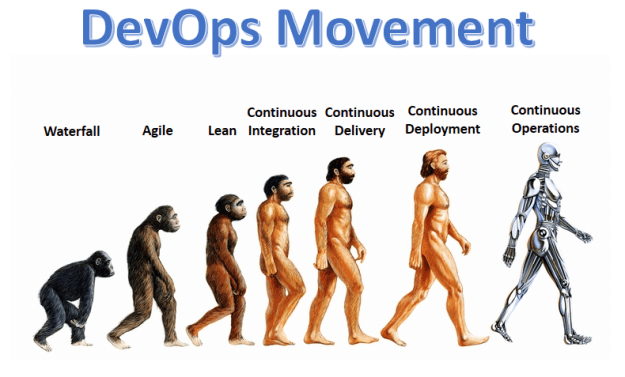
Below image can denote the transition of IT development cycles till DevOps practice with continuous operation [automated]:


DevOps Movement


https://youtu.be/vpgi5zZd6bs

Visit for next series of DevOps FAQs: https://wordpress.com/post/vskumar.blog/1684

Visit for series of Agile interview questions:

https://vskumar.blog/2017/09/04/sdlc-agile-interview-questions-for-freshers-1/


Also, Look into some more FAQs:

https://vskumar.blog/2018/12/29/devops-practices-faqs-2-devops-practices-faqs/

https://vskumar.blog/2019/02/01/devops-practices-faqs-3-domain-area/

How to Create a Learning Organization during DevOps Practices implementation ?

Create Learning-DevOps organization.png

If you are keen in learning DevOps Practices as on latest, you can apply to join in my group: https://www.facebook.com/groups/1911594275816833/

Please note there are rules to follow.

For DevOps roles and activities watch my video:

For contact/course details please visit:

https://vskumarblogs.wordpress.com/2016/12/23/devops-training-on-principles-and-best-practices/

Contact for AWS DevOps Engineer – Professional certification. Very few people globally covering the complete syllabus like I have explained from the AWS Exam guide. If interested please ping me in FB with your profile URL. Please note I coach only the global working IT Professionals.  Hence Profile URL is mandated to know your background.

Watch the below 50 minutes video for the above analysis:

For IT Corporates:How to save your IT traditional Infra work force to accelerate ROI ?

For Corporate Training division/unit only [not to their vendors] please!

Folks Greetings!

How to Convert your existing infra teams into AWS with POCs easily to prove in client interviews through seasoned mentors?

In the Current IT Trend, new technologies are getting transformed with cheaper cost in view of man power, operations and infra. In such case some companies might feel to serve pink slips to the traditional employees. But when you recruit new staff how much you spend on them ? And if you coach the existing staff to transform into new era, what will be the cost and ROI ? I do this kind of resources transformation activities on my own by coaching the experienced IT Professionals on new technology like; AWS Cloud, etc. For example, you can see my blog/coaching videos on my coaching for 10-15+ yrs global IT Folks:

The below blog is the latest one. You will be able to connect to the current Global IT needs and what I offer:

The goals for Cloud and DevOps Architects – by coaching

How to Future-Proof Your Career: Becoming a Cloud cum DevOps Architect

Learn AWS with POCs easily to prove in interviews ?

If any corporate is serious in looking to sustain their traditional staff and reuse them efficiently/effectively, I will be there behind them to support till they transform into their client requirement/project for billability. Looking forward for your cost savings exercise response.

Please Note:There is a difference between training and coaching or building teams for projects. For your existing IT Professionals you need to give coaching [through seasoned professionals] not the training. Then they will be productive.

# AWS Coaching #savings #eras #acceleration #corporations #itoperations

For Freshers “Course-A” is suitable. Tech-trend-campain.pnghttps://www.facebook.com/vskumarcloud/videos/352049242184854/https://www.facebook.com/vskumarcloud/videos/831779460496153/ https://www.facebook.com/vskumarcloud/videos/318929128812805/https://www.facebook.com/vskumarcloud/videos/653308511767928/ https://vskumar.blog/2018/12/30/coaching-mentoring-on-aws-solution-architect-associate-exam/https://vskumar.blog/2019/02/26/devops-or-cloud-which-is-priority-in-it/https://vskumar.blog/2019/01/03/1-aws-saatry-out-faqs-for-aws-saa-exam-prep/    

Learn AWS with POCs easily to prove in interviews ?


!!For Working IT Infra Professionals only!! For learning AWS.

<==== Before Click … Please Read….this======>
 
Come to a call to know our new scheme “Pay As You Learn”, monthly basis. The total AWS Course it takes around 5 months as part time basis with weekly one on one class hours with POCs to learn AWS through some chapters.
 
Please note each of our catching capability varies. This effort need to be understood by the individuals before talking on your interest/effort/affordability.
This is similar to a performance activity how the RM measures to each of us in a project.
 
Please note each aspired Cloud architect need to spend 200+ hrs before starting their role.
 
Hence in one month or few hours if somebody says you will be come a Solution Architect, they are bluffing you.
You need to learn and do practice on AWS services extensively like an implementable solution. This way our course builds you into new technology era.
 
========================================>
 

Many companies they do skill test by giving a scenario to develop through AWS Console or CLI. This way they can filter your profile to find its authenticity “actual” or “fake”. You all know in the global IT Market lot of fake profiles are floating around. So the recruiters are finding challenges to filter them. By attending skill test you will be proved you are the original professional infront of the fake profiles.

But if you want to learn this new technology, you were not habituated   like developers [as they keep updating their knowledge, for their bread and butter by spending weekly some hours] to accelerate the skills in new technology implementation. 

So, what you need to do ?

You need an individual coaching to speed up this learning activity.

It should not be in group or online training!! 

Read the below contents from the picture for details, what way I can help/support you.

You can choose the course ‘A’ or ‘B’. Then if you want to have POCs development knowledge, after completion of “B”, you can join.

In the Bottom the Courses TOC discussion videos are given for your perusal.

For Freshers “Course-A” is suitable.

Tech-trend-campain.png

We have a “Pay As You Learn” [monthly] Option for working IT Professionals.


The Course details for “A”:


The Course details for “B”:

AWS Course samples-Coaching/Mentoring on AWS Solution Architect- Associate exam

DevOps or Cloud Which is priority in IT?

1. AWS-SAA:Try out Sample questions for AWS SAA exam prep with a class video


What is Cloud Computing – concepts ?


FAQs-Cloud-Concepts

For the answers visit the below video:

Learn AWS with POCs easily to prove in interviews ?

AWS Course samples-Coaching/Mentoring on AWS Solution Architect- Associate exam

DevOps or Cloud Which is priority in IT?

1. AWS-SAA:Try out Sample questions for AWS SAA exam prep with a class video


Amaravati [AP-India] IT Jobs posting and trainings – A Face Book Group to join

Folks, 

  1. If your IT Company has the Branch sourounding to Amaravati [AP-India], you can become group member to post the IT Related Jobs.
  2. If you are a College student and ready to appear for exams and chase the off-campus interviews at different cities nearby, you can learn the latest technologies from this site also for interview preparation. Even if  some of you come with  a group an “Online coaching can be organized on the trending topics” along with the interview guidance. So you don’t need to get into wrong consultants shoes. Please note we don’t provide a job or assistance or recommend you to any company like others. After coaching confidently you need to try and you will be able to get a job with the learnt skills. You can join in this group.
  3. If you are a Consulting company and need some kind of Support for your client projects towards Cloud conversion/transition, the relevant support can be given globally to any Country. 
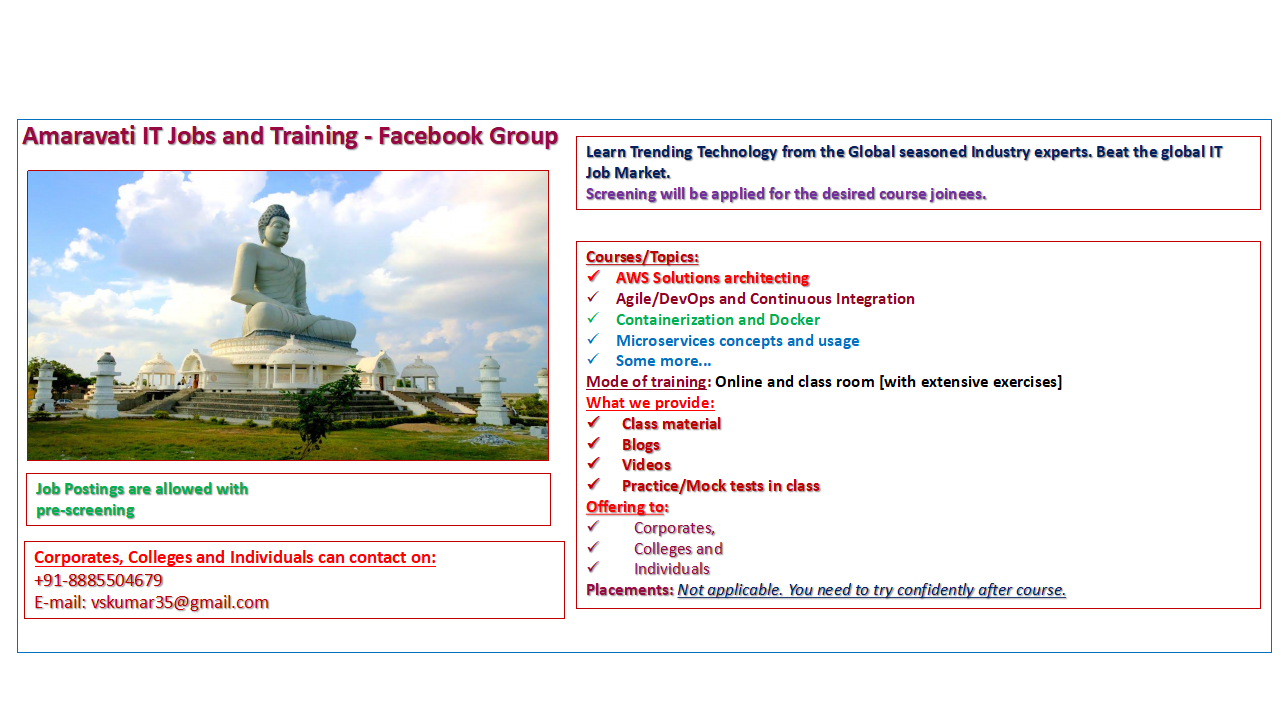
  4. The contacts are given in the below image.

Looking  forward for a response.

Amaravati FB-Group

15. AWS: What is SQS – A discussion video with live app scenarios ?

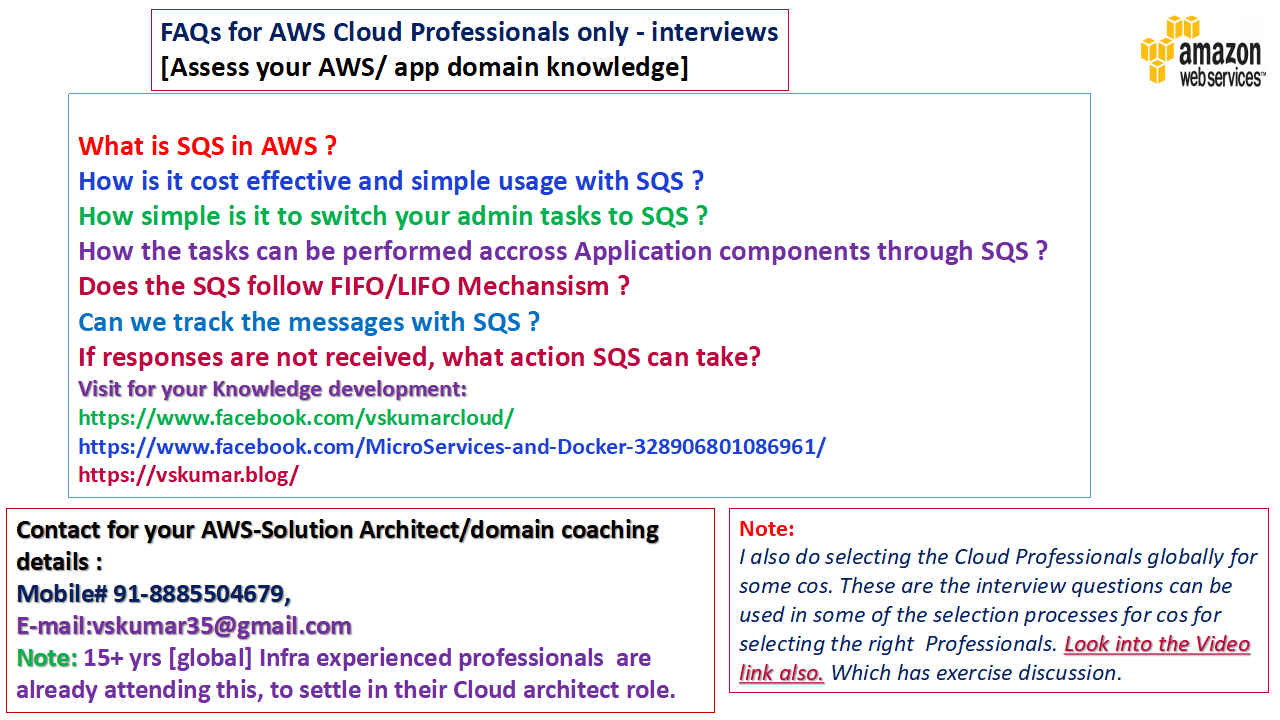
AWS-SQS-FAQs

If you are a technical designer for any Infra design or software architecture, you should  know the “Simple Ques Service” from AWS. Provided, you are working in that Cloud environment. The attached video had the  discussion on this topic with some live scenarios comparison. You will get to know implementation scenarios also.

If you are interested in session management look into this:


14. AWS: What is session management in ELB ?

1. How Active Directory [AD] File server [FS] can be connected to AWS ?
2. How NAT Gateways can be connected to AD FS ?

Very important and Critical topic is: Session management. It covers…
3. What is Session management ?
4. How ELB [Elastic Load Balancer] can be utilized to create session management tasks in AWS ?
5. What are the application level session management ?
6. What are sticky sessions ?
7. How to use sticky sessions in AWS ?

You watch all these in a class video, were discussed with live scenarios/examples, which URL is attached below:

https://business.facebook.com/watch/?v=653308511767928

How the defects can be created with ELBs configuration inconsistencies, see the below blog/video

2. Cloud Defects:What kind of defects can be created without session management in ELB/Cloud ?

13. AWS:How to take Snapshot and copy to another EC2?


AWS-Snapshot-EBS

Let us think in traditional approach first.

Let us take a scenario of files copy from one machine to another machine.

You need to do the following:

  1. We need to copy the files into a pen drive or HDD or Copy them into a shared network drive.
  2. If you copy them into HDD or Pen drive, you need to connect to other machine to copy them into 2nd machine.

Now in Cloud using AWS; to know ” how we can do this activity ” we can see from the below steps:

  1. You need to have one EC2. [in this example, I have created one EC2 Windows server. Then attached one EBS Volume [which is equivalent of HDD or a Pen drive].
  2. I made this EBS Volume as an HDD to this server.
  3. Then I created some .txt files to take backup of these files.
  4. Then I have created the backup of these files using AWS Snapshot process.
  5. And attached this Snapshot to another 2ndEBS Volume.
  6. I have created 2ndEC2 with the same configuration.
  7. And attached the 2nd  EBS .
  8. Then I released it as HDD.
  9. Finally, those two text files can be seen in this 2nd   EC2.

These detailed steps were drawn in the attached video with “AWS live exercise class lesson of 1.45 mts. duration”.

The similar exercises were given during the Cloud Engineer interviews. So if you are appearing for the interview this might be useful one.

If you have patience and time, you can watch it in the below link. And practice it for your interviews.

Good luck in your AWS practice.


Simplifying Monolithic Applications with Microservices Architecture

Micro-services-1

Introduction

Monolithic applications have been around for a long time and have been a popular approach for building complex software systems. However, as the complexity of the systems grew, so did the size and complexity of monolithic applications. This led to several challenges, such as scalability, maintenance, and deployment issues. Microservices architecture is a new approach that has gained popularity in recent years due to its ability to simplify monolithic applications. In this blog post, we will discuss how microservices can be used to simplify monolithic applications.

What are Microservices?

Microservices architecture is a software development approach that emphasizes the creation of small, independent services that work together to form a larger application. These services are loosely coupled and communicate with each other through APIs. Each service is responsible for a specific business function, and they can be deployed and scaled independently of each other.

How can Microservices simplify Monolithic Applications?

  1. Scalability

One of the main advantages of microservices architecture is scalability. With monolithic applications, scaling requires scaling the entire application, which can be a challenging and expensive process. With microservices, individual services can be scaled independently, making it easier and more cost-effective to scale the system. This means that the system can handle increasing traffic and load without sacrificing performance.

  1. Maintenance

Monolithic applications are often difficult to maintain due to their size and complexity. Making changes to a monolithic application requires extensive testing and can be time-consuming. Microservices, on the other hand, are smaller and more modular, making them easier to maintain. Changes to a single service can be made without affecting other services, which reduces the risk of unintended consequences.

  1. Deployment

Deploying monolithic applications can be a complicated process. A small change to the code can require the entire application to be re-deployed. This can lead to downtime and disruptions for users. Microservices architecture simplifies deployment by allowing each service to be deployed independently. This means that changes to a single service can be deployed without affecting other services.

  1. Flexibility

Microservices architecture provides greater flexibility than monolithic applications. Services can be written in different programming languages and can be hosted on different servers or cloud providers. This allows organizations to choose the best technology for each service, which can improve performance and reduce costs.

  1. Resilience

Monolithic applications are more susceptible to failures because a single failure can bring down the entire application. With microservices, individual services can fail without affecting other services. This makes the system more resilient and reduces the risk of downtime.

Conclusion

Microservices architecture provides several benefits over monolithic applications. It simplifies scalability, maintenance, deployment, and provides greater flexibility and resilience. However, it’s important to note that microservices architecture is not a silver bullet solution. It requires careful planning and implementation, and it may not be suitable for every application. Nonetheless, microservices architecture has become a popular approach for building complex software systems, and it’s worth considering for organizations looking to simplify their monolithic applications.

Microservices can be called as another revolution in IT Industry to simplify the applications engineering/maintenance/operation. These can be operated through Containers.

https://www.facebook.com/MicroServices-and-Docker-328906801086961

The attached Video class has the discussion on this topic for your free learning:

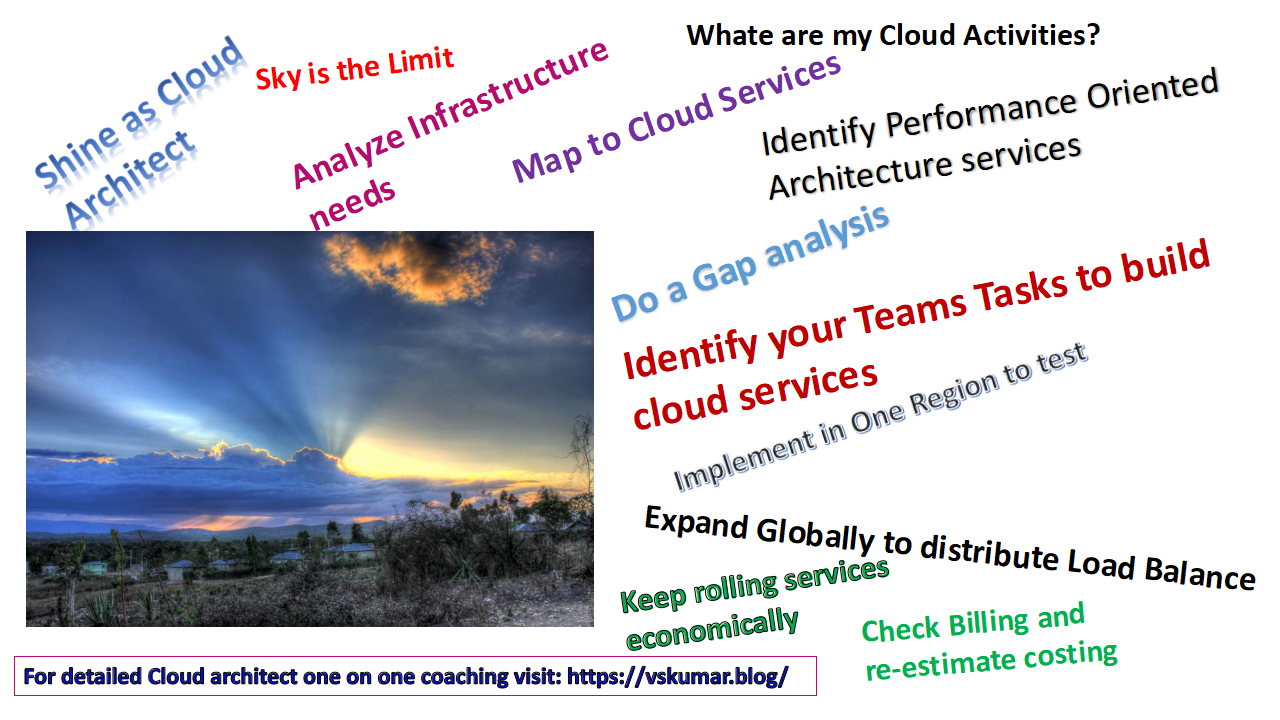
How best you can utilize Cloud Architect role as an efficient IT Management practitioner ?

vskumarcloud-build-cloud-architect.png

What are the Skills required for a Cloud Architect ?
How best you can utilize this role as efficient IT Management practitioner ?

Are you an IT management practitioner who wants to take your cloud migrations to the next level? Look no further than the role of Cloud Architect! While many organizations use this role for DevOps practices, it’s important to dedicate a separate Cloud Architect role for efficient and effective cloud migrations.

In 2017, Gartner published a list of activities and required skills for the Cloud Architect role, and while you may not be able to use all of them, there are some key activities that can help you see a difference in your business. By separating this role from DevOps activities, you can focus on Cloud Infrastructure Planning, Designing, Building, and Implementing to meet your business needs.

This separation can help to resolve burning issues related to DevOps and Cloud faster and reduce risks. If you’re an IT management practitioner who wants to implement these practices, don’t hesitate to reach out to me on Facebook. Check out my groups for IT professionals, where I post valuable discussions, videos, and blogs to help you take your cloud migrations to the next level.

Don’t miss out on the opportunity to optimize your cloud migrations and drive your business forward. Dedicate a Cloud Architect role and see the difference it can make.

For relevant Blog visit:

You can also see:

What is the need of upgrading cloud skills for a PM role ?

Finally, I would say you are mandated to separate this role from DevOps Activities assigning and dedicate the role for;
  • Cloud Infrastructure Planning,
  • Designing,
  • Building and
  • implementing effectively for business needs 
So many burning issues related to DevOps and Cloud can be separated and resolved faster to move forward. This way many risks can be reduced!!
If you are an IT management practitioner; and would like to get any clarifications to implement these practices you are advised to contact me on FB and have a call.

Visit my current running facebook groups for IT Professionals with my valuable discussions/videos/blogs posted:


DevOps Practices Group:

https://www.facebook.com/groups/1911594275816833/about/


Cloud Practices Group:

https://www.facebook.com/groups/585147288612549/about/


Build Cloud Solution Architects [With some videos of the live students classes/feedback]

https://www.facebook.com/vskumarcloud/


MicroServices and Docker [For learning concepts of Microservices and Docker containers]

https://www.facebook.com/MicroServices-and-Docker-328906801086961/

How to create AWS S3 Bucket

You can also compare the SAA Salary among all the roles being played with AWS:

See the difference on the salary amounts to seek your role as per your professional potentiality.

Do you want to the size of the Cloud job market globally if yes, visit:

https://vskumar.blog/2019/02/14/what-will-be-the-size-of-cloud-market-in-it-by-2022/

To know the real articulation of SA, Visit for my AWS SAA class video:

AWS-SAA-Course

Configuring CloudWatch SM-Agent: A Step-by-Step Guide.

Introduction Amazon CloudWatch is a monitoring service provided by Amazon Web Services (AWS) that enables developers to monitor, log and troubleshoot their applications and infrastructure running on the AWS Cloud. CloudWatch provides several features, including monitoring metrics, setting alarms, and creating custom metrics, among others. One of the most useful features of CloudWatch is the Systems Manager Agent (SM-Agent), which helps monitor and manage Amazon EC2 instances. In this blog post, we will discuss how to configure CloudWatch SM-Agent.

Step 1: Launching an EC2 Instance

The first step in configuring CloudWatch SM-Agent is to launch an EC2 instance. You can launch an EC2 instance using the AWS Management Console or the AWS CLI.

Step 2: Installing the Systems Manager Agent

After launching the EC2 instance, the next step is to install the Systems Manager Agent. You can install the agent using either the AWS Management Console or the AWS CLI.

To install the Systems Manager Agent using the AWS Management Console, follow these steps:

  1. Open the AWS Management Console and go to the EC2 service.
  2. Select the EC2 instance that you want to install the agent on.
  3. Click the Connect button and follow the instructions to connect to the instance.
  4. Once you are connected to the instance, open the terminal or command prompt.
  5. Run the following command to download and install the Systems Manager Agent:

sudo yum install -y amazon-ssm-agent

To install the Systems Manager Agent using the AWS CLI, follow these steps:

  1. Open the terminal or command prompt.
  2. Run the following command to download and install the Systems Manager Agent:

aws ssm create-association –name AWS-ConfigureAWSPackage –parameters ‘{“action”:[“Install”],”installationType”:[“Uninstall and reinstall”],”name”:[“AmazonCloudWatchAgent”],”version”:[“latest”]}’ –targets “Key=instanceids,Values=<instance_id>”

Step 3: Configuring the Systems Manager Agent

After installing the Systems Manager Agent, the next step is to configure it. You can configure the agent using the AWS Management Console or the AWS CLI.

To configure the Systems Manager Agent using the AWS Management Console, follow these steps:

  1. Open the AWS Management Console and go to the EC2 service.
  2. Select the EC2 instance that you want to configure the agent on.
  3. Click the Actions button and select the Instance Settings option.
  4. Click the Configure CloudWatch Agent option.
  5. Follow the instructions to configure the agent.

To configure the Systems Manager Agent using the AWS CLI, follow these steps:

  1. Open the terminal or command prompt.
  2. Run the following command to create a configuration file for the agent:

sudo nano /opt/aws/amazon-cloudwatch-agent/bin/config.json

  1. Copy and paste the following configuration code into the file:

{
“agent”: {
“metrics_collection_interval”: 60,
“run_as_user”: “cwagent”
},
“metrics”: {
“append_dimensions”: {
“AutoScalingGroupName”: “${aws:AutoScalingGroupName}”,
“InstanceId”: “${aws:InstanceId}”,
“InstanceType”: “${aws:InstanceType}”
},
“metrics_collected”: {
“mem”: {
“measurement”: [
“mem_used_percent”
],
“metrics_collection_interval”: 60,
“resources”: [
“*”
]
},
“swap”: {
“measurement”: [
“swap_used_percent”
],
“metrics_collection_interval”: 60,
“resources”: [
“*”
]
}
}
}
}

  1. Save and close the file.
  2. Run

Another way:

When you want to use Cloudwatch for monitoring the AWS Cloud services you need to configure with the below steps: a) Cloud watch agent through SM-Agent in an EC2  server with different IAM role policies. b) In the architecture you need to Install the Cloud watch agent with different IAM policy role on different EC2 clients.

  • Step1:
    Creating IAM Roles
  • Step2:
    How to install and configure SSM Agent in EC2 server
  • Step3:
    How to install Cloud-watch Agent on Client EC2.

The attached video has the class discussion and the required steps.

Visit my current running facebook groups for IT Professionals with my valuable discussions/videos/blogs posted:


DevOps Practices Group:

https://www.facebook.com/groups/1911594275816833/about/


Cloud Practices Group:

https://www.facebook.com/groups/585147288612549/about/


Build Cloud Solution Architects [With some videos of the live students classes/feedback]

https://www.facebook.com/vskumarcloud/


MicroServices and Docker [For learning concepts of Microservices and Docker containers]

https://www.facebook.com/MicroServices-and-Docker-328906801086961/